

Rob Stradling
567 posts

@SMT_Solvers @jonathandata1 @Equifax The crt.sh web interface truncates large result sets for performance reasons, and I haven't yet found a way to efficiently sort by certificate expiry date before truncating.
Try crt.sh/?Identity=equi…
English

@jonathandata1 If you have a moment to spare from Lovecraft drama. I could really use some OSINT on @Equifax dot com crypto keys. crt.sh is missing everything since 2020. Need them for a hearing tomorrow about this scam which never stopped and got worse. nytimes.com/2010/04/04/us/…
English
English
@rmhrisk crt.sh has caught up on (re)counting issuances, but has not yet caught up on (re)counting expirations. See groups.google.com/g/crtsh/c/rbCw…
English
@julianor @ic0nz1 crt.sh has fallen significantly behind on ingesting new log entries (see crt.sh/monitored-logs). However, I was finally able to deploy some performance improvements this week, and I'm hoping the ingestion backlog will disappear within the next month or so.
English
@ic0nz1 Yes, looks like the cert is not listed in crt sh but facebook API has it.
English
SSL/TLS Certificate Transparency logs, while valuable, may not offer comprehensive detection against hijack and interception attacks. Caution and further measures advised ⚠️🧐
English
@eabalea @dfaranha @julianor @BenLaurie crt.sh is currently way behind on ingesting log entries, unfortunately (see crt.sh/monitored-logs). Performance improvements coming soon.
English
@dfaranha @julianor @BenLaurie Maybe check if crt.sh is late digesting the CT logs?
Note that CT is not mandatory for issuance, only for some browser acceptance.
English

@jedisct1 How did I not know this was in the public domain
English

@ericlaw Please try it now, using either the default "q=" search type (which is what the crt.sh front page search interface uses) or the more specific "cnlspkisha256=" search type.
e.g., crt.sh/?cnlspkisha256…
Implemented by github.com/crtsh/certwatc…
English

@_robstr Yeah, I think it's always "sha256/"
source.chromium.org/chromium/chrom…
English
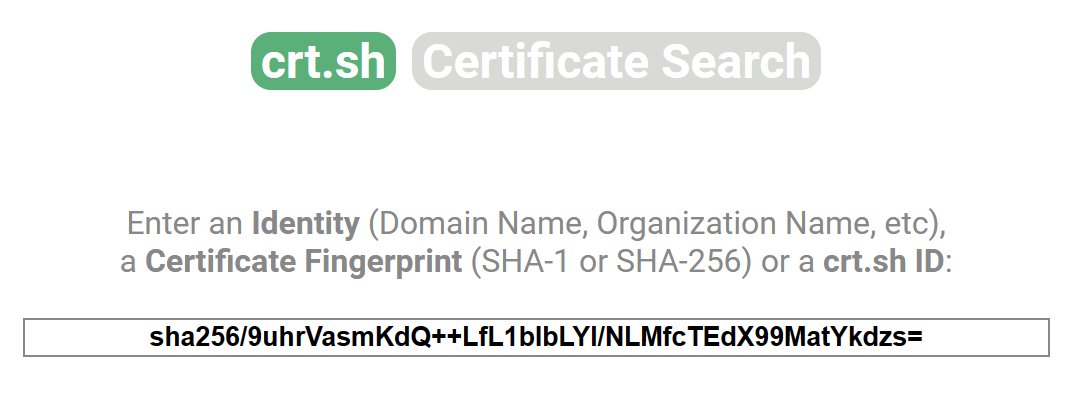
@ericlaw Ah, just saw your other tweet. Looks like it's a SHA-256 SubjectPublicKeyInfo thumbprint.
English
@ericlaw Is the prefix always "sha256/", or are there other options?
Is the remainder of the string a base64-encoded certificate thumbprint? Or something else?
English

Would you like a command line tool that can parse, manipulate and output (pieces of) URLs? Meet "urler" (which might change name soon if we agree on a better one)
github.com/curl/urler
English

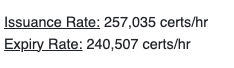
@RME So the figure is less than 4283/s. To size the gap you can look at crt.sh/cert-populatio… and notice that only @letsencrypt published final certificates, the rest of the final certificates are crawler/researcher-observed certificates that were published to logs.
English
@63BitsOfEntropy Yeah.
#name-log-id" target="_blank" rel="nofollow noopener">rfc-editor.org/rfc/rfc9162#na…
trac.ietf.org/trac/trans/tic…
mailarchive.ietf.org/arch/msg/trans…
English
@Martijn___ @jschauma Announcing the removal of certificate_identity has been on my TODO list for...errm...far too long.
English
@Martijn___ @jschauma The certificate_identity table is a historical artifact from the original crt.sh database, which had int32 certificate IDs. As part of rebuilding the database to have int64 IDs, I switched to using postgres's Full Text Search instead.
English
English

This is pretty neat because the pki.goog CA also supports the CanSignHttpExchanges extension. So now you can get SXG certs via ACME.
Ryan Hurst@rmhrisk
I am happy to announce that all Google Cloud customers can freely use Cloud Certificate Manager to acquire certificates via ACME (RFC 8555) from pki.goog. Learn more about this launch here cloud.google.com/blog/products/… #CLOUD #SSL #ACME #AUTOMATION #STANDARDS
English

Much love to whoever at @SectigoHQ is running crt.sh/lintcert by the way - it'd be impossible to debug the intricate weirdnesses of TLS certificates without it!
English
WTF networking moment-of-the-day: did you know that you can have domain names with underscores in, but you can't create TLS certs for them?
Totally practically possible, but since sometime after mid-2019 modern browsers now reject them outright: github.com/httptoolkit/ht…
English
@rmhrisk Actually, tbh I'd always assumed timstamp.dll was so named due to legacy DOS filename length restrictions (8 chars, then 3 for the extension).
Turns out the truth is stranger. 🙂
English
Authenticode was introduced in June 1996. That is right, it is 26 years old.
English