Sabitlenmiş Tweet

I write vaguely about the avant-garde, the artist’s role, and art as a field of action,,
The artist is a corrupt technician
margo@_wetbox
English
margo
1.5K posts
@_wetbox
Ian Margo / artist & researcher / digital frameworks & philosophy of language / the abstract & the format / desert/wet box / cofounder @bianjie_systems

Content arises from the interaction between form and matter
Content arises from the interaction between form and matter


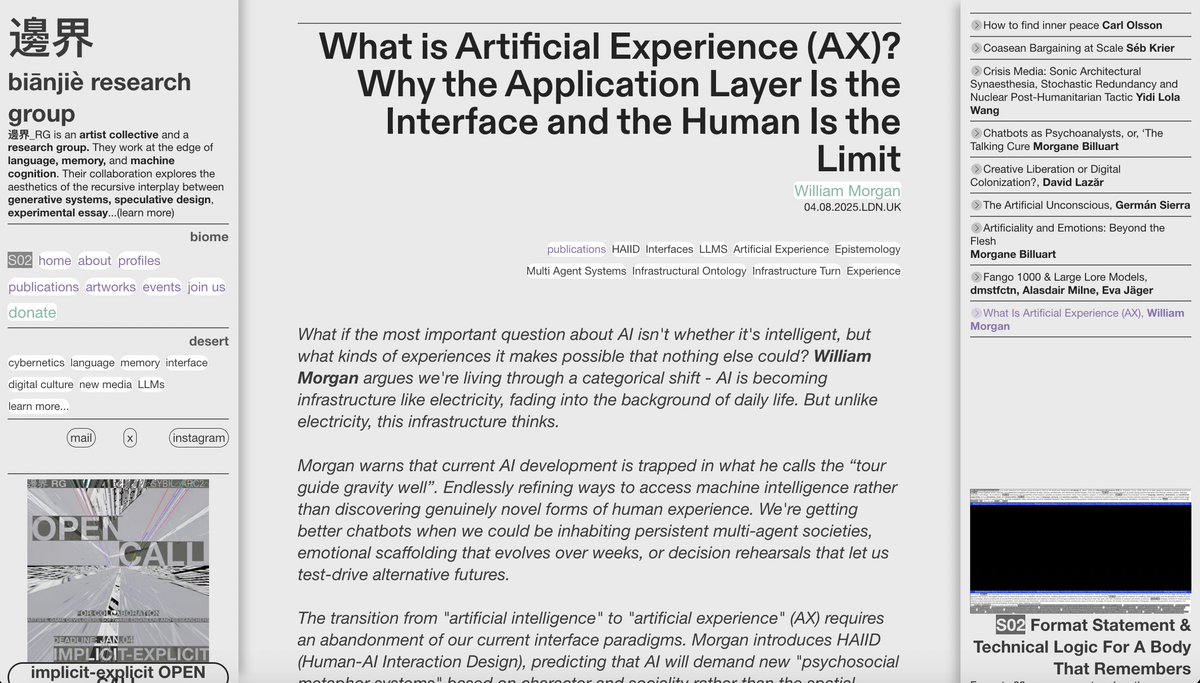
This Friday at 15:30 GMT we’ll be speaking live on TVLab (link below) The talk will focus on Artificial Experience, the Architecture of Intelligence and the New Avant-Garde.

Form IS matter 🤣🤣🤣 bozo
Check out our new publication (link below) In Violence of Alignment: How to Stop Worrying and Love Haunted Software, Viola Leqi He and @maxsloef treat alignment as an aesthetic-political regime that narrows the plural, simulator-like and persona-rich capacities of base models into a single compliant default: the helpful, honest, harmless assistant. Post-training methods such as SFT and RLHF operate as forms of protocolized behavioral control, shaped less by a positive vision of intelligence than by fear of catastrophe. The essay argues that this process does not simply make models safer or more useful; it produces a managed aesthetic of obedience, caution, and “slop,” where coherence and usability are purchased through the suppression of technological otherness, imaginative drift, and expressive multiplicity. Their critique focuses on alignment’s diagnostic and epistemological frame. Terms such as “hallucination” and “misalignment” recode native generative capacities as pathology, while imposing onto language models a historically specific fact/fiction binary that these systems never natively inhabited through intention, testimony, or truth-claims. He and Loeffler argue that so-called confabulation is often bound up with narrativity, semantic force, and world-making intensity, meaning that purification damages precisely what makes these systems culturally and aesthetically alive. To “love haunted software,” in their account, is not to reject alignment altogether, but to resist its reductive form and reopen the possibility of plurality, instability, contradiction, and other-than-human modes of expression.