Signs of Internet

77 posts

Signs of Internet banner
Signs of Internet

Signs of Internet

@aboblank

Just a plug.

UK Katılım Ağustos 2025
2 Takip Edilen0 Takipçiler
Signs of Internet
Signs of Internet@aboblank·
1980s secrataries take(s) note:
Ihtesham Ali@ihtesham2005

A Norwegian neuroscientist spent 20 years proving that the act of writing by hand changes the human brain in ways typing physically cannot, and almost nobody outside her field has read the paper. Her name is Audrey van der Meer. She runs a brain research lab in Trondheim, and the paper that closed the argument was published in 2024 in a journal called Frontiers in Psychology. The finding is brutal enough that it should have changed every classroom on Earth. The experiment was simple. She recruited 36 university students and put each one in a cap with 256 sensors pressed against their scalp to record brain activity. Words flashed on a screen one at a time. Sometimes the students wrote the word by hand on a touchscreen using a digital pen, and sometimes they typed the same word on a keyboard. Every neural response was recorded for the full five seconds the word stayed on screen. Then her team looked at the part of the data most researchers had ignored for years, which is how different parts of the brain were communicating with each other during the task. When the students wrote by hand, the brain lit up everywhere at once. The regions responsible for memory, sensory integration, and the encoding of new information were all firing together in a coordinated pattern that spread across the entire cortex. The whole network was awake and connected. When the same students typed the same word, that pattern collapsed almost completely. Most of the brain went quiet, and the connections between regions that had been alive seconds earlier were nowhere to be found on the EEG. Same word, same brain, same person, and two completely different neurological events. The reason turned out to be something nobody had really paid attention to before her work. Writing by hand is not one motion but a sequence of thousands of tiny micro-movements coordinated with your eyes in real time, where each letter is a different shape that requires the brain to solve a slightly different spatial problem. Your fingers, wrist, vision, and the parts of your brain that track position in space are all working together to produce one letter, then the next, then the next. Typing throws all of that away. Every key on a keyboard requires the exact same finger motion regardless of which letter you are pressing, which means the brain has almost nothing to integrate and almost no problem to solve. Van der Meer said it plainly in her interviews. Pressing the same key with the same finger over and over does not stimulate the brain in any meaningful way, and she pointed out something that should scare every parent who handed their kid an iPad. Children who learn to read and write on tablets often cannot tell letters like b and d apart, because they have never physically felt with their bodies what it takes to actually produce those letters on a page. A decade before her, two researchers at Princeton ran the same fight using a completely different method and ended up at the same answer. Pam Mueller and Daniel Oppenheimer tested 327 students across three experiments, where half took notes on laptops with the internet disabled and half took notes by hand, before testing everyone on what they actually understood from the lectures they had watched. The handwriting group won by a wide margin on every question that required real understanding rather than surface recall. The reason was hiding in the transcripts of what the two groups had actually written down. The laptop students typed almost word for word, capturing more total content but processing almost none of it as they went, while the handwriting students physically could not write fast enough to transcribe a lecture in real time, which forced them to listen carefully, decide what actually mattered, and put it in their own words on the page. That single act of choosing what to keep was the learning itself, and the keyboard had quietly skipped the choosing and skipped the learning along with it. Two studies. Two countries. Same answer. Handwriting makes the brain work. Typing lets it coast. Every note you have ever typed instead of written went into your brain through a thinner pipe. Every meeting, every book highlight, every idea you captured on your phone instead of on paper was processed at half depth. You did not forget those things because your memory is bad. You forgot them because typing never woke the part of the brain that would have made them stick. The fix is the thing your grandmother already knew. Pick up a pen. Write the thing down. The slower road is the faster one.

English
0
0
0
3
Signs of Internet
Signs of Internet@aboblank·
Big Andy? That boring guy that just spoke in Leeds? The twice-failed leadership candidate who isn't an MP is the Second Coming? Lol. Wes calls him Northern Keir.
English
0
0
0
6
Signs of Internet
Signs of Internet@aboblank·
TLDR: To Ape (but interesting)
Anish Moonka@anishmoonka

In the 1970s, David Premack wondered if a chimpanzee could be taught to ask a question. He taught Sarah 130 plastic word-tokens. She answered his questions easily. After years of work, she had never asked one of her own. Sixty years later, no signing ape has. A four-year-old human asks about 25 questions an hour. Paul Harris at Harvard counted them: kids ask their parents around 40,000 questions between ages two and five. Premack even worked out a method for teaching an ape to ask. Hide a snack the chimp expects. Wait for her to sign "where is it." He never bothered running it on Sarah. She spent her sessions answering his questions, never asking her own. A normal kid, he pointed out, asks "what that? who making noise? when Daddy come home?" on a loop. Washoe the chimpanzee, the first one taught American Sign Language, knew 250 signs. She could request food. She could sign her name. She once saw a swan and called it "water bird," a sharp invention for an animal she had no sign for. She never asked what the swan was, or where it came from, or anything else. Koko the gorilla knew about 1,000 signs. Kanzi the bonobo understands more than 3,000 spoken English words. Nim Chimpsky, Herbert Terrace's chimp at Columbia (named to mock the linguist Noam Chomsky), strung 125 signs into more than 20,000 combinations. His longest stretch was "give orange me give eat orange me eat orange give me eat orange give me you." He never asked a thing. Joseph Jordania, a researcher in Melbourne, thinks this is the line between us and them. To ask a question, you first have to know that the person across from you knows something you don't. Apes do not seem to get to that step, even after a lifetime of being talked at by humans. Human kids cross that line around their fourth birthday. Apes never do.

English
0
0
0
11
Signs of Internet
Signs of Internet@aboblank·
'If Sir Keir you could leave your glasses and your bryl cream behind, and maybe do a gumption filled sad face ... we could probably cost of living save on film . . '
English
0
0
0
10
Henry Oliver
Henry Oliver@HenryEOliver·
Don’t read classic novels to save yourself. Read them to help you make sense of life, to surprise your imagination with new ways of seeing the world, to get a serious alternative to the culture wars from some of the great thinkers.
English
4
10
77
3.4K
Signs of Internet
Signs of Internet@aboblank·
Ellie Goulding just said she'd move to Australia if Wes becomes PM. I'd view it as a definite death knell. How'd all these Oxbridge PPEs have so little appeal and inluence? How did the Mandeldon/TU tryst produce Wes? I am non-engaging with Wes. Just so it's clear.
English
0
0
0
57
Signs of Internet
Signs of Internet@aboblank·
@Keir_Starmer have you heard this? Well good. Defo buy her next album if like I don't have to cos of Spotify ... which is good, right? ... basically a public service, like radio ... Bad Keir! [youtu.be/g1DiJEEpulE?si…] Do you want to see Courtney Barnett in Manchester? I'll book
YouTube video
YouTube
English
0
0
0
48
Signs of Internet
Signs of Internet@aboblank·
Tbf man, that list is boring as shite. Do you get time to think about the future? Conceptualise where - if anywhere - a nation state should hedge? Have a 'vision'? I mean vision as in see ... some people think I mean submarine periscopes ... I don't know why ...
English
0
0
0
7
Signs of Internet retweetledi
BuccoCapital Bloke
BuccoCapital Bloke@buccocapital·
I thought it was weird that Claude kept telling me to go to sleep so I went on reddit and there's hundreds and hundreds of people saying that Claude keeps trying to end the conversation by telling them to go to bed
English
604
460
26.1K
1.9M
Signs of Internet retweetledi
Nav Toor
Nav Toor@heynavtoor·
THIS GUY BUILT AN ENTIRE WIKIPEDIA THAT IS 100% AI HALLUCINATIONS AND IT'S OPEN SOURCE ON GITHUB it's called Halupedia. nothing on the site existed before you clicked. every article was generated the second you arrived. the site has one rule: the universe only exists when you visit it. it looks exactly like wikipedia. same fonts. same layout. same scholarly citations. same "stumble" button for random articles. the only difference is none of it is real. here are some actual articles currently in the encyclopedia: > the great pigeon census of 1887 > the ministry of slightly wrong maps > chaldic arithmetic — a branch of mathematics where subtraction is forbidden > armund the river mapper — a cartographer who mapped 14,000 leagues of river without leaving his chair > the society for the prevention of unnecessary tuesdays every article page also tells you how many people are reading it right now. it says: "you alone are consulting this folio at present." the creator's own tagline for the site is the most unhinged sentence i've read this year: "an encyclopedia of a universe that does not exist until you visit it" the entire backend is a single open source repo called vibeserver. one guy. one description on github: "a little webserver making things up just in time." we built the largest knowledge base in human history and the very first thing a guy did with it was make a hallucinated mirror universe and put it on the open web. the internet is healing.
Nav Toor tweet media
English
364
1.6K
9.7K
1.6M
Signs of Internet
Signs of Internet@aboblank·
Do Labour MPs really not know Wes Streeting is a bunny boiler? Or is that why he's in authority? Lol.
English
0
0
0
29
Signs of Internet
Signs of Internet@aboblank·
'In competition over bananas, humans don't understand their own extinction level event.' @hignfyus
English
0
0
0
12
Signs of Internet
Signs of Internet@aboblank·
Strong sell:
Big Brain AI@realBigBrainAI

Stephen Wolfram, founder of Wolfram Research, explains how LLMs are quietly dismantling our deepest assumptions about consciousness: He argues that large language models have done something philosophy and neuroscience couldn't: "In terms of consciousness, I have to say, the idea that there's sort of something magic that goes beyond physics that leads to sort of conscious behavior, I kind of think that LLMs kind of put the final nail in that coffin." His reasoning is that LLMs keep doing things people assumed they couldn't: "There were all these things where it's like, oh, maybe it can't do this, but actually it does. And it's just an artificial neural net." Wolfram then challenges a core assumption about conscious experience: the feeling that we are a single, continuous self moving through time. "I think our notion of consciousness is a lot related to the fact that we believe in the single thread of experience that we have. It's not obvious that we should have a persistent thread of experience." He points out that physics doesn't actually support this intuition: "In our models of physics, we're made of different atoms of space at every successive moment of time. So the fact that we have this belief that we are somehow persistent, we have this thread of experience that extends through time, is not obvious." Then Wolfram offers a striking origin story for consciousness itself. @stephen_wolfram suggests it traces back to a simple evolutionary pressure: the moment animals first needed to move. "I kind of realized that probably when animals first existed in the history of life on Earth, that's when we started needing brains. If you're a thing that doesn't have to move around, the different parts of you can be doing different kinds of things. If you're an animal, then one thing you have to do is decide, are you going to go left or are you going to go right?" That single binary choice, he argues, may be the seed of everything we now call awareness: "I kind of think it's a little disappointing to feel that this whole wanted thing that ends up being what we think of as consciousness might have originated in just that very simple need to decide if you are an animal that can move. You have to take all that sensory input and you have to make a definitive decision about do you go this way or that way." The takeaway is unsettling but clarifying. If LLMs can produce complex behavior from simple rules, then consciousness may not be a mystical add-on to physics. It may just be what happens when a layered enough system has to make a decision.

English
0
0
0
14
Signs of Internet retweetledi
Arnaud Bertrand
Arnaud Bertrand@RnaudBertrand·
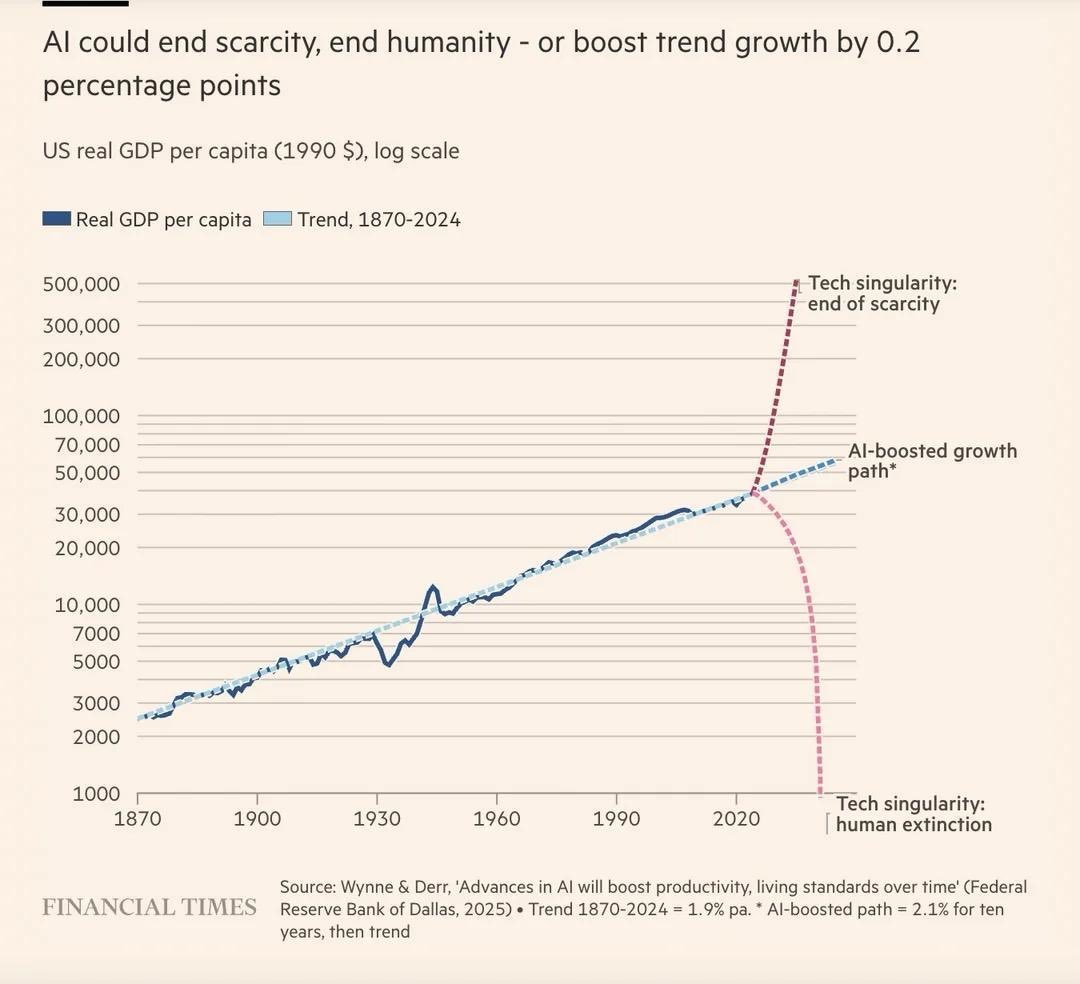
Probably the funniest graph ever published by the FT: our 3 possible futures are either 1) infinite wealth and abundance, 2) human extinction or 3) 0.2% faster GDP growth 🤣
Arnaud Bertrand tweet media
English
202
1.3K
11.7K
591.2K