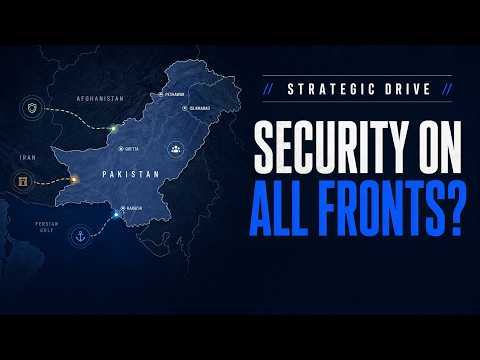
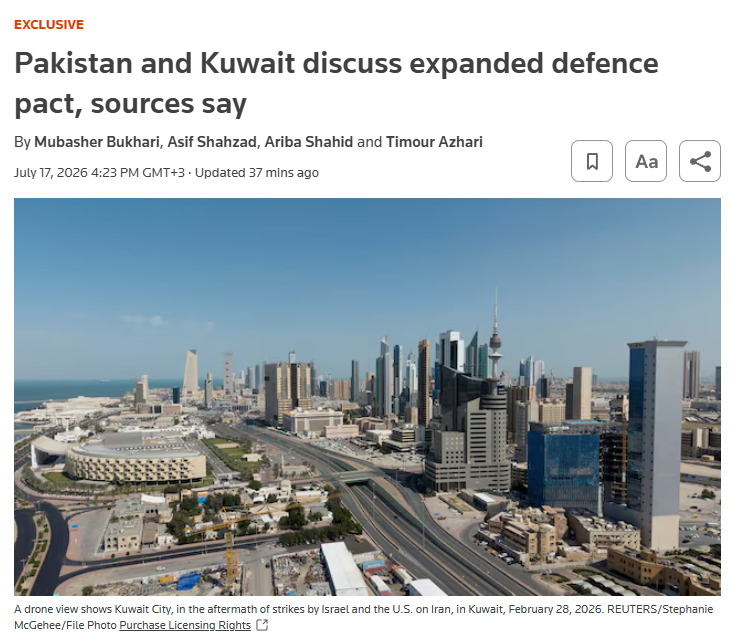
Pak-Saudi - The Strategic Mutual Defense Agreement signed at Al Yamamah Palace on September 17, 2025 has never been tabled in Pakistan's parliament. No committee has examined it. No elected body has debated it. Pakistan's Defense Minister suggested at signing that nuclear capabilities "will be made available" to Saudi Arabia. Within 48 hours, he walked it back. The text remains classified. What is on the record is a photograph of two men shaking hands, and the word of institutions that have never needed parliament's permission to conduct foreign policy. The question this raises is not about the pact's legality. It is about its necessity. When Middle East tensions escalated in March 2026, an estimated 1,500 to 2,000 Pakistani troops were already stationed on Saudi soil before a single clause of the September agreement was formally invoked. That is the baseline, not the deployment ceiling. On top of it: Pakistan Air Force IL-78 tanker aircraft repositioned from Nur Khan to Masroor on March 1 for onward movement to Riyadh. LY-80, FM-90 and Anza-series air defense batteries, still under Pakistani command, were integrated into Saudi Arabia's layered air defense network within days. F-16 Block-52 jets arrived at King Abdulaziz Air Base. CDF Asim Munir flew to Riyadh on March 7 and formally activated the pact, or did he? But the military relationship he activated had been running without interruption for fifty years. At its peak in the late 1970s and through the 1980s, estimates placed Pakistani military personnel in Saudi Arabia at between 50,000 and 60,000. The numbers drew down. The institutional thread never broke. Then there is Raheel Sharif. Pakistan's former army chief has commanded the 43-nation Islamic Military Counter Terrorism Coalition, headquartered in Riyadh, since May 2017. He did not need a new pact to be embedded in Saudi Arabia's security architecture. He was already its military commander, a position he has held for nearly a decade across multiple Pakistani governments, none of which appointed him to it and none of which can remove him. He is the operational interface between Pakistan's military establishment and the Gulf's most powerful monarchy, and he answers, in practice, to institutional loyalties that predate the Sharif government and will outlast it. The same architecture extends to Bahrain. Pakistan provides substantial manpower to the Bahrain Defense Force under a bilateral arrangement so embedded that when regional tensions escalated in March, Bahrain's king specifically thanked Pakistan for its "solidarity," a word that in Gulf diplomatic register carries operational weight, not ceremonial. These are not new commitments. They are old ones that no Pakistani voter was ever asked to authorize and no Pakistani parliament was ever asked to renew. So what does the September 2025 pact actually do? Brookings noted at signing that it went far beyond the standard language of cooperative security announcements, and that its nuclear ambiguity was not a drafting oversight. The vagueness serves both governments. Riyadh gets a signal to Tehran and Washington that Islamabad is committed at a level that now has a named legal instrument behind it. Islamabad gets Gulf liquidity, a Saudi vote at the IMF when the next program review arrives, and the standing claim that the nuclear dimension was never formally confirmed, which is technically accurate, because the text was never released. What Pakistan does not get is a parliamentary record. No elected body authorized the commitment of its armed forces. No constitutional mechanism was engaged. No public accounting of what the nuclear dimension, undefined as it is, would require Pakistan to do or risk. The pact was signed by men who were not elected to sign it, covering capabilities that remain undeclared to the population that would bear the consequences of using them. That is not a defense agreement. It is the Pakistani military doing what it has always done: conducting foreign policy in its own name, leaving the civilian government to explain it afterward, and daring anyone to raise the constitutional question in a country where constitutionality has always been an argument you lose before you finish making it.