amit gupta

15.7K posts

amit gupta banner
amit gupta

amit gupta

@agexpr

5th august & 22 January

kota Katılım Mayıs 2010
382 Takip Edilen958 Takipçiler
amit gupta retweetledi
Deedy
Deedy@deedydas·
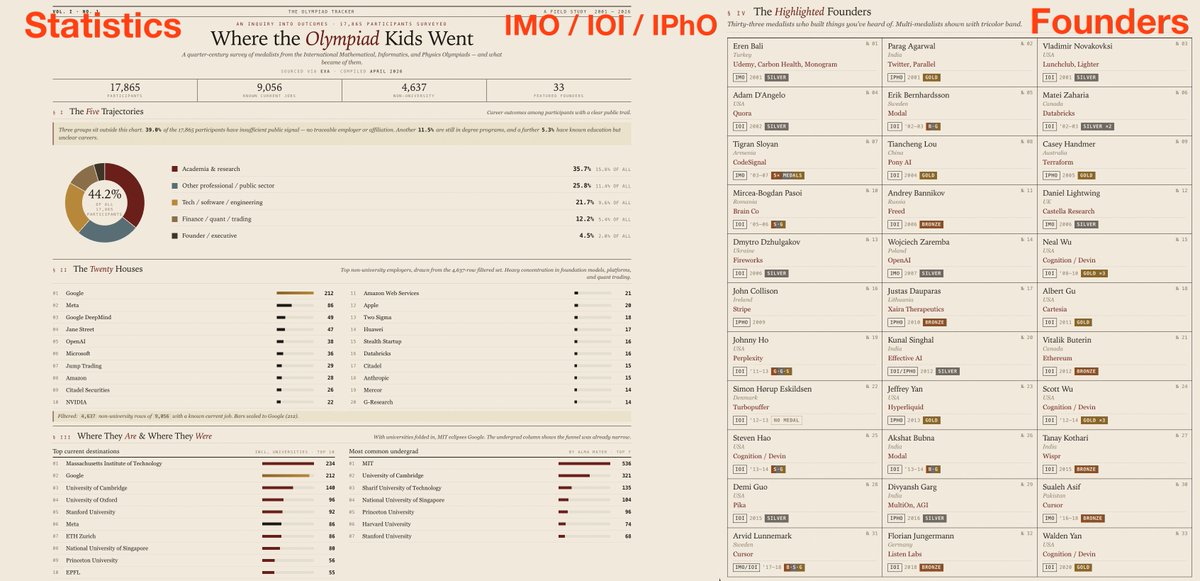
What do the smartest kids in the world do when they grow up? I did the largest study of ~18,000 International Olympiad medalists (IMO, IOI and IPhO) over the last 25yrs, arguably the sharpest analytical minds of the world in high school, to see where they ended up and traced ~50% of them. Founders of ~20 unicorns and ~7 decacorns and ~10 billionaires: OpenAI, Cursor, Stripe, Databricks, Perplexity, Ethereum, Cognition, Hyperliquid, Fireworks, Modal, Quora, Parallel, Cartesia, Wispr Most kids went to MIT, a whopping 12% of them, followed by Cambridge (7%) and Sharif (3%)! The career paths they chose (of those who graduated) were: — 36% Academia (professors) — 26% Other — 22% in Software / Tech — 12% in Quant / Finance — 5% Founders! The biggest employer was Google, by far, at 6%. Others interesting tidbits were: — 47 of them work at Jane Street (#3) — 38 at OpenAI (#5) — 15 at Anthropic — 8 at Cognition — 6 at Isomorphic Labs Olympiaders were 1500x more likely to be billionaires and 4000x more likely to be unicorn founders than the average person!
Deedy tweet media
English
246
922
7.3K
1.5M
amit gupta retweetledi
Math Files
Math Files@Math_files·
Albert Einstein once remarked, “You know, Henri, I began by studying mathematics, but eventually turned to physics.” Henri Poincaré asked, “Why was that?” Einstein replied, “Because although I could distinguish true statements from false ones, I couldn’t determine which were truly important.” Poincaré smiled and responded, “That’s quite interesting, Albert. I began with physics, but ultimately chose mathematics.” Einstein, intrigued, asked, “And why did you make that change?” Poincaré answered, “Because I couldn’t tell which of the important facts were actually true.” The exchange captures, with subtle wit, the contrasting philosophies of two of the greatest scientific minds.
Math Files tweet media
English
56
594
3.4K
230.2K
amit gupta retweetledi
𐌁𐌉Ᏽ 𐌕𐌉𐌌𐌉
Dear Microsoft: I don’t know why you keep asking me if I want to stay signed in when you are not actually going to keep me signed in.
English
33
1.4K
28.8K
289.1K
amit gupta retweetledi
SURAJ
SURAJ@SURAJ_624·
C. N. R. Rao, One Of India’s Greatest Scientists, Published 1800+ Research Papers, 55+ Books And Took Indian Chemistry To The Global Stage. He Was Honoured With Bharat Ratna In 2014 🇮🇳🔬📚
English
26
601
5.2K
77.5K
amit gupta retweetledi
História No Paint
História No Paint@HistoriaNoPaint·
toda vez que a popularidade do Trump está ruim:
Português
159
7.2K
76.4K
1.4M
amit gupta retweetledi
Ihtesham Ali
Ihtesham Ali@ihtesham2005·
An MIT professor taught the same math course for 62 years, and the day he retired, students from every country on earth showed up online to watch him give his final lecture. I opened the playlist at 2am and ended up watching three of them back to back. His name is Gilbert Strang. The course is MIT 18.06 Linear Algebra. Every machine learning engineer, every data scientist, every quant, every self-taught programmer who actually understands how AI works learned the math from this one man. Most of them never set foot on MIT's campus. They just opened a free playlist on YouTube and let him teach. Here's the story almost nobody tells you. Strang joined the MIT math faculty in 1962. He retired in 2023. That is 61 years of standing at the same chalkboard teaching the same subject to 18-year-olds. The interesting part is what he did when MIT launched OpenCourseWare in 2002. Most professors were skeptical. They worried that putting their lectures online would make their classrooms irrelevant. Strang did not hesitate. He said his life's mission was to open mathematics to students everywhere. He filmed every lecture and gave it away. The decision quietly changed how the world learns math. For decades linear algebra was taught the wrong way. Professors started with abstract vector spaces and proofs about field axioms. Students drowned in the abstraction. Most never recovered. They walked out believing they were bad at math when they had simply been taught in an order that nobody's brain is built to absorb. Strang inverted the entire curriculum. He started with matrix multiplication. Something you can write down on paper. Something you can compute by hand. Something you can see. Then he showed his students that everything else in linear algebra eigenvectors, singular value decomposition, orthogonality, the four fundamental subspaces was just a different lens for understanding what the matrix was actually doing under the hood. His rule was strict. If a student could not explain a concept using a concrete 3 by 3 example, that student did not actually understand the concept yet. The abstraction was supposed to come last, not first. The intuition was the foundation. The proofs were just confirmation that the intuition was correct. The second thing Strang changed was the classroom itself. He said please and thank you to his students. Every single lecture. He paused mid-derivation to ask "am I OK?" to check if anyone was lost. He never used the word "obviously" or "trivially" because he knew exactly what those words do to a student who is one step behind. He treated 19-year-olds learning math for the first time the way he treated his own colleagues. With patience. With respect. With the assumption that they belonged in the room. For 62 years. The result is something that has never happened in the history of education. A single math professor became the default teacher of his subject for the entire planet. Universities in India, China, Brazil, Nigeria, every country with a computer science department, started telling their own students to just watch Strang's lectures. The University of Illinois revised its linear algebra course to do almost no in-person lecturing. The reason was honest. The professor said they could not compete with the videos. His final lecture was in May 2023. The auditorium was packed with students who had never met him before. He walked to the chalkboard, taught for an hour, and at the end the entire room stood and applauded. He looked confused for a moment, like he genuinely did not understand why they were cheering. Then he smiled and waved them off and walked out. His written comment under the YouTube video of that final lecture was four sentences long. He said teaching had been a wonderful life. He said he was grateful to everyone who saw the importance of linear algebra. He said the movement of teaching it well would continue because it was right. That was it. No book promotion. No farewell speech. No legacy management. The man whose teaching is the foundation of modern AI just thanked the audience and went home. 20 million views. Zero ego. The entire engine of the AI revolution sits on top of math that millions of people learned for free from one quiet professor in Cambridge. The course is still on MIT OpenCourseWare. Every lecture, every problem set, every exam, every solution. Free. The most important math course of the 21st century is sitting one click away from you. Most people will never open it.
Ihtesham Ali tweet media
English
547
8.3K
32.1K
2.4M
amit gupta retweetledi
Math Lady Hazel 🇦🇷
Math Lady Hazel 🇦🇷@mathladyhazel·
What Quantum Physics does to a man.
Math Lady Hazel 🇦🇷 tweet media
English
260
1.5K
14.7K
339.9K
amit gupta retweetledi
Parimal
Parimal@Fintech03·
आचार्यात् पादमादत्ते पादं शिष्यः स्वमेधया । पादं सब्रह्मचारिभ्यः पादं कालक्रमेण च ॥ ācāryāt pādam ādatte pādaṃ śiṣyaḥ svamedhayā | pādaṃ sabrahmacāribhyaḥ pādaṃ kālakrameṇa ca || A student draws one quarter of knowledge from the teacher, one from their own intellect, one from peers, and the final quarter from time itself.
Vala Afshar@ValaAfshar

Never confuse education with intelligence. Intelligence isn't the ability to remember and repeat, like they teach you in school. Intelligence is the ability to learn from experience, solve problems, and use our knowledge to adapt to new situations. —Professor Richard Feynman

5
55
197
6.4K
amit gupta retweetledi
It's FOSS
It's FOSS@Itsfoss·
True story 🤣
English
267
3.5K
32K
933.6K
amit gupta retweetledi
ManuelJr
ManuelJr@manueljr1000·
Once you get past 15 years old and you still think Ronaldo is better than Messi that really says a lot about your ability to reason.
English
160
1.8K
11.8K
125.9K
amit gupta retweetledi
Alec Stapp
Alec Stapp@AlecStapp·
Just remembered the story about a computer scientist who had his bike stolen and tried to explain binary search to a cop
Alec Stapp tweet media
English
279
2.6K
45.8K
1.5M
amit gupta retweetledi
LSPN_FC
LSPN_FC@LSPN__FC·
This for me is Messi's most underrated assist
English
50
566
15.4K
1.5M
amit gupta retweetledi
⚡︎
⚡︎@_sorrengailll·
Raise your hands if you agree that Apple Music and iCloud storage should be free for all iPhone users
English
407
16.5K
107.2K
1.6M
amit gupta retweetledi
Parimal
Parimal@Fintech03·
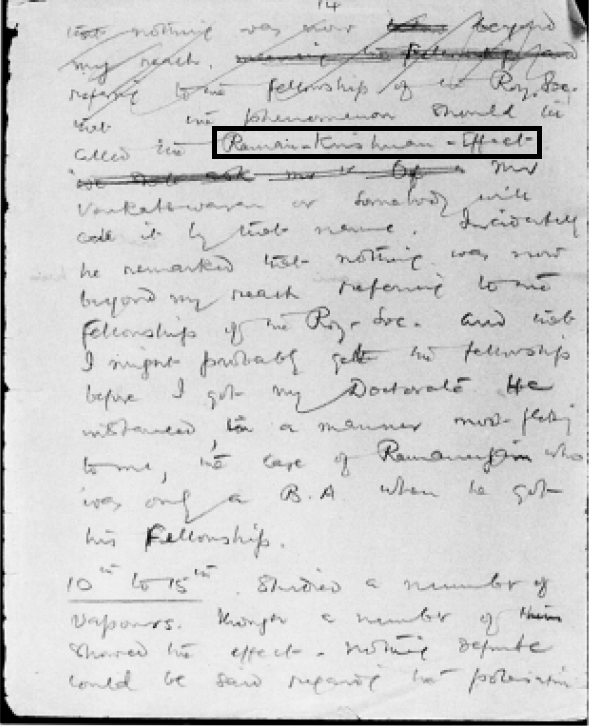
People often think the Raman Effect was a Eureka moment in a single afternoon. In reality, it was a grueling endurance test. Kariamanikkam Srinivasa Krishnan (1898-1961) was the person who sat in the darkroom of the IACS (Kolkata) for months. He painstakingly purified & tested 65 different dust-free liquids to see if they all showed the same feeble fluorescence (the early name for the Raman Effect). Krishnan kept a detailed research diary. Entries from early 1928 show that he was the one who 1st clearly observed that the new radiation was polarized, a key technical proof that it was not just ordinary fluorescence. Raman himself later wrote that if the Nobel had been awarded only for the work of 1928, Krishnan would have justly shared the prize. Later in his career, Krishnan moved to Crystal Magnetism. He wanted to measure the magnetic anisotropy (how a crystal's magnetic properties change based on its orientation) of tiny organic crystals. In the 1930s, there was no sophisticated equipment for this. He developed the Critical Torque Method. Using simple materials, famously described by colleagues as sealing wax & string, he suspended crystals from fine quartz fibers & measured their rotation in a magnetic field. This method was so precise that it allowed him to calculate the orientation of molecules inside a crystal before X-ray crystallography became common. It remains a foundational technique in magnetochemistry today. Yrs before Claude Shannon (the father of Information Theory) published his famous Sampling Theorem in 1948, K.S. Krishnan had already derived a similar mathematical concept in the context of physics. In elite scientific circles, Krishnan is regarded as 1 of the few Complete Physicists, someone who was equally brilliant at complex mathematical theory & dirty-hands experimental work. When the NPL was being built in Delhi, the architects planned to cut down several old trees to make way for the massive building. Krishnan refused. He personally intervened to redraw the architectural plans so that the trees could be saved. He believed that symmetry is achieved by harmonious addition, not by destruction. To this day, the NPL campus is 1 of the greenest scientific spots in Delhi because of his stubborn love for nature. In 1958, when India established the Shanti Swarup Bhatnagar Prize (the Indian Nobel), K.S. Krishnan was the very 1st recipient. He was also elected a Fellow of the Royal Society (FRS) in 1940, yet he remained so modest that he preferred people just call him KSK.
Parimal tweet mediaParimal tweet media
English
27
576
1.7K
81.8K