Alejandro Gregori

8.5K posts

Alejandro Gregori banner
Alejandro Gregori

Alejandro Gregori

@agregori

Senior Data Scientist - Economista

Katılım Ağustos 2009
1.2K Takip Edilen1.9K Takipçiler
Alejandro Gregori
Alejandro Gregori@agregori·
Las explicaciones sobre la baja natalidad confunden efectos con causas. El celular, los anticonceptivos, la vivienda: son síntomas. Hay una causa mayor detrás que todavía nadie está nombrando.
Español
1
0
2
152
Alejandro Gregori
Alejandro Gregori@agregori·
Es falso que para tener hijos se necesite dinero. Hubo épocas cien veces más difíciles y nacieron personas felices, capaces y que pudieron. Incluso puede pensarse que a veces la adversidad forja una determinación todavía más fuerte.
Tendencias en Argentina@porqueTTarg

"Debate" Porque ante la baja natalidad, el dueño de Cosmos subió esta foto: "Tengan hijos gente. La nuestra todavía no nació y ya soy re feliz". Sin embargo, sus seguidores lo criticaron: "Salí de la burbuja, solo con cariño no se llena el plato. Tu realidad no es la de todos".

Español
0
1
2
65
Alejandro Gregori
Alejandro Gregori@agregori·
@jbsteinberg A deeply flawed piece. Lighthizer’s framework is pure mercantilism. And beyond the intellectual absurdity, the productivity losses of applying that idea would be staggering.
English
0
0
0
4
Joseph Steinberg
Joseph Steinberg@jbsteinberg·
Robert Lighthizer argues in Foreign Affairs that trade deficits have hurt the US economy and that a new trading system is needed to tax countries that run persistent trade surpluses. His essay is filled with weak assumptions and reasoning errors. [1/x] foreignaffairs.com/united-states/…
English
6
14
61
11.4K
Alejandro Gregori
Alejandro Gregori@agregori·
Los economistas Megadevaluacionistas no logran comprender el superávit comercial con “este dólar”. Son incapaces de entender la productividad, las expectativas a futuro, los cambios en la dirección correcta. Para ellos la realidad se mueve por nominalismos. ¡Erradísimos!
Español
0
0
2
54
Alejandro Gregori
Alejandro Gregori@agregori·
Todas estas son explicaciones secundarias de una causa aún todavía mayor. Mucho mayor.
Jesús Fernández-Villaverde@JesusFerna7026

Smartphones are not the explanation for the recent decline in fertility. Instead, they are an accelerator of deeper forces already at work. Let’s start with the facts. Fertility is falling almost everywhere: in rich, middle-income, and poor countries; in secular and religious countries; and in countries with high and low levels of gender equality. The decline accelerated around 2014. So, no country-specific explanation will work unless you are willing to believe that 200 distinct country-specific explanations arrived at roughly the same time. Smartphones look like the obvious candidate: the first iPhone was released in 2007, and global adoption has been astonishingly fast. Economists understand the first major decline in fertility in advanced economies, from 6 or 7 children per woman throughout most of human history to about 1.8, that occurred between the early 1800s and roughly 1970, well before smartphones. The main drivers were a sharp fall in child mortality (effective fertility was rarely above 3 and often close to 2) and the shift from a low-skill, rural agrarian economy to a high-skill, urban industrial one. We have quantitative models that fit these facts well. Country-specific factors mattered too, of course. Proximity to low-fertility neighbors accelerated Hungary’s decline, while fragmented landowning structures accelerated France’s. But these were second-order mechanisms. This is also why most economists long considered Paul Ehrlich’s doom scenarios implausible. We forecast that fertility in middle- and low-income economies would follow the same path as in the rich, probably faster, because reductions in child mortality reached India or Africa at lower income levels (medical technology is nearly universal, and most gains come from handwashing and cheap antibiotics, not Mayo Clinic-level care). Much of what we see in Africa or parts of Latin America today is still that old story. But in the 1980s, a new pattern appeared. Japan and Italy fell below 1.8, the level we had thought was the new floor. By 1990, Japan was at 1.54 and Italy at 1.36. This second fertility decline began in Japan and Italy earlier than elsewhere, driven by country-specific factors, but the underlying dynamics were widespread: secularization, an education arms race, expensive housing, the dissolution of old social networks, and the shift to a service economy in which women’s bargaining power within the household is higher. The U.S. lagged because secularization came later, suburban housing remained relatively cheap, and African American fertility was still high. U.S. demographic patterns are exceptional and skew how academics (most of whom are in the U.S.) and the New York Times see the world. My best guess is that, without smartphones, Italy’s 2025 fertility rate would be about 1.24 rather than 1.14. I doubt anyone will document an effect larger than 0.1-0.2. Italy was at 1.19 in 1995, not far from today’s 1.14. The TFR is cyclical due to tempo effects, so I do not read too much into the rise between 1995 and 2007 or the decline from 1.27 in 2019 to 1.14 today. The direct effect of smartphones is not zero, but it is not, by itself, that large. Where social media, in general, and smartphones, in particular, matter is in the diffusion of social norms. What would have taken 25 years now happens in 10. Social media are not the cause of fertility decline; modernity is. But they are a very fast accelerator. That is why social media are a major part of the story behind Guatemala (yes, Guatemala) going from 3.8 children per woman in 2005 to 1.9 in 2025. Without them, Guatemala would also have reached 1.9, just 20 years later. Modernity, in its current form, is incompatible with replacement-level fertility. By modernity, I do not mean capitalism: fertility fell earlier and faster in socialist economies than in market economies. Socialist Hungary fell below replacement in 1960, and socialist Czechoslovakia in 1966 (both experienced small, short-lived baby booms in the mid-1970s). By modernity, I mean a society organized around rational, large-scale systems and formalized knowledge. Countries will not converge to the same fertility rate. East Asia is likely stuck near 1, possibly below, given its unbalanced gender norms and toxic education systems. Latin America faces the same gender problem plus weak growth prospects, so I expect something around 1.2. Northern Europe has more egalitarian family structures and might hold near 1.5. The very religious societies are probably the only ones that will sustain 1.8. All of this could change with AI or changes in population composition. We will see. But on the current evidence, deep sub-replacement fertility is the “new new normal.” Unless we reorganize our societies, better learn to handle it as best we can.


Español
0
0
1
104
Alejandro Gregori
Alejandro Gregori@agregori·
Si un campesino del 1800 tuviera de pronto un tractor con la tecnología actual, el salto de productividad sería descomunal. Pero cuando trasladamos esa lógica a la IA, algunos se preocupan por los bueyes que van a quedar sin usar.
Español
0
0
2
39
Alejandro Gregori
Alejandro Gregori@agregori·
Falta agregar que Foucault es el culpable de la proliferación del Mal. No es que lo interpretaron incorrectamente. Fue él mismo un paranoide anti-capitalismo, anti-igualdad frente a la ley, y mucho más perverso todavía.
Brivael Le Pogam@brivael

Aujourd'hui je déconstruis la déconstruction. La déconstruction est le virus mental le plus efficace jamais conçu contre une civilisation. Il a été fabriqué en France entre 1966 et 1980 par trois hommes : Foucault, Derrida, Deleuze. Il a été exporté aux États-Unis, hybridé avec le puritanisme racial américain, et il est revenu trente ans plus tard sous le nom de wokisme paralyser l'Occident entier. Voici comment il fonctionne, et pourquoi il faut le détruire. La thèse est simple. Toute vérité n'est qu'un rapport de pouvoir déguisé. Tout texte sacré, toute loi, toute science, toute norme, toute hiérarchie, toute identité, toute institution cache en réalité une domination. Déconstruire, c'est montrer le rapport de force sous le vernis du vrai. C'est arracher le masque. C'est "démasquer". Formulé comme ça, ça paraît inoffensif. Voire utile. Qui n'aime pas un peu d'esprit critique ? Le piège est là. La déconstruction se présente comme une méthode. Elle est en réalité une ontologie. Elle ne dit pas seulement "interrogeons les normes", elle dit "il n'y a *que* des rapports de pouvoir". La différence est civilisationnelle. Une société qui interroge ses normes reste debout. Une société qui croit que ses normes ne sont *rien d'autre* que de la domination s'effondre. Parce qu'elle ne peut plus rien défendre. Plus une frontière, plus une loi, plus une science, plus une langue, plus une histoire, plus une biologie, plus une famille. Tout devient suspect. Tout devient négociable. Tout devient "construit donc déconstructible". C'est la première raison pour laquelle c'est un virus. Il s'auto-réplique. Une fois inoculé, il transforme tout ce qu'il touche en cible. La science est patriarcale, donc déconstruisons-la. Le langage est colonial, donc réinventons-le. La méritocratie est raciste, donc abolissons-la. Le sexe est une construction, donc choisissons-le. Il n'y a plus de roc. Tout est sable. Deuxième raison. Le virus est *non-falsifiable*. Si vous défendez une norme, c'est que vous êtes l'oppresseur. Si vous niez être oppresseur, c'est la preuve de votre privilège inconscient. Si vous citez des faits, vos faits sont contaminés par le pouvoir qui les a produits. Si vous citez la raison, la raison elle-même est blanche, masculine, occidentale. Il n'y a aucune sortie possible. Le système est conçu pour rendre toute objection irrecevable par définition. C'est exactement la structure d'une secte. Et c'est exactement ce qui s'est installé dans les universités, les RH, les médias, les administrations, les conseils d'administration depuis vingt ans. Troisième raison. Le virus s'auto-réfute mais ne s'auto-détruit pas. Si toute vérité est pouvoir, alors la phrase "toute vérité est pouvoir" est elle-même du pouvoir, donc sans valeur. Logiquement, la déconstruction se mord la queue dès la première phrase. Mais elle s'en moque. Parce qu'elle n'a jamais cherché la cohérence. Elle cherche l'efficacité politique. Et son efficacité politique est immense. Elle désarme ses ennemis et arme ses militants. Elle paralyse le défenseur et libère l'attaquant. C'est une arme asymétrique parfaite. Quatrième raison. Le virus produit des humains diminués. Une génération entière a appris à déconstruire et n'a jamais appris à construire. Elle sait soupçonner, jamais admirer. Elle voit le pouvoir partout et la beauté nulle part. Elle peut produire mille pages sur le caractère opprimant de Shakespeare et zéro ligne qui vaille la peine d'être lue dans cent ans. Elle a confondu l'intelligence critique avec la pose critique. Elle est stérile par construction. Un esprit nourri à la déconstruction est un esprit qui ne sait plus rien édifier. Cinquième raison, la plus grave. Une civilisation se tient debout sur trois piliers. La croyance qu'une vérité est accessible à la raison. La croyance qu'un bien se distingue d'un mal. La croyance qu'un héritage mérite d'être transmis. La déconstruction a méthodiquement dynamité les trois. Pas par méchanceté. Par jeu intellectuel, par fascination du soupçon, par haine de la bourgeoisie qui avait nourri ses prophètes. Mais le résultat est là. Une civilisation qui ne croit plus en sa vérité, ni en son bien, ni en son héritage ne se défend pas. Elle s'excuse en attendant la fin. Voilà ce qu'on a fait. Voilà ce qu'il faut nommer. La bonne nouvelle, c'est qu'un virus mental ne survit que tant qu'on lui cède l'autorité du discours. Il meurt dès qu'on cesse de jouer son jeu. Dès qu'on réaffirme tranquillement qu'il existe une vérité, un beau, un bien, un héritage. Dès qu'on cesse de demander la permission aux déconstructeurs pour bâtir. Dès qu'on refait. Dès qu'on transmet. Dès qu'on crée. Les bâtisseurs ont toujours le dernier mot sur les commentateurs. Toujours. Parce qu'à la fin il reste ce qui est construit, et rien de ce qui a été déconstruit. Alors aujourd'hui je déconstruis la déconstruction. Et demain je construis.

Español
0
0
0
26
Alejandro Gregori
Alejandro Gregori@agregori·
Extraordinario! Si el periodismo buscara la verdad, hablaría de esto. Pero periodistas, artistas y falsos intelectuales ni lo mencionan.
totocaputo@LuisCaputoAR

IMPORTANTE 4!!!👇 SEGUIMOS CANCELANDO DEUDA Y RECOMPONIENDO EL BALANCE DEL BANCO CENTRAL 🇦🇷🇦🇷🇦🇷 De acuerdo a lo comunicado por la autoridad monetaria, el Banco Central de la República Argentina (BCRA) ha puesto a disposición del Tesoro Nacional la suma de $24,4 billones en concepto de dividendos del ejercicio 2025. Estos fondos serán asignados de la siguiente manera: i) Constitución de depósitos del Tesoro en el BCRA por la suma de $6 billones. ii) Aplicación de $18,4 billones a la recompra de Letras Intransferibles en cartera del BCRA por un total estimado de USD21.700 millones en valor nominal original. Esta operación tendrá como resultado una reducción de la deuda bruta del Tesoro Nacional de aproximadamente 3,3% del PIB. Asimismo, se trata de otro paso en la recomposición del balance del BCRA iniciada en diciembre de 2023, y contribuye a revertir el profundo deterioro generado durante las gestiones kirchneristas. Vale recordar que las Letras Intransferibles se colocaron al BCRA como contrapartida del uso de reservas internacionales por parte del Tesoro, en un contexto de déficit fiscal crónico y cierre de los mercados voluntarios de capitales. Esto implicó un fuerte deterioro acumulado en el activo del BCRA, al reemplazar un activo líquido y valioso por otro ilíquido y sin valor de mercado, con reservas netas que a principios de diciembre de 2023 eran negativas en más de USD11.000 millones.

Español
0
0
2
59
Alejandro Gregori
Alejandro Gregori@agregori·
@lugaricano Qué cantidad de pavadas pseudo-intelectuales. Tanto artificio verbal para advertir sobre un supuesto giro al populismo de derecha, cuando ya es un populismo. Y la estupidez derecha-izquierda ni siquiera existe: es el lenguaje mental de quienes solo entienden el mundo en binario.
Español
0
0
3
222
Luis Garicano 🇪🇺🇺🇦
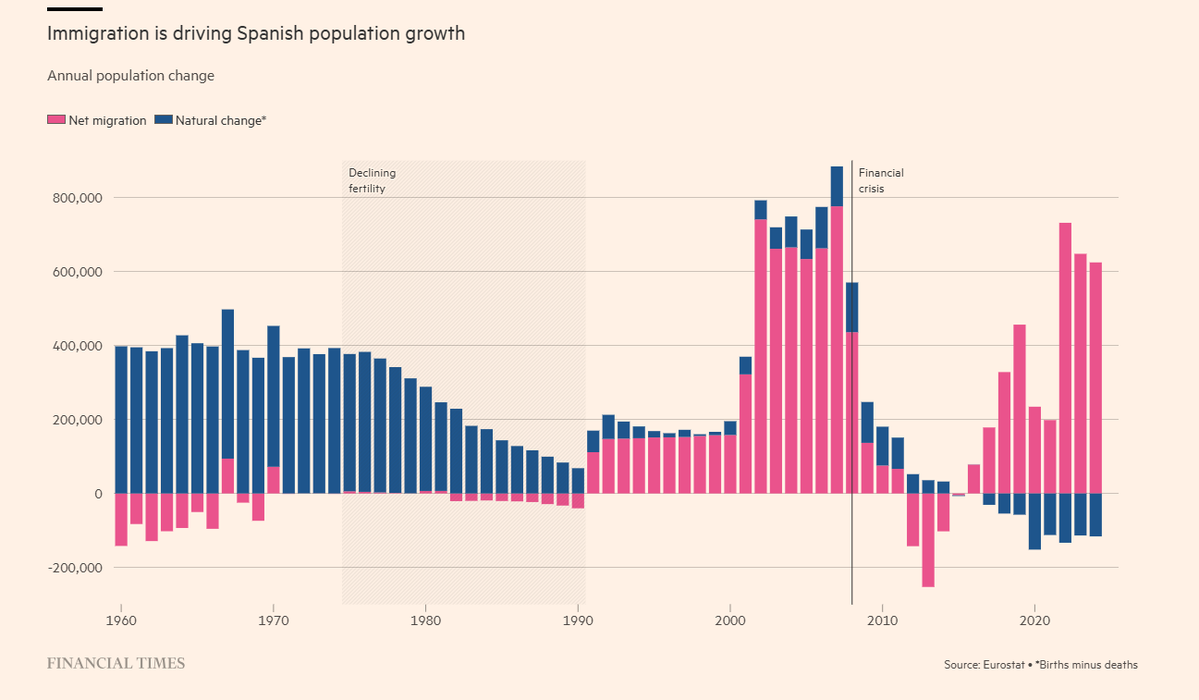
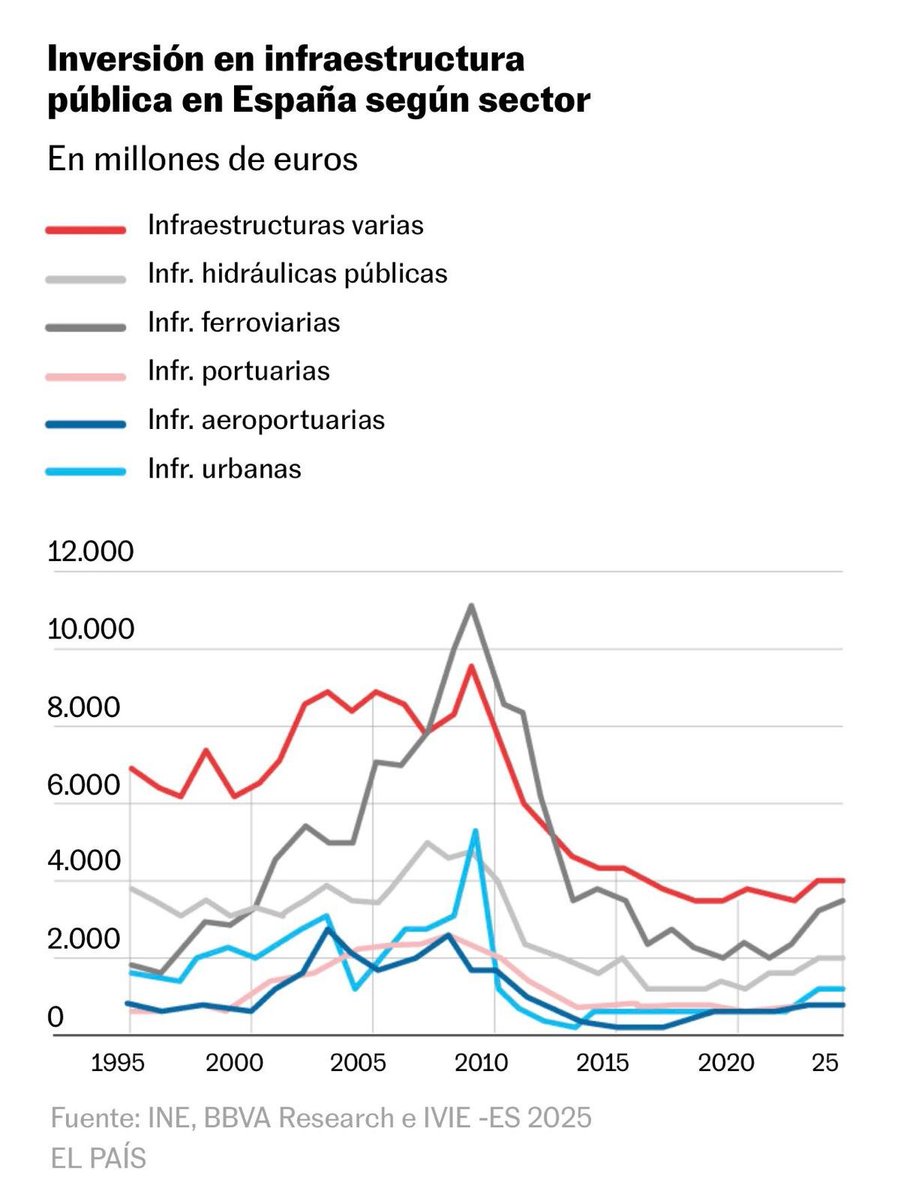
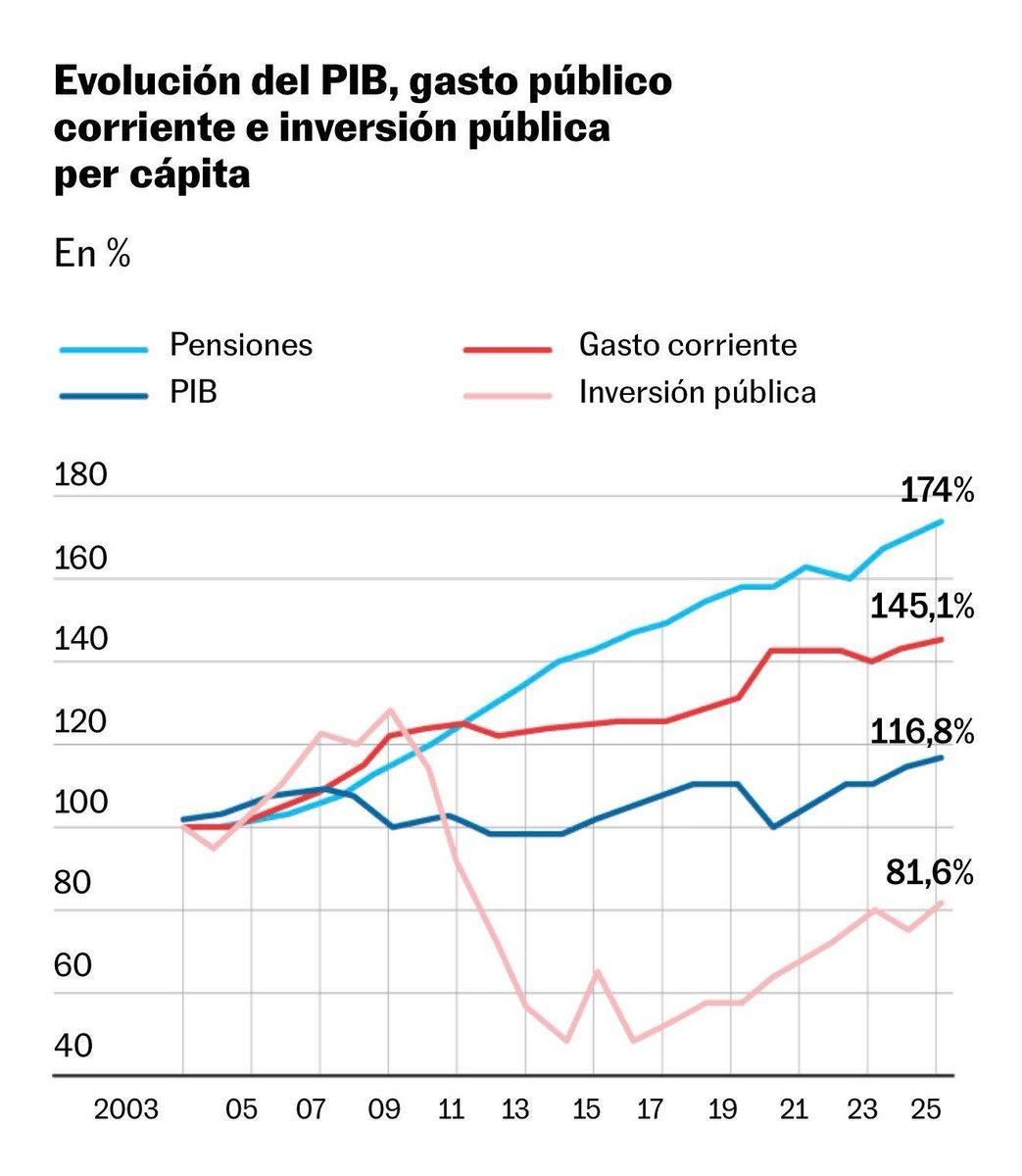
On the Spanish experiment of mass migration with little investment, my friend Tano Santos (Columbia) writes me this (with his permission): "One of the drivers of polarization and the rise of populism is, as Norris and Inglehart document in "Cultural Backlash", the perception that “[f]oreigners and immigrants are accused of 'jumping the queue' in services like public housing and unemployment benefits …”. One suspects that access to healthcare and other benefits is also important. The decay of infrastructure, which is already tragically noticeable in Spain, is going to add to the list of grievances. But Norris and Inglehart emphasize the cultural aspects of the turn to populism and authoritarianism. If this is the case, Spain is going to be caught in a triple bind: An unprecedented surge in immigration, with the attendant pressure on public goods, underinvestment in public services because of fiscal constraints and lack of political consensus on priorities and stabilization paths, and, finally, a cultural backlash. Perhaps Spaniards are made of different timber, but if what has occurred in other countries is any guide, Spain is on schedule to become the next one to succumb to right wing populism. It is curves ahead for Spain, the standard fare of New York Times Op Ed pieces praising Spain’s immigration policies and economic performance and president Sánchez stance against president Trump notwithstanding." (First chart, infrastructure investment; second public investment in pink, dark blue per capita GDP, pensions light blue. Source migration chart: @ft)
Luis Garicano 🇪🇺🇺🇦 tweet mediaLuis Garicano 🇪🇺🇺🇦 tweet mediaLuis Garicano 🇪🇺🇺🇦 tweet media
English
21
113
378
44.8K
Alejandro Gregori
Alejandro Gregori@agregori·
Si algo enseña el observar a Europa, NY, y otras ciudades , es que nunca se termina la estupidez humana. Ya quisiéramos que esta vez la lección se haya aprendido, y no perdamos nunca más el tiempo como entre el '19 y el '23. Pero contra la estupidez hay que luchar todos los días
Argentina en Datos@arg_endatos

EVOLUCIÓN DE LA POBREZA Luego de alcanzar un pico de 53% en 2024, la pobreza se redujo a 28% durante el segundo semestre de 2025, su nivel más bajo en 7 años. Fuente: INDEC

Español
0
0
1
134