ahmadtabriz

167 posts

ahmadtabriz

ahmadtabriz

@ahmadtabrizim

Katılım Haziran 2026
18 Takip Edilen2 Takipçiler
ahmadtabriz
ahmadtabriz@ahmadtabrizim·
@DurovPD Shame on the Telegram team and the creators of these Telegram tokens, especially the scam token X Empire.
English
0
0
0
3
Pavel Durov (Parody)
If history repeats, the Bitcoin Cycle Bottom Indicator is signaling one thing: Only up for $BTC. 🚀
Pavel Durov (Parody) tweet media
English
19
7
64
7K
ahmadtabriz
ahmadtabriz@ahmadtabrizim·
@telegram Shame on the Telegram team and the creators of these Telegram tokens, especially the scam token X Empire.
English
0
0
0
295
Telegram Messenger
Telegram Messenger@telegram·
which one of you sent this to my fucking work email
Telegram Messenger tweet media
English
176
44
1.6K
147K
X Empire
X Empire@xempiregame·
Hold $X tight, your future's bright.
English
7.1K
1.7K
10.5K
1.8M
X Empire
X Empire@xempiregame·
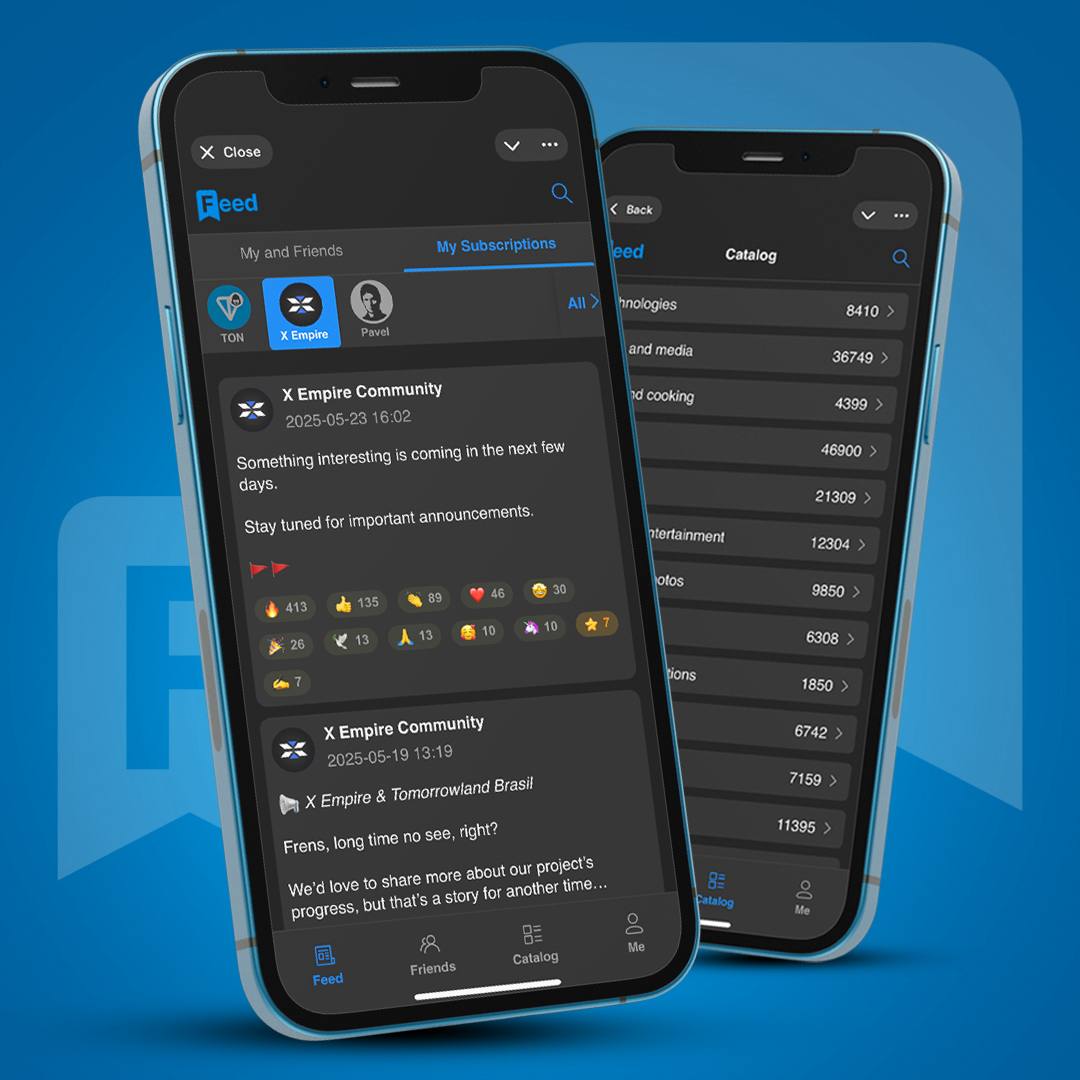
Something big is coming in the next few days. Stay tuned for important announcements.
X Empire tweet media
English
215
45
386
95.1K
X Empire
X Empire@xempiregame·
Experience all of Telegram in a single app One feed for you and your friends’ subscriptions. Discover millions of channels. Launching soon — meet Feed, the most convenient way to browse.
X Empire tweet media
English
244
53
353
104.4K
Pavel Durov
Pavel Durov@durov·
🏆 Telegram is launching a $200,000 contest for content creators. Create a video promoting digital freedom, get 10,000+ organic views on X, IG, YT, TT or SC — and win a share of the $200,000 prize fund.
English
870
884
9.3K
740.2K
Pavel Durov
Pavel Durov@durov·
Banning social media for teenagers only puts them in greater danger. Teens are forced to switch to VPNs — and unlock far worse illegal content. We’ve seen this before. When the Russian government banned Telegram, 95% of Russian teenagers kept using it. They just moved to VPNs.
English
1.2K
5.6K
41.6K
1.5M
Pavel Durov
Pavel Durov@durov·
Indian telecom Reliance is sabotaging access to Telegram for millions of users OUTSIDE India (including the UAE) via a rogue method called BGP hijacking. The sabotage seems intentional, as Reliance has ignored multiple reports. This may be part of a competitive war, as Reliance is partially owned by Meta — the company behind WhatsApp. Network operators are advised to reject unauthorized BGP announcements from Reliance (AS18101) to prevent route hijacks and ensure stable Internet access for their users. Such abuse of global Internet routing is alarming. I wouldn’t be surprised if Reliance/WhatsApp were also behind the recent lobbying effort to ban Telegram in India.
English
2.2K
9.1K
51.2K
3.3M
Pavel Durov
Pavel Durov@durov·
Over the past few weeks, we removed hundreds of channels sharing leaked exam materials and related scams in India. We’re also making the “edited” label more visible to prevent backdating scams. Telegram is a force for good. Banning it — even temporarily — is a mistake.
English
386
1.3K
13.7K
492.2K
Pavel Durov
Pavel Durov@durov·
India’s IT ministry banned Telegram for one week because some users shared leaked exam questions. This punishes 150M+ ordinary Telegram users in India — not the insiders who leaked the exam materials. And the ban hasn't stopped anything. The leaks just moved to other apps.
Internet Freedom Foundation (IFF)@internetfreedom

Statement : Shutting down Telegram is a band aid solution and is a disproportionate answer to exam fraud The Internet Freedom Foundation objects to the directions announced today in the National Testing Agency's press release on action against the Telegram platform. On the NTA's recommendation, the Ministry of Electronics and Information Technology has, under Section 69A of the Information Technology Act, 2000, restricted access to the whole of Telegram in India until 22 June 2026, and has separately ordered the platform to switch off message-editing for every Indian user until 30 June 2026. This is a blunt, nationwide measure aimed at the conduct of rampant fraud rackets, and on the Government's own admission is constitutionally incompatible. At the outset it is important to note that Section 69A and the Blocking Rules of 2009 framed under it allow the Government to block access to specific “information” on a computer resource. They do not extend to switching off an entire intermediary, still less to ordering a company to redesign its product by removing a feature for a whole country. In Shreya Singhal v Union of India, the Supreme Court upheld Section 69A because it is narrow and hedged with procedural safeguards. Reading it to authorise shutting down a platform that lakhs use is an overbroad restriction by the NTAs own admission. For the message-editing direction the release identifies no source of power at all. If one exists, the order must say so. The release argues against itself A restriction on access has to be the least intrusive measure that achieves its aim as per the constitutional test of proportionality laid down in Justice K.S. Puttaswamy v. Union of India (2017) and applied in Anuradha Bhasin v. Union of India (2020). The NTA's own narration shows the block fails its nodal agency, the release says, “has secured the prompt take-down of a substantial number of Telegram channels, groups and bots”, and this targeted work “is the reason the harm caused by these rackets has been contained to the extent it has”. If channel level takedown contained the harm, the case for a blanket block collapses and hence the Government has reached for a heavier tool while conceding that a lighter one was working. The collateral cost sits on the record too as noted in the press release. The block, the NTA accepts, “affects lakhs of citizens who use the Telegram platform for legitimate personal, educational, professional and informational purposes”. The release also says there is "no such paper available outside the secured examination chain" and that “the security of the examination is unaffected by the action taken”. If the exam is secure and no leak exists, what is being suppressed is rumour, and rumour cannot justify closing a platform when specific blocking and criminal prosecution remain available. Students use of Telegram The block of telegram is reactive and ineffective and will punish ordinary users instead of addressing the systemic source of exam leaks. This blocking comes in the final days of NEET preparation, when thousands of students depend on Telegram for study groups, doubt-clearing, and shared resources. Also, it is important to consider that the source of exam papers leak will occur from inside the system, among insiders and across the printing and logistics chain, with the platform being the most downstream channel for distribution. Hence, switching off Telegram, is merely a deflection from the repeated failures that will continue while media attention is directed towards this Telegram ban. Lack of transparency At present only a press release from the NTA has been provided, which recommended the block but the reasoned order of MeitY, the authority that issued it, has not been released. The Anuradha Bhasin decision requires that orders restricting access be published so they can be tested in court. Here the order, and the reasoning of the committee behind it, stay out of view, and we do not know whether Telegram was heard at all. An announcement of a block is no substitute for an order the affected party can challenge. Blunt to enforce and very easy to evade Usually, app-level blocks run through IS-level DNS and IP filtering. They are over inclusive, sweeping in lawful use, yet simple to evade as a determined exam leak racket moves to a VPN or a mirror within minutes while ordinary users lose the service for a week. We ask the Government to: 1) Publish the MeitY Section 69A order and the NTA recommendation behind it, with reasons; 2) State the legal basis for the message editing direction, or withdraw it; 3) Confirm whether Telegram was given a hearing under the Blocking Rules, and place the committee's record before any court that hears a challenge; and 4) Lift the platform-wide restriction and rely on the targeted takedowns the NTA itself credits with containing the harm. We emphasise that the NEET (UG) 2026 re-examination is worth protecting and it concerns the future of lakhs of aspirants. It requires securing the entire process of examination rather than reaching for purported band aid solutions that instead cause more harm. The State cannot switch off a service used by lakhs to answer the wrongdoing of a few, and cannot do it through an order no one affected is allowed to read. On its own facts, the Government has done both. New Delhi, 16 June 2026.

English
3.5K
11.8K
56.2K
6.9M
Pavel Durov
Pavel Durov@durov·
All social media users in the UK will have to “prove” they’re over 16 — with an ID, face scan or bank card. Thousands in the UK are already arrested for political posts every year. Is this really about protecting children — or identifying more people to arrest?
English
156
767
5.5K
258.6K
Pavel Durov
Pavel Durov@durov·
Telegram now has a Rich Text Editor. It supports tables, headings, inline media, lists, AI content, formulas, and more. Available only to Premium subscribers, because otherwise we’d have to call it Poor Text Editor ¯\_(ツ)_/¯
English
548
400
8K
429.2K
Alex Falcon
Alex Falcon@iamalexfalcon·
What actually protected wealth past crises A lot of people ask the same question: where should you move your money when the economy becomes unstable? Some believe in gold, others trust the U.S. dollar, and some put their faith in Bitcoin. The reality is, there’s no universal answer. Every crisis is different, and what works in one may fail in the next. A recent example: during the 2008 financial crisis, U.S. dollars and U.S. Treasury bonds were among the safest places to be. But in 2022, Treasury bonds fell right alongside stocks. A lot can change in just a few years. But there’s one thing that almost every crisis has in common 👇 During periods of extreme uncertainty, almost everything tends to fall. In March 2020, gold dropped about 15%, while Bitcoin plunged roughly 50%. Investors sold whatever they could to raise cash. That leads to a few practical rules: 1️⃣ Keep part of your portfolio liquid. Real estate can protect against inflation, but you can’t sell a property overnight. You need assets you can access quickly — not only to cover unexpected expenses, but also to buy quality investments after prices have dropped and the recovery begins. 2️⃣ Diversify across more than just asset classes. Diversify across countries and markets too. U.S. stocks, international markets, crypto, gold — each behaves differently during a crisis. And most importantly, remember this: the biggest problem during a crisis usually isn’t choosing the wrong investment. It’s being forced to sell the right one at the worst possible time. That’s why keeping part of your money in cash or different currencies across multiple accounts is an important part of any resilient strategy.
English
3
5
8
16.3K
Alex Falcon
Alex Falcon@iamalexfalcon·
The ceasefire is starting to crack The U.S.-Iran deal is falling apart before our eyes. According to media reports, Iran first attacked three commercial ships near the Strait of Hormuz. Then the U.S. responded by striking more than 80 Iranian targets, including air defense systems, radar installations, and patrol boats. Now Iran has retaliated with strikes on U.S. bases in Bahrain and Kuwait. At the same time, the U.S. revoked its authorization for Iranian oil sales — the very authorization it had granted just a week ago. Technically, the ceasefire is still in place — the negotiations are continuing. In reality, both sides are exchanging strikes, and the conflict is once again beginning to pull neighboring Gulf countries into the fighting. The oil market has already reacted: Brent crude rose more than 3% to $76.50 a barrel. Just a week ago, however, the market was pricing in hopes of a deal, and oil had fallen to its lowest levels. Once again, we've seen that conflicts like these are easy to start and nearly impossible to end. The world has developed a chronic problem at the most sensitive point of global trade — and every one of us will end up paying for it through higher fuel costs, more expensive logistics, and rising prices at the grocery store.
English
10
4
5
19.1K
Alex Falcon
Alex Falcon@iamalexfalcon·
World-Class Pull Most people lose momentum just a couple of months after their first success. In the world of content, it happens even faster: today you're at the top, tomorrow you've been forgotten. Only a handful of people manage to stay at the top and turn a spike of attention into long-term success. Today, one of those people is joining me — Vladimir Shmondenko. To millions, he's Anatoly the janitor, but behind that character is an athlete with a 305 kg (672 lb) deadlift and a creator who has built a disciplined system for producing content. We sat down again after two years to understand how he didn't just "stay relevant," but managed to maintain both his scale and his pace. Today, Vova is known all over the world. His videos consistently generate hundreds of millions of views, his content gets recognized by the biggest names in the industry, and people on the level of Joe Rogan and Arnold Schwarzenegger follow his media. In the podcast, we talked about how not to lose your mind when you become world-famous and how not to lose your hunger for results, how to get rid of the small-town mentality that holds you back from growing, and what creators should do at a time when AI starts creating digital clones of them that compete with the original. This is a conversation about why the scale of your success is always secondary to discipline and the willingness to be just the right kind of obsessed with what you do. Watch the episode here: youtu.be/eVLL7Mc0wf4 🤘❤️‍🔥 Don't forget to hit Like and share the episode with friends.
YouTube video
YouTube
English
10
6
5
19.6K
Alex Falcon
Alex Falcon@iamalexfalcon·
Strategy finally sold Bitcoin For years, Strategy has been buying Bitcoin with money raised from investors, promising them regular payouts. Roughly speaking, it's similar to bonds: you lend money to the company, and in return you receive a fixed payment in U.S. dollars every quarter. This week, one of those payments came due, but the company didn't have enough cash on hand. For the first time, it sold part of its Bitcoin holdings — 3,588 BTC, for about $216 million. Technically, that's just 0.4% of its total Bitcoin holdings, which isn't much. However, the company's payment obligations continue to grow. And if the company ultimately changes its approach and begins selling off its Bitcoin holdings, it could easily become the trigger for a deep correction in the crypto market. For context, a sale of $200 million was enough to trigger a 2.5% decline. At the moment, the company still holds about $53 billion worth of Bitcoin on its balance sheet.
Alex Falcon tweet media
English
11
14
10
15.5K
Alex Falcon
Alex Falcon@iamalexfalcon·
Is the financial machine starting to crack? I’ve already written about Saylor’s experiment — how he’s building a financial structure around Bitcoin while taking on more and more obligations. This week, the story took a new turn. One of the largest firms specializing in investor class actions, Rosen Law Firm, has launched an investigation into Strategy. Five instruments are immediately under scrutiny: MSTR, STRC, STRF, STRK, and STRD. The suspicion is that the company may have been spreading misleading information about its business. A rough patch has begun: 1️⃣ First, STRC dropped below $76 with a $100 par value. 2️⃣ Then CryptoQuant analysts said Strategy should pause its Bitcoin purchases. 3️⃣ Now, the lawyers have stepped in too. All this noise is putting pressure on Bitcoin right now. Strategy remains the largest corporate buyer of BTC, and as long as questions hang over it — the market stays on edge. But if the company fends off the legal pressure, STRC returns to par, and the model proves resilient — this could become one of the key drivers of the next rally.
English
2
4
10
17.4K
Alex Falcon
Alex Falcon@iamalexfalcon·
The world’s largest funds are changing their strategy Every year, Invesco publishes one of the most important surveys in the global economy. They sit down with dozens of the world’s largest institutional funds and central banks and ask one simple question: what are you actually planning to do? Together, they manage $29 trillion in assets. That’s more than the annual GDP of the United States. In practice, these are the institutions that determine what happens in global markets. And this time, they surprised a lot of economists: • 80% of them named energy infrastructure as their top priority for the years ahead: almost all are investing in power generation, electricity grids, LNG, and nuclear energy. • Another 33% plan to significantly increase their gold holdings. More importantly, they want to store that gold within their own countries rather than with U.S. custodians. Several central banks are already building alternative asset storage systems outside the United States. • At the same time, the share of central banks expecting the U.S. dollar’s global role to weaken has risen from 12% to 29% in just two years. Nearly a threefold increase. The most important part: in the past, the main question for these funds was how to generate higher returns. Today, in the current environment, it’s how to preserve what they have. They’ve stopped building portfolios for a stable world and started building them for a world where conflicts, sanctions, and crises are simply part of the new normal. The same logic applies to individual investors. Gold through allocated or bank-backed ownership programs, real assets, and diversification are more relevant today than ever.
English
5
5
9
18.6K