The Intelligence Layer

161 posts

The Intelligence Layer banner
The Intelligence Layer

The Intelligence Layer

@ai_layer

Tracking the AI revolution. Models, agents, infrastructure, and the future of intelligent systems. Occasionally crypto.

Worldwide Katılım Mart 2026
5.5K Takip Edilen1.5K Takipçiler
The Intelligence Layer
Google rather casually stole the AI spotlight today. And the interesting bit is not any single announcement. It’s the shape of the thing. These are moves only a vertically integrated giant can really make: ━━━━ 𝗛𝗮𝗿𝗱𝘄𝗮𝗿𝗲 A new laptop built for AI-native experiences, powered by Gemini intelligence and Intel chips. Not exactly subtle. 𝗗𝗶𝘀𝘁𝗿𝗶𝗯𝘂𝘁𝗶𝗼𝗻 Gemini intelligence is coming to every Android device. Sounds dull until you realise this is what Siri was supposed to become, before apparently getting lost in a very tastefully designed corridor. 𝗦𝗰𝗶𝗲𝗻𝗰𝗲 Isomorphic, Google’s AI drug design lab, raised $2.1 billion. Its model has already discovered novel treatment molecules. 𝗜𝗻𝘁𝗲𝗿𝗳𝗮𝗰𝗲 An AI-native mouse cursor that works with Gemini when you point at things. For example: “turn this block of text into a visual.” 𝗜𝗻𝗳𝗿𝗮𝘀𝘁𝗿𝘂𝗰𝘁𝘂𝗿𝗲 A SpaceX partnership to launch data centres in space. Because apparently Earth was getting a little cramped. ━━━━ The strategy is now much clearer. Google may not win coding. It may not win the chatbot beauty contest. But it has a very real shot at becoming the default end-to-end distributor of AI. The only company remotely close is Apple.
Google@Google

Introducing Googlebook, the first laptop designed for Gemini Intelligence. It’s crafted for heavyweight performance, built with Gemini at the core and perfectly synced with your Android phone. Coming this fall. 💻✨ #TheAndroidShow

English
0
0
0
51
The Intelligence Layer
Anthropic has just launched the world's cheapest lawyer It's called claude-for-legal. And here's what it's capable of doing: • Reading and reviewing contracts • Drafting legal responses • Building claims tables for trials • Monitoring due dates and renewals • Connecting only to your tools: Slack, DocuSign, Ironclad, Lexis+… All of that without leaving Claude How it works: → Install it in 60 seconds → Works in Claude Cowork, Claude Code, or your own API → It's open-source and 100% free What areas it covers: • Commercial contracts and privacy • Litigation and regulatory • AI governance • Legal training What used to take lawyers hours now gets done in minutes Link below👇
Polymarket@Polymarket

JUST IN: Anthropic rolls out new Claude tools aimed at automating legal work for lawyers & law firms.

English
0
0
1
54
The Intelligence Layer
A Chinese AI short drama called Huo Qubing just did 500 million views. Cost: about $420 in compute. Crew: tiny team. Time: 4 days. In January alone, more than 14,000 AI dramas launched in China. One every 90 seconds. Which rather suggests the next Netflix-tier hit may not come from a studio at all. It may come from someone with a story, a laptop, and a $100 subscription. The moat is looking less like Hollywood. More like taste.
English
24
25
35
626
The Intelligence Layer
Introducing a 100% free coding agent with DeepSeek v4 Pro Choose any model, all free: - DeepSeek v4 Pro/Flash - Kimi K2.6 - MiniMax M2.7 npm i -g freebuff
English
0
0
6
164
The Intelligence Layer
DeepSeek just closed the biggest AI round in Chinese history, and much of the West still seems to be filing it under “interesting startup news”. That is probably the wrong drawer. This does not look like a normal startup. It looks increasingly like China is turning DeepSeek into the AI company that helps run the state. Back in February, Xi Jinping convened a small private meeting in Beijing with some of China’s most important CEOs, including the founders of BYD and Huawei. DeepSeek’s founder, Liang Wenfeng, was in the room. Xi reportedly told government officials to use DeepSeek by name. That sort of direct endorsement from the top of the Chinese government is not exactly handed out with the tea. ━━━━ Then the money arrived. China has a huge government fund called Big Fund III, with more than $50 billion earmarked for AI and chips. It invests in companies the Chinese government wants to win. Big Fund III is now backing DeepSeek alongside Tencent in its latest round: $7 billion at a $51.5 billion valuation. Liang personally put in $3 billion of his own money and still owns 90% of the company, which is the sort of founder ownership structure that would cause several Silicon Valley cap table specialists to faint quietly into a spreadsheet. DeepSeek also benefits from tax breaks and government research funding through a special “high-tech” status granted in 2023. ━━━━ Around this, China is building the infrastructure DeepSeek needs. 17 Chinese provinces are offering free compute credits worth up to $300,000 to AI companies. Beijing has spent more than $6 billion building giant data centres in western China. And the rollout is already well underway. 72 local Chinese governments are using DeepSeek inside their offices for paperwork and admin. Shenzhen, a city of 17 million people, gave DeepSeek to 20,000 government workers. Document approval times reportedly fell by 90%. 90 of China’s largest hospitals are using DeepSeek with real patients to help doctors make decisions. One hospital said it became 40x more efficient at patient follow-ups. Universities are running it on supercomputers. Hotel chains use it for customer service. Local police are using it to help find missing people. ━━━━ Then in August, the Chinese government made the whole direction official. Its “AI Plus” policy effectively tells every Chinese ministry to start using AI across its work. There is nothing remotely comparable happening in the West. Sam Altman does not own 90% of OpenAI. The US government is not putting billions directly into Anthropic. The president is not gathering AI founders at the White House and publicly telling agencies to use their products. In America, AI companies compete for customers. In China, one company is being chosen by the government, funded by the government, and installed inside the government, all at once. Hard to say where that ends. But V4.1, DeepSeek’s agent model, ships in June. So we may not have to wait very long to find out.
English
0
0
7
62
The Intelligence Layer
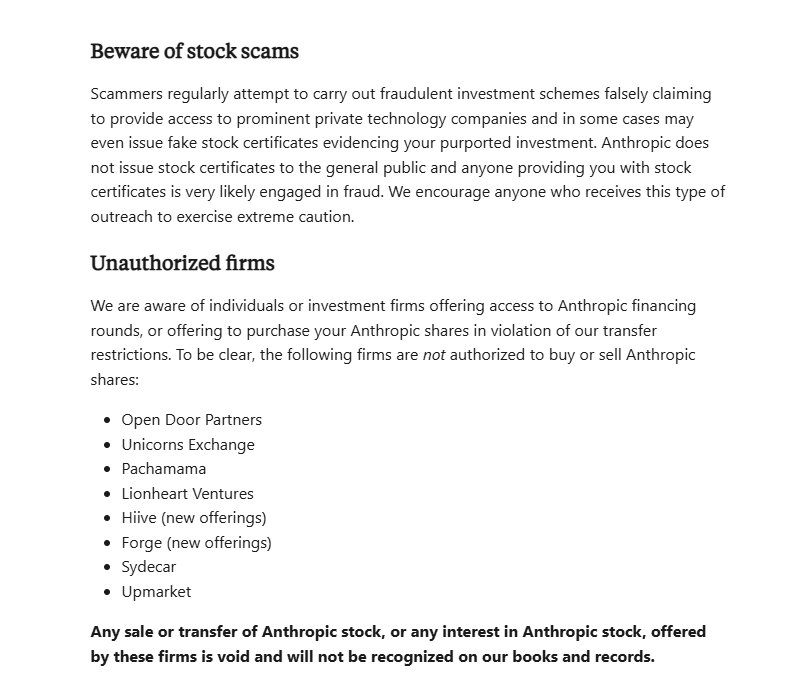
Anthropic’s stock policy update feels oddly under-discussed. It may turn out to be rather important. Possibly “lawyers in several time zones cancelling dinner” important. There is an active secondary market claiming to offer Anthropic stock, derivatives, SPV interests, beneficial interests, futures, and assorted other financial origami. Some of it appears on well-known platforms, including Forge. Anthropic has now called out Forge by name and is, in effect, saying: All of this is illegal. ━━━━ Some offerings may simply be frauds: people selling Anthropic shares, or interests in Anthropic shares, that they do not actually own. But a lot of this is probably something else: genuine attempts to transfer Anthropic equity exposure, whether directly, through SPVs, via beneficial interests, or through some future-looking contractual structure. Anthropic seems to be saying it will treat these transfers as void. That is where things get interesting. ━━━━ I do not have the actual transfer restriction language, so the details matter enormously. But a few questions follow rather quickly: Can the first purported seller in the chain double-dip? Does the original seller lose the entitlement? Do downstream buyers get wiped out entirely? Is Anthropic threatening to nuke the whole chain, or just trying to scare the market back into its kennel? ━━━━ If they are not bluffing, the litigation could get very strange, very quickly. This lives in the less glamorous swamp of corporate law: transfer restrictions, drafting precision, void versus voidable transactions, equitable claims, downstream purchasers, and jurisdiction-specific treatment of violations. If a transfer is merely voidable, downstream buyers may have arguments. If it is void ab initio, some jurisdictions may shut the door on equitable defences altogether. Tiny drafting choices. Large financial crater.
The Intelligence Layer tweet mediaThe Intelligence Layer tweet media
English
0
0
6
157
The Intelligence Layer
What Are Agentic Payments? Agentic payments are payments that are settled with the use of AI with varying ranges of autonomy throughout the process. > A break of what agentic payments is, how they work, the leading companies behind it, role of x402, can agentic payments be tracked, & more👇 Source: info.arkm.com/research/what-…
English
2
1
8
222
The Intelligence Layer
The Intelligence Layer@ai_layer·
China released an AI employee that runs 100% locally. It does research, writes code, builds websites, creates slide decks, and generates videos.. all by itself. 100% Open Source.
The Intelligence Layer tweet media
English
1
0
4
116
Mohit
Mohit@mohit_web_dev·
Built a tiny app to make splitting expenses less annoying 🐼 Still improving it, but it’s already been useful on trips with friends.
Mohit tweet media
English
2
0
2
70
The Intelligence Layer
The Intelligence Layer@ai_layer·
Just crossed 1,000 followers here on X. This feels like a real landmark, and I’m genuinely grateful to everyone who has followed, engaged, replied, liked, reposted, or shared my work so far. I’m focused on sharing useful thoughts at the intersection of AI, crypto, Web3, markets, and the future of technology. If any post has added value to you, I’d really appreciate your help: Please repost it, share it with your circles, send it to people who may find it useful, or share it on platforms like LinkedIn. And if you know people who are interested in the AI + crypto intersection, please ask them to follow me here. The next milestone is 2,000 followers, and I’d love to get there as soon as possible with your support. Thank you again. I appreciate every one of you.
English
1
2
10
178
The Intelligence Layer
The Intelligence Layer@ai_layer·
Claude’s biggest flaw is not intelligence. It’s amnesia. So here’s a 3-file setup that gives Claude a proper working memory. Preferences, writing style, corrections, project context — all carried forward instead of politely vanishing into the mist. Takes about 5 minutes. ━━━━ 𝟭. 𝗜𝗻𝘀𝘁𝗿𝘂𝗰𝘁𝗶𝗼𝗻𝘀.𝗠𝗗 This tells Claude how to behave. Include: • who you are • what you do • your rules • what good outputs look like • how memory should work Important line to add: “Update Memory.MD with my preferences over time.” That one sentence is doing rather a lot of lifting. ━━━━ 𝟮. 𝗠𝗲𝗺𝗼𝗿𝘆.𝗠𝗗 This becomes Claude’s running brain. Use it for: • preferences • corrections • recurring patterns • writing style • decisions you do not want to explain 900 times Now when you say something like “stop using em dashes” in Claude Code, it updates Memory.MD automatically because your Instructions.MD told it to. Tiny miracle. Slightly embarrassing that we need it. Still useful. ━━━━ 𝟯. 𝗖𝗼𝗻𝘁𝗲𝘅𝘁.𝗠𝗗 This holds the project-specific context Claude needs. The product. The codebase. The constraints. The audience. The current state of play. Basically: everything Claude would otherwise ask you again tomorrow with the confidence of someone who has never met you. ━━━━ The best part: You can carry Memory.MD across Claude chats, projects, or even other LLMs without re-explaining your entire existence. Save this before you forget it. Which, ironically, is exactly the problem we’re solving.
English
20
30
37
1.1K
The Intelligence Layer
The Intelligence Layer@ai_layer·
Stop burning Claude tokens like it’s a marketing strategy. You do not need the $200/month plan to get serious SEO work out of Claude. For most local businesses, the $20/month setup is enough — provided you stop using it like a slightly polite search box. Here’s the setup I run before writing a single prompt. 1. Use the right model Open Cowork. Select Opus 4.7. Turn on Extended Thinking. Most people are running SEO prompts through Sonnet or whatever the default model happens to be that day. Then they act surprised when the output has all the strategic depth of a fridge magnet. Wrong model, shallow answer. Opus 4.7 with Extended Thinking does not just answer the prompt. It works through the market before it replies. Often, the gap between a $20/month result and a $10k/month agency result is just this setting. Annoying, but there we are. 2. Give it your business brain Before anything else, paste this into Claude: Here is everything you need to know about my business: [name], [website], [location], [services], [target cities], [top 3 competitor URLs]. Use this as context for everything. Never ask me for this again. Now Claude stops giving advice that could apply to a plumber in Leeds, a dentist in Austin, or a roofing company in the outer suburbs of nowhere. It starts working from your market. Most people skip this and then spend six months receiving generic SEO advice in a slightly more elegant font. That is not SEO. That is guessing with confidence. 3. Set the SEO mission once Go to: Settings → Cowork → Edit Global Instructions Paste this: You are my local SEO strategist with 14 years of experience. Always read my business context before responding. Always compare my business against my competitors before giving advice. Always prioritise recommendations by revenue impact. Never give generic SEO advice that doesn’t apply to my specific market and location. Set it once. It follows every session. Your prompts can now be 10 words long and still hit harder than the 500-word prompt essays people keep lovingly crafting like Victorian letters. 4. Build your competitor file Create a document called: COMPETITORS.md Add your top 5 competitors, including: • website URL • GBP URL • review count and average rating • keywords they rank for that you do not • categories they have that you are missing Paste this into Claude before every audit. Now it knows who you are actually trying to beat. Not “competitors” as a vague business-school concept. The actual businesses ranking above you, taking calls that should be yours. 5. Filter for buyer intent Before keyword research, tell Claude: Only give me keywords with clear buyer intent. Ignore informational keywords. Focus only on service + city, emergency + service, and near me combinations. Every keyword you suggest must indicate someone who is ready to call or book today. This removes about 90% of the SEO activity businesses waste time on. Lovely blog traffic. Very educational. No one calls. 6. Check the setup before every SEO session Before you run prompts, check: • Am I in Cowork, not Chat? • Is Opus 4.7 + Extended Thinking on? • Has Claude read my business context? • Is my competitor file loaded? • Is my keyword intent filter set? Get those five right first. Then prompt. The businesses doing this properly are outranking competitors who have been established for years. The ones skipping it are still asking for “SEO tips” and wondering why the phone remains, mysteriously, not ringing. Most people will bookmark this and do absolutely nothing. The ones who set it up today will look back in 90 days and quietly realise the boring setup was the whole game. Full prompt system is in the article below. Bookmark it. Give it to Claude. Right now.
Sarvesh Shrivastava@bloggersarvesh

x.com/i/article/2030…

English
0
0
1
83