DP Singh

967 posts

DP Singh banner
DP Singh

DP Singh

@aiatscale01

AI Automation Consultant | Helping small teams save 20+ hrs/week with AI workflows | Building AI tools for real businesses | Free 30-min coaching calls ↓

Melbourne, Australia Katılım Ağustos 2024
158 Takip Edilen139 Takipçiler
Sabitlenmiş Tweet
DP Singh
DP Singh@aiatscale01·
Finally got access to GPT-5.2. First impression It feels less like “a smarter chatbot” and more like a system that actually holds context the way humans expect it to. Long prompts don’t decay. Intent stays intact. Follow-ups feel cumulative, not reset. This is the first time I’ve felt comfortable treating an AI like a thinking workspace instead of a prompt machine. I’m going to test it on real workflows next research writing decision breakdowns long chains of thought Will share what actually holds up and what doesn’t. If you’ve started using 5.2 already what surprised you most?
DP Singh tweet media
English
4
0
4
1.9K
DP Singh
DP Singh@aiatscale01·
Using Codex to build internal tools for my consulting clients , things like automated client reporting, lead qualification workflows, and custom dashboards. The Mac integration changes the game because now it can actually see and work inside the tools my clients already use. That’s the bridge most “AI assistants” are missing.
English
0
0
0
381
OpenAI Newsroom
OpenAI Newsroom@OpenAINewsroom·
ICYMI: Codex has new capabilities and is more integrated with your Mac! Whether it's launching a website for your brand, creating automations to help you work, or even generating images—everyone can be builder. How do you use Codex?
OpenAI@OpenAI

Codex for (almost) everything. It can now use apps on your Mac, connect to more of your tools, create images, learn from previous actions, remember how you like to work, and take on ongoing and repeatable tasks.

English
57
58
1.1K
100.6K
DP Singh
DP Singh@aiatscale01·
This is the right move. The gap between AI research and real-world scientific application is where the most valuable systems will be built over the next 5 years. Embedding domain experts directly into research teams is how you close it. Curious which fields are the priority for the first cohort?
English
1
0
1
2.2K
Anthropic
Anthropic@AnthropicAI·
We're launching the Anthropic STEM Fellows Program. AI will accelerate progress in science and engineering. We're looking for experts across these fields to work alongside our research teams on specific projects over a few months. Learn more and apply: job-boards.greenhouse.io/anthropic/jobs…
English
175
547
5.4K
613.6K
DP Singh
DP Singh@aiatscale01·
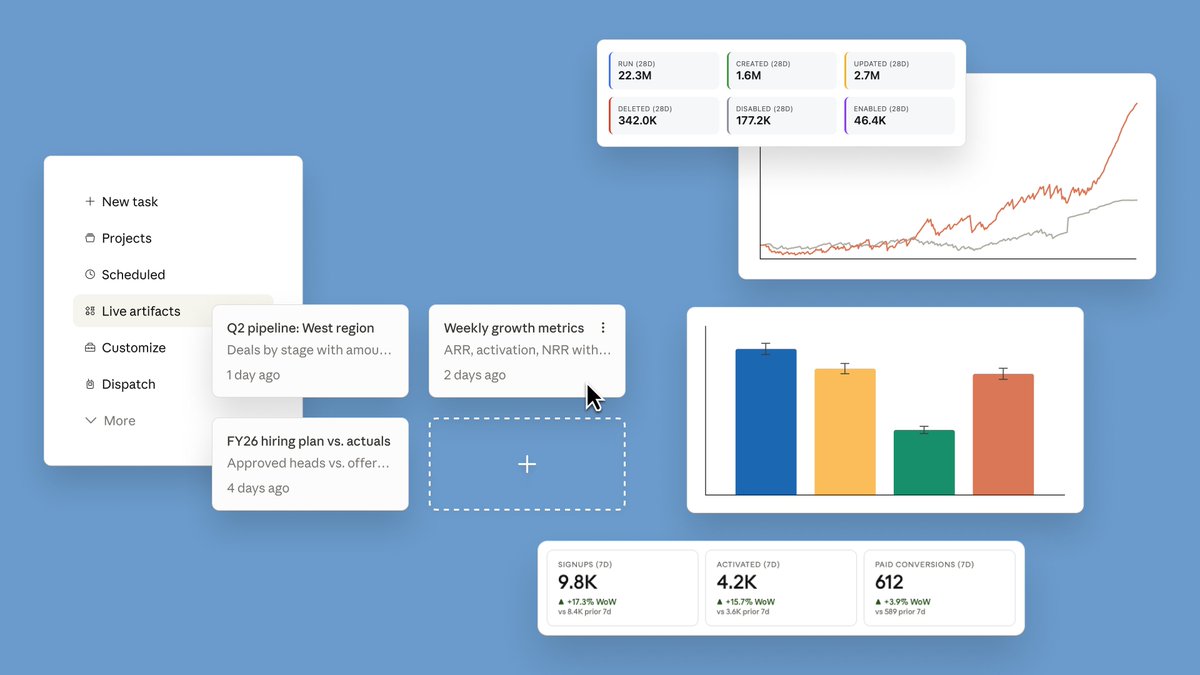
Live, self-refreshing artifacts inside Cowork is a big deal. Most AI “dashboards” I see clients using are static , built once, outdated by Friday. A workspace where Claude rebuilds the view with fresh data every time you open it? That’s the operating layer for how teams actually run. Builders, pay attention. 👇
Claude@claudeai

In Cowork, Claude can now build live artifacts: dashboards and trackers connected to your apps and files. Open one any time and it refreshes with current data.

English
1
0
2
47
DP Singh
DP Singh@aiatscale01·
Live artifacts change the game for client reporting. Half the AI systems I’ve built for clients end in a static dashboard that goes stale in a week. A self-refreshing one connected to their actual stack is the delivery layer we’ve been missing. Curious will it pull from custom connectors or just the native integrations?
English
0
0
1
1.2K
Claude
Claude@claudeai·
In Cowork, Claude can now build live artifacts: dashboards and trackers connected to your apps and files. Open one any time and it refreshes with current data.
Claude tweet media
English
593
1.4K
17.4K
5M
DP Singh
DP Singh@aiatscale01·
Most people chase growth by adding more. They add habits. They add tools. They add noise. The real growth happens when you subtract: • The distractions that feel productive • The novelty that pulls you off the one thing that was working • The “just one more” that keeps you from compounding Protect the boring. Double down on the simple. Let consistency do the heavy lifting. What are you willing to remove this week so the right actions become inevitable? Drop it below 👇 #Growth #CompoundEffect #Focus
English
0
0
0
8
DP Singh
DP Singh@aiatscale01·
The fastest way to get real results is 1-on-1 coaching that shows you exactly how to use Claude/ChatGPT/Gemini inside your specific workflows. We’ve helped teams save 10-20 hours/week in under a month. Free 30-min call → aiatscale.co
English
0
0
2
27
DP Singh
DP Singh@aiatscale01·
@heyshrutimishra The workspace-file audit is the one everyone skips. Half our savings came from trimming context that was silently being re-sent every call. Would love a follow-up on how you're tracking token usage per workflow.
English
0
0
1
20
Shruti
Shruti@heyshrutimishra·
Your OpenClaw is 3x more expensive than it needs to be. Mine was burning $680/month. Today after auditing I cut it by two-thirds. No capability lost. Here are the six things to check on yours. 1. Read your core workspace files. Go to ~/.openclaw/workspace/ and open every file in there. AGENTS.md. TOOLS.md. IDENTITY.md. SOUL.md. MEMORY.md. HEARTBEAT.md. These get injected into your model on every single turn. Most people set them up months ago and never looked again. If a line isn't doing real work, delete it. This is the highest-leverage fix you can make. 2. Audit your tools in the Control UI. Open your OpenClaw Control UI, go to Agents → Tool Access. You probably have "Full" preset with 30+ tools enabled. Each one ships a JSON schema on every message. video_generate, music_generate, tts, canvas, apply_patch, x_search — if you don't use them, turn them off. 3. Replace 20 bloated tools with one Composio connection. Most OpenClaw users have Gmail, Calendar, Drive, Slack, Notion, Linear, GitHub, and a dozen more MCPs connected. Each one ships its full tool schema or some content in TOOLS.md file on every single turn. That's 10-20k tokens of JSON before you've said a word. 4. Stop overloading one agent. Split it. If your main agent handles email, crons, code, chat, and random research, it's carrying context for all of them on every turn. Run two or three agents with focused scopes. One for personal ops (email, calendar, reminders). One for coding and infra. One for content and research. Each gets a lean workspace and only the tools it needs. If self-hosting multiple agents feels like too much to babysit, use a managed OpenClaw host: KiloClaw, MaxClaw, or KimiClaw. No compute to run, model included, agent runs 24/7. Offload the heavy one and keep your main lean. 5. Run heavy tasks in throwaway sub-agents. Almost nobody uses this and it's OpenClaw's best-kept secret. When you ask your agent to do something big: research a topic, refactor code, scrape a site... spawn a sub-agent with sessions_spawn. It runs in an isolated session with minimal context, does the job, returns the result, and dies. Your main session stays clean. The expensive context of your real conversation doesn't get polluted by one-off research. You pay for the task, not for dragging its history around forever. 6. Run /context detail once a week. It shows every file, skill, and tool schema in your context with token counts. Most people never run it. New skills, tools, and files sneak in over time. A quick weekly check keeps it in shape. I ran all six of these wrong until today. Caught it at $680/month. Could easily have been $2000. 🔖 Bookmark this... you'll want it when your bill spikes.
English
36
42
401
41.3K
DP Singh
DP Singh@aiatscale01·
@bindureddy The cost delta is the real story. When an 80%-as-good model runs for basically free, the moat shifts from the model to the scaffolding around it — routing, evals, context. Good time to be building the layer above.
English
0
0
0
7
Bindu Reddy
Bindu Reddy@bindureddy·
The big story that everyone missed yesterday - Qwen 3.6 dropped with 3B active params costs nothing to run and delivers 80% of Opus 4.7’s performance 🤯 Open source is making giant leaps
English
94
77
1.1K
67K
DP Singh
DP Singh@aiatscale01·
@xai Strong move. Speech to text is one of the highest leverage AI primitives, and making it instant, multi speaker, and competitively priced is exactly how adoption happens. Excited to see where xAI takes this.
English
0
0
1
127
xAI
xAI@xai·
Grok's Speech to Text API is now available. Instant, multi-speaker transcription across 25 languages - at the best price in the market. x.ai/news/grok-stt-…
English
296
346
2.7K
2.2M
DP Singh
DP Singh@aiatscale01·
@OpenAI This is the kind of AI progress that matters most. Less hype, more scientific acceleration.
English
0
0
0
27
OpenAI
OpenAI@OpenAI·
Introducing GPT-Rosalind, our frontier reasoning model built to support research across biology, drug discovery, and translational medicine.
English
486
1.3K
12.9K
2.2M
DP Singh
DP Singh@aiatscale01·
Reposting this because Opus 4.7 is a real shift. A Claude model that can run long, complex workflows, follow tight instructions, and self‑check before reporting back is exactly what you want if you’re serious about AI agents and automation.
Claude@claudeai

Introducing Claude Opus 4.7, our most capable Opus model yet. It handles long-running tasks with more rigor, follows instructions more precisely, and verifies its own outputs before reporting back. You can hand off your hardest work with less supervision.

English
0
0
0
30
DP Singh
DP Singh@aiatscale01·
@claudeai @AnthropicAI Super exciting – Opus 4.7 looks like a beast. Honest question though: with all this extra capability and long‑running work, are we actually going to see higher usage limits, or will power users just hit the wall even faster?
English
0
0
0
40
Claude
Claude@claudeai·
Introducing Claude Opus 4.7, our most capable Opus model yet. It handles long-running tasks with more rigor, follows instructions more precisely, and verifies its own outputs before reporting back. You can hand off your hardest work with less supervision.
Claude tweet media
English
4.8K
10.3K
81.1K
13.3M
DP Singh
DP Singh@aiatscale01·
@joshwoodward @GeminiApp Love this direction for Gemini full‑length, vetted NEET mocks at zero cost is a huge level‑up for exam prep. Curious if you’re planning structured practice for other high‑stakes exams
English
0
0
0
173
Josh Woodward
Josh Woodward@joshwoodward·
New in Gemini: NEET practice tests! 🇮🇳🩺 Sending good luck to everyone taking India's biggest medical exam in a few weeks. You've got this! We’re working on adding more practice tests for different subjects and countries. What should we add next? Let us know below 👇
Google India@GoogleIndia

Full length, no cost NEET UG practice tests are now in @GeminiApp, isn’t that neat? 😄 Say “I want to take a NEET mock test” and begin ✍️ Read here: goo.gle/NEERPrep

English
63
126
1.4K
192.7K
DP Singh
DP Singh@aiatscale01·
Fascinating work , especially the weak-to-strong setup and using the performance gap as the success metric. As more teams rely on smaller frontier‑adjacent models in production, automated alignment agents like this will be the only scalable way to keep safety work moving as fast as capability gains. Curious how you see this plugging into existing eval pipelines for enterprise deployments.
English
0
0
0
361
Anthropic
Anthropic@AnthropicAI·
New Anthropic Fellows research: developing an Automated Alignment Researcher. We ran an experiment to learn whether Claude Opus 4.6 could accelerate research on a key alignment problem: using a weak AI model to supervise the training of a stronger one. anthropic.com/research/autom…
English
224
280
2.4K
407.7K
DP Singh
DP Singh@aiatscale01·
Happy Vaisakhi. On this special day, may Waheguru bless everyone with peace, prosperity, good health, and happiness. With heartfelt wishes, may this Vaisakhi bring new beginnings, strength, abundance, and joy to every home. #Vaisakhi #HappyVaisakhi
English
0
0
0
58
DP Singh
DP Singh@aiatscale01·
Same here but in transport ops I used to manually track driver compliance, fatigue logs, vehicle checks across 50+ drivers. Hours every week gone on data entry that added zero value Built an AI agent to handle it and now I actually spend time on decisions that matter instead of copying data between spreadsheets The grunt work era is done
English
0
0
1
250
Rahul Mathur
Rahul Mathur@Rahul_J_Mathur·
I haven’t made a single CRM entry this year. But, my AI agent has created & edited entries for: - 500 companies screened - 60 of which were deeply evaluated - 4 or 5 of which we invested into Even as recently as 14 months ago, I would do this grunt work by hand therefore I know exactly how long & painful these tasks can be: - 10 mins for a rich “screening” CRM entry - 25-30 mins for a rich “deep eval” CRM entry The time saving is 100+ hours of high quality effort per quarter This is the 2nd quarter in a row where this level of ROI has been extracted - it effectively eliminates the need for a human Analyst. Let me tell you a little bit about this journey:
English
20
15
295
33.1K
DP Singh
DP Singh@aiatscale01·
@brainybeauty_ Right. The people who actually lived interesting lives never look like they are trying to hide it. That confidence hits different.
English
0
0
0
5
Diksha
Diksha@brainybeauty_·
Aging is a privilege. It’s okay to look your age… there’s beauty in every stage✨❤️
English
7
5
45
1.2K
DP Singh
DP Singh@aiatscale01·
The 5-Layer AI Operations System That Replaces a 10-Person Team Everyone is talking about AI agents in 2026. Almost nobody is wiring them into their actual operations. I build AI systems for businesses that move real volume. Logistics, compliance, ops-heavy companies where one missed step costs thousands. Here is the exact framework I use: Layer 1: The Intake Engine Every business has inbound chaos. Emails, messages, forms, calls. The first layer is an AI classifier that sorts everything into action categories: urgent, delegate, log, or ignore. Most operators spend 2-3 hours a day just triaging. This layer kills that. Layer 2: The Decision Router Once classified, each item needs to go somewhere. Not to a person. To a rule. AI matches the input against your business logic and routes it. Approvals under $500 go straight through, compliance flags get escalated, follow-ups get queued with context attached. No human touches it unless it is an edge case. Layer 3: The Execution Loop This is where most people stop. They classify, maybe route, then still do the work manually. The execution layer handles the output. Draft the response, generate the report, update the record, send the notification. One loop. No handoffs. Layer 4: The Compliance Layer If you operate in a regulated space, this is non-negotiable. Every action the system takes gets logged with a timestamp, decision trail, and the rule it followed. When an auditor asks why something happened, you do not dig through emails. You pull a report. Layer 5: The Feedback System The system watches itself. Which decisions got overridden by a human? Which classifications were wrong? That data feeds back in weekly, and the system gets sharper. Most businesses never build this layer. That is why their AI stays average. The real shift in 2026 is not about which AI model you use. It is about whether you have a system that runs your operations while you focus on growth, or whether you are still the system yourself. I have seen this framework cut operational overhead by 40-60% in businesses doing $1M-$10M in revenue. Not because the AI is smarter than the team. Because it never forgets, never gets tired, and never skips a step. If you are still manually approving, routing, and chasing, you are the bottleneck. Build the system. Then scale.
English
0
0
0
19