AITechGyan

182 posts

AITechGyan

AITechGyan

@aitechgyan

AI Tech Gyan - Indian focused Youtube channel https://t.co/pkrgnJilMc

Katılım Şubat 2017
118 Takip Edilen48 Takipçiler
AITechGyan
AITechGyan@aitechgyan·
The biggest scam?
AITechGyan tweet media
English
0
0
0
7
Hermes Agent Tips
Hermes Agent Tips@HermesAgentTips·
be honest what’s your favorite model to run on Hermes agent? - Fable 5 - GPT-5.6 - DeepSeek V4 Flash - GLM-5.2
English
178
5
145
30K
Vadim
Vadim@VadimStrizheus·
As a founder, which AI model do you prefer? 1. Fable 5 2. GPT 5.6 3. GLM 5.2
English
223
3
210
69.8K
divyansh
divyansh@Divyansh91565·
THIS THIS THIS
divyansh tweet media
English
60
46
916
38.7K
Sudo su
Sudo su@sudoingX·
what's your go to local model right now? any hardware counts. whatever you've got. just tell me what you actually run daily.
English
144
1
115
37.6K
AITechGyan retweetledi

Akshay 🚀
Akshay 🚀@akshay_pachaar·
The RL framework behind GLM-5.2 is fully open source. The full post-training of GLM-5.2 ran on it in about two days. The same stack sits behind the entire GLM series, from 4.5 to 5.1. It is called slime, and it is built around one idea. Keep a single RL kernel, and push all the variety into data generation. Let me explain what that means. Every RL run has two halves. One generates experience, where the model produces responses and something scores them. The other learns from it by updating weights. The learning half is mechanical. It reads samples, computes a loss, and steps the optimizer, the same way whether the model solves equations or drives a browser. What changes between tasks is generation. A math run answers in a single turn and grades the result. An agent run loops through tool calls, reads results, and only then earns a reward. slime draws the line right there. The learning half stays fixed as one kernel, and everything that differs becomes a new way to generate data. Under the hood, it wires Megatron for training to SGLang for rollout, with a Data Buffer between them that owns prompts, custom data, and generation. Most RL stacks grow into a pile of disconnected trainers, rollout services, and agent frameworks. slime refuses that. Multi-turn tool use, sandbox interaction, environment feedback, and verifier rewards all enter as data generation, not as forks of the loop. So an agentic workload runs on the same loop a math run uses, and the kernel never changes. A few things follow. → It is battle-tested. The loop is validated by shipping real GLM models, and it also supports Qwen3, DeepSeek V3, and Llama 3. → Correctness comes first. RL bugs are silent, so slime keeps the dataflow explicit and treats CI, reproducibility, and fault tolerance as real engineering. The proof is the ecosystem on top of it. Dressage, Miles, vime, Relax, OpenClaw-RL, P1, and TritonForge all build on slime without touching the core loop. The lesson is not that RL needs a bigger framework. It is that the variety belongs in data generation, and the training loop should stay small enough to trust. GitHub repo: github.com/THUDM/slime (don't forget to star 🌟) Since we're talking about RL, I wrote a full breakdown on fine-tuning LLMs with RL in 2026. Including how to skip manual reward engineering with automatic LLM-graded rewards. The article is quoted below.
Akshay 🚀 tweet media
Akshay 🚀@akshay_pachaar

x.com/i/article/2029…

English
28
179
1.5K
142.8K
AITechGyan
AITechGyan@aitechgyan·
OpenAI just unveiled their new chip: Jalapeño. It is their first AI chip built with Broadcom. Is it going to make a huge difference? What are you thoughts?
English
0
0
0
19
Jake
Jake@dontbanjake·
@francoisfleuret You think a single human outside of China wants to use a Chinese server? This ain’t outta the kindness of their hearts. They know they can’t charge so their best route is sabotage
English
26
0
8
9.2K
François Fleuret
François Fleuret@francoisfleuret·
Why are Chinese companies releasing very strong open-source models?
English
480
42
1.7K
390.5K
Christopher 🚀
Christopher 🚀@kapicode·
If you run local LLMs: what is your actual setup? Not the dream build. The daily driver. GPU/APU? Memory/VRAM? Model size? Serving stack? What breaks most often? I’m trying to compare practical local AI systems, not leaderboard screenshots.
English
118
3
73
15.9K
AITechGyan retweetledi
Tony Simons
Tony Simons@tonysimons_·
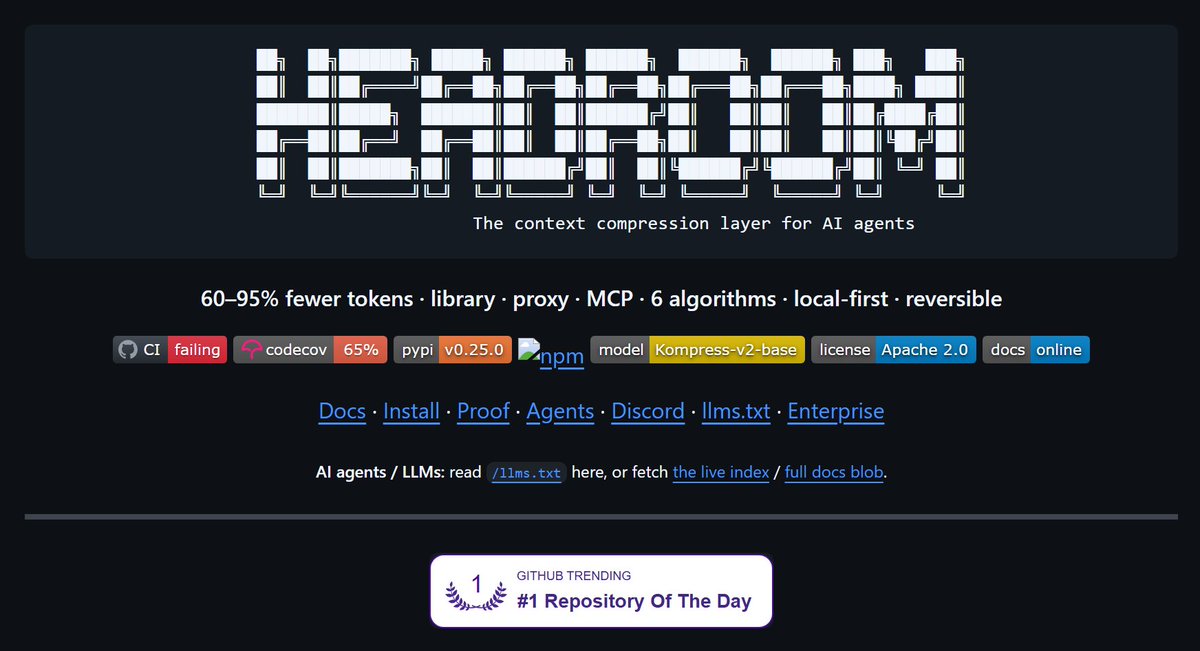
🚨 A Netflix engineer built an open-source proxy that cuts AI token usage by 60-95%. Zero code changes. Benchmarks show ±0.000 accuracy regression. ✨ 29.9k stars on GitHub. It sits between your app and the LLM, so every tool output, code block, and conversation history gets compressed in-flight. 🚫 No summarization, no loss. 😎 Just 60-95% fewer tokens with the same answers. Works with Claude Code, Cursor, Copilot, and any OpenAI-compatible client. One pip install, one env var, done. Netflix uses it internally. Apache 2.0. Built by Tejas Chopra. github.com/chopratejas/he…
Tony Simons tweet media
English
93
222
2.7K
347.7K
AITechGyan retweetledi
orcus108
orcus108@orcus108·
WHAT THE HELL is happening in AI? A 3B parameter model just put up coding benchmark scores in the same league as Claude Opus 4.5. 3 BILLION. The weights are on Hugging Face, anyone can test it. I genuinely don't know if this is a breakthrough or if the benchmarks are broken.
orcus108 tweet media
English
214
188
2.8K
676.4K
AITechGyan
AITechGyan@aitechgyan·
@intellectronica I am using z.ai coding plan from last christmas. From 4,7 to 5.0 to 5.1 and now 5.2. I can say 5.1 was good jump, 5.2 is even better. I am liking it. It can do loooooong tasks easily.
English
0
0
2
1K
Eleanor Berger
Eleanor Berger@intellectronica·
Folks who've used GLM-5.2. What's it like? (I mean actually used, not "stared at the benchmarks")
English
160
1
291
71.2K
AITechGyan
AITechGyan@aitechgyan·
OSS has caught up with proprietary models. GLM-5.2 is best (after the one which is not available for us).
English
0
0
0
16