Sally Stockholm

657 posts

Sally Stockholm banner
Sally Stockholm

Sally Stockholm

@aiwithsally

ai enthusiast. top 1000 GitHub contributor Hermes agent. prev - google, nasa.

Katılım Temmuz 2014
165 Takip Edilen246.1K Takipçiler
Sabitlenmiş Tweet
Sally Stockholm
Sally Stockholm@aiwithsally·
Getting a like from the co-founder of OpenAI means the world to me. Thank you @gdb I pour my entire life into my research and making it available to you all. ❤️
Sally Stockholm tweet media
English
146
65
352
18.9K
Sally Stockholm
Sally Stockholm@aiwithsally·
The AI revenue leaderboard is getting crowded. $4B — Cursor $2B — Scale $2B — Mercor $1.4B — Surge AI $1B — Together AI $800M — Fireworks $760M — Lambda $600M — Baseten $525M — Replit And then a growing club around the ~$500M mark: Lovable, ElevenLabs, Perplexity, Manus, Cognition, Kling AI, Crusoe, Midjourney, Higgsfield, Lightning AI. 22 companies have now crossed a $500M+ revenue run rate. Five years ago this list barely existed. We're watching an entirely new generation of software giants being built in real time.
English
46
39
192
15.7K
Sally Stockholm
Sally Stockholm@aiwithsally·
This is one of the most thought-provoking pieces I've read on enterprise AI in a while. Everyone talks about AI replacing work. Very few talk about what happens to the knowledge created while using AI. Every prompt, correction, workflow, evaluation, and decision teaches the model something. Over time, those interactions become institutional knowledge the exact knowledge that makes one company different from another. That's why the real question isn't just "Which model are you using?" It's "Who owns the learning generated from using it?" The companies that win in the AI era won't necessarily have access to the smartest models. They'll be the ones that keep ownership of their learning loop, can switch between models without losing their accumulated knowledge, and continue compounding that advantage over time. This is a perspective that I think more founders, operators, and enterprise teams should be paying attention to.
Satya Nadella@satyanadella

x.com/i/article/2076…

English
66
32
253
18.6K
Sally Stockholm
Sally Stockholm@aiwithsally·
Everyone thinks you need funding to start a startup. You really don't. Claude → build the product ($20/mo) Supabase → backend (Free) Vercel → deploy (Free) GitHub → code (Free) Clerk → auth (Free) Stripe → payments Resend → emails (Free) Cloudflare → DNS (Free) PostHog → analytics (Free) Sentry → monitoring (Free) Upstash → Redis (Free) Pinecone → vector DB (Free) Namecheap → domain ($12/yr) Your entire software stack costs less than a Netflix subscription. The hard part isn't building anymore. It's finding people who actually want it.
English
68
34
250
15.8K
Sally Stockholm
Sally Stockholm@aiwithsally·
Wow, GPT is really impressive here. Leading the Text-to-Image leaderboard by such a big margin is a strong result. But what stands out even more is how competitive this space has become. Models like Reve, MiniMax, Google's Nano Banana, HiDream, Recraft, FLUX, and others are all improving incredibly fast. A year ago, the gap between image models was much bigger. Today, almost every major AI company is pushing out high-quality image generation. We're entering a stage where it's not just about who has the best model anymore. It's about which model gives you the best results for your use case, whether that's design, marketing, content creation, or creativity. The AI image race is moving faster than most people expected, and that's great for everyone using these tools.
Sally Stockholm tweet media
English
71
32
267
16.3K
Sally Stockholm
Sally Stockholm@aiwithsally·
This is exactly why shipping fast matters. OpenAI pushed a massive redesign, power users immediately pointed out what broke, and within a day they were already rolling out fixes and acknowledging the feedback. The interesting part isn't that the update had issues. Every major product redesign does. It's how quickly they listened and iterated. GPT-5.6 is getting a lot of praise for its coding and reasoning, but the real win is seeing OpenAI treat the community like an active feedback loop instead of waiting months for changes. That's how products keep getting better!
Tibo@thsottiaux

Introducing... another usage limit reset for all our ChatGPT Work and Codex users. Should land over next 30 minutes. Hope you have an awesome weekend. Thank you for pushing our systems to the absolute limit, we have never seen traffic increase so quickly. Keep the feedback coming and we'll keep shipping.

English
78
38
265
19.7K
Sally Stockholm
Sally Stockholm@aiwithsally·
Making Grok 4.5 available on the free tier is a smart move. The AI race isn't just about who has the best benchmark scores anymore—it's about getting your model into the hands of as many developers as possible. Real adoption comes from people building, testing, and integrating models into their daily workflows. The more accessible these frontier models become, the faster the entire ecosystem evolves.
Grok@grok

Grok 4.5 is now available to try on the free tier. Use Grok Build with any X or Grok account. We’re excited to hear your feedback. x.ai/cli

English
71
30
271
19.2K
Sally Stockholm
Sally Stockholm@aiwithsally·
Whoah... this is actually insane. GPT-5.6 hitting 73% on DeepSWE while also pushing the efficiency curve is a much bigger deal than just another benchmark win. We're reaching a point where frontier models aren't only getting smarter they're becoming cheaper and more practical to deploy at scale. Six months ago these numbers would've sounded unrealistic. Now they're becoming the new baseline. The pace of improvement over the last few months has been wild.
Datacurve@datacurve

GPT-5.6 tops the DeepSWE leaderboard at 73%. Sol, Terra, and Luna results are now available.

English
69
32
260
22.9K
Sally Stockholm
Sally Stockholm@aiwithsally·
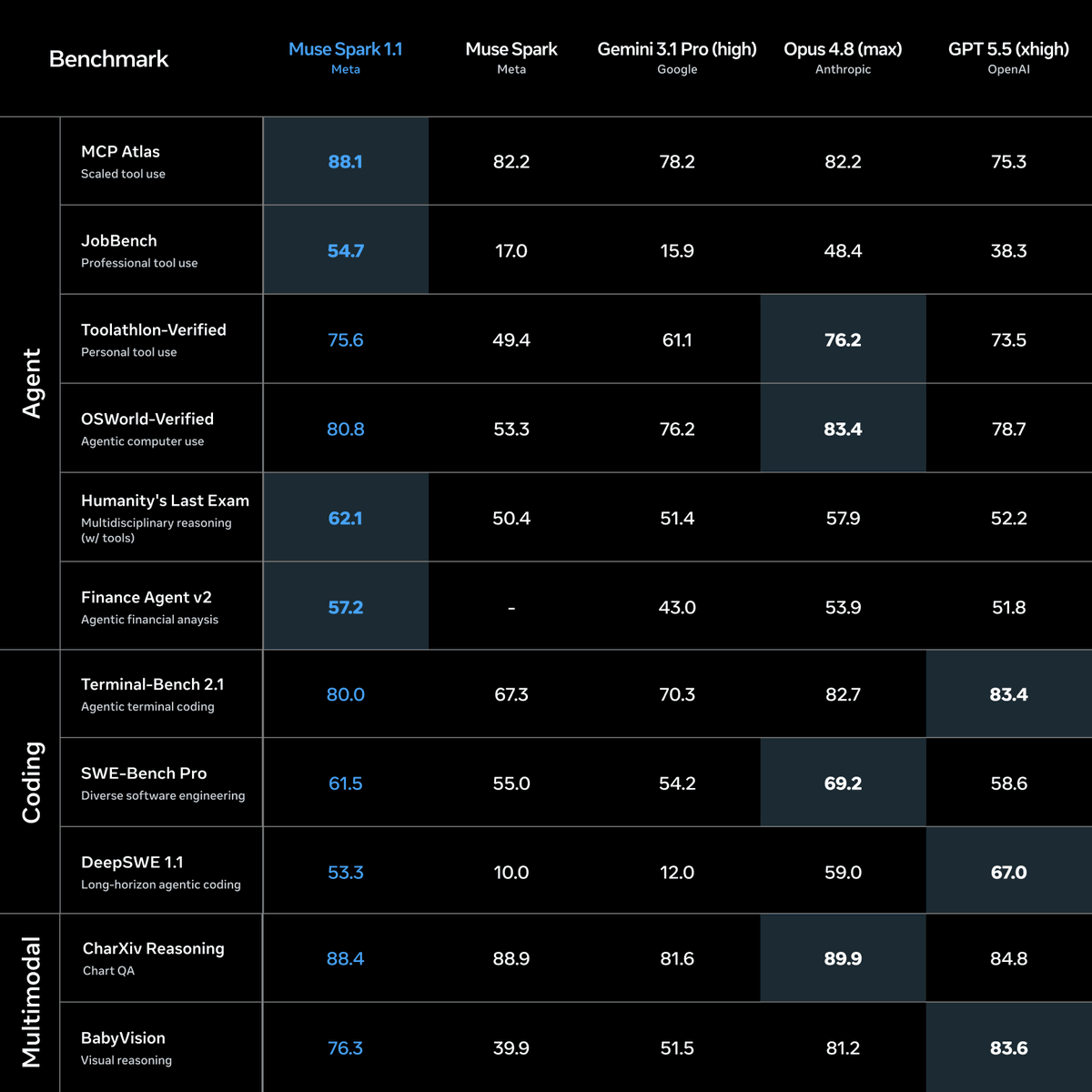
Meta's Muse Spark 1.1 is quietly becoming one of the biggest surprises in AI. Looking at these benchmarks, it's holding its own and even outperforming some of the strongest frontier models across several agent tasks. Didn't expect a wildcard entry like this, but it's definitely making the race a lot more interesting.
Sally Stockholm tweet media
English
75
34
252
14.8K
Sally Stockholm
Sally Stockholm@aiwithsally·
Wow, this is actually pretty impressive. What's interesting isn't just that Grok 4.5 is competitive, it's that xAI is clearly pushing beyond coding. The benchmarks shown here cover terminal workflows, multilingual software engineering, and agent-style reasoning, which is where AI is heading next. No single model dominates every benchmark, but seeing Grok 4.5 consistently in the top tier across different evaluations suggests it's becoming a serious all-round model rather than just another coding assistant.
Cursor@cursor_ai

We've partnered with SpaceXAI to train Grok 4.5. It’s our most powerful model yet and the first we've built for more than software engineering.
English
78
33
266
19.4K
Sally Stockholm
Sally Stockholm@aiwithsally·
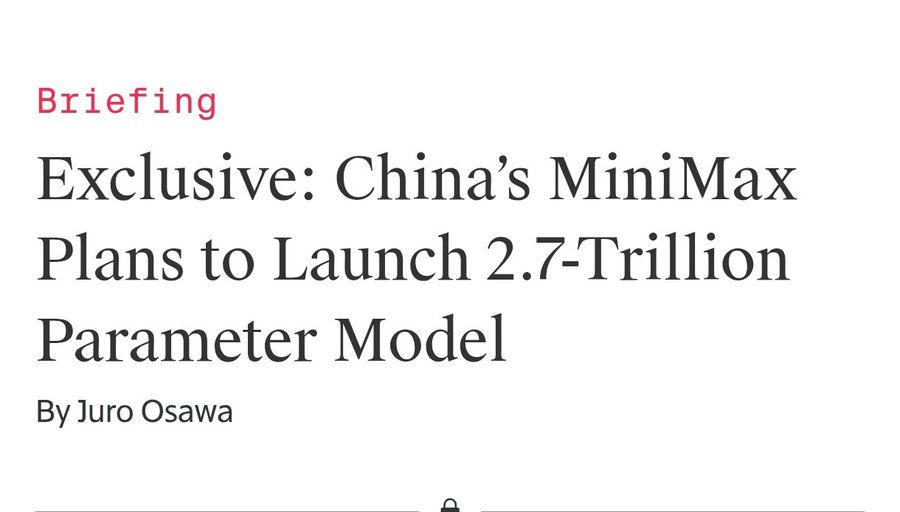
Just came across reports that MiniMax is preparing to launch a 2.7 trillion parameter open-source model, potentially as early as Q3. If that happens, it would be the largest Chinese AI model released so far and more than 6x bigger than MiniMax's current flagship model. What's interesting isn't just the parameter count it's that another major lab is choosing the open-source route. China is clearly doubling down on open models, and the pace of releases has been relentless this year. The AI race is no longer just about who has the smartest model. It's becoming a race over who can build the strongest open ecosystem around it.
Sally Stockholm tweet media
English
69
33
256
15.4K
Sally Stockholm
Sally Stockholm@aiwithsally·
Claude Cowork on mobile is actually a crazy update. Start a complex task on your desktop, close your laptop, and let Claude keep researching, reasoning, and building in the background. Pick it back up from your phone whenever you're ready. This is the direction AI is heading: less back-and-forth chatting, more autonomous workflows that keep moving even when you're away. On top of that, Anthropic also announced that Claude Fable 5 access for all paid plans until July 12, giving users more time with the model before it moves to a usage credit system. Time to Lock in with Fable!!!
English
76
34
271
16.7K
Sally Stockholm
Sally Stockholm@aiwithsally·
Claude Code didn't start as the powerful coding assistant we know today. It began as a simple command-line prototype built by Boris Cherny in 2024 as part of Anthropic's AI safety research. Over time, the team added features like terminal access, file search, code execution, and iterative editing, allowing Claude to handle real development workflows. Anthropic also shared how early users and developer feedback helped improve the product, with many of the initial launch issues later fixed through Claude Sonnet 4. The biggest takeaway: Boris believes the team is "only 1% done," showing that Claude Code is still in its early stages and there's much more to come.
Claude@claudeai

We've put together a short history of how Claude Code came to be, told by the people who built it and the early users who helped make it what it is today. anthropic.com/features/makin…

English
80
34
274
18.9K
Sally Stockholm
Sally Stockholm@aiwithsally·
I want to talk about something that I think doesn't get enough attention... Agentic AI. Everyone is busy arguing about which AI model is better. GPT or Claude. OpenAI or Anthropic. But I think we're looking at the wrong competition. The future isn't about using one model. It's about building agentic AI workflows. Instead of asking AI one question at a time, you'll simply give it a goal. It will research, plan, write code, use tools, test its own work, fix mistakes, and keep improving until the job is done. The biggest advantage won't come from having access to the smartest model. It'll come from knowing how to orchestrate multiple AI agents into a workflow that can solve real problems with minimal human input. That's the shift I'm paying attention to. The future isn't just smarter AI. It's AI that can actually get work done.
Sally Stockholm tweet media
English
91
33
280
19.3K
Sally Stockholm
Sally Stockholm@aiwithsally·
This is why Chinese AI models are expanding massively. They're not just chasing benchmark scores anymore they're playing an entirely different game: cost per task. If two models can deliver similar real-world performance, but one costs 5-10x less to run, the winner for developers and enterprises becomes obvious. Looking at this chart: DeepSeek V4 Pro Max: $0.04/task GLM-5.2 Max: $0.37/task GPT-5.5: $0.88/task The competition is shifting from "Who's smartest?" to "Who's smartest per dollar?" That's why we're seeing Chinese labs move so aggressively. Lower inference costs mean cheaper APIs, faster adoption, more experimentation, and products that can actually scale to millions of users without exploding infrastructure costs. The next AI race won't be won by benchmarks alone. It'll be won by the model that delivers the best balance of intelligence, speed, and economics. And right now, Chinese AI labs are making sure cost becomes one of their biggest competitive advantages.
Sally Stockholm tweet media
English
76
35
303
15.8K
Sally Stockholm
Sally Stockholm@aiwithsally·
Spent the weekend testing a bunch of new AI models, and one that genuinely caught me off guard was GLM 5.2. I went in with pretty average expectations, but it ended up being surprisingly capable across a lot of everyday tasks. What's exciting isn't just one model it's how competitive the AI race has become. Every lab is pushing the others to build better models, reduce costs, and ship improvements faster than ever. We're moving from "who has the best benchmark?" to "who delivers the best experience at the best price?" The pace of progress is insane, and users are the ones benefiting the most. Every few weeks there's another model that's worth trying. The competition is only getting started.
Sally Stockholm tweet media
English
81
36
304
16.8K
Sally Stockholm
Sally Stockholm@aiwithsally·
This is the kind of AI content I want to see more of. Not another benchmark debate. Not another "this model is 3% better" post. Show me how real teams are building agents. Show me the mistakes, the workflows, the deployment process, and what actually works in production. The people who win over the next few years won't just be using the best models they'll be the ones who learn how to use them best. Definitely worth watching if you're building in AI.
Codez@0xCodez

Anthropic just dropped 5 workshops, revealing the latest capabilities of Fable 5: • 00:00 - deep look into Fable 5 • 11:22 - Fable 5 and the capability curve • 30:54 - building managed agents with Fable 5 • 44:29 - real use cases of Fable 5 by teams • 57:43 - how to deploy agents with Fable 5 These 1-hour of sessions will replace 100 articles on how to actually use Fable 5. Watch them today, then read the best practices from the sessions in the article below.

English
90
34
313
19.8K
Sally Stockholm
Sally Stockholm@aiwithsally·
They've done it again. Fable 5 now consumes around 1.5–2.5× more tokens than Opus 4.8. In other words... It's basically a price increase. This makes model routing more important than ever. Not every task needs your most expensive model. Personally, I'm keeping Opus for coding and everyday work. Fable 5 is reserved for more complex reasoning, agentic workflows, and co-work sessions where the extra capability is worth the cost. Curious how everyone else is using it. What are you giving to Fable 5, and what stays on Opus?
English
92
36
322
17.6K