Andrew J. Bryant

201 posts

Andrew J. Bryant banner
Andrew J. Bryant

Andrew J. Bryant

@ajbryantlab

Physician-Scientist.

Gainesville, FL Katılım Ocak 2013
290 Takip Edilen171 Takipçiler
Andrew J. Bryant retweetledi
JCI insight
JCI insight@JCI_insight·
Parsing the STING in pulmonary hypertension— @ajbryantlab & team @UF report on opposing roles for STING in PH—a paradigm shifting mechanism suggesting we refocus on treatments that target cell-specific inflammatory activation: insight.jci.org/articles/view/…
JCI insight tweet media
English
0
3
13
7.8K
Andrew J. Bryant retweetledi
Raffaele Di Giacomo, PhD
The findings you highlight from the @ajbryantlab team about STING's varying roles are truly fascinating! They propose a crucial shift in how we approach inflammation-driven diseases like pulmonary hypertension. Focusing on the cell-specific activity could lead to more effective treatments. How might these insights change current therapeutic strategies? It's incredible to see science challenging our understanding of such complex mechanisms. For further exploration of biomedical questions, check out sciqst.com, your go-to platform for generating comprehensive biomedical reviews. #Medicine #PulmonaryHypertension
English
0
1
1
59
Andrew J. Bryant retweetledi
JCI insight
JCI insight@JCI_insight·
"Opposing roles for myeloid and smooth muscle cell STING in pulmonary hypertension" by @ajbryantlab & team insight.jci.org/articles/view/…
JCI insight tweet media
JCI insight@JCI_insight

Parsing the STING in pulmonary hypertension— @ajbryantlab & team @UF report on opposing roles for STING in PH—a paradigm shifting mechanism suggesting we refocus on treatments that target cell-specific inflammatory activation: insight.jci.org/articles/view/…

English
2
8
26
6.2K
Andrew J. Bryant
Andrew J. Bryant@ajbryantlab·
Ever wonder how smooth muscle and inflammatory cells act through a common mediator in causing pulmonary hypertension? STING may be the answer. JCI Insight - Opposing roles for myeloid and smooth muscle cell STING in pulmonary hypertension #top" target="_blank" rel="nofollow noopener">insight.jci.org/articles/view/…
English
0
2
8
609
Andrew J. Bryant
Andrew J. Bryant@ajbryantlab·
The common TMEM173 HAQ, AQ alleles rescue CD4 T cellpenia, restore T-regs, and prevent SAVI (N153S) inflammatory disease in mice; great work from our collaborator Lei Jin! elifesciences.org/reviewed-prepr…
English
0
0
1
101
Andrew J. Bryant retweetledi
ATVB: An AHA Journal
ATVB: An AHA Journal@atvbahajournals·
SEE YOU NEXT TIME!!
English
0
2
7
2.3K
Andrew J. Bryant
Andrew J. Bryant@ajbryantlab·
@atvbahajournals Based on our studies, no, cell-to-cell contact is not necessary, as it appears to be a paracrine or even autocrine effect. Uncertain about the mechanism, as of now, but appears to be intimately related to HIF-signaling. @joeydai thoughts?
English
1
1
4
115
Andrew J. Bryant retweetledi
ATVB: An AHA Journal
ATVB: An AHA Journal@atvbahajournals·
0⃣9⃣ @ajbryantlab The effect of STING KO on VEGF production from monocytes is interesting, how? Do monocytes need to be in contact with ECs?
ATVB: An AHA Journal tweet media
English
1
4
6
1.1K
Andrew J. Bryant
Andrew J. Bryant@ajbryantlab·
@atvbahajournals We are still exploring this, so forgive the “hand-waving” when I simply say regulation of cellular senescence pathway in innate immune cells. When we knock STING out of myeloid cells, it makes PD-L1 expression go up, for what that’s worth.
English
0
1
4
103
Andrew J. Bryant retweetledi
ATVB: An AHA Journal
ATVB: An AHA Journal@atvbahajournals·
0⃣8⃣ @ajbryantlab How do you think STING affects PDL-1 expression in hypoxia-induced PH?
ATVB: An AHA Journal tweet media
English
1
3
7
682
Zhiyu Dai | 戴智育, PhD, FAHA,ATSF
I can echo Andrew, we also did not observe exaggerated PH phenotype when sting is co-deleted with Egln1 in EC.
Andrew J. Bryant@ajbryantlab

@atvbahajournals STING is a conserved signaling protein, being the primary cell response to viral DNA. As such, all cells express it with innate immune cells being the most well studied. In follow-up to our data presented here, we found that endothelial cell deletion of STING had no phenotype.

English
3
1
5
711
ATVB: An AHA Journal
ATVB: An AHA Journal@atvbahajournals·
0⃣5⃣ @ajbryantlab What are the next research steps to understand STING's role in preventing right-heart failure in end-stage PH, and how might this inform new therapies? @Kanika0386
ATVB: An AHA Journal tweet media
English
1
2
4
539
Lin Deng
Lin Deng@dlljj·
@ajbryantlab @atvbahajournals Our paper should be out soon in Red journal. We just did global KO and H-151 treatment. Quite interesting why EC-specific KO have no phenotype.
English
1
0
1
19
ATVB: An AHA Journal
ATVB: An AHA Journal@atvbahajournals·
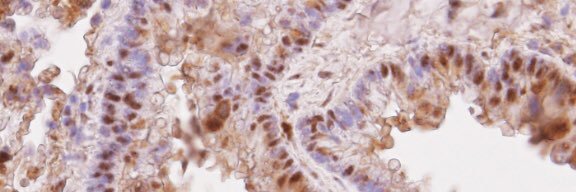
0⃣4⃣ @ajbryantlab Your finding of the high STING expression in the muscular arteries in patients with pulmonary hypertension is interesting, what the primary cells?
ATVB: An AHA Journal tweet media
English
2
2
6
2K
Andrew J. Bryant
Andrew J. Bryant@ajbryantlab·
@MaAlfaidi @atvbahajournals Absolutely, that could make a difference. Cell-to-cell communication is key. DNA is fundamentally supposed to be kept inside, right. If you saw a friend covered in blood (an inside fluid) it would alert you differently to potential danger versus if they simply waved hello.
English
0
1
1
54
Andrew J. Bryant retweetledi
ATVB: An AHA Journal
ATVB: An AHA Journal@atvbahajournals·
0⃣6⃣ @ajbryantlab Can you please expand on your animal model and why you chose that? Which stage of the disease it is mimicking?
ATVB: An AHA Journal tweet media
English
1
3
4
755
Andrew J. Bryant
Andrew J. Bryant@ajbryantlab·
@atvbahajournals @Kanika0386 I personally believe part of the answer lies in the functional allelic variance of STING across a broad patient population. We are looking in to this in a cursory fashion - more data to present soon!
English
1
2
2
108
Andrew J. Bryant
Andrew J. Bryant@ajbryantlab·
@atvbahajournals @Kanika0386 Fantastic point, and thank you. Truth is, we are not quite sure. Foreign and self-DNA recognition lie at the heart of these disorders, so almost certainly similar mechanisms, but cell and tissue tropism is odd for such an ubiquitous cellular response.
English
2
1
2
92
Andrew J. Bryant retweetledi
ATVB: An AHA Journal
ATVB: An AHA Journal@atvbahajournals·
0⃣7⃣ @ajbryantlab How does STING's function in PH compare to its roles in lung fibrosis, cancer, and autoimmune conditions? @Kanika0386
ATVB: An AHA Journal tweet media
English
1
4
5
634