Akshay Ram

437 posts

Akshay Ram banner
Akshay Ram

Akshay Ram

@akshay5995

Pet parent | Tech Lead

Bangkok, Thailand Katılım Şubat 2010
1.9K Takip Edilen243 Takipçiler
Akshay Ram retweetledi
Mario Zechner
Mario Zechner@badlogicgames·
Due to popular demand, you can now browse all my recommended reading/viewing suggestions here: mariozechner.at/recommended-re… Sadly, Space Karen's hard core engineered Twitter API is absolutey garbage, and I can only get tweets back to April. Will backfile with an export. Enjoy.
English

26
54
933
30.4K
Akshay Ram retweetledi
Ben Holmes
Ben Holmes@BHolmesDev·
You should use Codex differently than how you use Claude Code. I've found success with no plans and more involvement as an engineer. Here's a 1 min rundown of my process:
English
14
9
288
24.8K
Akshay Ram retweetledi
Yohei
Yohei@yoheinakajima·
great article, mostly focused on coding agents but applies elsewhere impo. aligns w a lot of my prior thoughts: - agents need scaffolding, not just smarter models - failures should become durable improvements - tools/functions should be small, reusable, and logged - execution environments matter - tests and deterministic checks are essential - memory should live outside the model - agent systems should improve through use
Addy Osmani@addyosmani

x.com/i/article/2050…

English
12
19
172
30.7K
Akshay Ram retweetledi
Mario Zechner
Mario Zechner@badlogicgames·
felt cute, did some @karpathy style cozy coding. now i can run GPT 2 124M in pure TypeScript at 7 tps. played with implementing the GEMV via C/WASM, but that only got me a 1.7x speed up.
English
9
6
182
29.2K
Akshay Ram retweetledi
sunil pai
sunil pai@threepointone·
didn't expect to get here, but 5.5 is just better than 4.7 now for me. faster, smarter, and doesn't try to do too much. I don't need xhigh or whatever, I prefer the shorter hops and letting me participate.
English
48
21
785
44.6K
Akshay Ram retweetledi
Zain Shah
Zain Shah@zan2434·
Imagine every pixel on your screen, streamed live directly from a model. No HTML, no layout engine, no code. Just exactly what you want to see. @eddiejiao_obj, @drewocarr and I built a prototype to see how this could actually work, and set out to make it real. We're calling it Flipbook. (1/5)
English
1.1K
3.7K
28.4K
5.9M
Akshay Ram retweetledi
Matt Pocock
Matt Pocock@mattpocockuk·
I just ran an AI coding course for ~2,000 people One massive piece of feedback was how dissatisfied people are with frameworks like BMAD, GSD, Spec-Kit Turns out that giving away control of context to a framework makes things a lot harder to debug My advice: own the process
English
92
30
659
49.4K
Akshay Ram
Akshay Ram@akshay5995·
The only good coding agents on mobile experience I’ve had is with @cursor_ai.
English
0
0
0
21
Akshay Ram retweetledi
Viv
Viv@Vtrivedy10·
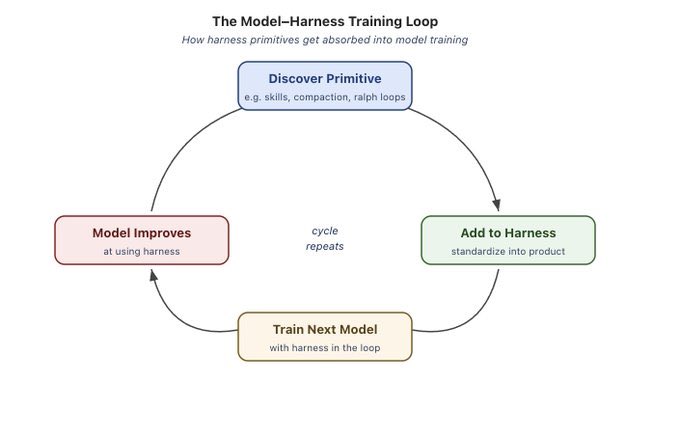
Harness Engineering Derived from what Models can’t do alone: It feels like a good time to step back and reshare some basic mental models for why harnesses exist in the first place - working backwards from The Model Why the Harness Exists: Harnesses exist to augment and shape models to do useful work for us. Models are fundamentally token input and output machines They cannot do useful things in the world without a harness. This is an important but under appreciated truth about the agentic systems we’re building The whole point of a harness is to extend the abilities of models to do useful work on our behalf Primitives the World Finds Useful Today: The diagrams below describe what capability we want and we work backwards from that capability to design a component of the harness. Filesystems, bash, compaction and Ralph Loops are all derived by working backwards from a goal to what a model can’t do today. We add those to the harness because they’re useful and help our agents more reliably complete work Model-Harness Training Loop: As we find incorporate a useful harness primitive into the model, model labs often directly train on that capability so the next version of the model is better at leveraging that tooling. This isn’t the end all be all, models are good at generalizing to other tools via in-context-learning. But this is a tried and true recipe we’ve seen repeat over the last 3 years and likely into the future. Different labs have different priors on useful harness capabilities. This is the entire reason they share prompting guides that differ dramatically down to their tool design. There’s harness mania happening right now which is cool to see as we’ve been investing in this for a while! :) It helps to step back and think about “why does this thing exist in the first place?”
Viv tweet mediaViv tweet media
English
12
45
339
19.6K
Akshay Ram retweetledi
Harrison Chase
Harrison Chase@hwchase17·
most of the agents we see being built do this the main cases where we see people using "agent in a sandbox" is when they are using claude agent sdk (which is poorly designed for "harness outside sandbox")
Nasir Shadravan@n4Cr

@hwchase17 Do you also move the harness it outside the sandbox like managed agents?

English
7
4
39
8.6K
Akshay Ram
Akshay Ram@akshay5995·
README.md CLAUDE.md AGENTS.md SKILLS.md … Can’t wait for IDEA.md standard
Andrej Karpathy@karpathy

Wow, this tweet went very viral! I wanted share a possibly slightly improved version of the tweet in an "idea file". The idea of the idea file is that in this era of LLM agents, there is less of a point/need of sharing the specific code/app, you just share the idea, then the other person's agent customizes & builds it for your specific needs. So here's the idea in a gist format: gist.github.com/karpathy/442a6… You can give this to your agent and it can build you your own LLM wiki and guide you on how to use it etc. It's intentionally kept a little bit abstract/vague because there are so many directions to take this in. And ofc, people can adjust the idea or contribute their own in the Discussion which is cool.

English
0
0
4
215
Akshay Ram retweetledi
Viv
Viv@Vtrivedy10·
ok hot take, who (dis)agrees? The general purpose agent/harness doesn’t exist the best harnesses are deeply Task specific and when we use a “default harness” out-of-the-box, we’re just making a tradeoff between - acceptable task performance - time+money spent designing around our task(s) that’s a totally fair tradeoff to make, maybe we’re happy with the out of box perf! what we call a “general purpose” harness is just one that’s reasonably good at a relatively large portion of tasks but there’s a reason why teams that want top 1% agent performance obsessively tweak the harness per Task+Model it’s because you can squeeze out a lot by building bespoke harness tooling for a Task. For a high value task, it’s totally worth the investment Your entire company might be predicated on that investment this effect is pretty clear when we try to swap models “models are non-fungible in their harness” - so the suck if we just drop in codex into the Claude Code harness but if you use the models together in a joint harness and design around the specific problem, you can get great perf I’ve mentioned before but i think the most exciting future is just-in-time harness creation per task idk if that’s a very popular take vs “one model will do everything” but it’s a current mental model and exciting thing i’m messing around with
Viv tweet media
English
33
29
278
70.3K