Alex Carrasco Martinez

83 posts

Alex Carrasco Martinez

Alex Carrasco Martinez

@alexcarrascom

🇵🇪 Ph.D. Student at @MITEcon. Economist (PUC-Rio, UNFV).

Cambridge, MA Katılım Ekim 2019
291 Takip Edilen312 Takipçiler
Alex Carrasco Martinez retweetledi

Waldo Mendoza Bellido
Waldo Mendoza Bellido@WaldoMendozaB·
Acaba de salir la tercera edición de "Cómo Investigan Los Economistas". Está edición la hice con mi hijo Liu. Lo hicimos con mucho esmero para los estudiantes y profesores que necesiten hacer una investigación en el campo de la Economía. Gracias PUCP. fondoeditorial.pucp.edu.pe/economia/163-c…
Español
8
87
318
12.9K
Alex Carrasco Martinez retweetledi
Jesús Fernández-Villaverde
Jesús Fernández-Villaverde@JesusFerna7026·
As promised: sequencing risk in retirement. If you have not read my post from yesterday, the summary is that the order in which returns arrive during your working life matters substantially for the wealth you accumulate, and no strategy can avoid this without incurring substantial costs in the form of missed returns. Today, I show that the problem is even worse once you stop working. During accumulation, early losses are recoverable: your portfolio is small, and future contributions have decades to compound. Late losses are devastating because they hit a large portfolio with no contributions left. In retirement, the logic reverses. Early losses are now the killer because you are withdrawing. If the market crashes in your first years of retirement, you must sell assets at depressed prices. Those assets will never participate in the recovery. This is the “reverse dollar-cost averaging” problem. When you are accumulating, volatility is your friend: your contributions buy more shares when prices are low. In retirement, volatility is your enemy: your withdrawals sell more shares when prices are low. Let me make this concrete by examining a worker who retires at age 68 with $1 million in accumulated assets. Note that the world is Markovian: which strategy led to $1 million (e.g., all equities, a glide path, winning the lottery the day before you retire, Uncle Jaime has passed away, you were the only heir, and his businesses in Argentina turned out to be a gold mine) is no longer relevant. Additionally, your portfolio is Markovian: if you hold a lot of equity trading at low prices, it is equivalent to owning zero equity. You can always sell your bonds and buy equity (yes, there are tax consequences, but they are country-specific and, if you are smart, you can get around most of them by trading in your retirement account). A trivial point that many of yesterday’s comments missed. Now they need to draw it down. The standard advice is the well-known 4% rule, popularized by William Bengen: withdraw $40,000 in the first year and adjust for inflation in subsequent years. The 4% is what the literature calls the safe withdrawal rate (SWR), the highest percentage of your initial capital you can withdraw annually, in real terms, without running out of money over a given horizon. Historically, a 4% SWR has been sustainable over 30 years with high probability. But the 4% rule is an average statement. It indicates that, across all historical 30-year windows, a 4% withdrawal rate has typically worked. It says nothing about your specific 30-year window. Consider two retirees. Retiree A retires at the start of a period with strong early returns. After year one, the market is up 20%. Their portfolio increased from $1 million to $1.2 million, excluding the $40,000 withdrawal, leaving $1.16 million. The withdrawal was a small fraction of a growing portfolio. The remaining $1.16 million has decades to compound. Retiree B retires at the start of a period with poor early returns. After year one, the market is down 20%. Their portfolio declined to $800,000, minus a $40,000 withdrawal, leaving $760,000. The withdrawal was a much larger fraction of a shrinking portfolio. And that $760,000 now needs to generate all future returns and fund all future withdrawals. Retiree A and Retiree B might experience the exact same average return over their 30-year retirement. But Retiree B is in trouble. Early losses, combined with withdrawals, create a vicious spiral: the portfolio shrinks; each subsequent withdrawal represents a larger percentage of remaining assets; the portfolio shrinks faster; and the next withdrawal does even more damage. This is not a marginal effect. Consider a retiree who began drawing down in 1966. Over the next decade, they faced the 1966 downturn, the 1969-70 recession, and the catastrophic 1973-74 bear market, during which stocks lost more than 40% in real terms. Each year, they were withdrawing from a shrinking portfolio. By the time the market recovered in the late 1970s and 1980s, their portfolio had been so depleted that the recovery could not save them. Now contrast this with a retiree who started drawing down in 1982. They caught the beginning of one of the greatest bull markets in history. Even after the 1987 crash and the 2000-02 dotcom bust, they were fine: the early gains had built such a large buffer that subsequent losses could not seriously threaten their retirement income. Same withdrawal rule. Same index. Same 30-year horizon. Radically different outcomes. Let me make this point more systematically. I use the same data as in the first post: actual annual real total returns on the S&P 500 (including reinvested dividends) and 10-year U.S. Treasury yields from 1945 to 2024, deflated by the BLS CPI-U. The only difference is that I now run the clock forward from retirement rather than backward from it. I took 34 cohorts of retirees, one for each year from 1991 to 2024. Each retires with $1 million and follows the textbook 4% rule: withdraw $40,000 per year in constant real terms, regardless of market conditions. The portfolio is allocated 20% to the S&P 500 and 80% to 10-year U.S. Treasuries, with annual rebalancing, a standard conservative retirement allocation. For the years I have data (through 2024), each cohort experiences the actual historical real returns that occurred during their retirement. However, most of these cohorts have not yet retired long enough to determine whether they will run out of money. For years beyond 2024, I use a block bootstrap: I randomly draw 5-year blocks of actual returns from the full 1945-2024 historical sample and stitch them together. Five-year blocks preserve the tendency of bad years to cluster, which matters because isolated bad years are much less dangerous than sequences of them. I then run each cohort forward until it either exhausts its funds or reaches 2075, whichever occurs first. The results are shown in the figure. Each line represents a cohort, colored by retirement year: dark blue for the early 1990s, through red for the 2020s. The dashed vertical line marks 2024, the boundary between observed data and the bootstrap simulation. Everything to the left of that line occurred. Everything to the right is one plausible future drawn from the historical record. 32 of 34 cohorts run out of money before 2075. The fastest to go broke is the 1999 cohort: they retired straight into the dot-com crash, never recovered, and are depleted by 2040. The cluster of cohorts retiring between 1998 and 2005 all reached zero between 2040 and 2051, because they shared the same devastating opening act: the dotcom bust followed by the 2008 financial crisis. Only two cohorts survive: 1991 and 1995. Both caught the extraordinary bull market of the 1990s in their critical early years, building a buffer large enough to absorb subsequent downturns (2000, 2008, 2022). Even so, the 1995 cohort is barely hanging on with $96,000 by 2075. The message is stark. With a conservative 20/80 portfolio and a fixed 4% withdrawal rate, the bond-heavy allocation does not generate sufficient real return to sustain withdrawals over a 50-year horizon for most cohorts. The only survivors are those who got lucky in their first decade. There are dozens of variations of this basic experiment you can run: different withdrawal rates, different stock-bond splits, different bootstrap methods, different starting capitals, and longer or shorter horizons. I have run thousands of them. They all give you essentially the same answer. You can raise the SWR to 5% and shorten the horizon to 25 years, which is more realistic for someone retiring at 68. The depletion dates move around. The core result does not change. This is why I am skeptical of the 4% rule as commonly presented. It is not that 4% is wrong as a rough guideline. It is that it obscures the enormous variance around that average. A retiree who happens to retire into a bear market faces a fundamentally different problem than one who retires into a bull market. The standard advice to mitigate this is the same glide path logic applied in reverse: hold more bonds in early retirement to cushion against a crash in those critical first years. But as I argued in the previous post, bonds are not risk-free. The retiree who shifted into bonds in the early 1970s was hit by inflation. The one who shifted into bonds in 2022 was hit by rising rates. The cushion is unreliable precisely when you need it most. There are partial remedies. Variable withdrawal strategies, in which you reduce spending after bad years and increase it after good years, are particularly effective. If you can cut your withdrawals by 10-20% after a market crash, you can dramatically reduce the damage from selling at the bottom. But this requires flexibility in retirement spending that not everyone has. Another approach is to maintain a cash buffer (two years of withdrawals in very short-term instruments) so that you never have to sell equities during a crash. You live off the buffer while the market recovers and replenish it during good years. This is simple and effective. The cost is the drag of holding two years of spending in low-return assets, but relative to the risk it mitigates, it might be a price well worth paying. Annuities get too much of a bad rap in my opinion. A life annuity is the only product that truly eliminates sequencing risk in retirement: you hand over a lump sum and get a guaranteed income stream no matter what markets do. The insurance company bears the investment risk, not you (though the company could go bankrupt, and you may not live in a country where the government backstops that). But the downsides are real too: you give up the upside, you lose liquidity, the annuity may not be indexed to inflation, and if you die early, the insurance company keeps the money. If there is one practical takeaway from these two posts, it is that, no matter how hard you try to design your investment strategy (and I have tried many), you cannot avoid most of the sequencing risk without incurring substantial losses in excess returns. Finally, you can gain substantial benefits from a flexible retirement age. I will discuss this point when I have time.
Jesús Fernández-Villaverde tweet media
English
48
68
467
60.2K
Alex Carrasco Martinez retweetledi
Jesús Fernández-Villaverde
Jesús Fernández-Villaverde@JesusFerna7026·
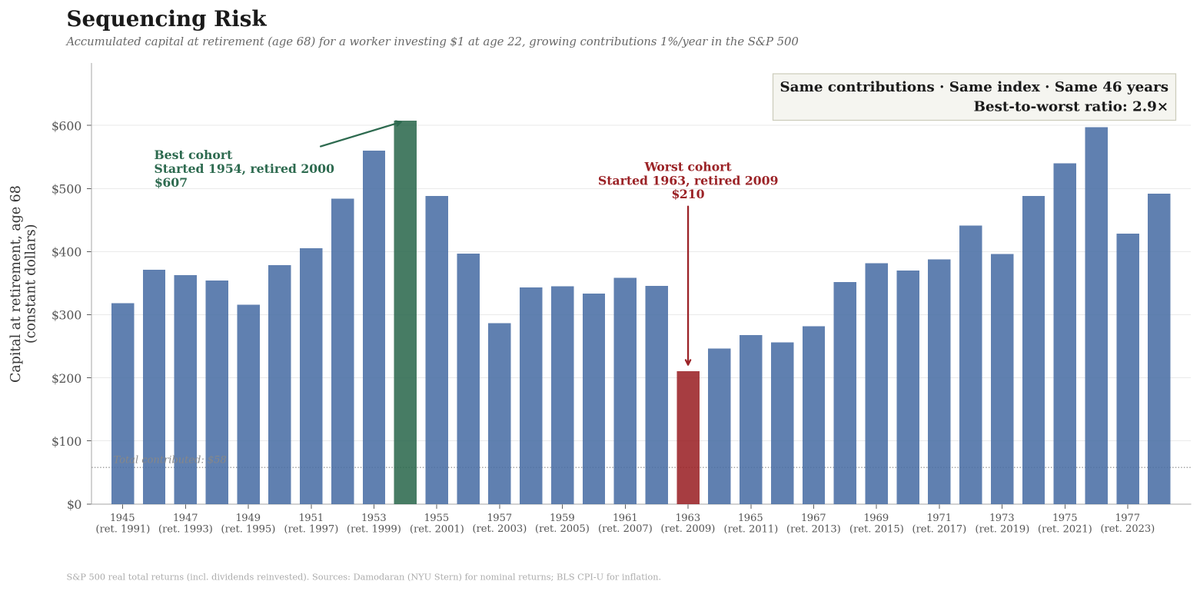
I am always amazed that most people saving for retirement (or designing optimal Social Security systems) rarely take sequencing risk seriously. Simply put, sequencing risk is the risk associated with the order in which returns arrive over one’s lifetime. Sequencing risk hits you twice: while you are working and accumulating wealth, and again while you are retired and drawing it down. Today, I will focus on the first part. The retirement phase warrants its own discussion, and I will address it in a subsequent post. Let me walk you through an exercise I ran yesterday using actual historical U.S. stock market data from the past 80 years to illustrate how important sequencing risk is. I took the annual total returns of the S&P 500 (including reinvested dividends) from 1945 to 2024. The source is the dataset maintained by Aswath Damodaran at NYU Stern, a standard reference for long-run U.S. equity returns. I then deflated each year’s nominal return by the CPI-U inflation rate published by the Bureau of Labor Statistics to obtain real total returns, i.e., returns in constant purchasing power. Over this 80-year period, the S&P 500 delivered a geometric mean real total return of about 7.5% per year. That is an impressive number. But this average return masks a lot. Imagine a worker who starts investing at age 22 and retires at age 68. That gives them 46 years of contributions. In their first year, they contribute $1. Each subsequent year, they increase their contribution by 1% (roughly keeping pace with real wage growth). Every dollar is invested in the S&P 500. They never touch the money until retirement. No panic selling, no market timing, no strategy switching (and no management fees!). Textbook investing and waiting. I ran this exercise for every possible cohort for which the data allow. The first cohort starts investing in 1945 and retires in 1991. The second starts in 1946 and retires in 1992. And so on, all the way to the last cohort, which starts in 1978 and retires in 2024. This yields 34 cohorts, each investing for 46 years, making the same contributions and investing in the same index. The only difference among them is which 46-year slice of historical returns they happen to live through. The most fortunate cohort, the one that started investing in 1954 and retired in 2000, had $607 on the day of retirement (remember, all in real terms), with a real annual return of 8.82%. The unluckiest cohort, the one that started in 1963 and retired in 2009, accumulated $210, with a real annual return of 4.83%. Same contributions. Same index. Same strategy. Same investment horizon. Yet the luckiest retiree ended up with 2.9 times more wealth than the unluckiest. Why? The 1954 cohort had a spectacular final decade. The late 1990s delivered some of the best equity returns in American history, and those returns compounded on a large portfolio built over decades. They retired at the peak, at the end of 1999, before the dot-com crash. The 1963 cohort was not so fortunate. They spent their last working years running straight into the 2008 financial crisis. The S&P 500 lost over 36% in real terms in 2008 alone. That loss hit their portfolio when it was at its largest, right before retirement, with no time left to recover. Clearly, sequencing risk is not about the average return. Both the 1954 and 1963 cohorts experienced roughly similar average returns over their 46-year periods. The difference is when the good and bad years occurred. For the 1954 cohort, the bad years came early (when the portfolio was small) and the good years came late (when the portfolio was large). For the 1963 cohort, the opposite was true. In fact, sequencing risk is even worse because poor returns in the stock market are correlated with weak labor markets: you have a much higher probability of losing your job (or seeing your wage income fall) precisely when the market is doing poorly, preventing you from saving when prices are low and equities are most attractive. However, let me set that point aside today to simplify the exposition. The standard response of the financial planning industry to sequencing risk is the so-called glide path. The idea is simple: when you are young, you hold mostly equities. As you age, you gradually shift toward bonds. By the time you are near retirement, most of your portfolio is in bonds. A common implementation is a linear rule: start with 90% in stocks at age 22 and reduce the equity share steadily until you reach 20% in stocks at age 68. This is roughly what target-date retirement funds do. The logic is sound in principle. You reduce your exposure to equities precisely when a crash would hurt you most. If 2008 happens when you are 65 and 80% of your portfolio is in bonds, the equity crash barely affects you. I applied this glide path strategy to the same 34 cohorts, using historical real returns on the S&P 500 for the equity portion and real returns on 10-year U.S. Treasury bonds (from Damodaran) for the bond portion. Each year, the portfolio is rebalanced to the glide path weights. The glide path does what it is intended to do: it reduces dispersion. The gap between the best and worst cohorts narrows from 2.9x under pure equities ($607 vs. $210) to 1.6x under the glide path ($292 vs. $178), but so does the upside. The best equity cohort (1954–2000) earned a geometric mean real return of 8.82% per year. The best glide path cohort (1975–2021) earned 6.59%. That is a 2.2 percentage point gap. Over 46 years of compounding, a 2.2 percentage-point annual yield yields an enormous difference in terminal wealth: the best glide-path outcome ($292) is less than half the best equity outcome ($607). In other words, the cost of this insurance is substantial. In fact, the median cohort ends up meaningfully poorer under the glide path than under 100% equities. You are not trimming a bit of upside. You are forgoing a substantial share of your expected wealth at retirement. This should not be surprising. Over the long run, equities have outperformed bonds by a wide margin. The equity risk premium is one of the most robust facts in finance. Every year you shift a dollar from stocks to bonds, you accept a lower expected return. Do this for 25 years of your career (roughly the back half, when the glide path has you increasingly in bonds), and the cumulative cost from foregone compounding is very large. But the part that makes me most uncomfortable with the standard glide path advice is that bonds are not safe. People hear “bonds” and think “safe.” They are not. Bonds carry two risks that are easy to forget when inflation is low and interest rates are stable. The first is inflation risk. A conventional bond pays you a fixed nominal coupon (yes, there are TIPS and similar instruments, but they have their own problems, so let me skip them for today). If inflation rises above the market’s expectations when the bond was issued, the real value of those payments declines. The cohorts that retired through the 1970s learned this the hard way. In the data, the real return on 10-year Treasuries was negative in multiple years during the 1970s. The second is interest rate risk. When interest rates rise, the market value of existing bonds declines. The longer the maturity of your bond, the larger the hit. In 2022, the Bloomberg U.S. Aggregate Bond Index declined by approximately 19% in real terms. If you were 65 and had just shifted most of your portfolio into bonds following the standard glide path advice, you would have lost nearly a fifth of your “safe” allocation in a single year. And here is the real sting of 2022: equities fell, too. The S&P 500 lost about 24.5% in real terms that year. The glide path assumes bonds will be there to cushion you when stocks fall. In 2022, both fell together. The cushion was not there. This is not some once-in-a-century event. Stocks and bonds have moved in the same direction before: the 1940s, the 1970s, and in 2022. The negative correlation between stocks and bonds that many investors take for granted is a feature of the disinflationary period from roughly 1982 to 2020. It is not a law of nature. Let me be clear: I am not saying the glide path is wrong. For many people, it is the right choice. If a 30% equity crash near retirement would force you to sell assets at the worst possible time to cover living expenses, the insurance is worth paying for. However, you should know what you are paying. The glide path (or variations of it that I am skipping in the interest of space) is not free. It entails substantial costs in expected returns. Worse, the insurance itself can fail. Bonds can lose money in real terms for extended periods. Bonds can fall at the same time as equities. The glide path reduces sequencing risk. It does not eliminate it. It also introduces risks of its own. The deeper lesson from this exercise is that a substantial part of your retirement outcome depends on when you are born. You can do everything right (save diligently from your first paycheck, invest consistently, stay the course through every crash, never panic sell) and still end up with vastly different results than someone who did the same thing a decade earlier or later. The 1963 cohort did nothing wrong. They just had the misfortune of turning 68 in 2009. No allocation strategy eliminates this. Even under the glide path, the best cohort ends up with substantially more than the worst. Sequencing risk is, to a significant extent, a matter of luck. Next time: what happens when sequencing risk hits you in retirement, when you are drawing down instead of building up. The math there is, if anything, even more unforgiving.
Jesús Fernández-Villaverde tweet media
English
96
183
1.1K
199.2K
Alex Carrasco Martinez retweetledi
Jesús Fernández-Villaverde
Jesús Fernández-Villaverde@JesusFerna7026·
Contrariamente a lo que se afirma insensatamente con frecuencia, un sistema público de pensiones contributivas de reparto no es una estafa piramidal. Todo sistema de reparto se caracteriza por una tasa interna de retorno (TIR), que es la tasa de descuento que iguala, en valor presente, las cotizaciones de los trabajadores con las prestaciones que reciben (todas las cifras de este post están en términos reales, es decir, ya descontada la inflación). Esta TIR puede ser la media del sistema (para todos los trabajadores) o individual (en la que se emplea el valor actuarial esperado, que considera las posibilidades de supervivencia). Aunque un sistema de reparto no capitaliza las cotizaciones, esta TIR es un valor contable fundamental para determinar la sostenibilidad del sistema. Un sistema es sostenible si la TIR es igual al crecimiento de los ingresos del sistema, que, a largo plazo, es aproximadamente igual al crecimiento del PIB (factores como un cambio en la participación de los salarios en la renta nacional no cambian la TIR sostenible a largo plazo; solo generan transiciones temporales). El problema del sistema público de pensiones en España es, por tanto, que su TIR es excesivamente alta: es de aproximadamente 5,7% anual, frente a un crecimiento medio del PIB desde 1990 del 2,1%. Esta diferencia de 3,6% es la que hace que la pensión media en España tenga hoy un valor entre un 45% y un 60% por encima de lo que las cotizaciones de la persona que la recibe justificarían. Cuando los pensionistas dicen que “solo estoy recibiendo lo que pagué con mis cotizaciones”, se equivocan: están recibiendo entre un 45% y un 60% más. Por supuesto, se puede argumentar que un sistema de pensiones no tiene por qué ser contributivo y que la TIR del sistema puede estar por encima de la TIR sostenible. Pero eso implica querer distribuir por edad, no por renta, riqueza o necesidad familiar y, personalmente, no creo que tenga sentido alguno en un Estado del bienestar. Pero lo importante para nosotros es que, siempre que la TIR del sistema sea coherente con el crecimiento conjunto de la población y de las cotizaciones, el sistema puede ser sostenible de manera indefinida, algo que, por definición, no ocurre en los esquemas de Ponzi o en estafas piramidales, que terminan quebrando. El argumento según el cual el sistema solo se sostiene gracias a la llegada de nuevas generaciones y que, por tanto, sería un esquema de Ponzi, es esencialmente vacío. Un sistema de capitalización también requiere que las inversiones de sus partícipes generen rendimientos positivos a lo largo del tiempo. Pero esos rendimientos solo son posibles si la economía incorpora nuevos trabajadores que mantienen la actividad productiva y hacen viables los beneficios empresariales y los retornos del capital. En un escenario extremo de desaparición total de las nuevas generaciones, ni un sistema de reparto ni un sistema de capitalización podrían funcionar, sencillamente porque no habría trabajadores que produjesen bienes y servicios (esto no quiere decir, claro, que no fuera buena idea contar con un pilar de capitalización en el sistema). Sería lo mismo que afirmar que las facultades de educación son una estafa piramidal porque necesitan de nuevos niños a quienes sus graduados enseñen como profesores El debate sobre la sostenibilidad de las pensiones en España es crucial para nuestro futuro, y tan irresponsables y frívolos son los que argumentan que no hay problema alguno y que las pensiones son sostenibles, como los que califican el sistema de reparto de pensiones de estafa piramidal. En ambos casos tenemos la combinación nefasta de ignorancia y demagogia: decir lo que sea para alcanzar los objetivos políticos personales de cada uno. La historia juzgará con dureza a todos estos personajes que se escudan detrás de la bandera del progresismo o de España para mentir a los españoles y poner en peligro a las generaciones futuras, a cambio de asegurarse un plato de lentejas que su pésima carrera profesional no les permite. Y no, mentir o exagerar nunca es una buena idea “para llegar al gran público”. De la mentira y la demagogia, nunca ha surgido nada bueno.
Jesús Fernández-Villaverde tweet media
Español
95
274
908
105.4K
Alex Carrasco Martinez retweetledi
Jesús Fernández-Villaverde
Jesús Fernández-Villaverde@JesusFerna7026·
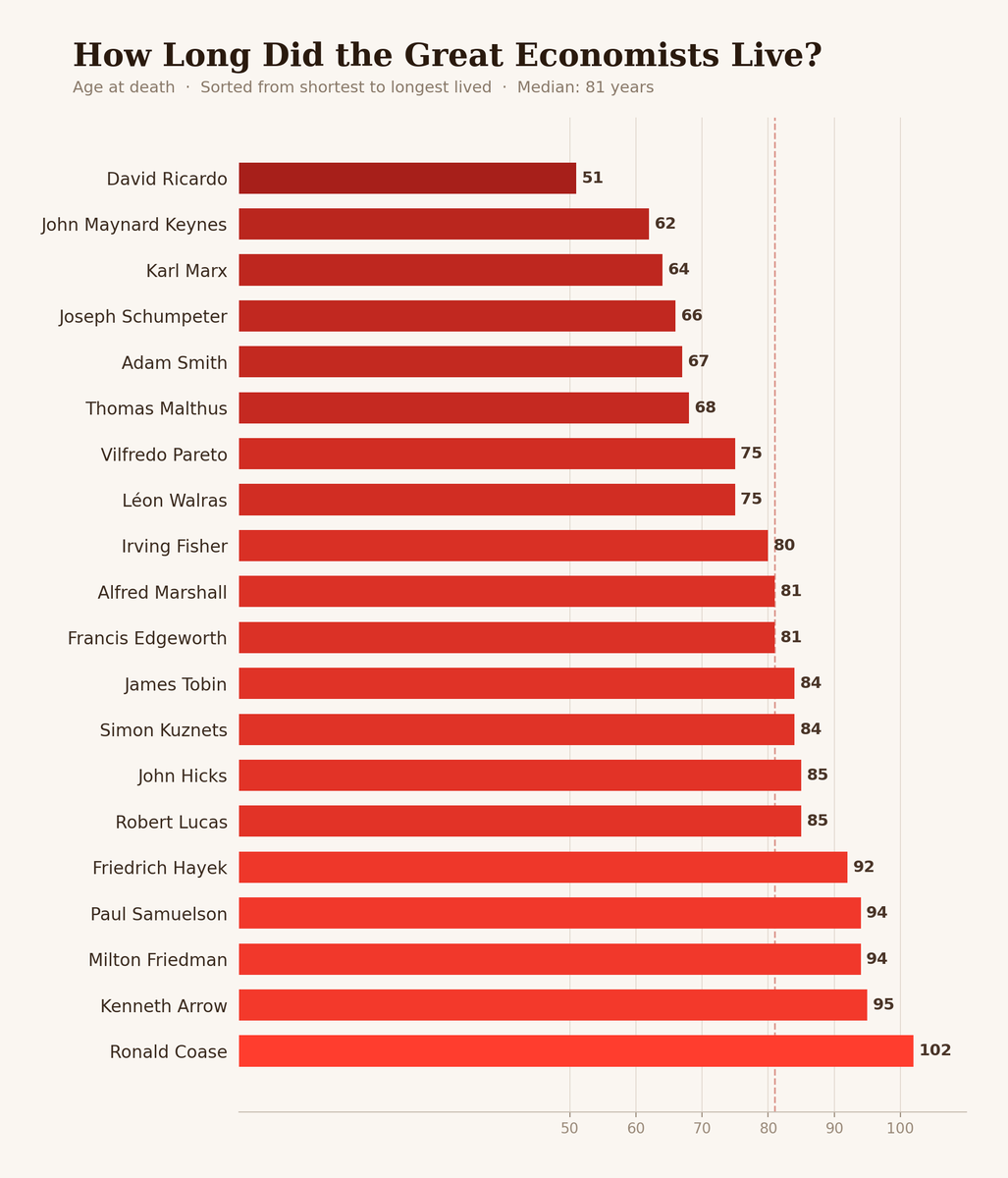
I have been working on how to explain the major changes in life cycles that increased life expectancy entails. A simple exercise I find useful is to list the top 20 economists of all time (my subjective list) and plot their ages at death; see the figure. The difference between David Ricardo (51 years old at death) and Ronald Coase (102) is striking. To put a number on this, I regress age at death on year of birth. The R² is surprisingly high (0.521) for such a crude regression. The slope implies approximately one additional year of life for every six years by which an economist is born later. This is close to the historical rule of thumb I explain to undergrads: life expectancy has risen by about one year every four years (I joke that, if they survive my 80-minute lecture on life expectancy, which so far all of them have, they have only lost 60 minutes of life because their life expectancy has gone up by 20 minutes). Selection bias likely explains most of the difference: you need to reach your forties to become a prominent economist, and much of the rise in life expectancy during the 19th and 20th centuries came from fewer deaths in infancy and childhood. Therefore, among today’s top economists, we should expect many to reach their 90s and nearly all to reach their 80s, especially since smoking and other unhealthy habits are uncommon in the profession.
Jesús Fernández-Villaverde tweet media
English
8
26
187
59.5K
Alex Carrasco Martinez retweetledi
Basil Halperin
Basil Halperin@BasilHalperin·
Some teaching principles: basilhalperin.com/essays/teachin… 0. Have extreme empathy. 1. Grading should be predictable. 2. Enthusiasm matters! Show that you care – channel your enjoyment! 3. Actively solicit feedback. ...
Basil Halperin tweet media
English
3
10
44
7.7K
Alex Carrasco Martinez retweetledi
Jesús Fernández-Villaverde
Jesús Fernández-Villaverde@JesusFerna7026·
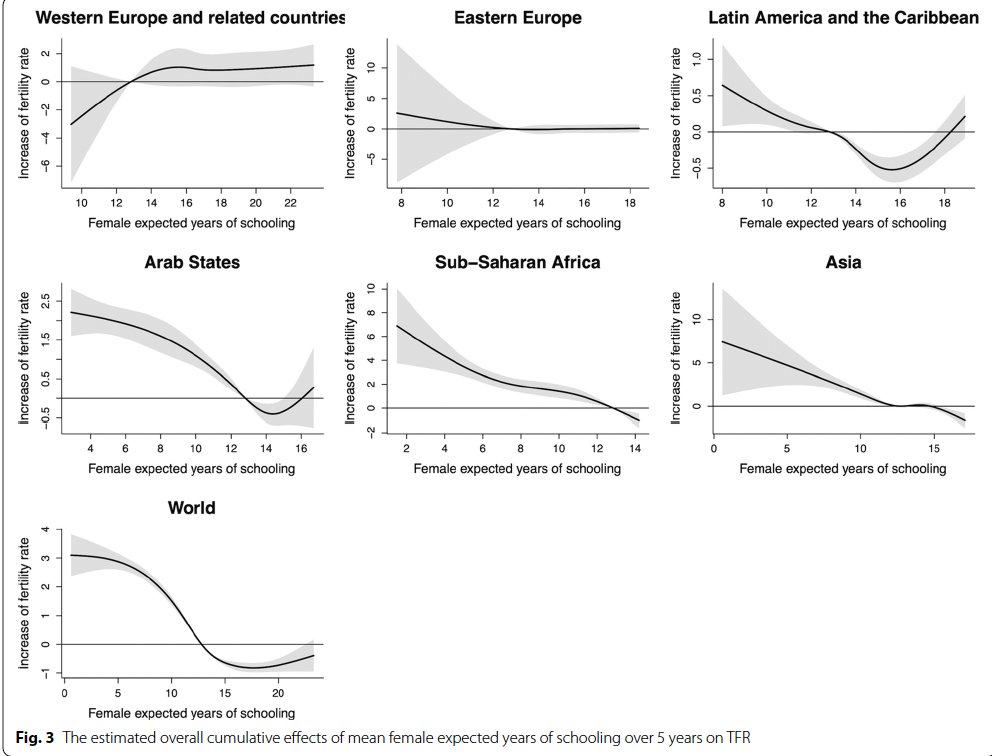
This figure comes from a recent paper by Cheng et al. link.springer.com/content/pdf/10… that correlates several statistical measures of income, social outcomes, and related variables with total fertility rates (TFR). The figure shows the relationship between the estimated overall cumulative effects of the mean female expected years of schooling over 5 years on TFR across regions. Right off the bat, let’s recall that this is a relation, not a causality statement. It does not say that education causes higher or lower TFR; it only states that education and TFR move together. For example, the causality arrow could move in the opposite direction: because teenage pregnancies are rarer now, thanks to easier access to contraception, more women can continue their studies. Nonetheless, we see two patterns in the figure. One for Western countries with a positive slope and one for the rest of the world with a negative slope. There are two interpretations of this difference. Interpretation one is that Western countries are “different” from the rest for unspecified reasons. Interpretation two is that Western countries are the “future of the rest”: that, as the “package of modernity” arrives in a country, education and fertility start moving together in a positive way. If you break down the other regions of the world, which are quite coarse, into subgroups, you see a pattern closer to that of the Western countries in those more advanced subareas. Increasingly, in rich economies, having kids is becoming the ultimate status symbol: one of the few things that one cannot “imitate” with a cheap substitute in Ikea or on social media. The social consequences of such change will be quite significant. And my hypothesis is that the rest will follow the West. After all, Horace already taught us that mutato nomine de te fabula narratur.
Jesús Fernández-Villaverde tweet media
English
19
40
243
42.5K
Alex Carrasco Martinez retweetledi
Dejanir Silva
Dejanir Silva@SilvaDejanir·
If you want to learn more about Machine Learning for Computational Economics, I’m teaching a course on the topic, building on my RFS work. 📘 Lecture notes + Julia implementations: 👉 dejanirsilva.github.io/mlce/
GIF
English
2
56
205
25.4K
Alex Carrasco Martinez retweetledi
Stefanie Stantcheva
Stefanie Stantcheva@S_Stantcheva·
What an extraordinary honor to receive the 2025 John Bates Clark Medal from the @AEAInformation yesterday at #ASSA2026 & be able to express my gratitude for the generosity of so many who embody the positive-sum spirit. I hope to keep contributing to this community I admire deeply
Stefanie Stantcheva tweet media
English
106
126
1.7K
114K
Alex Carrasco Martinez retweetledi
NBER
NBER@nberpubs·
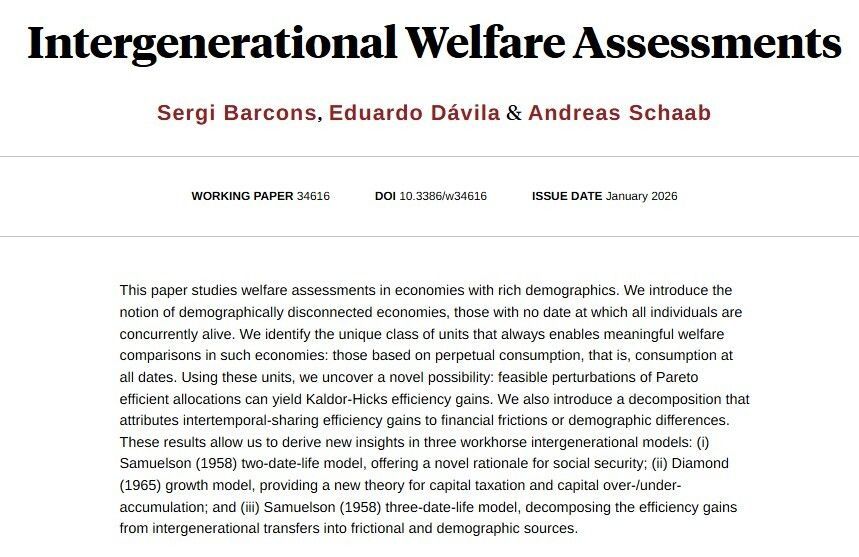
Welfare economics with multiple generations is fundamentally different. This paper shows why demographics create scope for intervention even when equilibria are Pareto efficient, from Sergi Barcons, Eduardo Dávila, and Andreas Schaab nber.org/papers/w34616
NBER tweet media
English
0
17
49
4.8K
Alex Carrasco Martinez retweetledi
Emil Verner
Emil Verner@EmilVerner·
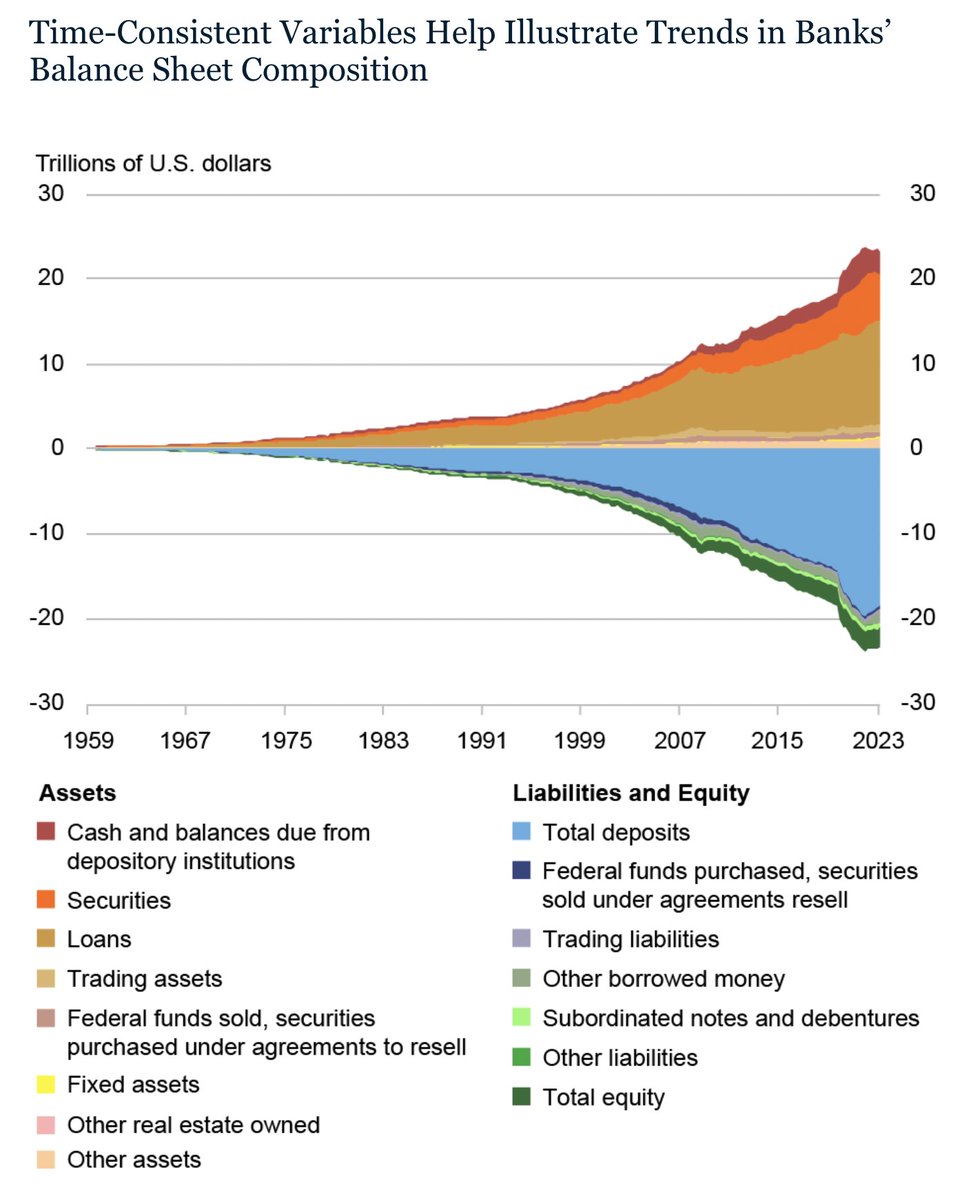
🚨New dataset🚨 Time-consistent balance sheets and income statements for commercial banks in the United States from *1959* to 2025. newyorkfed.org/research/banki… 1/
Emil Verner tweet media
English
1
32
152
19.3K
Alex Carrasco Martinez retweetledi
Michał Brzoza-Brzezina
Michał Brzoza-Brzezina@BrzozaBrzezina·
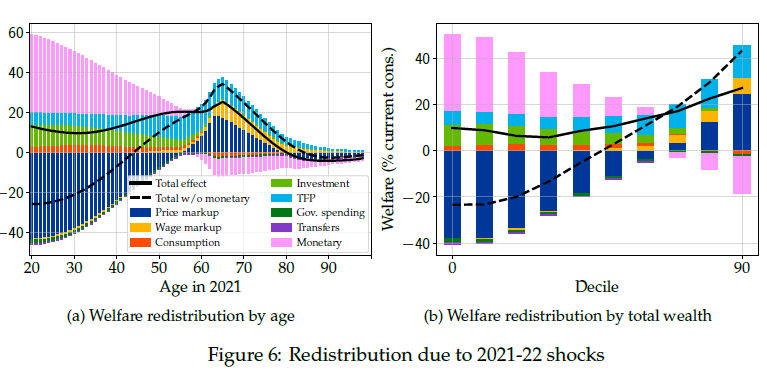
Finished new paper with R.Rigato "The Great Redistribution that Wasn’t: a HANK-OLG Perspective on Monetary Policy" By responding late to 2021-22 inflation the ECB prevented large redistribution from young/poor to old/rich households. Cost: more inflation sites.google.com/view/michal-br…
Michał Brzoza-Brzezina tweet media
English
0
9
55
4.5K
Alex Carrasco Martinez retweetledi
Ivan Werning
Ivan Werning@IvanWerning·
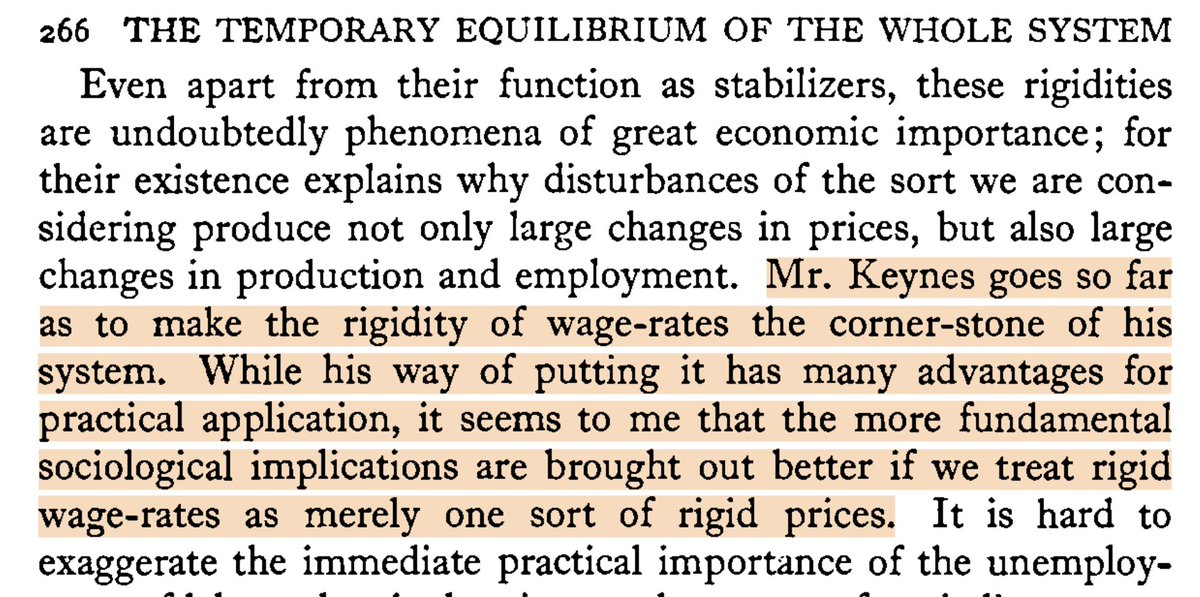
Sir John Hicks (1939) "Value and Capital" a landmark book in General Equilibrium and how to think of a dynamic economy. Here is on sticky prices, not just wages...
Ivan Werning tweet mediaIvan Werning tweet media
English
8
26
183
19.4K
Alex Carrasco Martinez retweetledi
Waldo Mendoza Bellido
Waldo Mendoza Bellido@WaldoMendozaB·
Una completa historia monetaria del Perú. Entrevista a Julio Velarde a cargo de Adrián Armas. Desde la política monetaria de Velasco hasta la política actual. youtu.be/t7J4xTh4OJ4?si…
YouTube video
YouTube
Español
3
99
277
23.6K
Alex Carrasco Martinez retweetledi
Ivan Werning
Ivan Werning@IvanWerning·
Yes, Olivier Blanchard is right here. Silly models can be dead serious. I'm serious. Don't judge a model by how abstract or simple it is, but whether it delivers insight or helps organize thoughts. Just as in art, which is also about seeking truth
Ivan Werning tweet media
Olivier Blanchard@ojblanchard1

This model has done more to stimulate research and discussions of crucial issues of macro than hundreds of books. (Same is true of Aghion Howitt 1992 paper for which they go the Nobel) Simple, toy, models can make a gigantic difference, stimulating both further theoretical and empirical research, and organizing precise discussions.

English
18
71
484
73K
Alex Carrasco Martinez retweetledi
Theo Ribas Palomo
Theo Ribas Palomo@theo_palomo·
1/ 📢Our new paper “Tax Progressivity & Inequality in Brazil: Evidence from Integrated Administrative Data” is now public! We reveal new data on income concentration & the first estimate of effective tax rates paid by Brazil’s super-rich. #Inequality #TaxPolicy
Theo Ribas Palomo tweet media
English
8
90
287
30.5K
Alex Carrasco Martinez retweetledi
Noah Williams
Noah Williams@Bellmanequation·
Preview of a key result in my paper in progress with Tom Sargent. An optimizing model with adapting beliefs can track Fed policy pretty well over the past 30 years.
Noah Williams tweet media
English
8
21
180
26.6K
Alex Carrasco Martinez retweetledi
Ludwig Straub
Ludwig Straub@ludwigstraub·
Just got back from this year’s @KansasCityFed Jackson Hole Symposium. What a special place! Beautiful scenery, interesting papers, and great discussions. I presented new work with @a_auclert, @HannesMalmberg1, Matt Rognlie… 🧵
Ludwig Straub tweet media
English
10
30
264
25.5K