Alilabib

467 posts

Alilabib banner
Alilabib

Alilabib

@ali_labib_

#Software_Developer Co-founder@Martech_sa

El Daqahlia, Egypt Katılım Ekim 2017
552 Takip Edilen155 Takipçiler
Alilabib retweetledi

Eptech
Eptech@byeptec·
في القطاع الطبي، الثقة تُبنى بصورة احترافية قبل أي شيء. في EPTech نُبدع في صناعة محتوى طبي يعكس المصداقية، ويعزز الحضور الرقمي باحتراف. سعداء بتعاوننا مع د. فيصل المهيد، وبناء هوية رقمية تليق بخبرته وتميزه. للتعاون، يسعدنا تواصلكم. #EPTech #إدارة_حسابات #تصميم_سوشيال_ميديا
Eptech tweet mediaEptech tweet media
العربية
0
1
1
31
Alilabib retweetledi
حوت العملات الرقمية official
مالك احد اكبر صناديق التحوط في المملكة المتحدة يقول بيع كل شيء الانهيار قادم 🚨🚨🚨🚨:
العربية
219
515
3.9K
872.3K
Alilabib retweetledi
Raul Junco
Raul Junco@RaulJuncoV·
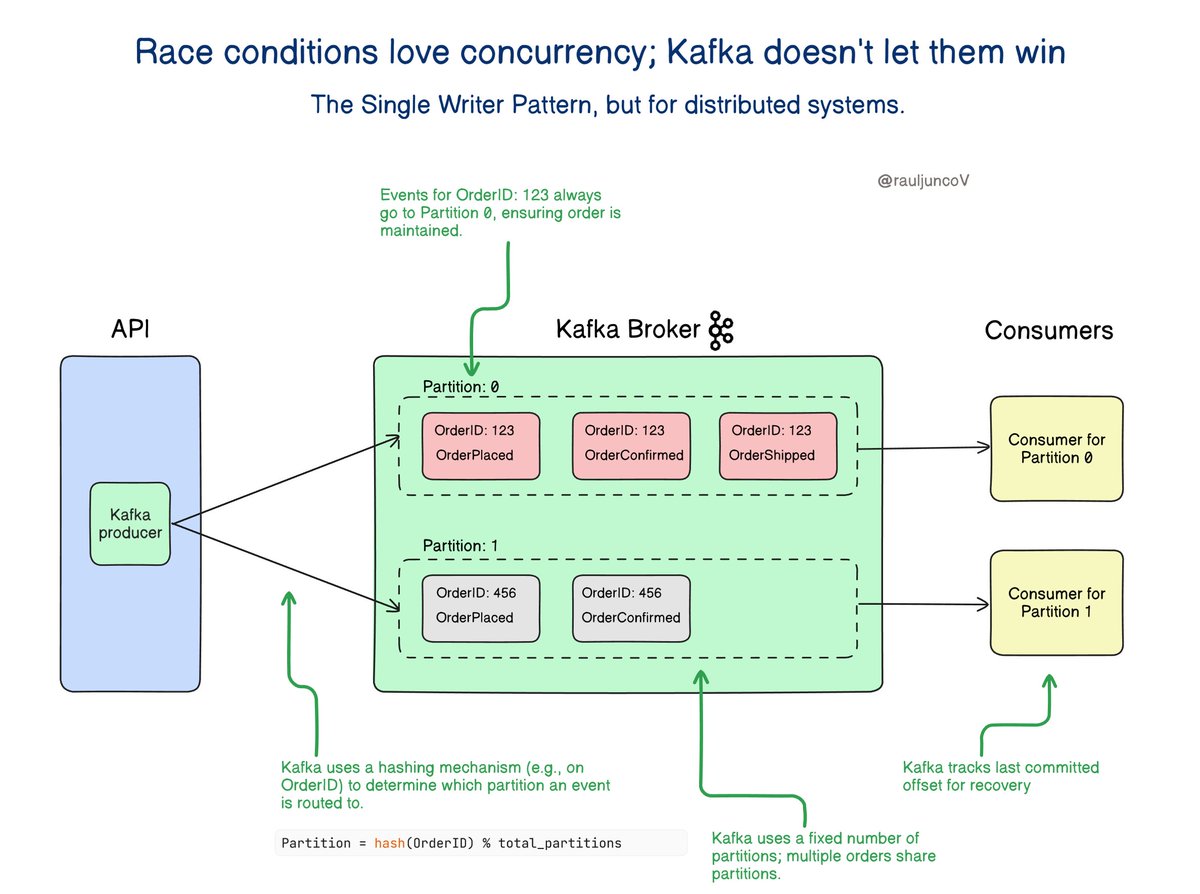
Race conditions love concurrency, but Kafka doesn’t let them win. The Single Writer pattern, applied to distributed systems. Anyone who’s worked with real-time data knows how painful out-of-order events can be. One misstep and your system state is toast. What Is the Single Writer Pattern? The Single Writer pattern makes sure that only one entity writes or processes data at a time to avoid conflicts and maintain consistency. Kafka applies this idea at the partition level. Within a consumer group, only one consumer processes a given partition at any moment. No clashes. No interleaving. Just ordered, deterministic processing. How Kafka Implements It? Kafka splits topics into partitions. Each partition is assigned to only one consumer at a time. One consumer processes all messages from a partition in order, which keeps the sequence right and avoids race conditions. Real-World Example: E-commerce Order Events Imagine an e-commerce platform receiving events like: • OrderPlaced • OrderConfirmed • OrderShipped All events for a specific order are routed to the same partition, ensuring they’re processed in order without needing a separate partition for every order. One consumer processes the events in the correct order, so the system doesn’t ship an order before confirming it. Fault Tolerance Without Compromising Order If a consumer fails, Kafka reassigns its partitions to another consumer. The new consumer starts from where the last one left off, keeping the order right and avoiding repeated work. Key Takeaways • Kafka enforces the Single Writer pattern at the partition level. • This ensures order-preserving, race-free processing in distributed systems. • Failover is handled gracefully, with consumers resuming from committed positions. Stop fighting concurrency, design for it. Event ordering isn’t a nice-to-have. It’s foundational for correctness in distributed systems. How are you handling ordering in production today: keys, idempotency, outbox, transactions?
Raul Junco tweet media
English
13
41
317
14.7K
Alilabib retweetledi
Milan Jovanović
Milan Jovanović@mjovanovictech·
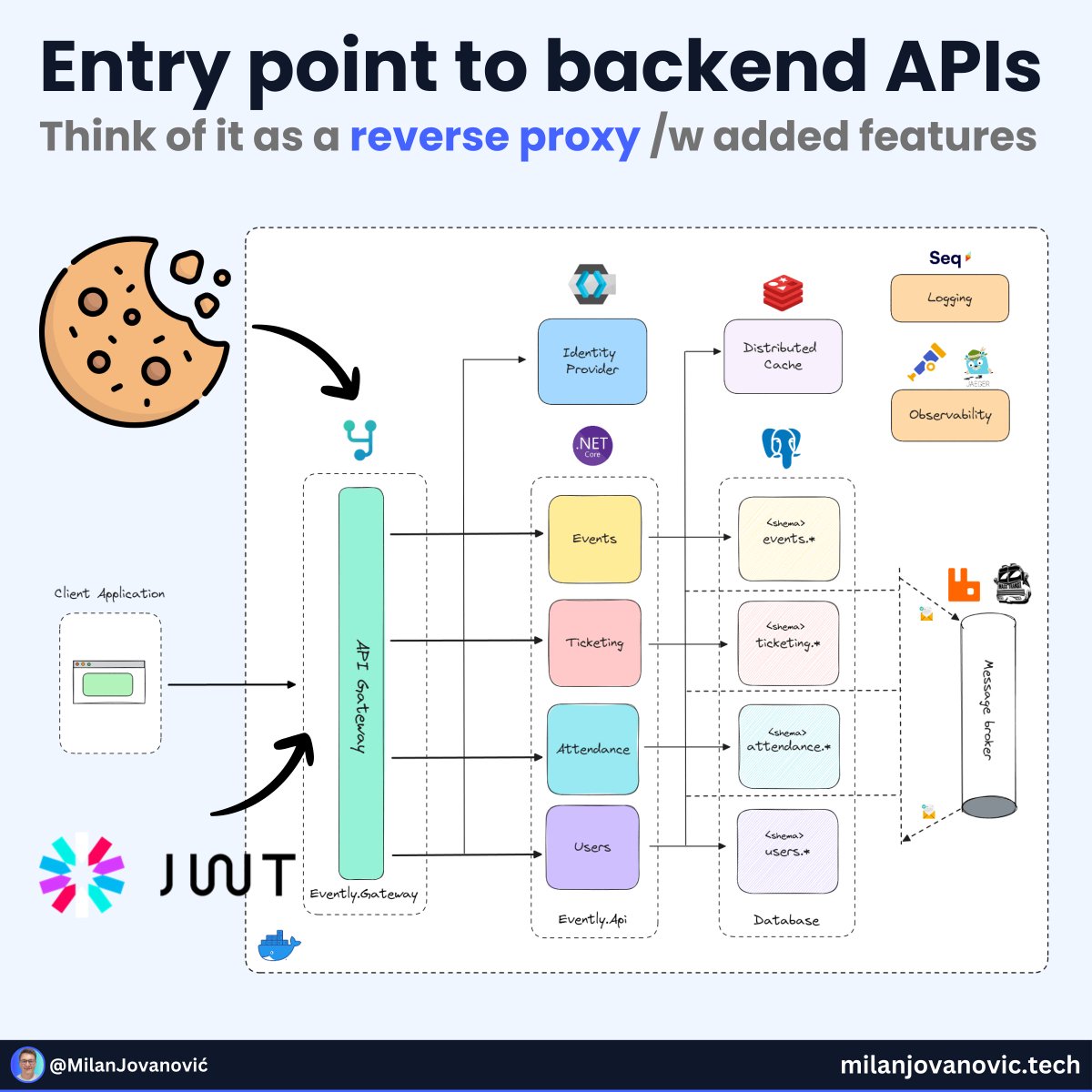
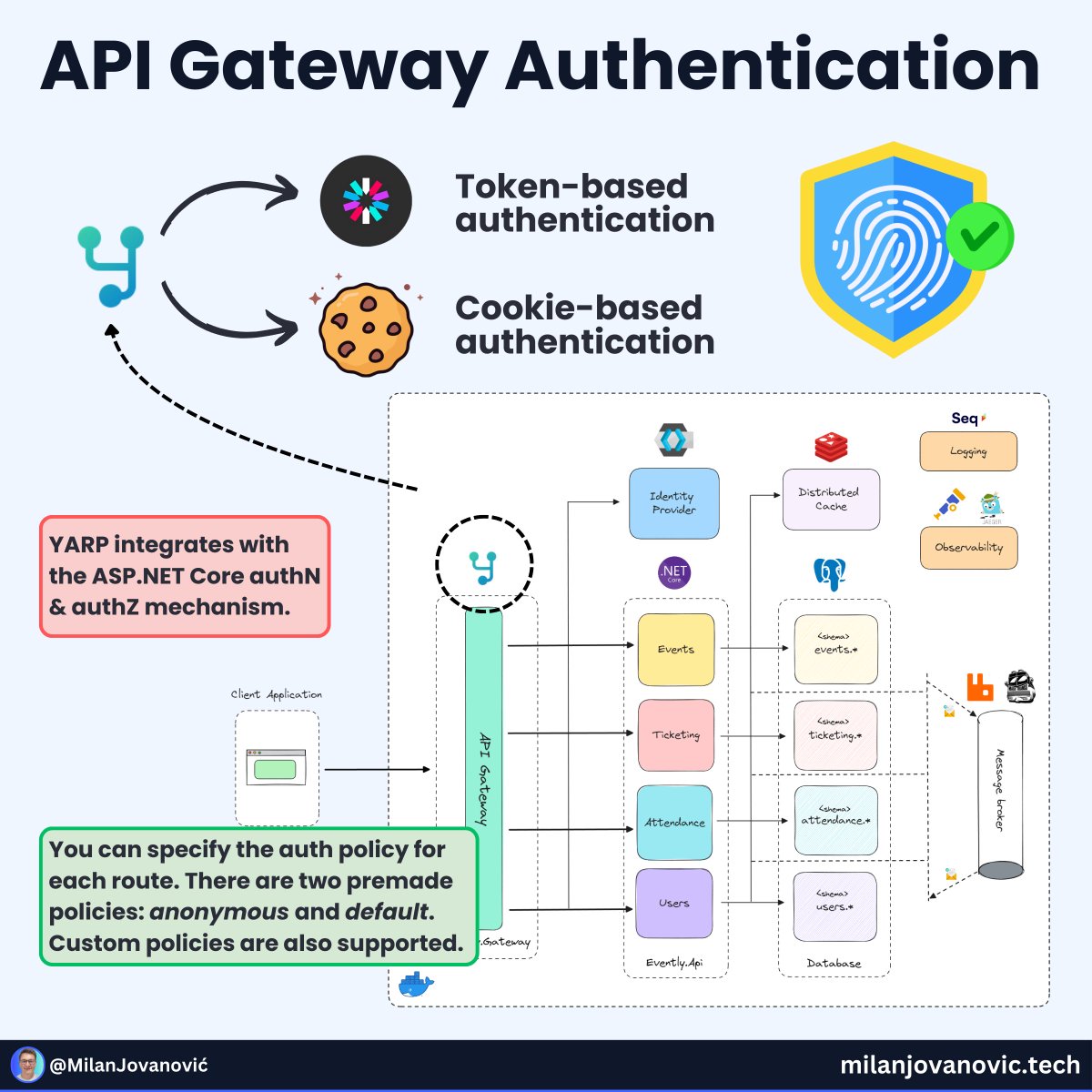
What is an API Gateway? API gateways are a crucial component in the architecture of microservice applications. They act as a reverse proxy, routing incoming requests to the appropriate backend service and abstracting the underlying implementation details from the client. One of the primary benefits of using an API gateway is the ability to manage and optimize the communication between different services, particularly when it comes to: • Security • Caching • Rate limiting It also provides a single endpoint for external clients to access, simplifying the integration process and minimizing the number of round trips required to retrieve data. Some popular options for API Gateways are: • YARP • Ocelot • Traefik • Envoy There are also cloud gateways such as Azure API Gateway and Amazon API Gateway. Here's how you can build an API Gateway in .NET: milanjovanovic.tech/blog/implement… What's your choice for an API gateway? --- Sign up for the .NET Weekly with 75K+ other engineers, and get a free Clean Architecture template: milanjovanovic.tech/templates/clea…
Milan Jovanović tweet mediaMilan Jovanović tweet mediaMilan Jovanović tweet mediaMilan Jovanović tweet media
English
5
80
465
20.4K
Alilabib retweetledi
Dhanian 🗯️
Dhanian 🗯️@e_opore·
MICROSERVICES ARCHITECTURE IN SYSTEM DESIGN → Microservices Architecture is a system design approach where an application is built as a collection of small, independent, and loosely coupled services. → Each service focuses on a single business capability and can be developed, deployed, and scaled independently. → CORE CONCEPT → Monolithic Application → Split into Independent Services → Each Service → Own logic → Own database → Own deployment lifecycle → Services communicate via APIs or events → KEY CHARACTERISTICS → Single Responsibility → each service handles one business function → Loose Coupling → services do not depend on internal logic of others → Independent Deployment → changes in one service do not affect others → Technology Diversity → each service can use different tech stacks → Fault Isolation → failure in one service does not crash the whole system → MICROSERVICES COMPONENTS → Client → API Gateway → Microservices → API Gateway → authentication → routing → rate limiting → Microservices → User Service → Order Service → Payment Service → Each Service → Own Database → Message Queue/Event Bus → async communication → Service Registry → service discovery → Load Balancer → distributes traffic → COMMUNICATION PATTERNS → Synchronous Communication → REST or gRPC → request/response → Simple but tightly coupled → Asynchronous Communication → Events → Message Queues (Kafka, RabbitMQ, SQS) → High scalability → loose coupling → DATA MANAGEMENT STRATEGY → Database per Service → no shared databases → Data consistency → achieved using events → Eventual consistency → preferred over strong consistency → Saga Pattern → manages distributed transactions → SCALING IN MICROSERVICES → Scale services independently based on load → High-traffic service → scale out only that service → Auto-scaling → Kubernetes / Cloud platforms → Horizontal scaling → preferred approach → FAULT TOLERANCE & RESILIENCE → Circuit Breaker → stops cascading failures → Retry Mechanisms → handles temporary failures → Timeouts → prevents resource blocking → Bulkhead Pattern → isolates failures → DEPLOYMENT & ORCHESTRATION → Containerization → Docker → Orchestration → Kubernetes → CI/CD Pipelines → automated testing & deployment → Rolling Updates → zero downtime deployments → OBSERVABILITY → Centralized Logging → Distributed Tracing → Metrics & Monitoring → Health Checks for each service → PROS OF MICROSERVICES → High scalability → Faster development cycles → Independent team ownership → Better fault isolation → Cloud-native compatibility → CONS OF MICROSERVICES → Increased system complexity → Network latency → Data consistency challenges → Higher operational overhead → Requires strong DevOps practices → WHEN TO USE MICROSERVICES → Large-scale applications → Rapidly growing user base → Multiple development teams → Systems requiring high availability and scalability → QUICK TIP → Microservices Architecture enables: → Independent development and scaling → Resilient and fault-tolerant systems → Faster innovation and deployment → Modern cloud-native system design SYSTEM DESIGN HANDBOOK (FULL GUIDE): codewithdhanian.gumroad.com/l/fywkaw
Dhanian 🗯️ tweet media
English
24
202
1.3K
40K
Alilabib retweetledi
التميمي
التميمي@altmemy199·
للي ما يدري فيه مستودع على GitHub عليه حوالي 100k نجمة، مجمّعين فيه 20 ألف system prompt لـ Cursor وDevin وغيرها من موديلات الـAI 👀 كنز برومبتات جاهز، بس يحتاج واحد فاضي 😂 github.com/x1xhlol/system…
التميمي tweet media
العربية
4
72
972
69.9K
Alilabib retweetledi
Brais Moure
Brais Moure@MoureDev·
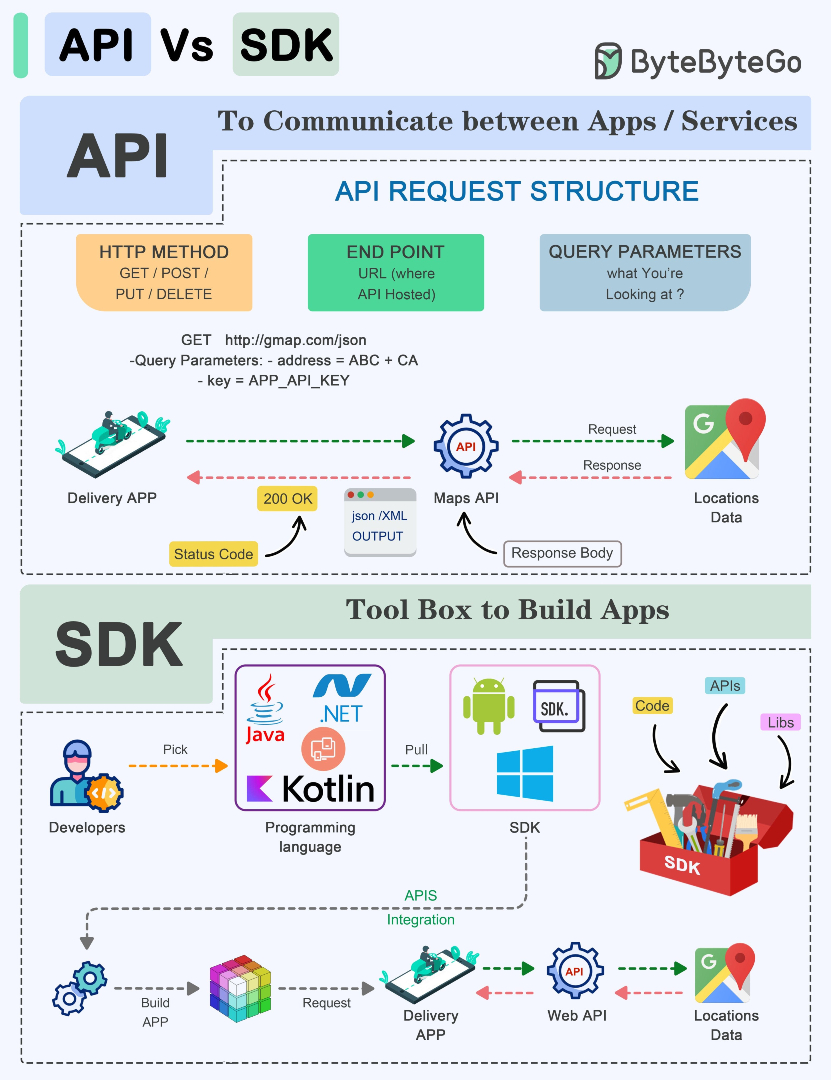
API (Application Programming Interface) vs SDK (Software Development Kit) ↓
Brais Moure tweet media
English
4
125
691
33.6K
Alilabib retweetledi
Dr Milan Milanović
Dr Milan Milanović@milan_milanovic·
𝗛𝗼𝘄 𝗱𝗼𝗲𝘀 𝗦𝗶𝗻𝗴𝗹𝗲 𝗦𝗶𝗴𝗻-𝗢𝗻 (𝗦𝗦𝗢) 𝘄𝗼𝗿𝗸? Single sign-on (SSO) is an authentication process that allows a user to access multiple applications with a single login. This is accomplished using a central authentication server that stores the user's credentials and verifies them for each application. Here are 𝘁𝗵𝗲 𝘀𝘁𝗲𝗽𝘀 that happen if you want to access Trello by using your Google account: 1. Use the Trello login web page and select Google account as a login method 2. Trello redirects the user to the Google login page 3. User is served with the Google login page 4. The user enters their Google credentials 5. Google sends authentication info to the SSO Authorization server 6. If credentials are valid, the Authorization server returns the auth token (SAML) 7. Google sends the auth token to the Trello 8. In the last step, Trello sends the token to the Google Authorization server to validate its 9. If the token is valid, Trello will allow access to the user and store the session for future interactions The 𝗯𝗲𝗻𝗲𝗳𝗶𝘁𝘀 of SSO are: 🔹 Improved user experience: Users do not need to remember multiple usernames and passwords. 🔹 Increased security: Users are less likely to reuse passwords across applications. The 𝗱𝗶𝘀𝗮𝗱𝘃𝗮𝗻𝘁𝗮𝗴𝗲𝘀 are: 🔸 Single point of failure: One of the most notable disadvantages is that SSO creates a single point of failure. The attacker could access all connected applications and services if the SSO system is compromised. 🔸Security risks: If credentials are compromised, the security of all connected applications could be at risk. Some 𝗰𝗼𝗺𝗺𝗼𝗻 𝘁𝘆𝗽𝗲𝘀 𝗼𝗳 𝗦𝗦𝗢 are: 🔹 𝗦𝗔𝗠𝗟-𝗯𝗮𝘀𝗲𝗱 𝗦𝗦𝗢: This is the most common type of SSO. It uses the SAML protocol to exchange authentication information between the SSO server and applications. 🔹 𝗢𝗔𝘂𝘁𝗵 𝟮.𝟬: It provides delegated access to server resources on behalf of a resource owner. It specifies how tokens are transferred, allowing an IDP to authenticate a user's identity and for the credentials to be used to access APIs. 🔹 𝗢𝗽𝗲𝗻𝗜𝗗 𝗖𝗼𝗻𝗻𝗲𝗰𝘁: This is a newer type of SSO based on OAuth 2.0. It is a simpler protocol than SAML and easier to integrate with web applications. Some 𝗽𝗼𝗽𝘂𝗹𝗮𝗿 𝗦𝗦𝗢 𝘀𝗼𝗹𝘂𝘁𝗶𝗼𝗻𝘀 are: 🔹 Azure Active Directory 🔹 Okta 🔹 Ping Identity 🔹 OneLogin 🔹 Google Cloud Identity Platform 👉 Learn more about it: newsletter.techworld-with-milan.com/p/how-does-sin…
Dr Milan Milanović tweet media
English
7
177
1K
65.6K
Alilabib retweetledi
Raul Junco
Raul Junco@RaulJuncoV·
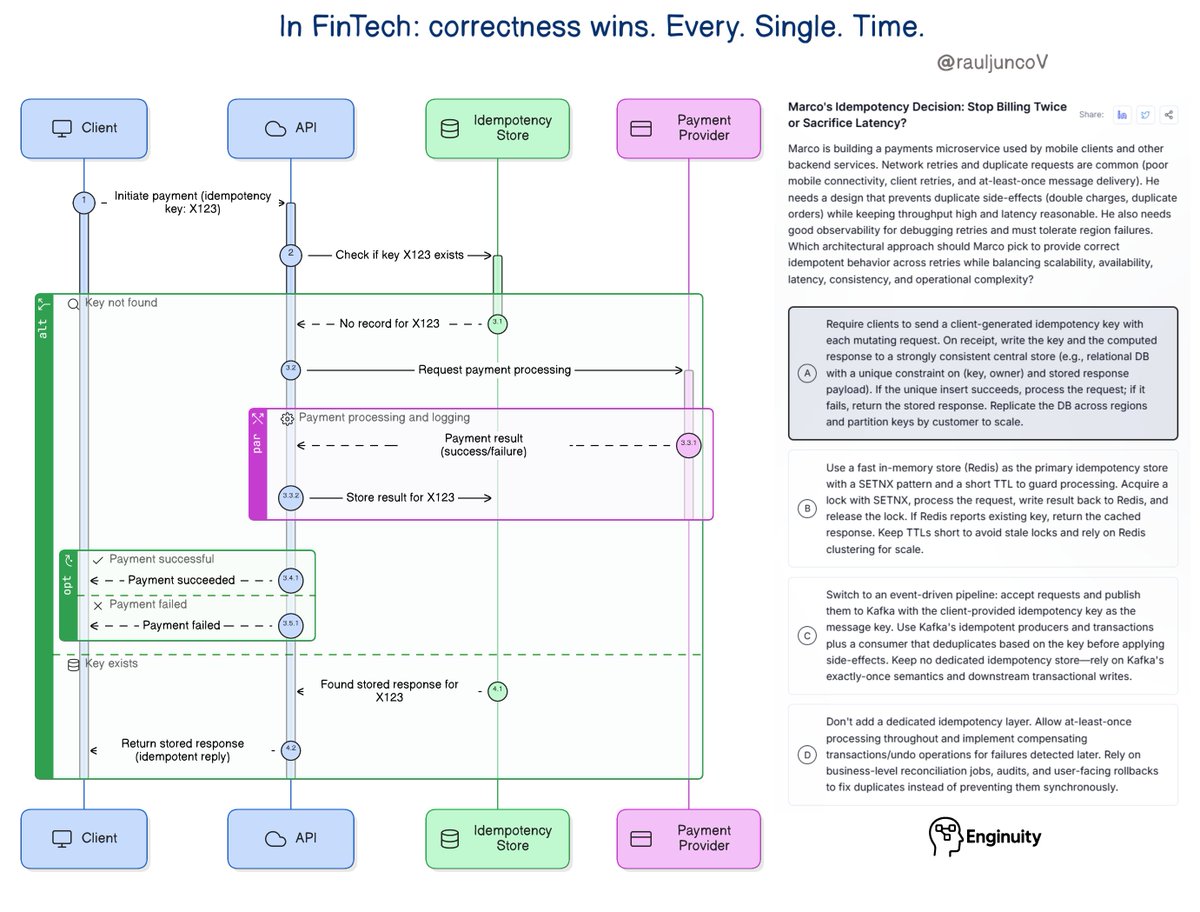
Payments don’t allow second chances. Here’s the decision Marco had to make 👇 Most engineers choose speed first. Then they spend months building refunds, reconciliation jobs, and damage control. Payments don’t care about “low latency.” They care about not charging users twice. These were his choices: A -> Strong Consistency Store a client-generated idempotency key + the final response in a durable DB. Unique constraint rejects duplicates. Auditable. Correct. Slightly slower. B -> Redis TTL Hack SETNX lock → process → cache result. Blazing fast… until Redis restarts, TTL expires early, or a partition hits. Then you bill someone twice and “investigate” for days. C -> Kafka Magic Thinking Publish events and trust “exactly-once” processing downstream. But payments need correctness before success is returned. This solves scale, not accountability. D -> Fix It Later Let double-charges happen. Then run audits, refunds, apologies, and maybe PR damage control. Cheap to build. Expensive to earn trust back. Marco picked A. Because the “fast” options become the most expensive ones once real money moves. In FinTech: correctness wins. Every. Single. Time. Latency stings. Double-charging destroys trust.
Raul Junco tweet media
English
28
95
676
47K
Alilabib retweetledi
Daleel FM
Daleel FM@DaleelFm·
في هذا الفيديو، يشاركنا د. عادل يسَقي الجانب الرقمي لكتاب دليل، حيث تتحول الصفحات إلى تجربة تفاعلية سهلة وسريعة. منذ انطلاقه عام 2021، جمع دليل طب الأسرة بين المعرفة الطبية والتقنية الحديثة ليكون المرجع الأقرب لكل طبيب وطالبة طب. 🚀 رحلة مستمرة لخدمة أطباء الأسرة في المملكة. #طب_الأسرة #DaleelFM #FamilyMedicine
العربية
1
3
7
2K
Alilabib retweetledi
Eptech
Eptech@byeptec·
🎉 كل عام وأنتم بخير بمناسبة عيد الأضحى المبارك 🕋 #EPTEC #عيد_الأضحى #EidMubarak #عيد_سعيد #عيد_الأضحى_المبارك
العربية
0
1
2
78
Alilabib retweetledi
الجمعية السعودية لطب الأسرة والمجتمع
الجمعية السعودية لطب الأسرة والمجتمع و دليل طب الأسرة @DaleelFm مع عددٍ من الجهات المشاركة والراعية تطلق المؤتمر السعودي الثاني للأبحاث المختصرة في طب الأسرة #sparc كأولى فعاليات #اليوم_العالمي_لطبيب_الأسرة_25 وسط حضور مميّز وملفت للمختصين والمهتمين في مجال الرعاية الصحية الأولية
العربية
2
15
27
12.8K
Alilabib retweetledi
Dhanian 🗯️
Dhanian 🗯️@e_opore·
100 JavaScript Projects That Can Land You a Job in 2025 Part 1: Beginner Projects (1–20) Build strong JavaScript foundations. 1. Calculator 2. Digital Clock 3. To-Do List 4. Tip Calculator 5. Countdown Timer 6. BMI Calculator 7. Weather App (API) 8. Rock Paper Scissors Game 9. Quiz App 10. Random Joke Generator 11. Image Slider 12. Number Guessing Game 13. Password Generator 14. Form Validation 15. Expense Tracker 16. Character Counter 17. Light/Dark Mode Toggle 18. Accordion Menu 19. Scroll-to-Top Button 20. Modal Popup Part 2: Intermediate DOM & API Projects (21–40) Enhance interactivity and API skills. 21. Currency Converter 22. GitHub Profile Finder 23. Movie Search App (OMDB API) 24. Notes App (Local Storage) 25. Markdown Previewer 26. Pomodoro Timer 27. QR Code Generator 28. Random Quote Machine 29. Local Weather App 30. Digital Resume Generator 31. Image Gallery with Lightbox 32. Speech-to-Text App 33. Dictionary App (API) 34. Country Info Explorer 35. Clock with Alarms 36. URL Shortener 37. Email Validator 38. Music Player UI 39. Searchable Table 40. Draggable Kanban Board Part 3: CRUD and Local Storage Apps (41–60) Work with data, persistence, and structured UI. 41. Shopping Cart App 42. Contact Manager 43. Bookmark Saver 44. Simple Blog App 45. Habit Tracker 46. Daily Planner 47. Login/Signup Form (LocalStorage) 48. Budget App 49. Grade Calculator 50. Book Library 51. Flashcards App 52. Reading Progress Tracker 53. Meal Planner 54. Calendar App 55. Color Theme Picker 56. Inventory Manager 57. Pet Adoption App 58. Grocery List 59. Movie Watchlist 60. Freelance Task Board Part 4: Advanced Projects with APIs & Frameworks (61–80) Showcase modern development skills and integrations. 61. Weather Dashboard with Charts 62. Crypto Price Tracker (CoinGecko API) 63. Job Board with Filtering 64. Real-Time Chat App (Firebase) 65. Recipe App (Spoonacular API) 66. Product Review Platform 67. Fitness Tracker 68. Expense Pie Chart App 69. Hacker News Clone 70. GitHub Repo Explorer 71. Spotify Clone UI 72. Fake E-Commerce Store 73. Translation App 74. Stock Market Tracker 75. Dev Portfolio Generator 76. AI Text Summarizer (OpenAI API) 77. Voice Assistant 78. Instagram-like Feed 79. WhatsApp Clone (Socket.io + Express) 80. News Aggregator Part 5: Fullstack MERN/MEVN Projects (81–100) Build end-to-end applications with database, backend, and authentication. 81. Authentication System (JWT, bcrypt) 82. Blog CMS (MERN Stack) 83. Real-Time Chat (MERN + Socket.io) 84. Project Management App 85. Job Tracker 86. Personal Finance Dashboard 87. SaaS Pricing Page with Stripe 88. Task Manager API with CRUD 89. YouTube Clone 90. File Uploader (Cloudinary or S3) 91. Notes API + React Frontend 92. Online Polling App 93. Social Media Feed (Likes, Comments) 94. AI Image Generator (OpenAI DALL·E) 95. Collaborative Drawing App 96. E-Commerce Full App 97. Portfolio CMS 98. Resume Builder with PDF Export 99. Event Booking App 100. Online Course Platform Want the full source code for all 100 projects? Download the official ebook with clean, production-ready code examples: Get it here →codewithdhanian.gumroad.com/l/vajjm
English
7
88
468
27.2K
Alilabib retweetledi
Akshay 🚀
Akshay 🚀@akshay_pachaar·
5 MCP servers that will give superpowers to your AI Agents: (100% open-source)
GIF
English
38
276
2K
293.8K
Alilabib retweetledi
Sumanth
Sumanth@Sumanth_077·
Microsoft launched the best course on Generative AI! The free 21 lesson course is available on Github and will teach you everything you need to know to start building Generative AI applications.
Sumanth tweet media
English
53
469
2.3K
207.2K
Alilabib retweetledi
Aurimas Griciūnas
Aurimas Griciūnas@Aurimas_Gr·
How do we implement 𝗧𝗼𝗼𝗹 𝗖𝗮𝗹𝗹𝗶𝗻𝗴 𝘃𝗶𝗮 𝗠𝗖𝗣? Let’s unpack the difference between using MCP to implement Tool Calling and baking the Tools directly into your Agents. I’ve recently seen many MCP vs. Function Calling articles floating around, some misleading. Let’s simplify. ❗️ 𝗖𝗹𝗮𝗿𝗶𝗳𝘆𝗶𝗻𝗴 𝗼𝗻𝗲 𝗱𝗲𝘁𝗮𝗶𝗹: Function Calling and Tool Use in Agentic Systems are almost the same thing. You can implement tools via functions, the only difference is that functions are usually used to enforce stricter structure to the input and output schema. 𝘜𝘴𝘪𝘯𝘨 𝘔𝘊𝘗 𝘵𝘰 𝘦𝘹𝘱𝘰𝘴𝘦 𝘵𝘰𝘰𝘭𝘴 𝘵𝘰 𝘺𝘰𝘶𝘳 𝘈𝘨𝘦𝘯𝘵𝘴: ℹ️ In this case your Agent becomes an MCP Host and implements one or more MCP Clients to communicate with MCP Servers. 𝟭. User Query is passed to the Agent (usually a Python application). 𝟮. The application implements MCP Client and via it retrieves all available tools from the MCP servers. 𝟯. The list of available Tools is passed together with the User Query to a LLM via a prompt. The LLM figures out which tools need to be invoked and with what parameters. 𝟰. The Agent application communicates with the MCP server (via MCP Client) again and sends the tool execution request. After execution completes the Agent receives the required data. 𝟱. User Query is sent to the LLM together with the data retrieved by the Tool calls. 𝟲. The answer is constructed and returned to the user via the Agent. 𝘜𝘴𝘪𝘯𝘨 𝘕𝘢𝘵𝘪𝘷𝘦 𝘍𝘶𝘯𝘤𝘵𝘪𝘰𝘯 𝘊𝘢𝘭𝘭𝘪𝘯𝘨: 𝟭. User Query is passed to the Agent (usually a Python application). 𝟮. All of the available Functions/Tools are defined as part of the Agent code (procedural memory). 𝟯. The list of available Tools is passed together with the User Query to a LLM via a prompt. The LLM figures out which functions need to be invoked and with what parameters. 𝟰. The Agent application directly executes the functions. 𝟱. User Query is sent to the LLM together with the data retrieved after function execution. 𝟲. The answer is constructed and returned to the user via the Agent. 𝗠𝘆 𝘁𝗵𝗼𝘂𝗴𝗵𝘁𝘀: ❗️ Will MCP eat up the practice of Native Function Calling? If we adopt the standard then I believe so. ❗️ Will MCP compete with LLM Orchestration frameworks? I believe MCP will replace the Tool use abstractions as they are used today and frameworks will be responsible mostly for managing the topology and state of the Agentic systems long term. Are you using MCP already to expose Tools to your Agents? Let me know in the comments. #LLM #AI #MachineLearning
GIF
English
27
202
762
46.9K
Alilabib retweetledi
Ivan Velichko
Ivan Velichko@iximiuz·
SSH Tunnels - a (not so) secret sysadmin trick to glue services together 🔽 Helpful for: - Exposing apps running locally to the Internet - Mapping remote endpoints to local ports - Accessing DBs in private networks with a local GUI ...and a ton more. Save the memo 👇
Ivan Velichko tweet media
English
6
147
894
40.8K
Alilabib retweetledi
Raul Junco
Raul Junco@RaulJuncoV·
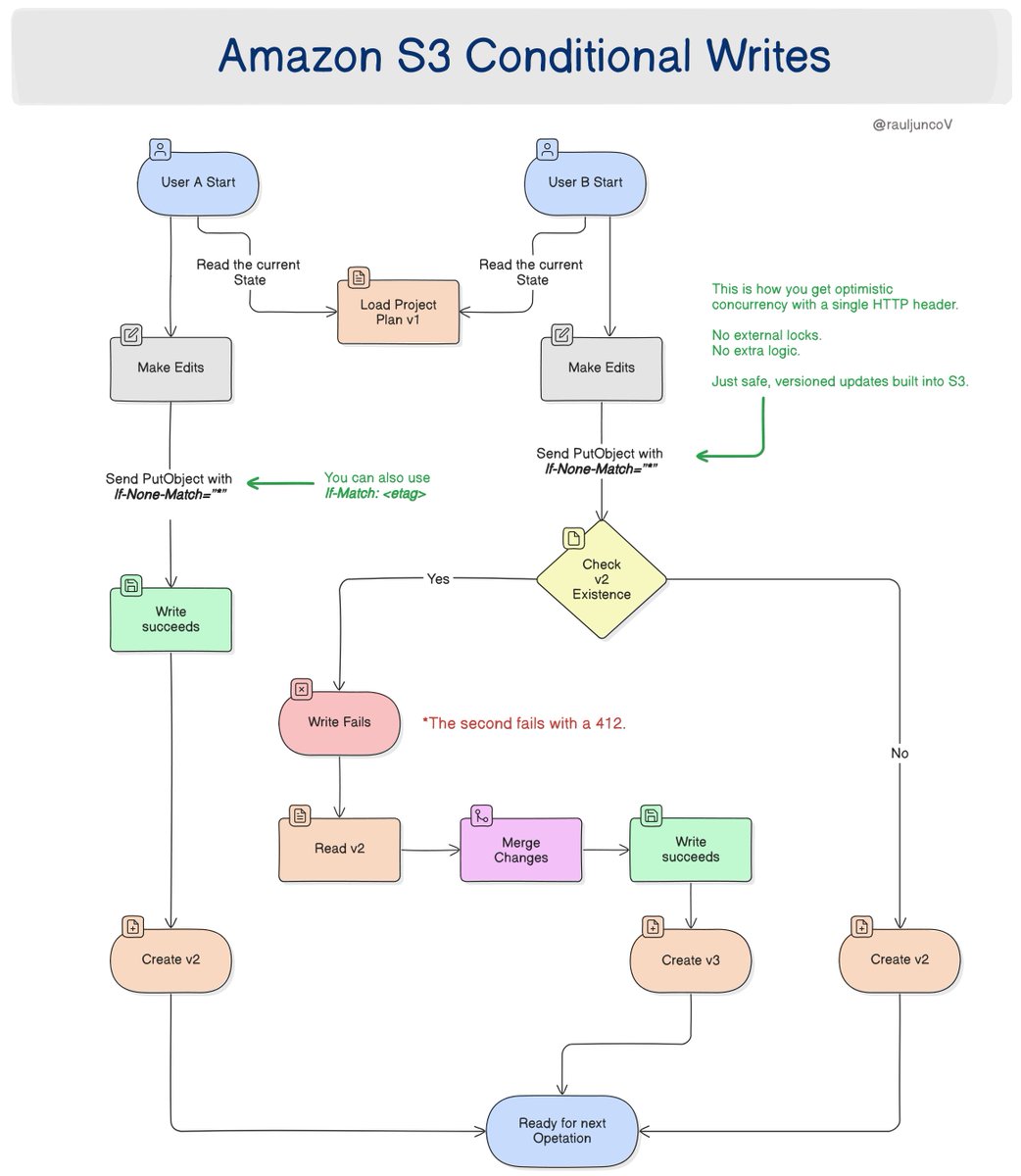
Amazon S3 added Conditional Writes last year. But most teams are still not using them. S3 used to be where you dumped backups and static files. Reliable, cheap, boring. Now? It's a core piece of modern architecture. It powers serverless apps, stores ML outputs, holds database snapshots, and feeds real-time analytics. And with conditional writes, it just leveled up again. Imagine you're building a collaborative document editor. 1. Two users load project-plan-v1.json. 2. Both make changes. 3. Both try to save project-plan-v2.json. 4. Without coordination, one overwrites the other. Classic race condition. With conditional writes, each user sends a PUT to S3 with If-None-Match: *. The first write succeeds. The second fails with a 412. No overwrites. No locks. The second user reads the latest version, merges, and retries as project-plan-v3.json. Done. You get optimistic concurrency with a single HTTP header. No external locks. No extra logic. Just safe, versioned updates built into S3. This works anywhere: - Upload APIs - ML checkpoints - ETL outputs - Config files Any system where multiple writers need to avoid stepping on each other. S3 is no longer just object storage. It's a write-once, conflict-aware coordination primitive. If you're still writing coordination code around S3, stop. The storage layer has your back now. What's the most challenging concurrency issue you've faced with S3?
Raul Junco tweet media
English
12
51
420
28.7K
Alilabib retweetledi
Sahn Lam
Sahn Lam@sahnlam·
What is a Deadlock?
Sahn Lam tweet media
English
10
188
1.1K
64.7K
Alilabib retweetledi
Ashish Pratap Singh
Ashish Pratap Singh@ashishps_1·
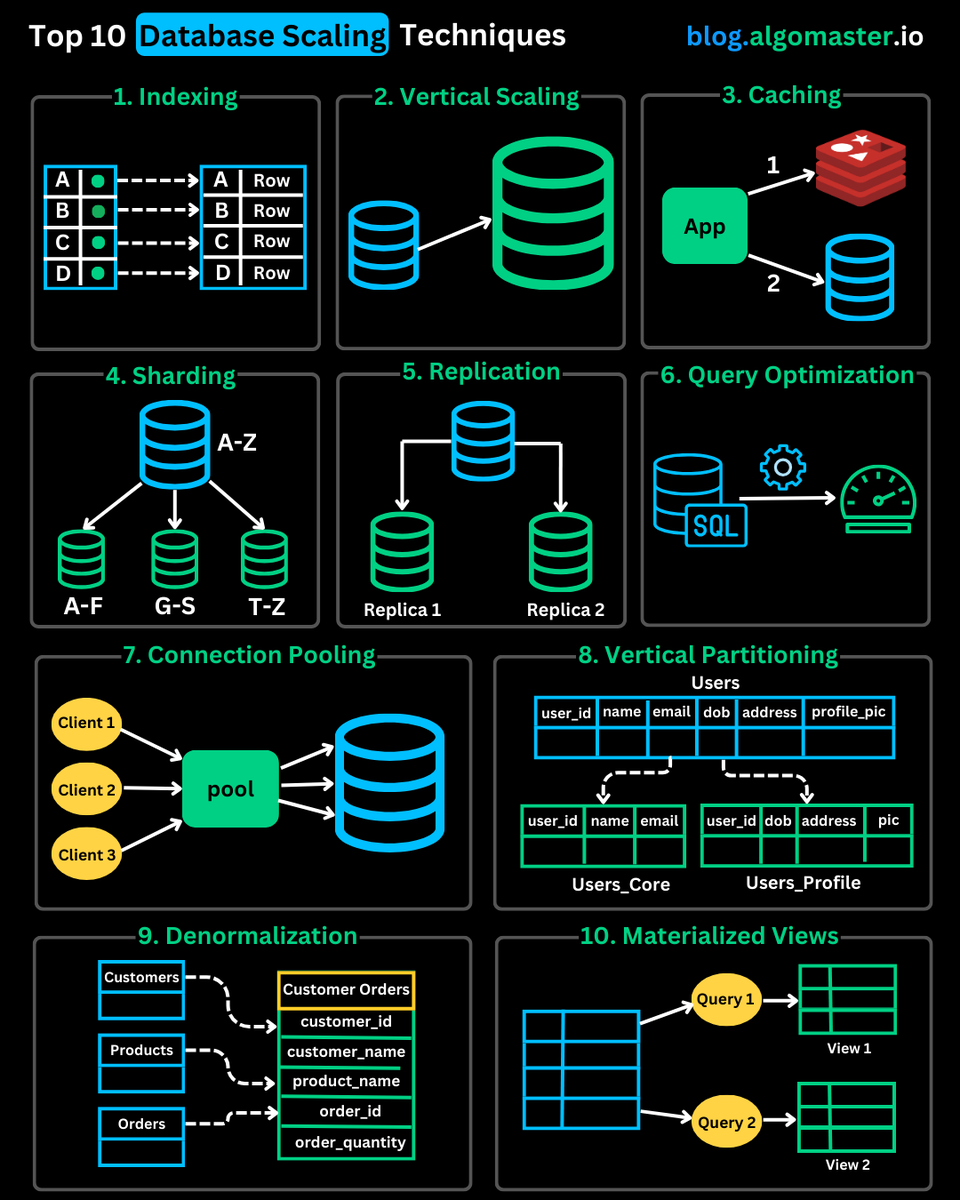
Top 10 Database Scaling Techniques You Should Know: 1. 𝐈𝐧𝐝𝐞𝐱𝐢𝐧𝐠: Create indexes on frequently queried columns to speed up data retrieval. 2. 𝐕𝐞𝐫𝐭𝐢𝐜𝐚𝐥 𝐒𝐜𝐚𝐥𝐢𝐧𝐠: Upgrade your database server by adding more CPU, RAM, or storage to handle increased load. 3. 𝐂𝐚𝐜𝐡𝐢𝐧𝐠: Store frequently accessed data in-memory (e.g., Redis, Memcached) to reduce database load and improve response time. 4. 𝐒𝐡𝐚𝐫𝐝𝐢𝐧𝐠: Distribute data across multiple servers by splitting the database into smaller, independent shards, allowing for horizontal scaling and improved performance. 5. 𝐑𝐞𝐩𝐥𝐢𝐜𝐚𝐭𝐢𝐨𝐧: Create multiple copies (replicas) of the database across different servers, enabling read queries to be distributed across replicas and improving availability. 6. 𝐐𝐮𝐞𝐫𝐲 𝐎𝐩𝐭𝐢𝐦𝐢𝐳𝐚𝐭𝐢𝐨𝐧: Fine-tune SQL queries, eliminate expensive operations, and leverage indexes effectively to improve execution speed and reduce database load. 7. 𝐂𝐨𝐧𝐧𝐞𝐜𝐭𝐢𝐨𝐧 𝐏𝐨𝐨𝐥𝐢𝐧𝐠: Reduce the overhead of opening/closing database connections by reusing existing ones, improving performance under heavy traffic. 8. 𝐕𝐞𝐫𝐭𝐢𝐜𝐚𝐥 𝐏𝐚𝐫𝐭𝐢𝐭𝐢𝐨𝐧𝐢𝐧𝐠: Split large tables into smaller, more manageable parts (partitions), each containing a subset of the columns from the original table. 9. 𝐃𝐞𝐧𝐨𝐫𝐦𝐚𝐥𝐢𝐳𝐚𝐭𝐢𝐨𝐧: Store data in a redundant but structured format to minimize complex joins and speed up read-heavy workloads. 10. 𝐌𝐚𝐭𝐞𝐫𝐢𝐚𝐥𝐢𝐳𝐞𝐝 𝐕𝐢𝐞𝐰𝐬: Pre-compute and store results of complex queries as separate tables to avoid expensive recalculation, reducing database load and improving response times. ♻️ Repost to help others in your network.
Ashish Pratap Singh tweet media
English
6
233
1.3K
66.9K