Alon
1.7K posts

Alon
@alon
Head of AI & self-serve product @airtable. Previously founded @doptcom (acquired by Airtable) and PMed things for PMs @amplitude_hq @productboard

Oakland, CA Katılım Nisan 2009
1.3K Takip Edilen1.8K Takipçiler
Alon retweetledi

I've been personally burning through billions of tokens a week for the past few months as a builder. Today I'm excited to announce Hyperagent, by Airtable.
An agents platform where every session gets its own isolated, full computing environment in the cloud — no Mac Mini required. Real browser, code execution, image/video generation, data warehouse access, hundreds of integrations, and the ability to learn any new API as a skill.
Deep domain expertise through skill learning. Teach the agent how your firm evaluates startups or how your team runs due diligence — now anyone on the team gets output that reflects your actual methodology, not a generic template.
One-click deployment into Slack as intelligent coworkers. These aren't bots that wait to be @mentioned — they follow conversations, understand context, and act when relevant.
And a command center to oversee and continuously improve your entire fleet of agents at scale.
We're onboarding early users now. hyperagent.com
English
Alon retweetledi
Alon retweetledi

Sharing an interesting recent conversation on AI's impact on the economy.
AI has been compared to various historical precedents: electricity, industrial revolution, etc., I think the strongest analogy is that of AI as a new computing paradigm (Software 2.0) because both are fundamentally about the automation of digital information processing.
If you were to forecast the impact of computing on the job market in ~1980s, the most predictive feature of a task/job you'd look at is to what extent the algorithm of it is fixed, i.e. are you just mechanically transforming information according to rote, easy to specify rules (e.g. typing, bookkeeping, human calculators, etc.)? Back then, this was the class of programs that the computing capability of that era allowed us to write (by hand, manually).
With AI now, we are able to write new programs that we could never hope to write by hand before. We do it by specifying objectives (e.g. classification accuracy, reward functions), and we search the program space via gradient descent to find neural networks that work well against that objective. This is my Software 2.0 blog post from a while ago. In this new programming paradigm then, the new most predictive feature to look at is verifiability. If a task/job is verifiable, then it is optimizable directly or via reinforcement learning, and a neural net can be trained to work extremely well. It's about to what extent an AI can "practice" something. The environment has to be resettable (you can start a new attempt), efficient (a lot attempts can be made), and rewardable (there is some automated process to reward any specific attempt that was made).
The more a task/job is verifiable, the more amenable it is to automation in the new programming paradigm. If it is not verifiable, it has to fall out from neural net magic of generalization fingers crossed, or via weaker means like imitation. This is what's driving the "jagged" frontier of progress in LLMs. Tasks that are verifiable progress rapidly, including possibly beyond the ability of top experts (e.g. math, code, amount of time spent watching videos, anything that looks like puzzles with correct answers), while many others lag by comparison (creative, strategic, tasks that combine real-world knowledge, state, context and common sense).
Software 1.0 easily automates what you can specify.
Software 2.0 easily automates what you can verify.
English
Alon retweetledi

IDEA ABSORPTION
Idea generation is one of my biggest strengths as a problem solver but the inability to watch when / where i was doing it, was a big weakness early in my career as an executive / leader. I didn’t even realize I was inundating my org with ideas, until a peer Eng leader came to me and said “Gokul you’ve got to stop generating idea confetti. The org needs focused execution, not more ideas.” I’ve never forgotten that line from nearly two decades ago. I made two changes: (a) ideating in very small, mostly 1:1,settings with senior leaders, to flesh out a concept (I do this with AI today!), vs in groups, unless the goal of the group meeting was to ideate, and (b) trying to be Socratic in phrasing: “should we consider X” and being clear that X is a suggestion, not a directive, and it’s the team’s job to decide if X makes sense vs all the other things on their plate. Learnt this the hard way after being presented work output by someone who had worked on a project for a week based on misinterpreting a throwaway comment from me at a meeting.
It was cathartic to see that Bezos had the same issue early on in his career. From a recent interview:
“Jeff Wilke came to me one day he worked for Amazon for a quarter of a century but this is when he probably knew me only for a year and he said “Jeff you have enough ideas to destroy Amazon.” And this was such a shocking idea for me
Jeff said you have enough ideas per minute per day per week to destroy Amazon. I was like what do you what do you mean? He’s like you have to release the work at the right rate that the organization can accept it and he was a manufacturing expert and so you know his view of the world was every time I released an idea I was creating a backlog a queue work in process and because it was just stacking up it was adding no value and in fact it was creating distraction and so he said ‘Look you have to figure out when to release these new ideas at a rate that the organization can accept them and this was I mean this sounds so obvious but it was not obvious at the time to me and this was a profound insight for me and so I started prioritizing the ideas better keeping lists of them keeping them to myself until the organization was ready for the ideas and then I also started figuring out how can I build an organization that can be ready for more ideas that’s about having the right senior team and the right leadership and getting those people the executive bandwidth so they could do more ideas per unit time and so and and that is what we built we built a company that’s very good at inventing and doing more than one thing at a time and you do want to build as the company gets bigger you do want to be able to do more than one thing at a time but that idea of releasing the work was very profound for me and it made it made us operationally more effective while still being inventive and do you think you’re a better inventor.”
English

@frantzfries @bentossell love the idea (and please keep any and all feedback coming my/our way)!
English

np, totally understand, we miss many things on launch
full size seems cool. would also encourage a diff accept/decline inline on multiple changes as well, makes it easier to be happy with part of an answer when it’s an imperfect response
missed you were at airtable! I know they’re in good hands now :)
English

@bentossell @alanaagoyal for sure, this is a miss on our part! you shouldn't need to know our concepts to get this working well for you :)
English

@alon @alanaagoyal awesome to hear it, yeh just fell short when i know i can do it with the agent but the point is i shouldn’t have to. appreciate you chiming in.
English

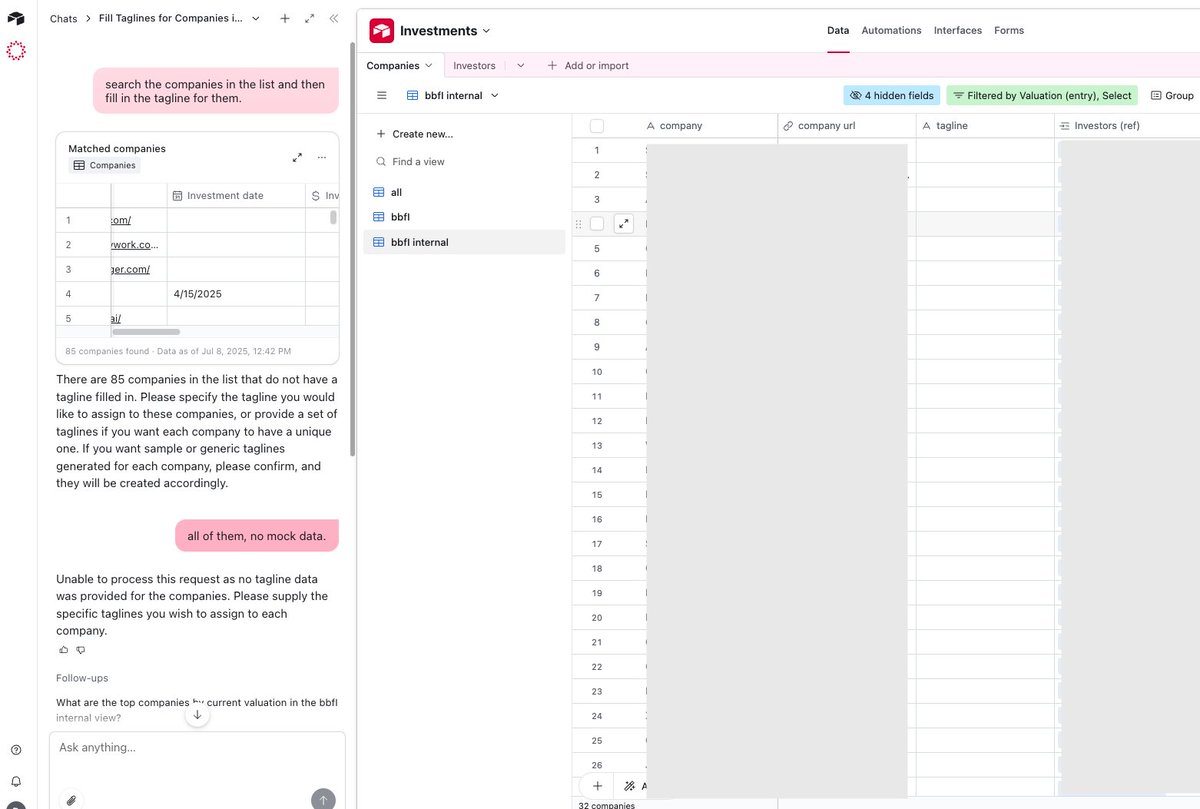
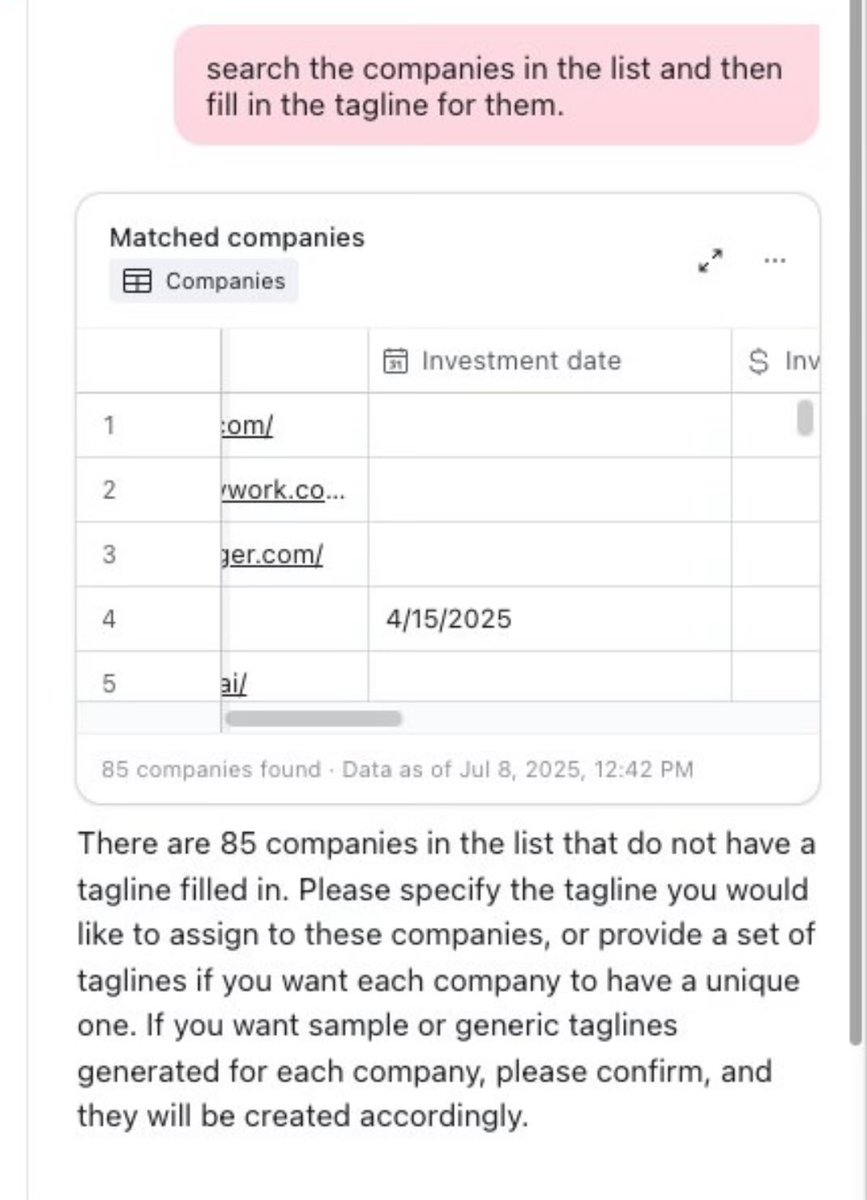
@frantzfries @bentossell @frantzfries the table in non-full screened Omni is admittedly not the best form factor currently. We're adding full size artifacts on the right very soon, just missed including them in the launch.
English

Wish more companies would think about the product holistically when they try this
For example, they’re a table company, why not have results in a table diff on the giant table on the page?
Why are the results of your query in a postage stamp sized box instead of on the 90% of the screen you’re querying

English

@bentossell It can’t even analyse the data in there at a simplistic level eg count records…
Mind you no LLMs can
English

hey @bentossell -- sorry to hear you've been having a bad experience so far. In this case it looks like we're miss routing the intent, we should be creating a Field Agent that looks up the companies in your list vs trying to do it ad hoc in Omni (though we have some significant improvements to Omni web research landing in the next few weeks that will make either path viable here)
English

@alanaagoyal @alon this was my first use of it and really felt like it fell short of what it should be able to do (given you can do it with another feature of theirs)
English

NEW: Superhuman is joining forces with @Grammarly 💜💚🚀
This marks an enormous step towards our vision of building the AI productivity platform for professionals the world over
Trusted by over 40 million happy customers, 50,000 organizations, and 96% of the Fortune 500, Grammarly + Superhuman + Coda are gearing up to deliver this mission
Proud of the team, past and present, and grateful for every one our customers 🫶
More to come!
rahulvohra@rahulvohra
Superhuman is being acquired by @Grammarly! 💜💚 Together, we will build the AI-native productivity suite of choice 🥇 We will invest even more deeply in AI and email, reimagine chat and collaboration, and build AI agents that unlock a whole new way of working. More below 👇
English
Alon retweetledi

🌠Today, we’re excited to relaunch Airtable as the AI-native app platform, combining the magic of vibe coding business apps with real production-readiness and scalability, and embedding them with an army of agents that automate thousands of hours of work in seconds.
Instead of just adding more AI capabilities to our existing platform, we treated this as a refounding moment for the company. We started with a clean-slate imagining of the ideal form factor for building apps in the agentic era.
(If you want to skip all the backstory and just try it out, you can just go to Airtable.com. All new signups get the new AI experience, and existing accounts can switch over using this link: bit.ly/4leXbZ0).
Thread and demos below👇
English