

Ali Alsayed
1.8K posts

Ali Alsayed
@alsayed87
Crafting solutions @ Jeem with code & lowcode | Lifelong Learner 📚 Tweets about product and AI/ML.
Dubai Katılım Haziran 2014
601 Takip Edilen903 Takipçiler

Chatbots talk.
AI agents work.
One explains how to do things.
The other actually does them.
English

Ali Alsayed retweetledi

Saas as an API endpoint for agents.
Either do that with yours or lose.
English
Software makers need to stop thinking about: Screens and Dropdowns
and start thinking about: Actions, endpoints, context and feedback loops
Software is going to be used by #AI agents not humans
English
#AI agents will also hack. It’s all about the prompt and how humans will trick them into complying with malicious requests.
English
Reminder: #AI will always play catch up to humans.
We all need to be in that category of humans to stay ahead and relevant in different jobs.
English
Ali Alsayed retweetledi

UI/UX Designers, did you know you can now use ChatGPT in Figma.
FigGPT is an AI Figma plugin that will help you generate content for your UI design, summarise text, change text style and also generate design ideas.
Repost to share with others 💜
English
At some point, middle management will disappear thanks to #AI. AI can assign tasks, manage performance and fire underperforming employees be it humans or agents. Which is pretty much what middle managers do.
English
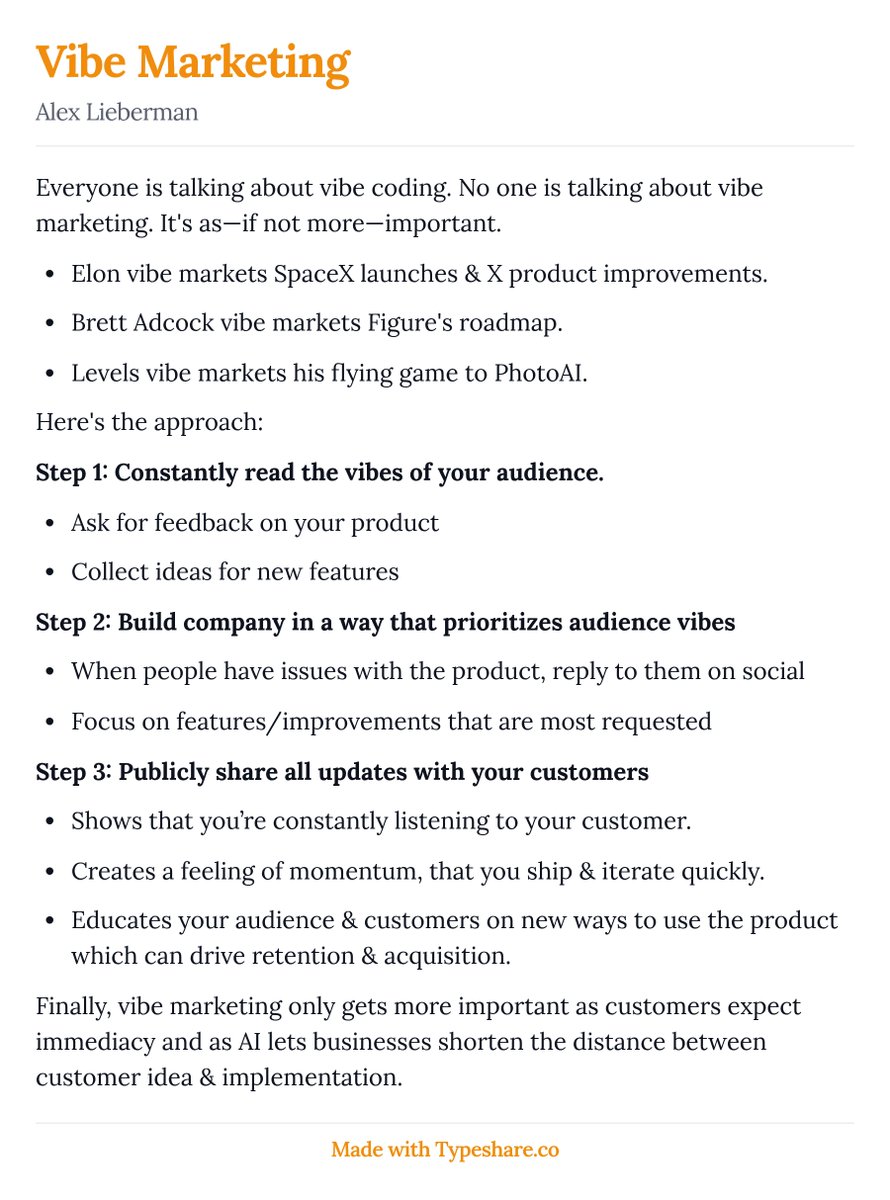
@businessbarista So we’re calling “Build in Public” vibe marketing now?
English

Business owners are interested in business value. They’re not excited about #ML.
Know how to pitch.
English
When your #ML model is too good to be true, it probably is. We need to know why it’s that good.
Is it leaking data from the future? Depending on what you’re predicting, that’s one possible reason.
English
Historical data is the collective experience of an organization from which it can learn from. Yet some refuse to use it.
I’ll never understand.
English
Why More Data Won’t Fix Feature Imbalance in #ML
When training machine learning models, adding more data is often the go-to solution for improving performance. But here’s the catch: if the distribution of features isn’t consistent between the training and validation datasets, more data won’t help.
Why does it matter?
When feature proportions differ between datasets, the model learns patterns that don’t generalize to new data. This leads to poor performance in production, no matter how many instances you add.
So what do we do Instead?
1. Ensure your training and validation datasets have similar feature distributions.
2. Use techniques like stratified sampling or data augmentation to balance your datasets.
3. Regularly monitor feature drift to catch issues early.
It’s not just about how much data you have—it’s about having the right data. Balanced feature distributions are the key to building models that perform well in the real world.
English
Sometimes ( maybe a lot of times ) a less accurate #ML model is better.
English
Struggling to figure out if your #ML model is overfitting or underfitting? Use this simple two step approach:
Step 1: Check Errors
- Overfitting: Validation error is much higher than training error (e.g., 20%+ difference). The model might be memorizing random patterns in the training data.
- Underfitting: High errors on both training and validation datasets. The model may be too simple to learn meaningful patterns.
Step 2: Adjust Model Complexity
- Train models of varying complexities and compare their errors.
- The optimal model has the lowest validation error. If there’s a big gap between this error and your original model, it confirms overfitting or underfitting.
English
What makes a #ML model "complex"? It’s all about the parameters tuned during training. Different model types measure complexity in unique ways:
1. Linear Models: Complexity is determined by the number of features influencing the coefficients.
2. Decision Trees: Complexity grows with the number of conditions in tree nodes.
3. Tree Ensembles (e.g., Random Forests): It depends on the number of trees and the conditions in each tree.
Neural Networks: Complexity comes from the network architecture, including layers, neurons per layer, and connections.
4. Neural Networks: Complexity comes from the network architecture, including layers, neurons per layer, and connections.
English