Wakil Ketua dan Anggota Dewan Ekonomi Nasional (DEN), Mari Elka Pangestu buka suara soal Indonesia yang sudah masuk keanggotaan penuh BRICS. Mari Elka juga mengatakan bahwa keuntungan dari menjadi anggota BRICS adalah adanya forum yang bisa memperjuangkan isu di negara berkembang.
#DewanEkonomiNasional#MariElkaPangestu#BRICS#Indonesia#MetroTV
Green technology transfers can help spur the adoption of cleaner innovations and production processes around the world, but they are systematically blocked by an intellectual property rights regime in the WTO or trade deals that doesn't recognize #ClimateChange as a threat
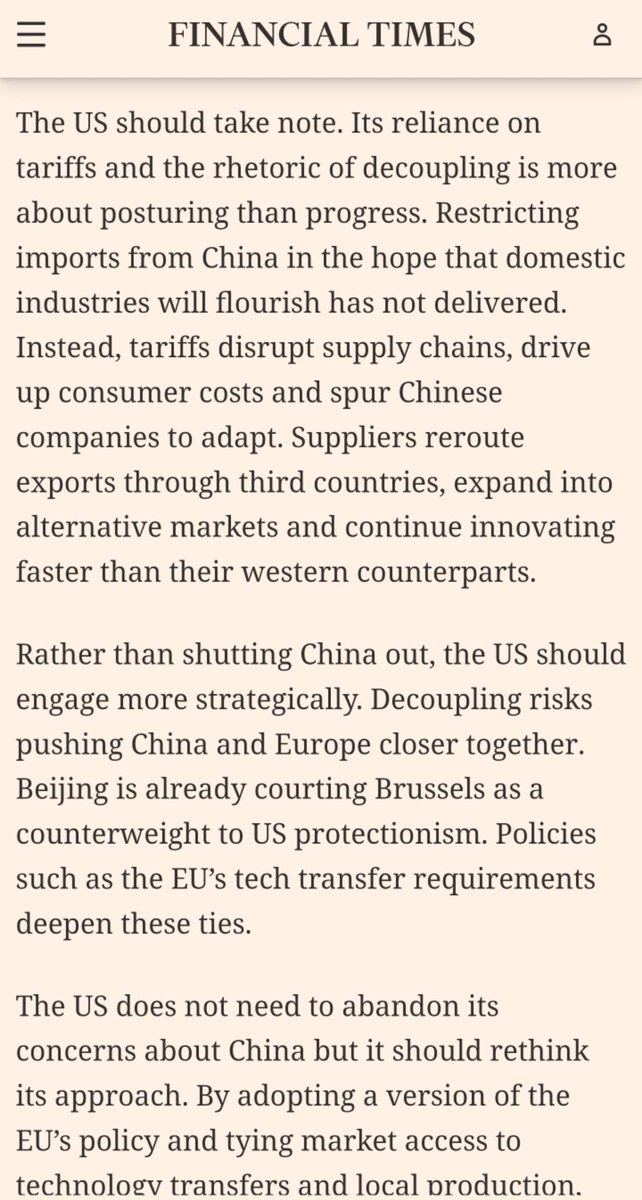
Surprisingly clear-headed FT article about an equally surprising display of strategic thinking from Europe.
Rather than follow the US in its hysterical policy of banning Chinese technology, Europe seems to be crafting a more pragmatic solution: allowing Chinese companies in, provided they build local factories and transfer some of their technological expertise.
This ensures that Europe:
a) learns from China where it can, and
b) in cases where it's simply impossible to catch up at least Europe still benefits from the products and technology, made at home
The article illustrates this with the example of EV batteries, where Europe's homegrown efforts have largely failed (e.g. Northvolt's recent bankruptcy). So what should Europe do: have no EV batteries at all? Shoot itself in the foot with tariffs which mean it'll have to pay much more for its EV batteries than the rest of the world?
No, the smart play here is obviously to leverage China's advanced position in this field while ensuring Europe captures some of the value and builds domestic capabilities. By requiring local production and technology transfers, Europe gets:
- Immediate access to China's world-leading battery technology
- Local manufacturing jobs and expertise
- A chance to develop its own capabilities over time with the knowledge transfer
- Competitive prices for its own EV industry
This is, by the way, exactly the way China developed: they recognized the obvious, which was that the West had built a lot of know-how and advantages that couldn't easily be replicated. Rather than pretend otherwise or foolishly try to reinvent the wheel, they made themselves fully open to foreign firms on the condition they'd produce locally and agree to share some of the technology. That's how they caught up and how, in many industries, they have now overtaken the West; which is exactly why we're today in the opposite situation.
Historian and Columbia University professor Adam Tooze recently, and very astutely, remarked that "the first China shock was when China was incorporating into our supply chains. The second China shock is when we beg to be incorporated into theirs." (x.com/RnaudBertrand/…) It's true, that's where we are, and if we don't we'll stay behind in the same way China would have stayed behind had it not integrated into our supply chains.
Some will say "but this is admitting weakness". Damn right it is! Because, increasingly, we are weak... And when you are weak, there's nothing more destructive (and frankly pathetic) than thinking yourself strong: that's how you make yourself even weaker. Much better to be humble and realistic, admitting weaknesses and working on correcting them.
Now of course, there are other factors at play, it's not only about a technology catchup. China succeeded at becoming a manufacturing behemoth also because of its massive scale, lower labor costs (at least initially), tight integration between the state and the economy, and an extremely sophisticated ecosystem of suppliers, skills, and infrastructure built over decades. Advantages that Europe largely cannot replicate.
But the core principle remains valid: no major economy has ever successfully developed by cutting itself off from the most advanced technologies of its time. Imagine for the sake of argument that China was even more advanced, with say fusion power and warp drive technology that enabled it to travel anywhere in the universe. Would we then refuse to engage with them and insist on developing our own fusion and warp drive technology from scratch, just to avoid any dependency on China? Of course not - that would be absurd. We'd want to benefit from these revolutionary technologies while working to understand and eventually master them ourselves.
The situation with EV batteries and other technologies where China is ahead isn't fundamentally different. Yes, the technological gap is smaller, but the principle is the same: when someone has developed superior technology, the smart move isn't to isolate yourself from it but to find ways to use it yourself and learn from it.
The US approach of trying to completely block Chinese technology seems driven more by pride and politics than economic logic. The irony is striking: they go to extraordinary lengths to block China's access to technologies where the West leads, like advanced semiconductors - clearly recognizing that access to superior technology is a crucial advantage. Yet they simultaneously deprive themselves of the technologies where China is ahead. This contradiction exposes the fundamental lack of logic in their strategy.
Anyhow, in conclusion we seem to have stumbled into some bizarre parallel universe where Europe is, as strange as it sounds, pursuing their own interests with a dash of common sense. I don't know what the hell is going on in Brussels but this sort of rational decision-making is most out of character. Let's all savor this brief moment of lucidity before the normal madness resumes...
Link to the FT piece: ft.com/content/4b1b72…
10 Great Books on Trade and Globalisation (seems relevant)
1)The Globalisation Paradox- @rodrikdani
Great work on the nuances of globalisation. Recognizing its wide benefits, but also how tradeoffs: national self-determination, democracy and economic hyper globalisation conflict.
The problem with liberalism is that it rests on a fundamental contradiction that cannot be resolved. It will always fail, it will always collapse, and this explains everything about our current moment.
Liberals try to hold two commitments at once: on the one hand, they are firmly committed to capitalism; on the other, they express support for principles like human rights, democracy, equality, freedom of speech, environment and the rule of law. This duality is the core of liberalism.
But there's a problem. Capital accumulation requires cheapening labour and nature. This eventually comes into direct conflict with principles like rights and equality. And whenever this conflict appears, the liberal ruling class sides with capital, abandons their lofty principles, and throws workers and nature under the bus. Every. Single. Time.
This results in flagrant displays of hypocrisy. They run on nice-sounding platforms but end up either betraying their promises or actively working against their stated values. They'll slash public services, bail out banks, imprison journalists, beat up students, expand fracking, coup democratically elected leaders in the global South, bomb liberation movements, fund a genocide - they'll even trash international law itself - anything that's needed to maintain the conditions for capital accumulation.
At most, they may try to negotiate mediocre compromises, a few social policies here and there - some abortion rights, a tiny increase in the minimum wage - but nothing that might pose any serious threat to capital accumulation. Thus the soul-crushing slowness of liberal incrementalism. Ultimately they are unwilling to take any of the obvious steps that would actually resolve our urgent social and ecological crises.
This is why nobody trusts liberal politicians. This is why they come across as so fantastically insincere, and even sneering. This is why they feel so spineless and *empty*.
The center cannot hold. Liberalism will always collapse, inevitably handing power to fascists, and this is not acceptable. There is only one way to overcome this deadly impasse, and that is to mobilize a socialist alternative. A political movement that can unite the working-classes, overcome capitalism, deliver real economic democracy, and enable us to achieve rapid progress toward social and ecological goals.
MK mengabulkan sebagian permohonan Partai Buruh dan sejumlah pemohon lain terkait UU Ciptaker. MK mengubah sejumlah pasal dalam UU Ciptaker. Apa saja? news.detik.com/berita/d-76161…
🇵🇸 A toolkit to support organisers strategise for and build effective Stop Arming Israel campaigns from the ground up in universities and trade unions.
workersinpalestine.org/files/toolkit-…
NEW POST: The Economics Nobel has caused a lot of commotion this year. Here is the first reflection on AJR on @criticaldev: Yaku Fernandez-Landa reflects on the Nobel's influence in Economics or Why theories fail.
developingeconomics.org/2024/10/21/the…
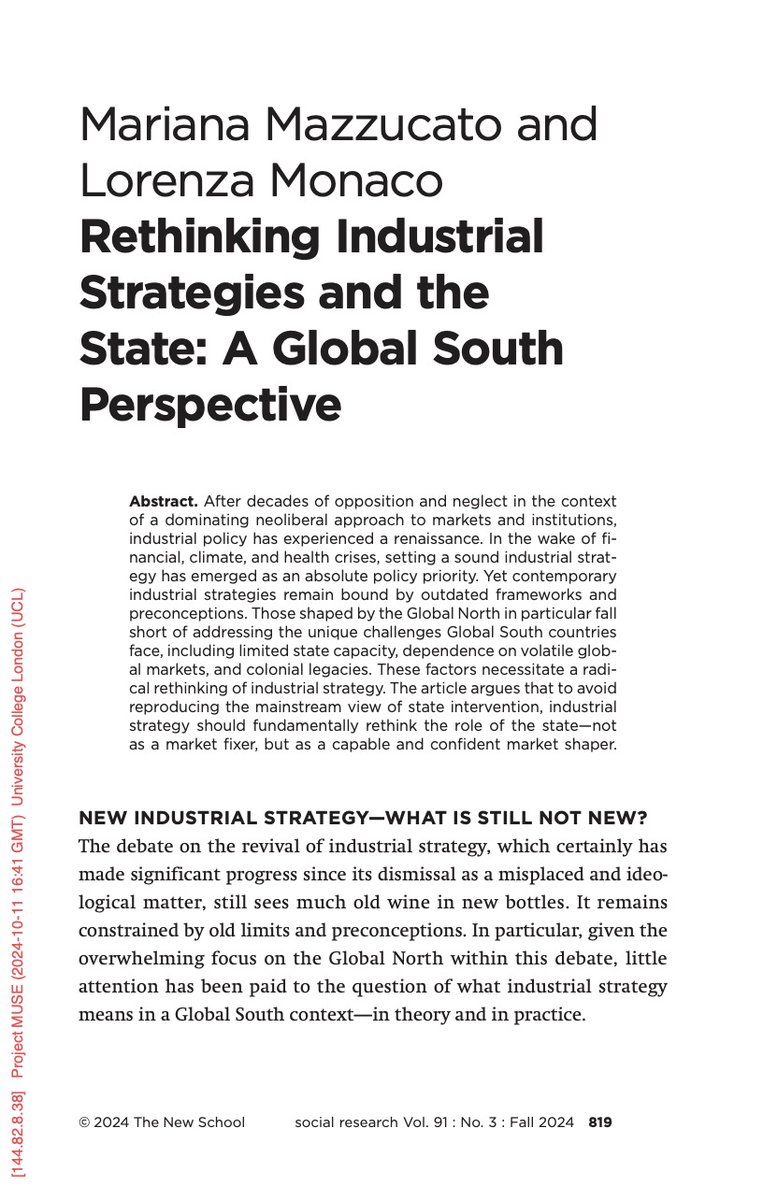
Our new paper “Rethinking Industrial Strategies and the State: A Global South Perspective” has just been published in the latest issue of @SocResJournal: “Challenges to Democracy and the Future of Capitalism”.
In this paper, @lmonaco13 and I highlight the distinct challenges faced by late industrialisers in the Global South. Against this background, we discuss the ways in which industrial strategy should be radically redesigned, proposing core “ingredients” for a purposeful mission-oriented approach that places stronger emphasis on the Global South and development.
Read it here ➡️ muse.jhu.edu/pub/1/article/…
(1/4 🧵)🚨 BREAKING 🚨 We are suing the Dutch state for failing to prevent genocide in #Gaza and to uphold international law. Learn about our demands in this thread ⬇️ and read more about the case here: ↩️
bit.ly/3Y0MWO3
Live video footage from Tel Aviv showed a barrage of projectiles that the Israeli military says were Iranian missiles after warnings of an imminent attack.
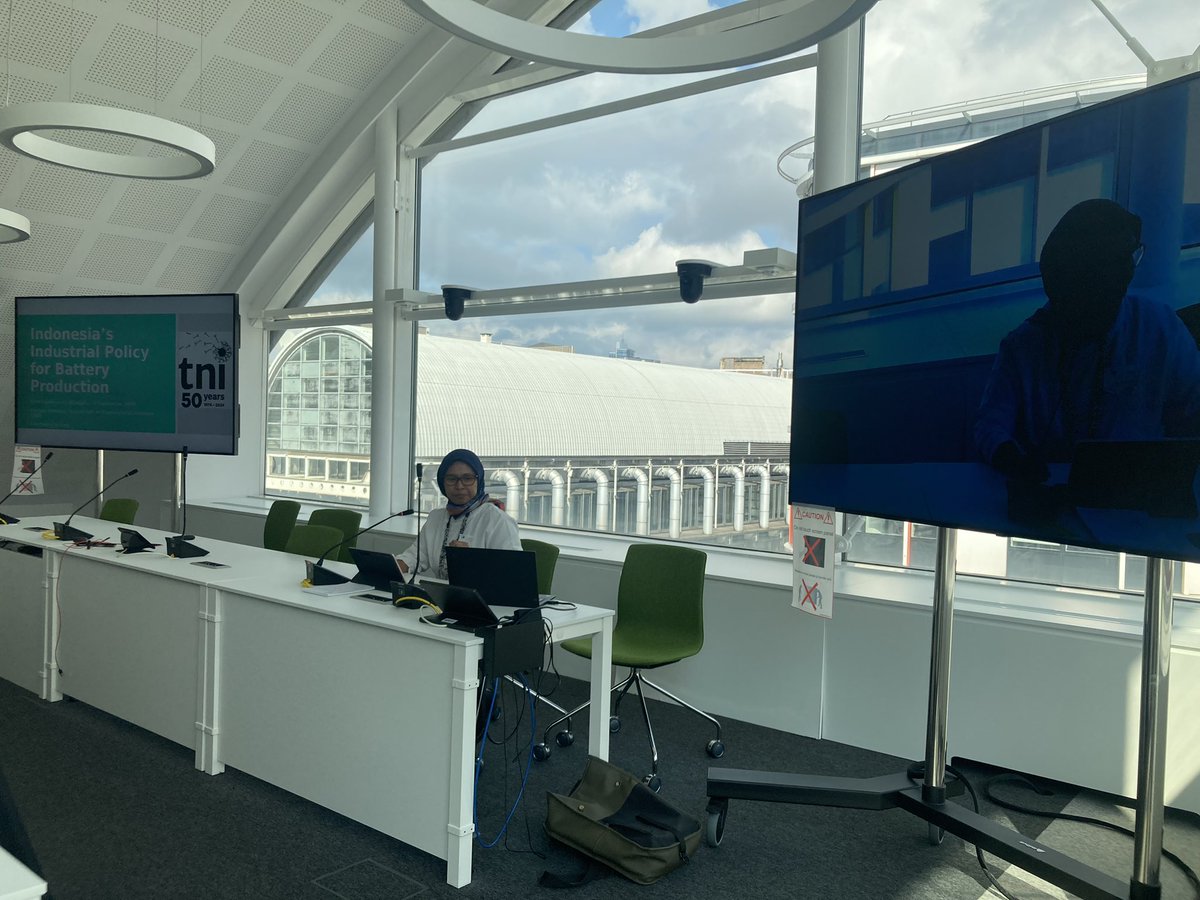
While mineral extraction drives Indonesia’s industrial growth, market forces dominate. With big foreign and national corporations at play, how can we reclaim control for the people? @am_mie@TNInstitute kicks off our three-day strategy meeting to tackle this! 💪
Fmr Italian senior diplomat @MarcoCarnelos in @MiddleEastEye:
"The US, not China, is threatening the rules-based world order. US foreign policy failures have inflicted untold misery worldwide for decades, while Beijing is now achieving tangible results"
middleeasteye.net/opinion/us-chi…
This article illustrates how - partly due to Gaza - we're truly witnessing a sea change in worldwide opinions. Trust towards the U.S. is disappearing like snow under the sun, especially regarding the Middle-East.
As the article describes, the notion of a "rules-based order" as promoted by the US is "nothing more than a semantic trick aimed at concealing western hypocrisy and double standards."
And specifically in the Middle East, a region that the US has tried to shape like no other in the world, American initiatives over the past 3 decades "have almost systematically failed". Take "the collapse of an Israeli-Palestinian deal in 2000", the "war on terror", the “Assad must go” policy in Syria, the failed nuclear deal with Iran that Trump withdrew from, the "biased Abraham Accords, which only served Israel’s interests" and finally, of course, what we're witnessing in Gaza and the West Bank today.
The article contrasts this with China's approach to the region. First of, "China has no military bases in the region", its focus has been to be friends with everyone by "developing economic and trade relations with the countries in the region".
Also, "more recently, China’s diplomatic efforts have accomplished two major successes", which could happen for the very reason that it maintains friendly relations with everyone: the "rapprochement between Iran and Saudi Arabia" and the "reconciliation talks among the different Palestinian factions, especially between Fatah and Hamas".
As the article explains, this means that "China could legitimately claim that its role as a mediator between Israel and Palestine stands a greater chance of success": because "one thing is certain: Beijing - again, contrary to Washington - would be an honest broker" and "a Chinese success here could significantly bolster the rules-based order, but the right one - one that respects international law".
As the article concludes "China is not challenging the Global West’s rules-based order. It is simply joining the Global Rest in demanding respect for international law, its consistent application to all states without double standards and the putting aside, finally, of misleading western terminology."
You can agree or disagree with what the article says, but what you cannot argue against is that perceptions are changing, which is what matters at the end of the day given that we live in a world - for better or worse - where perception is reality.
I've made 7 free online courses to help you read Karl Marx:
Reading Marx's Capital v1 (2019 & 2007 eds)
Reading Marx's Capital v2
Reading Marx's Grundrisse (2023 & 2020 eds)
Marx, Capital, & the Madness of Economic Reason
The ABC of Contemporary Capital
davidharvey.org/reading-capital