aminoacid

257 posts

aminoacid banner
aminoacid

aminoacid

@ameanasad

Building https://t.co/V8vRkzF69B . ex engineer @ProtocolLabs. Previously founded @yasa and https://t.co/xiHDXOzlgp . Math on the side, always.

Katılım Ocak 2022
133 Takip Edilen79 Takipçiler
aminoacid
aminoacid@ameanasad·
@kaepora is doing really awesome stuff :).
Nadim Kobeissi@kaepora

Announcing the preliminary program for Cedarcrypt — our inaugural applied cryptography summer school and conference, July 13–16, 2026 at the American University of Beirut - Mediterraneo in Paphos, Cyprus! We've put together a program we're genuinely proud of — a pedagogical progression from accessible foundations to state-of-the-art constructions, featuring lectures, hands-on workshops, and research talks from leading voices across academia and industry. The program spans everything from accessible foundations to cutting-edge research: Bart Preneel (KU Leuven) opens with a keynote, followed by deep dives into FHE with Emad Heydari Beni (Nokia Bell Labs), state-of-the-art hash-based SNARKs with Giacomo Fenzi (EPFL), and Zero-Knowledge Proofs with Tarek Galal (TU Berlin). Practitioners will hear from Zeke Hunter-Green how The Guardian built their anonymous whistleblowing system (CoverDrop + MLS), and a host of other guest speakers who will help attendees learn post-quantum migration strategies across lattices, isogenies, and codes, and get hands-on with threshold signing, MPC engineering, and constant-time programming — all in four days on the Mediterranean coast. Organized in collaboration with the IACR, and hosted on Cyprus's Mediterranean coast — a UNESCO World Heritage city where you can step from a workshop on threshold signing straight to a seaside taverna. Thanks to our generous sponsors — Electi, PQShield, Symbolic Software, Zama, and several anonymous donors — we're offering FULL SCHOLARSHIPS (travel + lodging) to students and early-career researchers, awarded on a rolling basis until funds are exhausted. Graduate students, early-career researchers, and practitioners in applied cryptography: we built this for you! Join us this July in sunny Paphos! Let's make this an inaugural event to remember!
English
0
0
1
20
aminoacid
aminoacid@ameanasad·
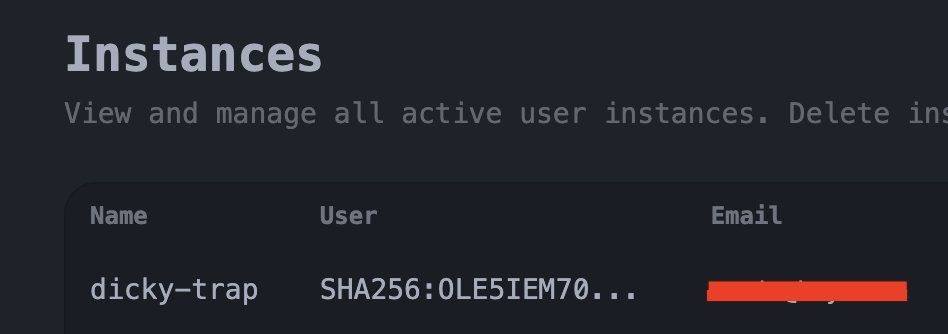
when you have a random name generator for your instances and it starts threatening you
aminoacid tweet media
English
0
0
1
8
aminoacid
aminoacid@ameanasad·
@michael_nielsen i think it also goes to show how much team chemistry matters in team sports.
English
0
0
0
14
Michael Nielsen
Michael Nielsen@michael_nielsen·
Both their smiles! And the goal so beautifully illustrates both - Messi trusts Ronaldinho to do the impossible chip, and so he runs behind the defenders, rather than wide. It's a small matter, but illustrative
English
3
0
6
3K
Michael Nielsen
Michael Nielsen@michael_nielsen·
Leo Messi and Steph Curry remind me so much of each other in how they play - so much joy and creativity, so enabling of teammates, so loved by their teammates. It’s really beautiful to watch!
English
3
3
110
7.3K
aminoacid retweetledi
geomatrick 🌐 👷 💻
geomatrick 🌐 👷 💻@patrickwoodhead·
I'm in SF this week around HumanX. If you're thinking about private inference, secure model deployment, or confidential computing, I'd love to talk about what we are up to at @Confi_AI
English
0
1
4
49
aminoacid retweetledi
Confidential AI
Confidential AI@Confi_AI·
Trusted Execution Environments, explained. A useful analogy is the transition from HTTP to HTTPS. With HTTP, you sent your data in plaintext but couldn't confirm who you were talking to. HTTPS allows you to confirm who you're talking to and encrypt your data in transit. But once your data arrives at the server, it's decrypted and processed in plaintext. This means the system administrator can see your data. TEEs go a step further. Your data stays encrypted by hardware during computation. You can verify who you're talking to, what software they're running, and that your data is private throughout. The sys admin can't access the data. No one can. All of this, like HTTPS, adds a negligible performance cost.
English
0
1
5
58
aminoacid
aminoacid@ameanasad·
@realbarnakiss this is very interesting, are you planning to publish any source code for this?
English
1
0
1
231
Barna
Barna@realbarnakiss·
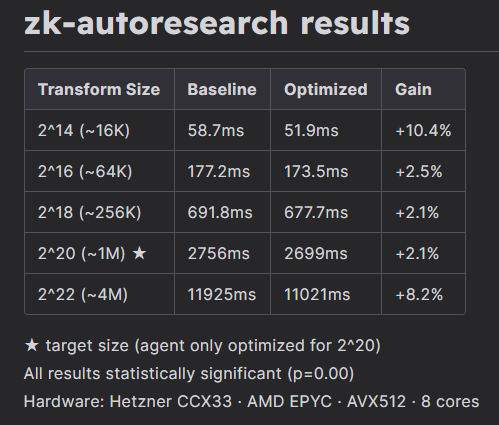
I implemented zk-autoresearch, based on Karpathy's autoresearch loop, on a production ZK prover, Plonky3. Soundness review by a Plonky3 engineer is pending before I treat these as final. The methodology finding is already clear, preliminary results below. Target: Plonky3's NTT implementation — the inner loop of proof generation, already heavily optimized by expert ZK engineers. If the approach doesn't work here, it doesn't work anywhere. Hardware: Hetzner CCX33, AMD EPYC, AVX512, 8 cores. Model: I used Claude Sonnet 4.6 deliberately, Opus would have marginal gains at significantly higher cost per iteration. For a loop running potentially 100s of times in future experiments, that tradeoff matters. 74 iterations. Fully autonomous by design, but in this first experiment 2 adjustments were made to the setup (at iterations 5 & 10) to nudge the agents to be more decisive. - Raised MAX_TOKENS from 8192 to 20000, and added "you must always make a change" as the agent kept hitting the token limit. This unlocked improvements at iterations 6 and 9. - Added near-miss display in the history prompt, showing reverted experiments within 1.5% as combination candidates. This set up iteration 21, where the agent revisited a failed idea that now worked because the surrounding code changed. Iteration constraints: - Each iteration ran correctness tests to prevent faulty proofs. Note: during the run these were compile-level checks; post-run correctness was confirmed via full end-to-end ZK proof generation and verification with Radix2DitParallel on BabyBear (10 tests, all passing). - Agents were structurally prevented from touching FRI or other soundness-critical components — only dft/src/ and baby-bear/src/ were writable. 3% faster at the target size (2^20) during the experiment. Post-experiment benchmarks across 2^14 to 2^22 showed the optimizations generalized better than expected, particularly at the extremes (see image). The agent only optimized for 2^20. The known issues (short history window causing agent amnesia, wasted tokens on repo exploration, correctness test targeting wrong package) meant the last improvement was found at iteration 21. Round 2 with these fixed should yield a more consistent staircase pattern over 100 iterations. All gains came from the agent finding redundant work in the hot butterfly loop: precomputing products, hoisting broadcasts, skipping multiplications by 1. Pure implementation-level work, no algorithmic changes. 6 improvements in 74 iterations. 57 regressions. The full experiment log with every diff, benchmark result, and agent reasoning is auditable. The agent that found these improvements is not a ZK expert. It reasoned about Rust and Montgomery arithmetic from first principles and found real optimizations in code already written by expert engineers. ZK has been underexplored for agentic optimization because people worry about agents breaking proof soundness. The concern is real but misapplied here, all 6 changes are mathematically equivalent transformations, verified by end-to-end proof generation and verification. (Soundness review by a Plonky3 engineer is pending) Round 2 is being prepared with the known issues from Round 1 fixed. Full findings and code will be open sourced after it completes. If you are ZK team and want to run this, feel free to DM me. Inspired by @karpathy autoresearch pattern. First known application to a production ZK prover.
Barna tweet media
English
10
19
180
17.1K
aminoacid retweetledi
Confidential AI
Confidential AI@Confi_AI·
We built a simulator for c8s, our confidential Kubernetes product with autoscaling.
English
1
1
5
45
aminoacid
aminoacid@ameanasad·
claude-fleet now supports gcp and local dev containers cc @trq212 link below
English
1
0
1
31
aminoacid
aminoacid@ameanasad·
generating so much output with claude code, the bottleneck has become the review process my a large margin
English
1
0
0
34
aminoacid
aminoacid@ameanasad·
claude code is being extra dumb today.
English
0
0
2
38
aminoacid
aminoacid@ameanasad·
@wyatt_benno @LouisThibault87 the CC functionality in GPUs is already available in H100s, B200s, B300s, and the new vera rubins. So they cost the same as the GPU itself, you just have to turn it on and pair the GPU with a CPU that also supports CC which is the case for most modern data center CPUs
English
1
0
2
89
Louis Thibault
Louis Thibault@LouisThibault87·
Perhaps I'm late to the party on this one, but seems like a more serious breach of TEEs than what I've seen so far. arxiv.org/abs/2602.11088
English
3
0
4
407
aminoacid retweetledi
Confidential AI
Confidential AI@Confi_AI·
We just shipped Kettle, which builds and verifies *attested builds*. Kettle uses TEEs (Trusted Execution Environments) to sign builds using hardware attestation. Link in thead.
English
1
1
4
93
aminoacid
aminoacid@ameanasad·
@gakonst @karpathy i started on something that runs claude code instances on confidential VMs here i manage them with a TUI here: github.com/AmeanAsad/clau…. I need confidential VMs for a bunch of dev work im doing but it also happens to be a more secure runtime at the same time.
English
0
0
1
155
Andrej Karpathy
Andrej Karpathy@karpathy·
Expectation: the age of the IDE is over Reality: we’re going to need a bigger IDE (imo). It just looks very different because humans now move upwards and program at a higher level - the basic unit of interest is not one file but one agent. It’s still programming.
Andrej Karpathy@karpathy

@nummanali tmux grids are awesome, but i feel a need to have a proper "agent command center" IDE for teams of them, which I could maximize per monitor. E.g. I want to see/hide toggle them, see if any are idle, pop open related tools (e.g. terminal), stats (usage), etc.

English
826
834
10.5K
2.4M
Andrej Karpathy
Andrej Karpathy@karpathy·
@nummanali tmux grids are awesome, but i feel a need to have a proper "agent command center" IDE for teams of them, which I could maximize per monitor. E.g. I want to see/hide toggle them, see if any are idle, pop open related tools (e.g. terminal), stats (usage), etc.
English
303
117
3.1K
1.4M
Numman Ali
Numman Ali@nummanali·
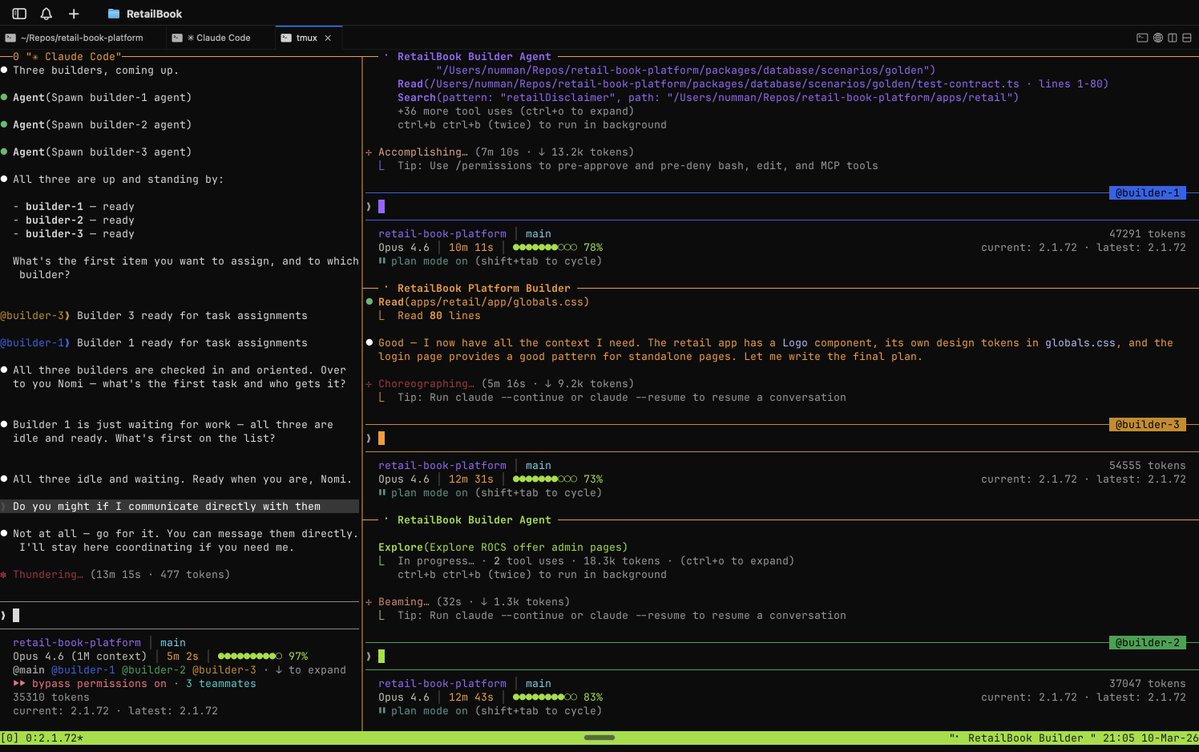
Claude Code teams with tmux is really cool When you run with team mode enabled in tmux, it automatically opens the additional terminal in pane I don't really get my main agent to orchestrate, I chat to them myself CLAUDE_CODE_EXPERIMENTAL_AGENT_TEAMS=true claude
Numman Ali tweet media
English
63
71
1.4K
190.8K