Aman

12 posts

Aman

Aman

@amkr2525

New Delhi, India Katılım Mayıs 2015
132 Takip Edilen14 Takipçiler
Aman
Aman@amkr2525·
What’s it like exploring Fedora from the inside? I documented my journey as an Outreachy 2026 applicant 🌍💻. Please read and share your feedback! #Outreachy #Fedora #OpenSource #Linux
English
0
0
0
59
Aman retweetledi
Neel Somani
Neel Somani@neelsomani·
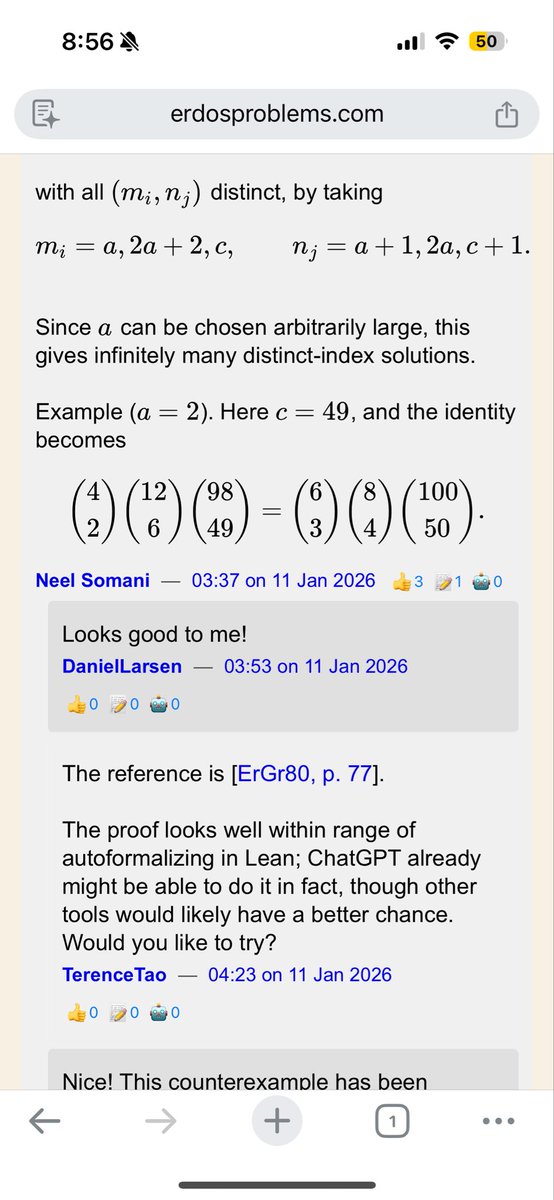
Weekend win: The proof I submitted for Erdos Problem #397 was accepted by Terence Tao. The proof was generated by GPT 5.2 Pro and formalized with Harmonic. Many open problems are sitting there, waiting for someone to prompt ChatGPT to solve them:
Neel Somani tweet media
English
334
1.2K
8.7K
3.6M
Aman retweetledi
Aman retweetledi
Andrej Karpathy
Andrej Karpathy@karpathy·
Agency > Intelligence I had this intuitively wrong for decades, I think due to a pervasive cultural veneration of intelligence, various entertainment/media, obsession with IQ etc. Agency is significantly more powerful and significantly more scarce. Are you hiring for agency? Are we educating for agency? Are you acting as if you had 10X agency? Grok explanation is ~close: “Agency, as a personality trait, refers to an individual's capacity to take initiative, make decisions, and exert control over their actions and environment. It’s about being proactive rather than reactive—someone with high agency doesn’t just let life happen to them; they shape it. Think of it as a blend of self-efficacy, determination, and a sense of ownership over one’s path. People with strong agency tend to set goals and pursue them with confidence, even in the face of obstacles. They’re the type to say, “I’ll figure it out,” and then actually do it. On the flip side, someone low in agency might feel more like a passenger in their own life, waiting for external forces—like luck, other people, or circumstances—to dictate what happens next. It’s not quite the same as assertiveness or ambition, though it can overlap. Agency is quieter, more internal—it’s the belief that you *can* act, paired with the will to follow through. Psychologists often tie it to concepts like locus of control: high-agency folks lean toward an internal locus, feeling they steer their fate, while low-agency folks might lean external, seeing life as something that happens *to* them.”
Garry Tan@garrytan

Intelligence is on tap now so agency is even more important

English
2K
9.3K
49.8K
11.3M
Aman retweetledi
Andrej Karpathy
Andrej Karpathy@karpathy·
I've never felt this much behind as a programmer. The profession is being dramatically refactored as the bits contributed by the programmer are increasingly sparse and between. I have a sense that I could be 10X more powerful if I just properly string together what has become available over the last ~year and a failure to claim the boost feels decidedly like skill issue. There's a new programmable layer of abstraction to master (in addition to the usual layers below) involving agents, subagents, their prompts, contexts, memory, modes, permissions, tools, plugins, skills, hooks, MCP, LSP, slash commands, workflows, IDE integrations, and a need to build an all-encompassing mental model for strengths and pitfalls of fundamentally stochastic, fallible, unintelligible and changing entities suddenly intermingled with what used to be good old fashioned engineering. Clearly some powerful alien tool was handed around except it comes with no manual and everyone has to figure out how to hold it and operate it, while the resulting magnitude 9 earthquake is rocking the profession. Roll up your sleeves to not fall behind.
English
2.6K
7.4K
55.7K
16.9M
Aman retweetledi
Andrej Karpathy
Andrej Karpathy@karpathy·
A number of people are talking about implications of AI to schools. I spoke about some of my thoughts to a school board earlier, some highlights: 1. You will never be able to detect the use of AI in homework. Full stop. All "detectors" of AI imo don't really work, can be defeated in various ways, and are in principle doomed to fail. You have to assume that any work done outside classroom has used AI. 2. Therefore, the majority of grading has to shift to in-class work (instead of at-home assignments), in settings where teachers can physically monitor students. The students remain motivated to learn how to solve problems without AI because they know they will be evaluated without it in class later. 3. We want students to be able to use AI, it is here to stay and it is extremely powerful, but we also don't want students to be naked in the world without it. Using the calculator as an example of a historically disruptive technology, school teaches you how to do all the basic math & arithmetic so that you can in principle do it by hand, even if calculators are pervasive and greatly speed up work in practical settings. In addition, you understand what it's doing for you, so should it give you a wrong answer (e.g. you mistyped "prompt"), you should be able to notice it, gut check it, verify it in some other way, etc. The verification ability is especially important in the case of AI, which is presently a lot more fallible in a great variety of ways compared to calculators. 4. A lot of the evaluation settings remain at teacher's discretion and involve a creative design space of no tools, cheatsheets, open book, provided AI responses, direct internet/AI access, etc. TLDR the goal is that the students are proficient in the use of AI, but can also exist without it, and imo the only way to get there is to flip classes around and move the majority of testing to in class settings.
Andrej Karpathy@karpathy

Gemini Nano Banana Pro can solve exam questions *in* the exam page image. With doodles, diagrams, all that. ChatGPT thinks these solutions are all correct except Se_2P_2 should be "diselenium diphosphide" and a spelling mistake (should be "thiocyanic acid" not "thoicyanic") :O

English
930
2.4K
16.5K
2.5M