Andrew Milne

394 posts

Andrew Milne banner
Andrew Milne

Andrew Milne

@andy_tonality

Music theorist, practitioner, and cognitive scientist at MARCS Institute, Western Sydney University. @[email protected] @andytonality.bsky.social

Sydney, New South Wales Katılım Temmuz 2011
855 Takip Edilen326 Takipçiler
Andrew Milne retweetledi
Andrew Milne
Andrew Milne@andy_tonality·
We are offering an exciting #MusicScience PhD scholarship in Sydney, for our ARC Discovery project Revealing Universal and Cultural Origins of Music-Induced Emotion: international field trips, music cognition experiments, & Bayesian analyses! Please share. westernsydney.edu.au/schools/grs/sc…
Andrew Milne tweet media
English
1
3
5
478
Andrew Milne retweetledi
Ceren Ayyildiz
Ceren Ayyildiz@cerenayyildiz4·
At least 3 bonuses: Andy is an amazing supervisor + you’ll be working with the leading researchers in the field + it’s a very exciting research project with lots of opportunities along the way!
Andrew Milne@andy_tonality

We are offering an exciting #MusicScience PhD scholarship in Sydney, for our ARC Discovery project Revealing Universal and Cultural Origins of Music-Induced Emotion: international field trips, music cognition experiments, & Bayesian analyses! Please share. westernsydney.edu.au/schools/grs/sc…

English
0
2
4
305
Andrew Milne
Andrew Milne@andy_tonality·
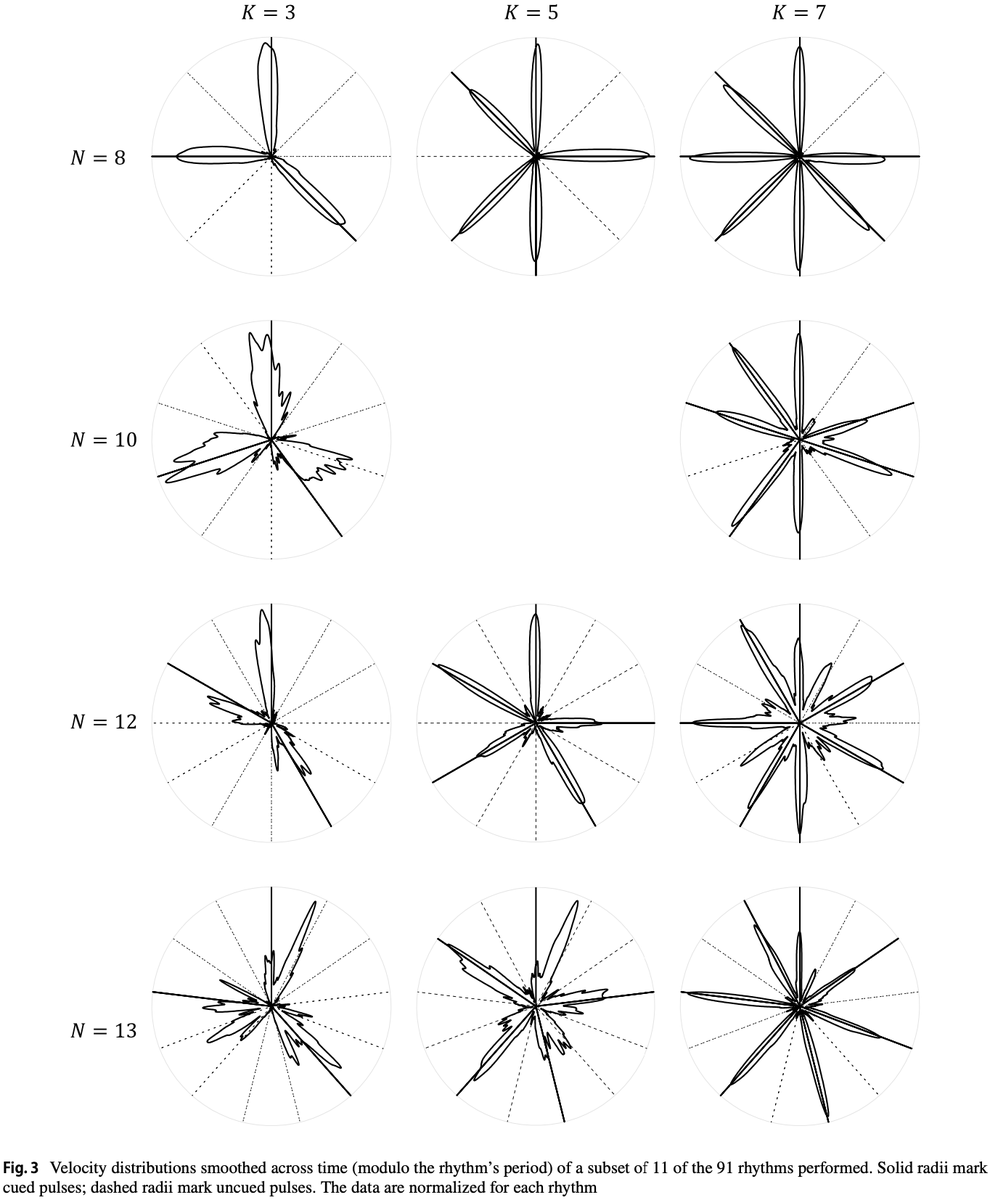
In contradistinction to Povel and Essens' classic work, we find the edges of groups of cues are tapped with lower (not higher) probability. Instead, our findings show that taps to our unfamiliar and "difficult" rhythms are guided by rather crude and lossy heuristics. (6/6)
English
1
0
0
149
Andrew Milne
Andrew Milne@andy_tonality·
A new paper about how rhythmic structure affects tapping accuracy and temporal expectation. Participants tapped along with 91 highly syncopated rhythms, several in unusual time signatures. Some rhythms were performed well; some very poorly. doi.org/10.3758/s13414… (1/6)
Andrew Milne tweet media
English
3
10
37
2.7K
Andrew Milne
Andrew Milne@andy_tonality·
@elegantfowl Yes, semantics is one of several difficulties with this type of research.
English
0
0
0
11
Spycrafty
Spycrafty@elegantfowl·
@andy_tonality True 'nuff ... finding evidence of some universality obscured by semantics is quite a feat!
English
1
0
0
14
Andrew Milne
Andrew Milne@andy_tonality·
doi.org/10.1371/journa… : This is the second article from our #musicscience field-research in Papua New Guinea and Sydney. We find that acoustical roughness is universally associated with musical consonance/dissonance (operationalized as “stability”). 1/11 @elineadrianne
English
1
11
25
1.7K
Judea Pearl
Judea Pearl@yudapearl·
The idea of a hierarchy is that expressions at level i can be written in the notation of level i or higher, but not the converse. Eg, You can't write an expression for P(harm) or P(cause|effect) in the notation of do-expressions, namely, the notation that describes RCTs. The implications are practical: you cannot infer P(harm) from RCT's, no matter how many you have and how clean and precise they are.
English
2
0
2
119
Dr Kareem Carr
Dr Kareem Carr@kareem_carr·
The Ladder of Causation This is a fundamental idea that everybody who cares about data needs to know about. 1. The Ladder of Causation has three levels. 1. Association. This involves the prediction of outcomes as a passive observer of a system. 2. Intervention. This involves the prediction of the consequences of taking actions to alter the behavior of a system. 3. Counterfactuals. This involves prediction of the consequences of taking actions to alter the behavior of a system had circumstances been different. 2. The levels of causation are defined by the kinds of data to which we have access as experimenters. Imagine a machine that can spit out data. You can observe what comes out of the machine and analyze the information, but you can't touch the machine. This is the level of Association. It is the level of most statistical analyses and AI algorithms. Now imagine that you are allowed to touch the machine. You can set it to generate specific datasets that you would like in the future. This is the level of Intervention. It is the kind of data that we get out of standard scientific experiments where we fully control the environment. The final level of the ladder of causation is our own imaginations. It is the ability to imagine the machine as it used to be, and to imagine what we would have gotten from it had we pushed different buttons. We have to use our imaginations because we can never directly observe what would have happened in the past had we done things differently. This is the level of Counterfactuals. It is the hardest kind of science to do because we can't do experiments to answer the questions that we really want to answer. 3. The counterfactual imagination is central to our science, our morality and even our storytelling. The counterfactual level is the most conceptually difficult level because we can never get counterfactual data even in theory. It is also the most fascinating level. It is the level of thought experiments like the one that led Einstein to invent the theory of relativity. He imagined himself riding along a light beam and took that idea to its logical conclusion. Most of the laws of physics are counterfactual laws. They tell us what will happen in all situations including worlds with histories that are different from our own. This is one of the reasons that physics is such a powerful science. The counterfactual level is also the level of our moral imaginations. It is core to our ability to reason morally that we can imagine what would have happened had we or others acted differently. The ability to consider counterfactuals is central to our ability to read and write stories. Arguably, it is the ability to understand counterfactuals that sets human beings apart from other animals. There are many more deep ideas here which I will explore in future threads. This is post 004. It is part of a series of posts about the new science of causal inference. They are based on the content of the Book of Why by Judea Pearl with lots of commentary from me. Follow me (@kareem_carr) so you don't miss out on the next post. Please show support by liking and retweeting the thread.
Dr Kareem Carr tweet media
English
33
224
1.2K
374.5K
Andrew Milne
Andrew Milne@andy_tonality·
@noahkahrs @elineadrianne Thank you. The changes were not that substantive – a bit more care around the terminology of consonance/dissonance and stability/finishedness, and some more theoretical background related to universal versus cultural mechanisms. The peer reviews are available on the website.
English
0
0
0
44
Andrew Milne
Andrew Milne@andy_tonality·
A huge thank you to our research assistants, hosts, and organisers from Towet, Yawan, and other villages in the Uruwa River Valley, for your warm welcome and keeping us safe, and your enthusiastic engagement with the research. Irot orogo! 11/11
English
1
0
1
84
Andrew Milne
Andrew Milne@andy_tonality·
In combination with the earlier article – the results show the relevance of specific universal and cultural mechanisms in mediating the effect of music on our emotions and feelings. 10/11
Andrew Milne tweet media
English
1
0
1
99