andyguzman.eth | privacy/acc retweetledi
andyguzman.eth | privacy/acc
3.8K posts


andyguzman.eth | privacy/acc
@AndyGuzmanEth
Neutrality requires blindness . . . @ethereumfndn More privacy on Ethereum & the 🌎 ⨳ Catholic, husband and father
Costa Rica Katılım December 2010
2.9K Takip Edilen3.5K Takipçiler
2026 Yıllık Özeti
@AndyGuzmanEth hesabının Twitter yılını gör
@Andercot yes but this is not a given. Centralization (and industry capture) is an outcome you can see again and again in many industries
hence decentralized AI and other decentralized tech is fundamental for a self-sovereignty future
English

The surest way to a dystopian hellhole is centralization, but the fastest pace of development is one where participants think they can capture the whole market and burn as much capital as quickly to capture it.
The best outcome for humanity is likely in the end, open source is so competitive with centralized frontier models there is no monopoly, the private capital deployed is never recouped, and OpenAI and Anthropic never justify their valuations.
This means the money was ultimately burned for the benefit of all humanity and gains placed into an open source resource, just as their charter originally stated.
Maximum irony in the maximum closed for-profit non-profit ultimately being non-profitable and birthing its open-source successor.
therefore likely
English
@casiojapi > That's why we're announcing that Fat Solutions is continuing its work as usual.
Thankful for you guys! :)
English

To our clients, friends, and colleagues across this industry: we have some news to share.
The past few years have not been easy on this space. Crypto is nowhere near where we thought it would be when we started. Protocols and innovation have stalled, and (apart from gambling) nothing paradigm-shifting has emerged in a long time.
Most of the funding sources that fueled new ideas died over the last year, or are slowly bleeding out and laying off their best people because none of it is sustainable anymore.
As for privacy, nobody seems to care... Nobody cares that their entire onchain activity is public... Nobody cares about chainalysis... Nobody wants to support privacy protocols because they are too scared of regulators, AML, KYC, WW3, politics and the AGI taking over everything.
The will to build something better than what banks and traditional finance have to offer has largely disappeared. Data breaches happen constantly, hacks are a daily meme, yet indifference only grows.
The organizations that sustained most of this work are shutting down one after another, and companies like ours are announcing layoffs or closing entirely as AI takes over everything.
We gave this everything we had. And honestly, it's not clear to us how any of this continues.
That's why we're announcing that Fat Solutions is continuing its work as usual.
Huge thanks to everyone who worked with us and believed in what we are doing.

English


andyguzman.eth | privacy/acc retweetledi

Today we're launching EthSystems.
We build confidential systems for institutional Ethereum.
Institutions want to use Ethereum, but one of the biggest problems is the lack of built-in, modular privacy tools.
We were the Ethereum Foundation's Institutional Privacy Task Force (IPTF) for the past year. We had hundreds of conversations with central banks, regulators, tier-one banks, and asset managers, shipping open source work the whole time.
Wall Street has found crypto as an asset class, but not yet as commercial infrastructure. Institutions want to run real flows on Ethereum: stablecoins, tokenized assets, settlement. These are businesses with billions of dollars on the line, and no bank will operate in full public view. On a public ledger, confidentiality is the hard part: each party to a transaction should see what it has a right to see, and nothing more.
We have a year of proof of work: private bonds, confidential stablecoin transfers, private settlement across chains, the Ethereum Privacy Map, and more. All with protocol specs and security properties, at our website.
We've spent a decade working on privacy in crypto. We know there's no silver bullet. Different use cases need different systems, each designed, specified, and hardened properly, and someone has to do that work. That's why EthSystems exists.
We're an independent, for-profit company, backed by long-term Ethereum-aligned investors. This is a decade-long transition, and we aren't going anywhere.
If you're an institution that wants to build on Ethereum, talk to us. We're hiring: BD in New York, protocol engineers, ops: join@ethsystems.org
English
andyguzman.eth | privacy/acc retweetledi

We've been quietly working on this for a long time, and today we finally get to share it 🙌
Introducing Shutter Governance, a voting system for municipalities, councils, universities, unions, and cooperatives where ballots stay private and anyone can verify the results
🧵 1/6

English

andyguzman.eth | privacy/acc retweetledi

Two weeks ago, Ethereum researchers met in Berlin to continue charting the protocol's long-term trajectory, following along discussions with client teams in Svalbard in April.
The updated strawmap is at strawmap.org, and I attached a picture of it to this post.
My own high-level takeaways:
* "Lean Ethereum" is not a single one-shot upgrade, it is a collection of improvements that will come online to the Ethereum network over the course of three or four years. But make no mistake, this IS the third major iteration of Ethereum in the same way that the Merge was the second. Almost every major piece of the protocol will be replaced:
- Verification through recursive STARKs, rather than direct re-execution. Recursive STARKs become an enshrined first-class core component of the protocol
- Replacing everything quantum-vulnerable with quantum-safe alternatives
- Consensus: decoupled available chain and finality, one or two-round finality. Theoretically optimal security properties, simpler than today, and faster than today
- Multidimensional gas
- State: not just tree structure, but what *types* of state are available
- Changes to client architecture
...
At the same time, simplification, cleanup and future-proofing. And this will all be done in a way that minimizes disruption to existing application. We've done this before (the Merge), we can do it again.
* H-star (aka Hegota) is probably Ethereum's last thematically "pre-Lean" fork. Starting from I-star, most of everything we do will have a very strong "Lean" feel to it in one way or another.
* Privacy is no longer an afterthought, it is a first class goal. When designing Frames, the mempool, additions to the state tree, we explicitly ask the question "okay, how do quantum-safe, intermediary-free privacy protocol transactions go through this, and what is the overhead?"
* Formal verification of everything for security.
* FV also makes us much more comfortable with canonicalization (having pieces of the protocol that are directly defined as a piece of bytecode expressed in some language). evm-asm is being written in part to become a canonical proof system for the EVM.
* Quantum safety has shifted up a LOT in priority. This adds a lot of work (eg. finalizing a quantum-safe blobs design has become urgent; this work has already been ongoing for months)
* Probably the single most disruptive part of the plan is the changes to state. There is growing consensus around leaving present-day-style "dynamic state" mostly unchanged, but scaling it only a medium amount, and adding new types of state that are more scalability-friendly (eg. no need for builders to sync/store all of it) but more restrictive, and that will scale a large amount.
eg. possible Ethereum in 2030: 2 TB of present-day-style (dynamic) state, and 100 TB of new-style (scalable but restrictive) state
This "new-style" state would work very well for ERC20s, NFTs, many defi use cases, but not eg. highly "central" objects like Uniswap contracts, or onchain order books, or other complex things (which are crucial for Ethereum but which only take up a small percentage of state)
Hence, it will not be *necessary* to rewrite any apps, but it will be *very cost-effective* to eg. rewrite an ERC20 token into a newer design that uses a new type of UTXO storage that is currently being explored, so that it will have >10x lower txfees.
Design of these new state types (current ideas: keyed nonces, ring buffers, UTXOs, statically accessible state, temp state) is an area where we will need a lot of feedback from application developers (incl. privacy-friendly application developers) and probably several rounds of rethinking and iteration.
* In the context of a much larger total state size, we need to figure out the incentive issues around who stores this state and what motivates them to. Even saying "each node stores 1%" is not good enough - why do they store that 1% and why are they willing to serve it? This is being elevated as a first-class research area.
* Ethereum will need to have a "VM" other than EVM in one form or another - at the very least, we need something like leanISA for recursive STARKs - and the gains are large in exposing it to users so that we support programmable privacy and better scalability. Right now, the most likely contenders are leanISA and RISC-V.
My own ideal is that in this world, we adjust the protocol so that the EVM becomes a high-level-language compiler-level feature, and the protocol only "sees" RISC-V / leanISA directly. But this is still far away.
* Gas limit increases, blob increases and slot time decreases will happen many times over the next ~5 years. We expect a large gas limit increase with Glasterdam. Each step of increased scale or decreased slot time is a matter of getting to the point where it is safe to do it, which comes from a combination of client optimization and protocol changes.
Ethereum is CROPS.
Ethereum is scaling.
Ethereum is reinventing itself.
Onward.

English
andyguzman.eth | privacy/acc retweetledi

@argotorg 5/ Announced just today: @ethereuminsti, an independent non-profit dedicated to accelerating institutional adoption of Ethereum and its broader ecosystem.
We're looking forward to seeing how they help the world's largest institutions build on Ethereum.
x.com/ethereuminsti/…
Ethereum Institutional@ethereuminsti
1/ Announcing Ethereum Institutional An independent non-profit dedicated to accelerating the institutional adoption of Ethereum, its L2s, applications and overall ecosystem.
English
andyguzman.eth | privacy/acc retweetledi

1/ Announcing Ethereum Institutional
An independent non-profit dedicated to accelerating the institutional adoption of Ethereum, its L2s, applications and overall ecosystem.
English
andyguzman.eth | privacy/acc retweetledi

Diamond iO Update
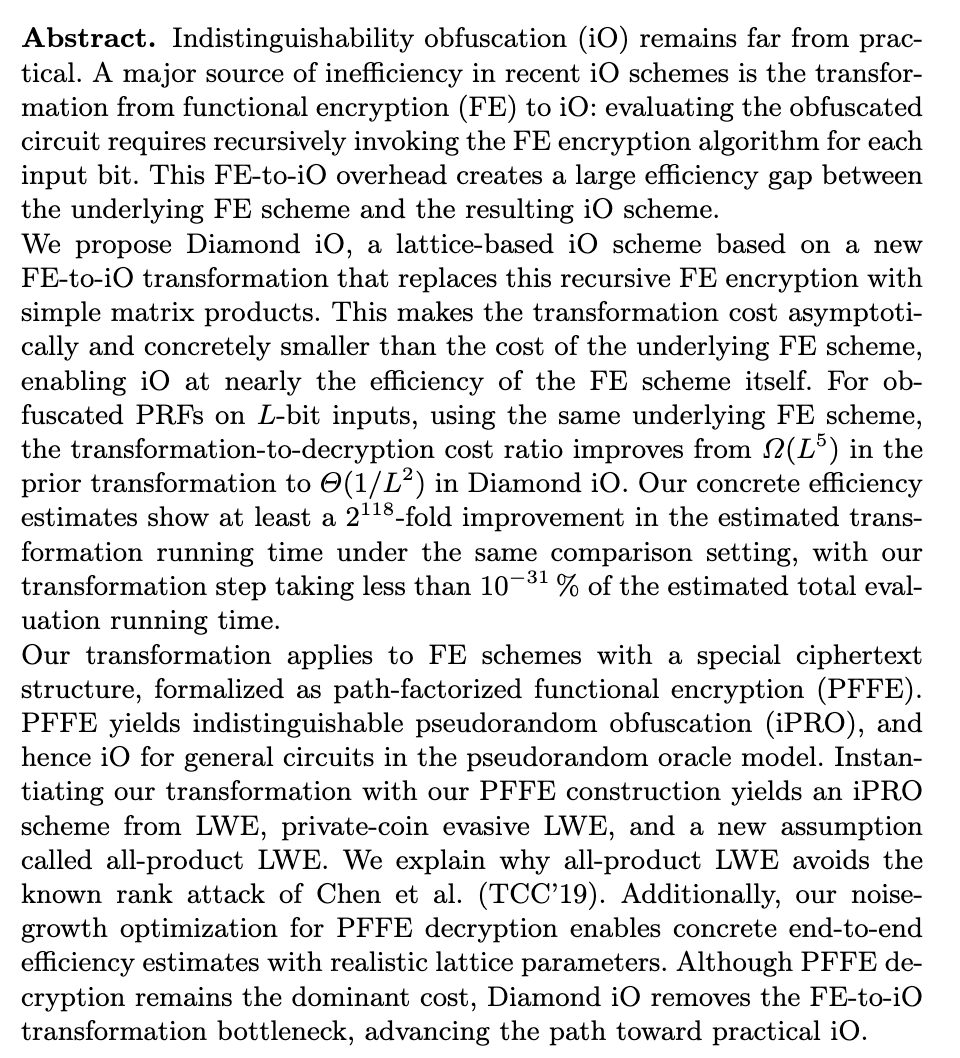
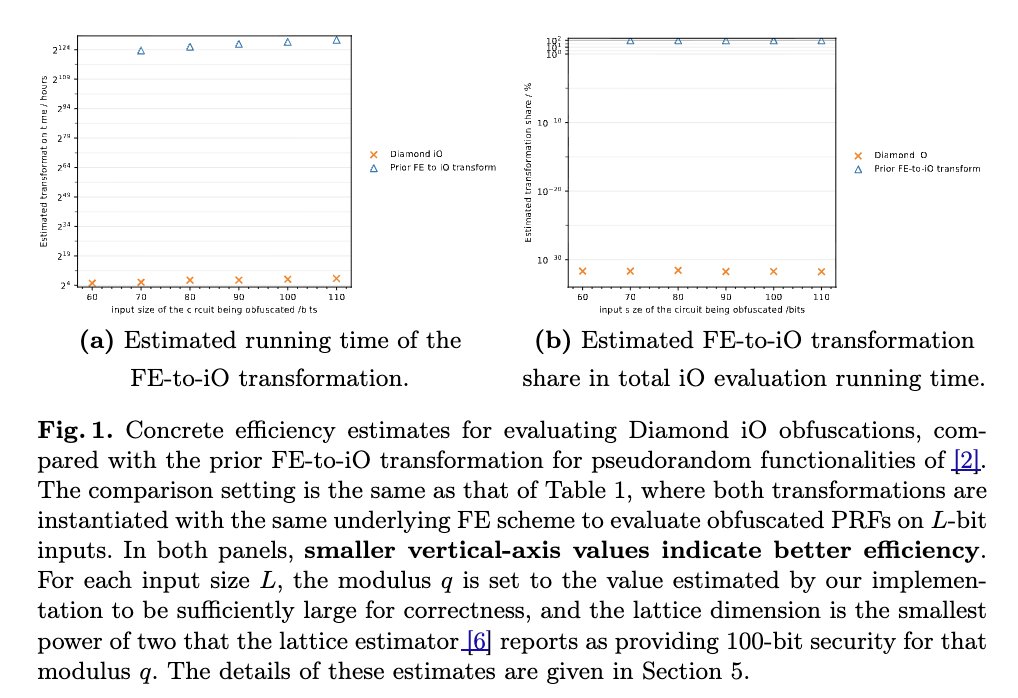
We are excited to share that we have introduced several new optimization techniques for Diamond iO, implemented the full end-to-end pipeline with realistic lattice parameters, and produced concrete performance estimates.
Latest paper: eprint.iacr.org/2025/236
Latest implementation: github.com/MachinaIO/mxx
Last year’s initial Diamond iO implementation deliberately left out one crucial component: FHE evaluation over BGG+ encodings. The reason was simple: the noise growth was too large to support realistic lattice parameters.
This component is not specific to Diamond iO. FHE evaluation over BGG+ encodings has been used as a theoretical building block in advanced lattice-based cryptography for more than a decade, but there has been very little work on making it actually implementable.
In the latest update, we make this component concrete. We introduce several techniques that substantially reduce noise growth, including native lookup-table evaluation, constant-depth arithmetic circuits, and specialized noise refreshing. The new implementation also runs all major lattice operations on GPUs.
Together, these optimizations allow us to instantiate the full Diamond iO pipeline with realistic lattice parameters: a modulus size of at most 1540 bits and lattice dimension 2^{16}, comparable to large parameter sets used in CKKS-style FHE implementations. The total running time is still far beyond practical use, but we can now estimate the end-to-end cost rather than leaving a major component abstract.
What improves?
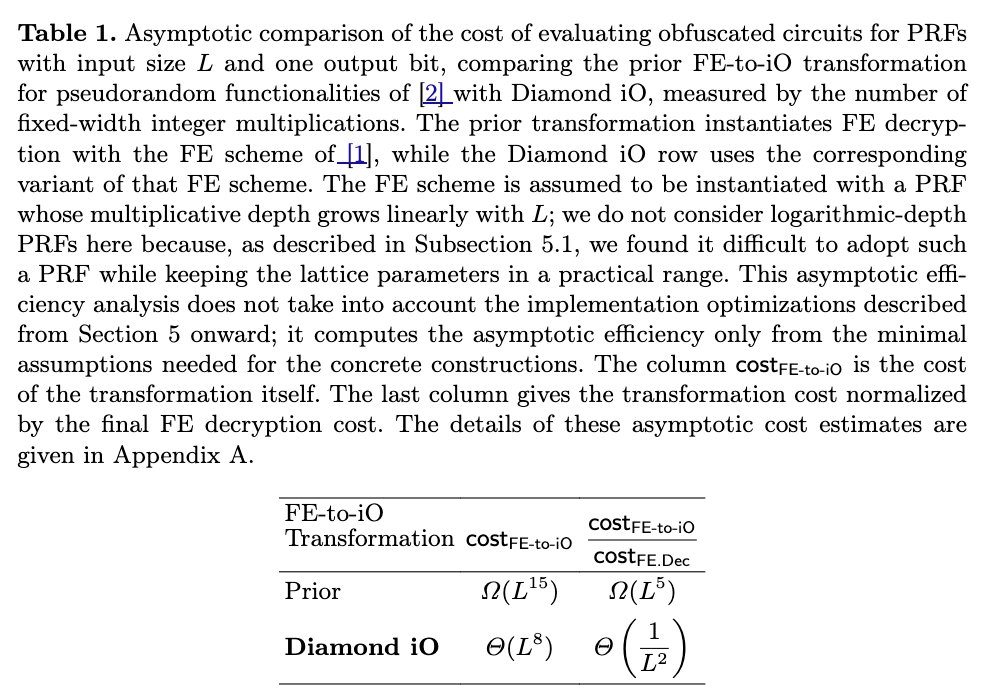
Our estimates suggest that Diamond iO reduces the overhead of the main bottleneck in most modern iO schemes: the transformation from functional encryption (FE) to iO.
Compared with prior FE-to-iO transformations, Diamond iO reduces this overhead by at least a factor of 2^118, making the transformation almost as efficient as the underlying FE scheme itself. In other words, Diamond iO appears to largely remove the FE-to-iO transformation as the dominant cost.
What remains?
Diamond iO is still very far from practical.
Once the FE-to-iO overhead is reduced, the bottleneck shifts to the final FE decryption step, which requires FHE evaluation over BGG+ encodings. Our current estimate is that this step would still take about 10^36 hours.
As explained in Vitalik’s recent post, much of the inefficiency in modern iO comes from the need to stack a complicated tower of cryptographic primitives:
FHE × ABE × GC × XiO × ...
Diamond iO significantly simplifies this picture: the construction is essentially simple matrix operations plus an FHE × ABE layer, where the ABE component is essentially BGG+ encodings.
In our view, this gives a much clearer roadmap toward practical iO: further simplify the remaining FHE × ABE layer, and the gap to practicality could shrink dramatically.
English
andyguzman.eth | privacy/acc retweetledi
Practical iO should not be a problem only for “iO specialists.”
We want researchers and engineers from FHE, ZKP, and MPC to be able to contribute to making iO practical.
In this explainer, we present concrete remaining challenges in Diamond iO that different communities can work on using their existing expertise:
machina-io.com/posts/io-is-no…
The point is that practical iO breaks down into several concrete bottlenecks, including:
* making FHE evaluation over BGG+ encodings practical;
* scaling input size without exponential noise growth;
* cryptanalyzing the non-standard lattice assumptions behind Diamond iO;
* designing proof systems whose verification is cheap over BGG+ encodings;
* building distributed obfuscation without making the obfuscated circuit size scale with the committee size.
If you work on FHE, ZKPs, MPC, lattice-based cryptography, or cryptanalysis, there is likely a concrete part of the practical iO roadmap where your expertise can matter.
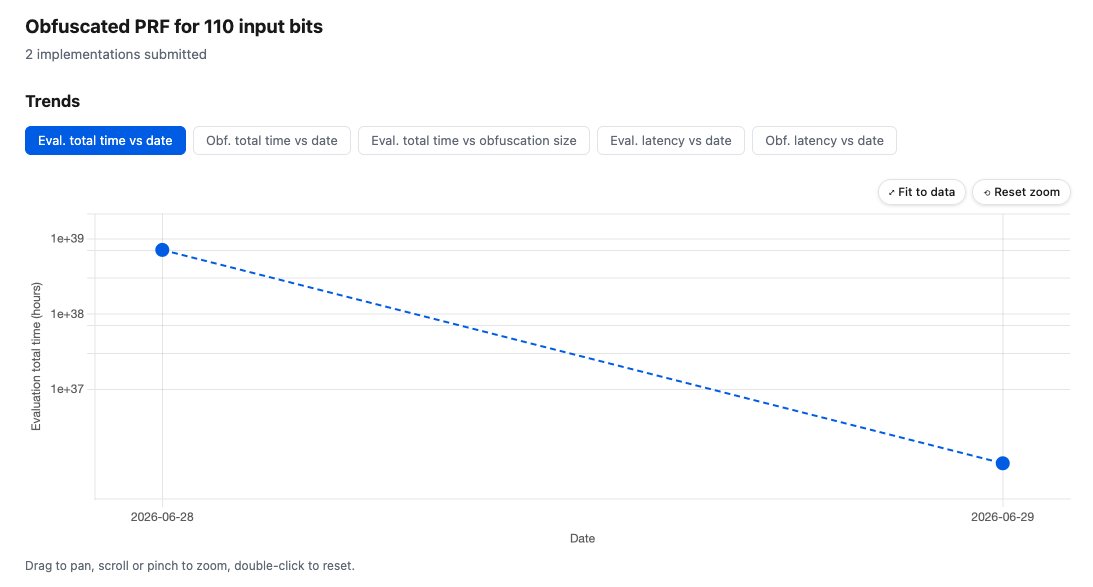
We are also launching ObfusBench as a public leaderboard and obstacle tracker for iO efficiency:
sorasuegami.github.io/obfusbench
The goal is to make progress visible, comparable, and attributable: when someone improves one component, we want that improvement to show up in end-to-end estimates under a common framework.
Practical iO is still far away, but it is becoming a much more modular and collaborative engineering/research problem.

English
andyguzman.eth | privacy/acc retweetledi

0/ The Tornado Cash legal saga continues.
Alex Pertsev is still fighting for his freedom.
Guest thread by @ameensol spotlighting @alex_pertsev's legal case in the Netherlands and the ongoing battle to protect privacy. 🧵

English

@stonecoldpat0 @tkstanczak Nahh, mostly about different visions about what EF should be, but more common priorities of what should fund/do
English

@tkstanczak Are people really fighting for titles at the EF? o.o
English

Strategically, this list is good.
When discussing Devcon budgets last year, I asked if Devcon India should be the last Devcon. As much as I love Devcon, the multimillion-dollar main event sponsored by EF did not match the idea of letting other event organizers thrive in the ecosystem.
In 2025, before we decided that I should recuse myself from any client funding decisions last year, I was considering what possible decreases for client teams we could execute. It was not easy, and I barely started thinking about it before abandoning it. I see that the team found a way to express it more clearly. Moreover, with modern cybersecurity threats, the defense mechanisms change diametrically, and it is good to see that reflected in the strategy.
@hwwonx and I both started our terms last year by pushing strongly against the megaprojects/megagrants for projects that were not core to the Ethereum protocol. Vitalik supported the most valuable of these projects personally, creating organizations that will strengthen open source and open hardware outside of the EF. These were significant donations from his own funds; you can track them through his earlier announcements. I am glad to see that these are not coming back under the EF budgets.
What I would still love to see from the EF would be more professional and transparent treasury management, on the level of a pension fund or so. We should put pressure on not allowing the Foundation to forgo thousands of ETH because of a lacking treasury function, including slow staking and funds allocation.
When hiring the institutional team last year, I informed them all that I wouldn't want the team to plan to stay with the EF for more than 18 months. I believed that 2025 was critical for the institutional adoption of Ethereum and that the other organizations were not yet ready to lead conversations.
A better institutional message from the Bitmine, Sharplink, Etherealize, Nethermind, and many other teams, now also with more funding toward adoption research at EthLabs, gives the EF a perfect opportunity to minimize the ecosystem function.
The dissolution of PSE and merging it into Protocol and Access is the culmination of a painful three-year process of restructuring PSE, which at some point had more than 100 people. We had disagreements on how the leadership of privacy teams should look, but we agree that the structure fits better directly under Protocol and Access.
The previous departures of Protocol Guild leaders from the EF are also healthy. Protocol Guild has always been a tricky matter. On one hand, I have seen the positive aspects of it, leading to talent retention in core development; on the other hand, it created some taxation-like pressures and alignment conversations that were unhealthy. Having all of Protocol Guild outside of the EF keeps the positives while limiting the negatives.
EthLabs founders are people of great talent and dedication who would only be limited by the current, but also the past, shape of the EF. I think that, with proper funding, they will bring a lot of positive acceleration research.
My biggest worry is about execution. If you look at the diagram, it feels like it goes back to a messy, unclear structure: seven high-level structures instead of four, while it should be three without PSE, and confusing team names internally. This most likely reflects the team's challenges in controlling pressures for people to keep titles. It may be read by some as a return to a "decentralized" EF, but I feel that it more likely represents the EF's struggle to limit decision-making at the board level and limited delegation to reliable senior leaders.
vitalik.eth@VitalikButerin
This year, the EF is decreasing its budget by roughly 40%, which entails some difficult decisions. The goal of the decreases was set out in the Treasury Management Policy last year: the EF is transitioning into being a long-term-oriented endowment-based organization, shifting from its pre-2026 average of spending ~15% of its remaining funds each year, toward a post-2030 target of ~5% per year. Often, when an organization goes through something like this, people try to pretend that nothing of great value was lost, that it is an efficiency increase, that the only people cut are unproductive dead weight, and everyone else stopped partying, studied the blade, entered cracked S-tier beast mode, and this was sufficient to make up for the downside. I will not try to pretend this. I respect my EF colleagues far too much to pretend that there was not much that is lost. They are brilliant people. They are dedicated engineers of whom some have worked on the Ethereum protocol for nearly a decade. They have brought a bright light to the Ethereum ecosystem with their code, their words, their warmth as human beings and their actions. My dearest hope is that they find a path that brings them fulfillment and happiness whether inside Ethereum or outside. Hopefully many will be able to bring their excellent talents and mindset to the wider Ethereum ecosystem, or the even wider CROPS world. Instead, I will try to explain what *are* some of the grand sacrifices being made. The Ethereum Strawmap is no small thing. It is an extremely ambitious undertaking seeking to replace and augment almost every part of the protocol - consensus, proofs, privacy, account model, state, and more. This is the third iteration of Ethereum, in the same way that the Merge was the second, even if the shipping style is less Big Bang and more one-piece-at-a-time. On top of this, the EF is increasing its role in the Access Layer. We are not compromising on Ethereum being a Deeply Impressive protocol, something worthy of its place in a world with quantum computing, rockets to Mars and powerful biotech and AI, and capable of meeting the challenges that this era will bring. Some of the deficit will be recovered through more work happening outside the EF. But not all. So what are the grand sacrifices that will enable a leaner effort to accomplish all of this? I will give a few examples (though far from an exhaustive list): * The multi-client model will shift in the direction of multiple clients existing less for _redundancy_, and more for _specialization_. Up to this point, redundancy has been the main security strategy: if one client has a bug, if it has less than 33%, the chain keeps going and does not even stop finalizing. We are increasingly exploring moving more pieces of the protocol to a different security strategy: AI-assisted formal verification. Some smaller pieces of Ethereum (eg. BLS libraries) have worked this way already for a long time. But soon many more parts of Ethereum will likely function on this model. This may greatly reduce resource requirements of shipping a large number of EIPs. The resources saved by client teams can ideally instead be used to better serve different specialized user needs, including EF Access Layer goals. * PSE (Privacy and Scaling Explorations) is winding down as a unit. The number of people working on ZKPs for privacy and scaling is probably as high as ever, but they are working less on "exploration" and more on *implementing* ZKP-based privacy and scaling into the Protocol and Access Layer * Devcon will likely over time become smaller-scale, somewhat more spartan, much lower-deficit than previous years, in addition to other changes in vision in line with the Mandate. * Fewer beyond-Ethereum megaprojects coming from EF. As I announced earlier this year, I am taking on some of the responsibility of doing projects in this category that I consider valuable with my personal funds. * EF institutional work is reducing in scope, specializing more specifically on creating replicable test cases of highly CROPS-friendly deployments, even if at smaller scale. These do not explain all departures; in some cases they do not explain departures at all and rather explain _reduced need for new spending_. But they are a large part of the strategy at play. In the longer term, I personally favor a "soft lean-and-done" approach to Ethereum: once the Strawmap is completed, generally stick to security fixes and small high-value changes, and have a much higher bar for considering new feature additions to the protocol. This allows Ethereum to remain capture-resistant without demanding very large budgets. Learn less from multimillion-line-of-code behemoth projects, more from bitcoin. The past years have been a challenging era for Ethereum. However, the ecosystem is adapting, both inside the EF and outside, and I am confident that Ethereum is very well-positioned to succeed and thrive. firefly.social/post/x/2069408…
English
There's a lot of privacy that needs to happen between the core protocol (L1 or L2) and the user
That's what Access Layer refers to: wallets, rpcs, front ends, onchain protocols (dapps), offchain data.
One big change is teams working on privacy will work more domain wise vs property wise (CROPs vs privacy-only)
English

@VitalikButerin @aerugoettinea Basically back to the building out the core of the Ethereum Layer-1 and with the help of privacy focused Layer-2 projects still being able to make privacy a strong feature on Ethereum. Thanks Vitalik.
English
andyguzman.eth | privacy/acc retweetledi

Aztec just hit Stage 2 on @l2beat.
Onchain governance revoked ownership of the rollup contract.
The code is immutable, no admin can override the protocol, and users can always exit via the escape hatch.
Aztec is the only decentralized L2 with privacy native to the protocol.

English
andyguzman.eth | privacy/acc retweetledi

Thrilled to support in my own small way the further decentralisation of Ethereum.
The more organisations that are contributing meaningfully to the network the more resilient and robust it will become.
The internet took the same path.
This is a big step for Ethereum.
Ethlabs@ethlabs_org
Announcing Ethlabs: a non-profit R&D lab for Ethereum and ETH Our mission is to make Ethereum the settlement layer of the global economy. The internet became global because shared protocols created a common language between networks. Private systems remained useful, but bounded. Finance is approaching a similar moment. As value, assets, and markets become digital, the world needs shared settlement infrastructure. Ethereum is uniquely positioned to become that shared base layer, the neutral foundation on which users, institutions, and agents can transact without intermediation. What we believe: • We believe credible neutrality matters. Ten years of uptime and the lowest counterparty risk. Ground that cannot be pulled away by any one country, institution, company, or person. • We believe ETH matters. The most valuable, programmable store of value. A decade of broad distribution, deep liquidity in onchain markets, and maximally trustless asset on Ethereum. • We believe DeFi matters. Markets, liquidity, credit, exchange, and coordination, open to anyone. • We believe adoption matters. Principles do not change the world until people benefit from them. We sit between two worlds: real usage from the builders at the frontier, and the protocol that has to support it. We work with users, applications, wallets, L2s, infrastructure teams, institutions, ETH holders, core devs and researchers, then turn what they actually need into protocol work, shared standards, infrastructure, and shipped products. Ethlabs is independent but Ethereum is a shared project. We are one node in a much larger network of stewards. This is the multi-node future. We have spent the better part of the past decade contributing to Ethereum core research and development. We are opinionated and transparent. We move with urgency, learn in public, and course-correct when we’re wrong. We are building a lean, talent-dense team for people who want to do the most important work of their careers: join@ethlabs.org
English
andyguzman.eth | privacy/acc retweetledi

Announcing Ethlabs: a non-profit R&D lab for Ethereum and ETH
Our mission is to make Ethereum the settlement layer of the global economy.
The internet became global because shared protocols created a common language between networks. Private systems remained useful, but bounded. Finance is approaching a similar moment. As value, assets, and markets become digital, the world needs shared settlement infrastructure.
Ethereum is uniquely positioned to become that shared base layer, the neutral foundation on which users, institutions, and agents can transact without intermediation.
What we believe:
• We believe credible neutrality matters. Ten years of uptime and the lowest counterparty risk. Ground that cannot be pulled away by any one country, institution, company, or person.
• We believe ETH matters. The most valuable, programmable store of value. A decade of broad distribution, deep liquidity in onchain markets, and maximally trustless asset on Ethereum.
• We believe DeFi matters. Markets, liquidity, credit, exchange, and coordination, open to anyone.
• We believe adoption matters. Principles do not change the world until people benefit from them.
We sit between two worlds: real usage from the builders at the frontier, and the protocol that has to support it. We work with users, applications, wallets, L2s, infrastructure teams, institutions, ETH holders, core devs and researchers, then turn what they actually need into protocol work, shared standards, infrastructure, and shipped products.
Ethlabs is independent but Ethereum is a shared project. We are one node in a much larger network of stewards. This is the multi-node future.
We have spent the better part of the past decade contributing to Ethereum core research and development.
We are opinionated and transparent. We move with urgency, learn in public, and course-correct when we’re wrong.
We are building a lean, talent-dense team for people who want to do the most important work of their careers: join@ethlabs.org
English
andyguzman.eth | privacy/acc retweetledi