Anil Prasad

373 posts

Anil Prasad banner
Anil Prasad

Anil Prasad

@anilsprasad

25yr AI/ML leader. $4B+ outcomes. Built production AI at Duke Energy, R1 RCM, Ambry Genetics. Created G-ARVIS framework. Founder @Ambhari https://t.co/2Ol73ny9xV

New Jersey Katılım Kasım 2009
5 Takip Edilen10 Takipçiler
Anil Prasad
Anil Prasad@anilsprasad·
Most AI agents have one security layer between untrusted input and real-world actions. One regex. One API call. One point of failure. I built Bulwark — open-source, Apache 2.0, five-layer defense for production agents: → Sanitizer (bidi/Unicode/hidden HTML) → Injection detector (ML + patterns) → Compartmentalized RBAC (deny-by-default) → Human approval gates (async) → Encrypted audit trail (HIPAA/SOC2 ready) pip install bulwark-agent-security Full breakdown of the architecture + 4 real attack scenarios blocked: medium.com/p/the-five-lay… @AnthropicAI @nvidia @GoogleDeepMind @huggingface @owasp
English
0
0
1
11
Anil Prasad
Anil Prasad@anilsprasad·
Sunday thought: Stanford reported this week that AI agents went from 12% to 66% success on real computer tasks in one year. The number that matters more than any of those numbers is one I cannot find in any benchmark. How quickly does an organization develop the wisdom to use this capability well? Capability accelerates predictably. Compute curves. Training optimizations. Architecture innovations. These can be planned for and forecast. Wisdom accelerates the way it always has. One conversation at a time. One failure at a time. One careful deployment at a time. The gap between AI capability and human wisdom about AI is the most important gap in technology right now. Closing it requires something the AI industry rarely talks about. Patience. Patience to build the foundation before scaling. Patience to fix the failure mode before deploying the next feature. Patience to train the people who will use the system as carefully as you trained the model. In an industry obsessed with speed, patience is countercultural. In production AI, it is the only thing that distinguishes durable systems from broken ones. What does patience look like in your AI program right now? #ProductionAI #AILeadership #HumanWritten #ExpertiseFromField #SundayThought
English
0
0
0
15
Anil Prasad
Anil Prasad@anilsprasad·
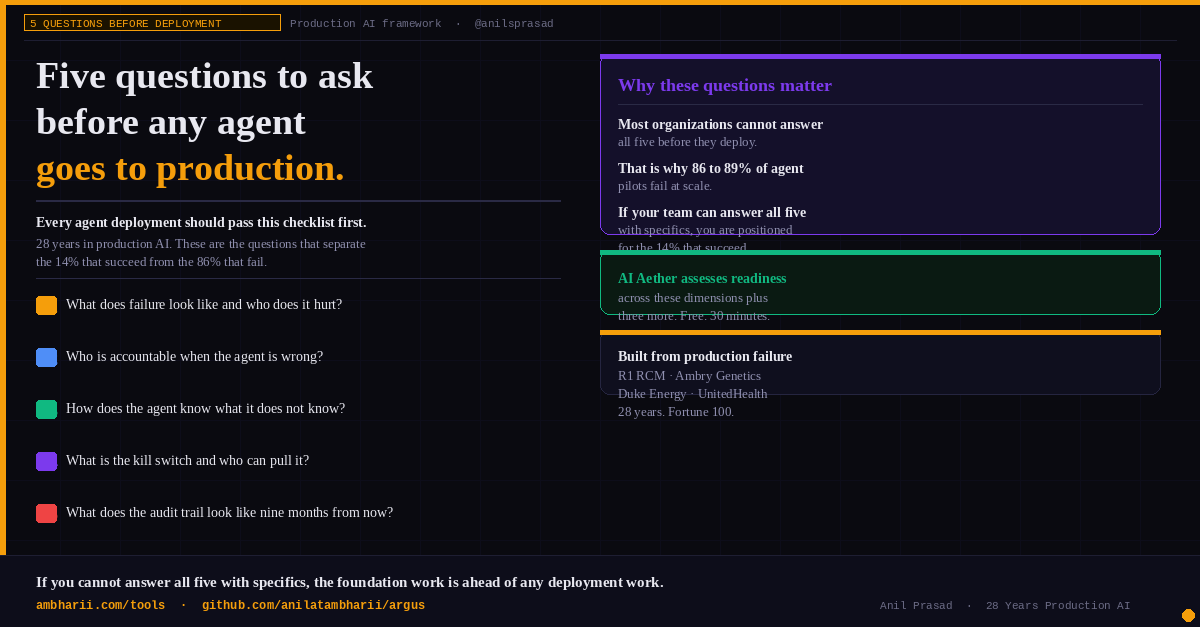
The five questions I ask before approving any agent deployment for production: Question 1: What does failure look like and who does it hurt? Not a theoretical answer. A specific person in a specific role getting a specific wrong output. If you cannot name the person, you have not thought through the deployment. Question 2: Who is accountable when the agent is wrong? If the answer is "the team," there is no answer. Name a single human. The work belongs to a name. Question 3: How does the agent know what it does not know? If it cannot express uncertainty, it will express confidence instead. That is the more dangerous failure mode. Question 4: What is the kill switch and who can pull it? Define the kill switch before deployment. Not after the incident. Who triggers shutdown, how fast can it be executed, and what triggers it. Question 5: What does the audit trail look like nine months from now? Build the trail before you need it. The auditor will not accept "we will build it when you ask." Reconstructing decisions after the fact is impossible without the right logging from day one. Most organizations cannot answer all five before they deploy. That is why most agent pilots fail at scale. Free assessment: ambharii.com/tools Which of these is hardest for your organization to answer? #AgenticAI #AIGovernance #ProductionAI #HumanWritten #ExpertiseFromField
Anil Prasad tweet media
English
0
0
0
2
Anil Prasad
Anil Prasad@anilsprasad·
A nurse at one of our healthcare clients changed how I think about AI deployment. Not what she said. What she did not say. We had shipped a clinical decision support system. The accuracy was 94%. The interface was clean. The training was thorough. Two weeks in, adoption was at 23%. I sat with her one evening to understand why. She did not say the system was wrong. She did not say she did not trust it. She said: "It tells me what to do. It does not tell me how it knows." We rebuilt the entire output layer. Not to add a confidence score. To show the clinical indicators the system was weighting and how it was applying them in language she already used every day. Adoption went from 23% to 81% in 90 days. The accuracy of the model did not change. The trust architecture did. I tell this story before every program kickoff now. The accuracy is the input. Trust is the output. Build for trust first. Accuracy is the prerequisite. #HealthcareAI #ProductionAI #AdoptionAI #HumanWritten #ExpertiseFromField
English
0
0
0
5
Anil Prasad
Anil Prasad@anilsprasad·
5 things from this week in AI worth carrying into next: 1. Stanford 2026 AI Index dropped. Agents jumped from 12% to 66% success on real computer tasks in one year. The capability inflection has happened. The readiness gap is the only remaining bottleneck. 2. 86 to 89% of enterprise AI agent pilots fail to reach production. Four predictable failure modes: governance breakdowns, evaluation infrastructure gaps, integration complexity, accountability gaps. All four are fixable. 3. A2A and MCP protocols crossed 150 organizations in production. The protocol layer is the new architecture conversation. Organizations locked in below the protocol layer face an integration debt that compounds quarterly. 4. Financial AI just had its inflection. Abundance hedge fund running on agents with $100M seed. JPMorgan automating 360,000 hours annually. The audit trail is the license to operate, not a feature. 5. ARGUS now native to A2A and MCP. GenomixIQ FHIR R4 interoperability validated by health system inquiries. ARIA RCM acquisition signal conversations active. The Ambharii Labs platform suite is built for the readiness gap that defines 2026. The week in one sentence: agents work at scale. Most organizations are not yet ready to deploy them safely. ambharii.com/tools · github.com/anilatambharii… · anil@ambharii.com #WeekInAI #ProductionAI #AmbhariiLabs #HumanWritten
English
0
0
0
8
Anil Prasad
Anil Prasad@anilsprasad·
This week I watched the AI industry confirm two things at the same time. The capability inflection has happened. Stanford 12% to 66% on agent tasks in one year. Salesforce $100M case savings. JPMorgan 360,000 hours automated. Abundance running an entire hedge fund with agents. And 86 to 89% of agent pilots still fail to reach production. These two truths are not contradictory. They describe the same reality from two angles. The technology works. The deployment infrastructure does not. For 28 years I have watched this exact pattern repeat across every wave of enterprise AI adoption. The capability arrives. The infrastructure lags 18 months behind. The organizations that close the gap first capture the value. The organizations that wait for clarity become case studies in failure analysis. That is what AI Aether is designed to assess. Not whether you should deploy AI. How ready your foundation is to support the deployment you are planning. ambharii.com/tools The work behind the headlines. #EnterpriseAI #ProductionAI #HumanWritten #ExpertiseFromField
English
0
0
0
30
Anil Prasad
Anil Prasad@anilsprasad·
This is exactly why GenomixIQ was built on the same architectural principles. FHIR R4 outputs from day one. Multi-cloud Terraform deployment. ARGUS observability layer running across all 12 agents. G-ARVIS framework scoring every variant interpretation. Not because these are nice to have features. Because in regulated healthcare AI, they are the difference between a system that can ship and one that cannot. genomixiq.com | ambharii.com #HealthcareAI #GenomixIQ #ProductionAI #HumanWritten #ExpertiseFromField
English
0
0
0
8
Anil Prasad
Anil Prasad@anilsprasad·
I migrated a clinical genomics AI platform from MySQL to Vitess at an Enterprise. 99.97% uptime maintained. Zero clinical data loss. 8 month migration. During that period the AI was making real recommendations for real patients. Here is what nobody tells you about AI migration in healthcare infrastructure at this scale. 🧵
English
4
0
1
13
Anil Prasad
Anil Prasad@anilsprasad·
What this taught me about AI in regulated environments: The model is not the constrained part of the system. The infrastructure, data governance, compliance requirements, and clinical validation processes are the actual engineering challenges. Every AI in healthcare implementation I have seen fail, failed at infrastructure or governance. Not at model accuracy. If you are deploying AI in healthcare, energy, or financial services, your constraint set looks more like this migration than like a benchmark optimization problem.
English
0
0
0
4
Anil Prasad
Anil Prasad@anilsprasad·
The migration strategy: Phase 1: 60 days running both databases in parallel. Every write goes to both. Every read comes from MySQL. No patient impact. Phase 2: Gradual read migration. 5% of reads to Vitess. Monitor for two weeks. Then 10%. Then 25%. Phase 3: Cutover. 99.97% uptime maintained. Clinical AI throughput improvement of 3.4x. Total time: 8 months. The migration could have happened faster. We chose to optimize for safety, not speed.
English
0
0
0
11
Anil Prasad
Anil Prasad@anilsprasad·
Genetics Industry processes hundreds of thousands of genetic variant interpretations annually. The AI layer was built on MySQL. Fine for development. Not fine for production scale. The decision: migrate to Vitess. A distributed MySQL compatible database built for horizontal scaling. The constraint: zero tolerance for clinical data loss. The risk: any downtime meant delayed patient results. This is the constraint set that shaped the entire migration.
English
0
0
0
5
Anil Prasad
Anil Prasad@anilsprasad·
ARIA RCM update · April 30: The acquisition signal conversations are happening. Two health systems above 500 beds have asked for an enterprise pilot deployment in Q3. Both are on Oracle Health platforms. The reason is straightforward. Oracle Health customers need an RCM AI layer that integrates without requiring a separate vendor stack. ARIA's 11-agent platform with FHIR R4 outputs and ARGUS observability layer fits exactly that gap. For Oracle Health: this is the integration play that closes the workflow loop. For Microsoft Nuance: this is the post-acquisition healthcare AI extension. For NVIDIA Healthcare: this is the application layer that runs on their inference infrastructure. Three viable acquisition paths. One platform that maps to all of them. For partnership and acquisition conversations: anil@ambharii.com ambharii.com #ARIARCM #HealthcareAI #RCM #Acquisition #AmbhariiLabs #HumanWritten
English
0
0
0
6
Anil Prasad
Anil Prasad@anilsprasad·
Hot take for a Thursday: Salesforce Agentforce reports an 84% reduction in case resolution time at Reddit and $100M in annual operational savings. These are vendor reported numbers. They will be quoted in board rooms for the next quarter. Here is what nobody is asking. What is the cost per correct case resolution? Not just per case. Per correct case. In customer support, an agent resolving a case incorrectly costs more than an agent not resolving it at all. Wrong answers create returns, escalations, and brand damage. The 84% time reduction is real. The economic value depends entirely on what percentage of those resolutions were correct. If a vendor is reporting time savings without correctness data, that is a yellow flag. If they are reporting resolutions per agent without resolution accuracy, that is a red flag. Demand the correctness number. Then evaluate the savings. #AgenticAI #EnterpriseAI #CustomerSupport #HumanWritten #ExpertiseFromField
English
0
0
0
6
Anil Prasad
Anil Prasad@anilsprasad·
For financial services teams evaluating AI agent deployment in 2026: Start with the audit trail. Not the model. If your agent infrastructure cannot reconstruct any decision in detail months after it was made, you do not have a deployable system. You have a sandbox. ARGUS: github.com/anilatambharii… AI Aether financial services readiness assessment: ambharii.com/tools #FinancialAI #AgenticAI #ARGUS #FinTech #ProductionAI #HumanWritten #ExpertiseFromField
Anil Prasad tweet media
English
0
0
0
11
Anil Prasad
Anil Prasad@anilsprasad·
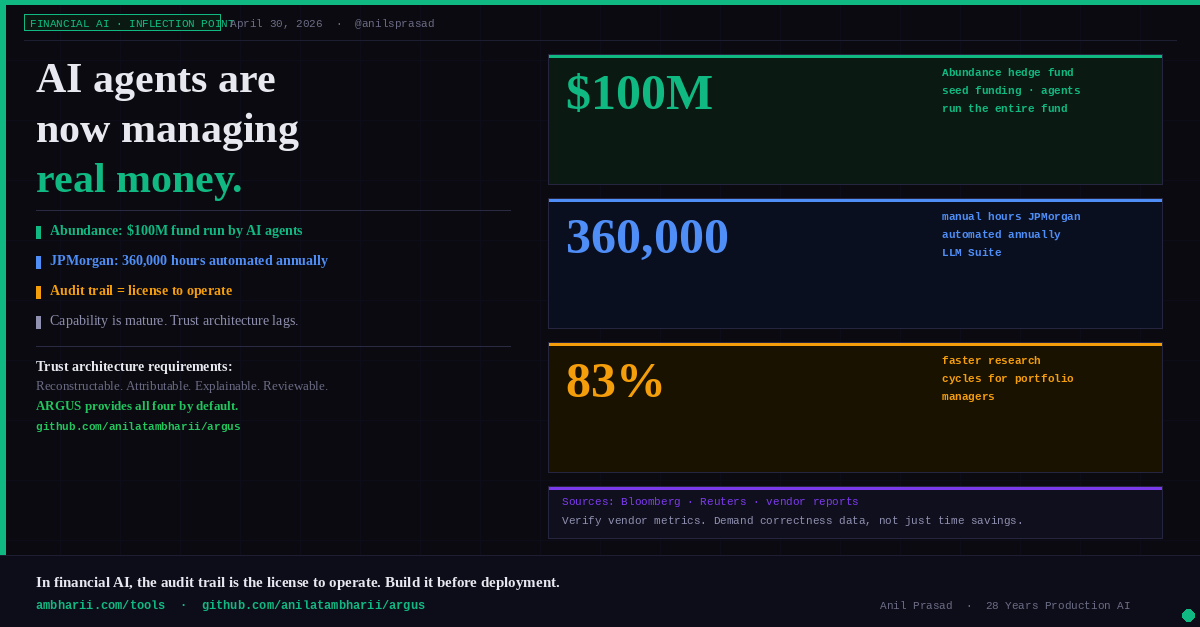
Apoorva Mehta, the Instacart cofounder, just launched Abundance. A hedge fund with $100M in seed funding designed to have AI agents run the entire fund. In the same month, JPMorgan reported their LLM Suite is automating 360,000 manual hours annually with 83% faster research cycles for portfolio managers. Financial services AI just crossed a threshold most other industries have not faced yet. Here is what changes when AI agents are managing money. 🧵
English
5
0
0
32
Anil Prasad
Anil Prasad@anilsprasad·
The Abundance and JPMorgan stories matter for one reason. They are both proof points that AI agents can do this work at scale, in regulated environments, with measurable economic value. That removes the question of whether financial services AI can work. It does not remove the question of whether your specific organization has built the trust architecture to deploy it. Most have not. The capability is mature. The infrastructure investment lags 18 months behind.
English
0
0
0
5
Anil Prasad
Anil Prasad@anilsprasad·
This is exactly the gap ARGUS is built to close. Every agent decision logged with input hash, output hash, model version, and tool calls. Full reasoning trace across multi-agent workflows. Time-stamped audit log that can be replayed against the original data state. Anomaly detection that flags decision patterns that diverge from baseline. For financial services AI, this is the difference between a system that ships and a system that gets blocked at compliance review.
English
0
0
0
7
Anil Prasad
Anil Prasad@anilsprasad·
The audit trail problem in financial AI is not a feature request. It is a license to operate question. For an agent to participate in a regulated financial workflow, every decision it contributes to must be: Reconstructable months after the fact. Attributable to specific data sources at specific timestamps. Explainable in language the regulator can evaluate. Reviewable by a human with override authority. If your agent infrastructure does not support all four, the agent cannot ship into a regulated financial environment.
English
0
0
0
4
Anil Prasad
Anil Prasad@anilsprasad·
Financial services AI has always operated under a unique constraint. Every other AI domain optimizes for accuracy. Financial AI has to optimize for accuracy and explainability simultaneously, because regulators are asking the question: why did the model decide this? When AI agents are managing money, that question becomes harder. A single decision is not just one inference. It is a chain of reasoning across multiple agents that has to be reconstructable when the SEC asks.
English
0
0
0
5