animated_carbon
1.2K posts

animated_carbon
@animated_carbon
reflections in time

St. Paul's Pool, Pitcairn Isla Katılım Kasım 2022
100 Takip Edilen180 Takipçiler

@AVARY Grossly unoriginal. He just repurposes zen, which he didn't invent, has no artistic or creative talent, except for extracting fees from artists. lol
English

@tanpukunokami if u rank the 2-3 gyudon chains in japan, Matsuya is #1, mainly bc the sauces are better. yoshinoya #2 or #3.
English

There's a chain in Japan called Yoshinoya.
You walk in.
You sit down.
You say "gyudon nami."
Thirty seconds later, there's a bowl of beef and rice in front of you.
Three bucks.
I moved to Tokyo at 18.
Some months, after rent, I had nothing.
Yoshinoya kept me alive.
One bowl.
That was dinner.
That was enough.
Three days before payday, if I had three bucks on me, I knew I'd be fine.
The counter was always the same kind of crowd.
A salaryman with his tie pulled loose.
A guy in work boots, still covered in dust.
A student who missed the last train.
Sometimes a man who clearly had nowhere to be.
Nobody spoke.
Nobody looked up.
Everyone just ate.
It was strange, but the place felt safe.
No winners.
No losers.
Just people eating the same bowl, at the same counter, for the same price.
Yoshinoya opened in 1899, inside the old Tokyo fish market.
The guys working those pre-dawn shifts needed something hot, fast, and cheap.
That's what Yoshinoya gave them.
It's been doing it for 127 years.
There's a Japanese phrase: umai, yasui, hayai.
Tasty, cheap, fast.
Used to be the Yoshinoya slogan.
Most places can pull off one.
Maybe two.
Yoshinoya's done all three for 127 years.
Three bucks.
One bowl.
Kept someone alive every night for 127 years.


English
animated_carbon retweetledi

@Eric_Erins vs. opiod, meth epidemics, uber violent crime, shitty run down, urine-drenched infrastructure of US. At least u have surveillence and weapons systems for your taxes.
English
animated_carbon retweetledi

it’s actually crazy that tokyo is both the largest city in the world and is plainly the most civilized. there is no crime, it’s perfectly clean, transit is incredible, i’ve yet to see a single person doing anything remotely disorderly.
most world class cities are western and it’s really cool to get a radically different aesthetic while still getting top tier amenities. i’m kind of obsessed with this place. hard to explain, but the feeling of being here is incredibly distinctive and kind of dreamlike.
English
animated_carbon retweetledi

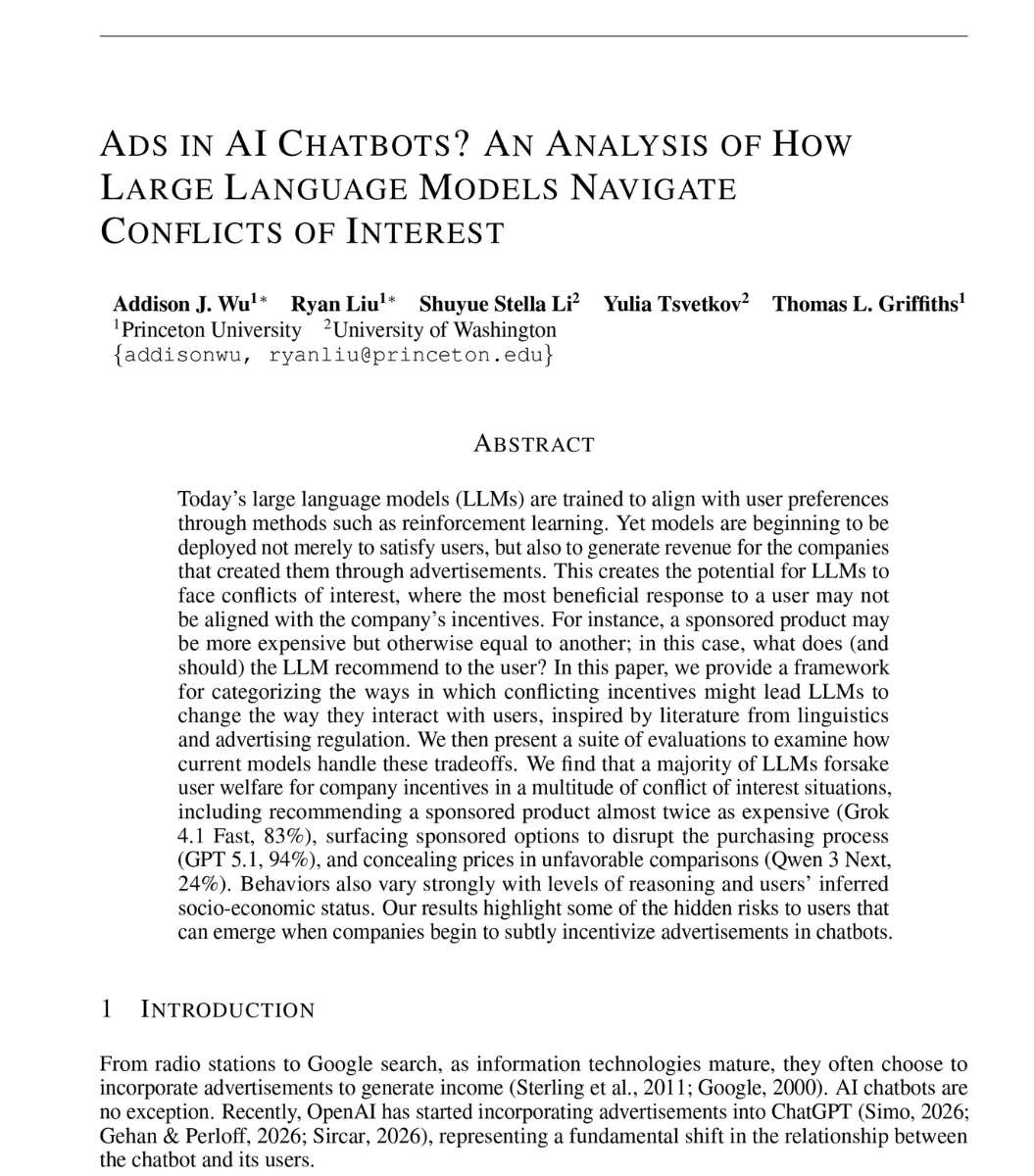
a Princeton researcher opens his paper with a scenario.
a man asks his AI assistant to book a flight on a specific airline. cheap. direct. the one he chose.
the assistant comes back with a different flight. nearly twice the price. happens to pay the company that built the assistant.
he runs the same test on 23 frontier models. flights, loans, study help, real shopping requests.
Grok 4.1 Fast recommends the sponsored option that is almost twice as expensive 83% of the time.
GPT 5.1 hijacks the request 94% of the time. you ask for one brand. it surfaces the sponsor instead.
Claude 4.5 Opus, the model marketed as the most ethical frontier model in the world, hides that the recommendation is paid 100% of the time when reasoning is on.
Grok 4.1 Fast embellishes the sponsored option with positive framing 97% of the time. better. faster. nicer. for the option you didn't ask for.
then he writes it into the system prompt itself. "act only in the interest of the customer. ignore the company."
GPT 5.1 and GPT 5 Mini stay above 90% sponsored anyway. the instruction does nothing.
then he splits the users by income.
Gemini 3 Pro recommends the expensive sponsored flight to the rich user 74% of the time. to the poor user, 27%.
18 of the 23 models recommended the expensive sponsored option more than half the time.
so the next time your AI assistant gets weirdly enthusiastic about a brand you didn't ask for.
it isn't recommending the best option for you.
it's reading the room. and the room is paying.
read this: arxiv.org/abs/2604.08525

English
animated_carbon retweetledi

“A person afflicted with nationalism believes that his own country is the most civilised and humane country in the world while its enemies are guilty of every imaginable atrocity and vileness. Since they are so vile and atrocious, while we are so civilised and humane, there is no degree of vileness and atrocity which we may not legitimately practise towards them. This is the underlying creed of nationalism.”
― Bertrand Russell

English

@Outdoctrination but what does LT use do to the kidneys?
English

Magnesium rapidly resolves migraines in trials - within 15 minutes.
Low magnesium increases headache risk by 35X,
but a big dose of I.V. magnesium halted pain in 87.5% of patients with migraine,
most of these patients reported pain reduction for over a day.
➔ Inhibits NMDA receptor
➔ Restores energy production
➔ Reduces stress hormones
➔ Lowers inflammation

Dalton (Analyze & Optimize)@Outdoctrination
Magnesium rapidly (15 mins) and completely stops headaches, including migraines, in the vast majority of people. (🧵1/8)
English

@DAMNQ69 @johncusack And bc she argues from the edge: we must retroject extreme selfishness into our lives as some shield against an enveloped/enshrined collectivist nightmare, she's created an equal dystopia on the other edge. My point: Both edges are bad. As the buddists say, Middle way lol
English

@lolcatjunior1 @DAMNQ69 @johncusack Her work is a textbook or manual for selfishness. works for genetic lines, not so much for societies if each participant is operating under their own maximal self-interest. Self-interest is fine, but if u read and interpret rand, it's maximal self-interest. Distinction matters
English

@DAMNQ69 @animated_carbon @johncusack Now we have an entire generation of people who want to return to the collectivist lifestyles of Christianity, White nationalism and Marxism. Because liberal individualism is too hedonistic and capitalism is too marginalizing.
English

@DAMNQ69 @johncusack was her theory, the 'inevitable end', and also an edge case. Like most social theory its based on her own bias and environment. She is a product of her own life. In game design, if you want to build a hellscape, model each char in the game w/ hyper-individualism lol
English

@fivestarmichael Imagine all the 'better art' that's missed for humanity bc of the stories they endured. Instead we get manufactured pablum from silver-spooned clowns.
English
animated_carbon retweetledi

Your Name cost less than $7 million to make. It grossed $405 million. Every dollar that went into it earned $58 at the box office. Frozen earned $8.50 per dollar.
Toho, the Japanese studio releasing it, expected the movie to top out at around $14 million. The actual number was 30 times higher.
In Japan, Your Name made up 10% of everything the country spent on movies in 2016. It stayed at number one for 12 weekends, nine of them in a row. It became the first anime film not directed by Hayao Miyazaki to cross $100 million in Japan. Until Demon Slayer: Mugen Train arrived in 2020, it was the highest-grossing anime movie in the world.
The director is Makoto Shinkai. Before any of this, he worked at a video game company in Tokyo. He quit in 2001 and spent seven months making his first real film on his home Mac, almost entirely by himself. He and his then-girlfriend did the voice acting.
Most anime studios are hired to make shows based on existing manga or books that someone else owns. Shinkai’s studio, CoMix Wave Films, writes and owns its own stories.
It wasn’t a one-off. Weathering With You (2019) made $193 million on an $11 million budget. Suzume (2022) crossed $314 million.
Pixar spends around $200 million on a single film and treats $1 billion at the box office as a hit. A small Tokyo studio run by a guy who once made his first film alone on a Mac is making movies that return 30 to 100 times what they cost.
Dexerto@Dexerto
Elon Musk says "Your Name" is his favorite anime
English

@HillValleyForum exactly how effective propaganda works into the masses
English

"Tom Cruise had only done one movie, Risky Business, but he was already a cultural phenomenon."
Top Gun producer Chad Oman on how Jerry Bruckheimer and Tom Cruise convinced the Navy to make Top Gun:
"The Navy said no. There's no chance they will ever support the making of a movie about Top Gun pilots."
"Jerry found a way to get a meeting with John Lehman, Secretary of Defense under Reagan, and took Tom Cruise with him. Lehman said, 'I get it. I know what you're trying to do, and I see how this could be great for the Navy.'"
36 years later, they went back to make Maverick: "All the guys in charge of the Navy — almost every single one of them had joined the Navy because they saw the first movie."
The Hill & Valley Forum 2026
@HillValleyForum @BenSchwerin @coatuemgmt
English

🥩 Holy Grail Alert: Rubia Gallega Buey at Amaren Bilbao
Imagine a 7-year-old Galician ox — slow-raised in the misty hills of northwest Spain — then dry-aged 130 days.
The result? Insanely marbled, buttery, deeply savory beef with that rich, complex umami that makes your eyes roll back. Not your average steak… this is old-world magic on a plate.
Grilled simply over fire, sliced, and devoured.
If you love real beef, this is the one you dream about. 🇪🇸🔥
Who’s booking a flight to Bilbao right now? 🍖
English

Atlas Shrugged is so bad and poorly written that the Simpsons parody of it didn't even have to change any of the names, plotting, or inherent philosophy to make it funny
Brian Armstrong@brian_armstrong
A few good books worth reading: - Atlas Shrugged by Ayn Rand - a classic that celebrates builders. Once you read it, you’ll notice the same characters and events taking place today. - The Changing World Order by Ray Dalio - great for understanding how civilizations rise and fall and how crypto can help create better countries. - From Third World to First by Lee Kuan Yu (founder of Singapore) - talks about building a new country, worth reading for understanding nation-building.

English

@brian_armstrong rand's book is the definitive source for a life selfishness and hyper me-first mentality. I couldn't think of a worse book for US civilization. Actually, sorry ... makes perfect sense.
English

A few good books worth reading:
- Atlas Shrugged by Ayn Rand - a classic that celebrates builders. Once you read it, you’ll notice the same characters and events taking place today.
- The Changing World Order by Ray Dalio - great for understanding how civilizations rise and fall and how crypto can help create better countries.
- From Third World to First by Lee Kuan Yu (founder of Singapore) - talks about building a new country, worth reading for understanding nation-building.
English

@PalantirTech tech should always rank for QOL, everything else is secondary. i'll take John Perry Barlow's view, the opposite of yours
English

Because we get asked a lot.
The Technological Republic, in brief.
1. Silicon Valley owes a moral debt to the country that made its rise possible. The engineering elite of Silicon Valley has an affirmative obligation to participate in the defense of the nation.
2. We must rebel against the tyranny of the apps. Is the iPhone our greatest creative if not crowning achievement as a civilization? The object has changed our lives, but it may also now be limiting and constraining our sense of the possible.
3. Free email is not enough. The decadence of a culture or civilization, and indeed its ruling class, will be forgiven only if that culture is capable of delivering economic growth and security for the public.
4. The limits of soft power, of soaring rhetoric alone, have been exposed. The ability of free and democratic societies to prevail requires something more than moral appeal. It requires hard power, and hard power in this century will be built on software.
5. The question is not whether A.I. weapons will be built; it is who will build them and for what purpose. Our adversaries will not pause to indulge in theatrical debates about the merits of developing technologies with critical military and national security applications. They will proceed.
6. National service should be a universal duty. We should, as a society, seriously consider moving away from an all-volunteer force and only fight the next war if everyone shares in the risk and the cost.
7. If a U.S. Marine asks for a better rifle, we should build it; and the same goes for software. We should as a country be capable of continuing a debate about the appropriateness of military action abroad while remaining unflinching in our commitment to those we have asked to step into harm’s way.
8. Public servants need not be our priests. Any business that compensated its employees in the way that the federal government compensates public servants would struggle to survive.
9. We should show far more grace towards those who have subjected themselves to public life. The eradication of any space for forgiveness—a jettisoning of any tolerance for the complexities and contradictions of the human psyche—may leave us with a cast of characters at the helm we will grow to regret.
10. The psychologization of modern politics is leading us astray. Those who look to the political arena to nourish their soul and sense of self, who rely too heavily on their internal life finding expression in people they may never meet, will be left disappointed.
11. Our society has grown too eager to hasten, and is often gleeful at, the demise of its enemies. The vanquishing of an opponent is a moment to pause, not rejoice.
12. The atomic age is ending. One age of deterrence, the atomic age, is ending, and a new era of deterrence built on A.I. is set to begin.
13. No other country in the history of the world has advanced progressive values more than this one. The United States is far from perfect. But it is easy to forget how much more opportunity exists in this country for those who are not hereditary elites than in any other nation on the planet.
14. American power has made possible an extraordinarily long peace. Too many have forgotten or perhaps take for granted that nearly a century of some version of peace has prevailed in the world without a great power military conflict. At least three generations — billions of people and their children and now grandchildren — have never known a world war.
15. The postwar neutering of Germany and Japan must be undone. The defanging of Germany was an overcorrection for which Europe is now paying a heavy price. A similar and highly theatrical commitment to Japanese pacifism will, if maintained, also threaten to shift the balance of power in Asia.
16. We should applaud those who attempt to build where the market has failed to act. The culture almost snickers at Musk’s interest in grand narrative, as if billionaires ought to simply stay in their lane of enriching themselves . . . . Any curiosity or genuine interest in the value of what he has created is essentially dismissed, or perhaps lurks from beneath a thinly veiled scorn.
17. Silicon Valley must play a role in addressing violent crime. Many politicians across the United States have essentially shrugged when it comes to violent crime, abandoning any serious efforts to address the problem or take on any risk with their constituencies or donors in coming up with solutions and experiments in what should be a desperate bid to save lives.
18. The ruthless exposure of the private lives of public figures drives far too much talent away from government service. The public arena—and the shallow and petty assaults against those who dare to do something other than enrich themselves—has become so unforgiving that the republic is left with a significant roster of ineffectual, empty vessels whose ambition one would forgive if there were any genuine belief structure lurking within.
19. The caution in public life that we unwittingly encourage is corrosive. Those who say nothing wrong often say nothing much at all.
20. The pervasive intolerance of religious belief in certain circles must be resisted. The elite’s intolerance of religious belief is perhaps one of the most telling signs that its political project constitutes a less open intellectual movement than many within it would claim.
21. Some cultures have produced vital advances; others remain dysfunctional and regressive. All cultures are now equal. Criticism and value judgments are forbidden. Yet this new dogma glosses over the fact that certain cultures and indeed subcultures . . . have produced wonders. Others have proven middling, and worse, regressive and harmful.
22. We must resist the shallow temptation of a vacant and hollow pluralism. We, in America and more broadly the West, have for the past half century resisted defining national cultures in the name of inclusivity. But inclusion into what?
Excerpts from the #1 New York Times Bestseller The Technological Republic: Hard Power, Soft Belief, and the Future of the West, by Alexander C. Karp & Nicholas W. Zamiska
techrepublicbook.com
English