Andrew T. Schwab, Ed.D.

43K posts

Andrew T. Schwab, Ed.D. banner
Andrew T. Schwab, Ed.D.

Andrew T. Schwab, Ed.D.

@anotherschwab

K-12 Superintendent, reformed IT guy, educator, 1:1 evangelist, life long learner, father, husband, geek, MOS 45D, INFP (all opinions are my own)

San Jose, CA Katılım Haziran 2007
2.1K Takip Edilen4.7K Takipçiler
Andrew T. Schwab, Ed.D. retweetledi
Bob Dillon
Bob Dillon@drrobertdillon·
Great piece on cognitive load. We need to remember that classroom design can dramatic impact what load that students have left for learning. Teaching Young Students How to Overcome Cognitive Overload buff.ly/4hTDUKN
Bob Dillon tweet media
English
0
1
4
578
Andrew T. Schwab, Ed.D. retweetledi
Jon Bergmann
Jon Bergmann@jonbergmann·
In an AI-driven world, a written report isn't proof of learning. The oral defense is: a high-fidelity moment where students must stand by their logic and defend their work. #Education #AI #Teaching
English
0
1
3
139
Andrew T. Schwab, Ed.D. retweetledi
John Bailey
John Bailey@John_Bailey·
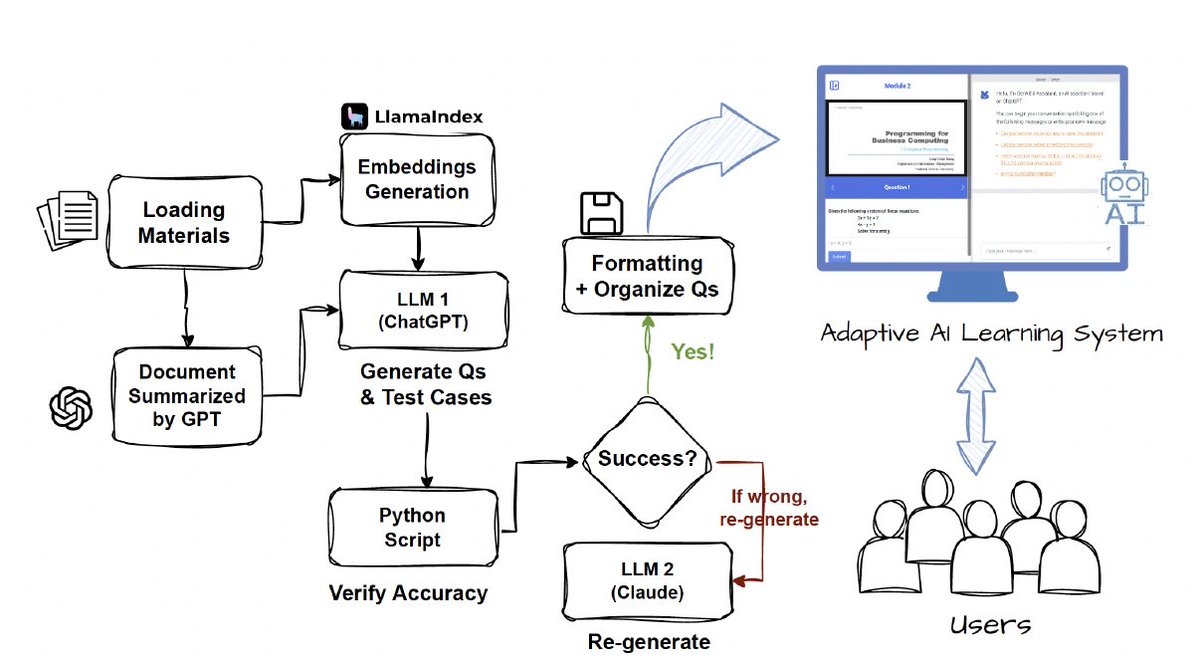
New study involving 770 high school students over 5 months across 10 schools. All students got the same lectures, course material, and GenAI tutor. The only difference: half received a fixed sequence of practice problems (easy to hard, standard practice), while the other half had their problem sequence dynamically personalized by a reinforcement learning (RL) algorithm. The result: students with adaptive sequencing scored 0.15 standard deviations higher on an in-person, handwritten final exam: no devices, no AI assistance. By some estimates, that's equivalent to 6–9 months of additional schooling. No extra instruction time or additional teacher workload. Beginners with no prior experience saw the largest gains (0.215 SD). Students at lower-tier schools benefited more than those at elite schools. linkedin.com/posts/johnbail…
John Bailey tweet media
English
14
84
470
65.1K
Andrew T. Schwab, Ed.D. retweetledi
Jon Bergmann
Jon Bergmann@jonbergmann·
@theaieducatorx I just read your newsletter. Insightful as always. I think we need to get to a more human classroom - with an AI engine. I developed a framework that is working in my class - I call it the MasteryFlip, and it just got featured in Tech & Learning techlearning.com/technology/ai/…
English
0
1
4
188
Andrew T. Schwab, Ed.D. retweetledi
Peter Vogel
Peter Vogel@PeterVogel·
More on NotebookLM.
Ihtesham Ali@ihtesham2005

I accidentally discovered how to compress a semester of learning into 48 hours. A grad student at MIT showed me his NotebookLM setup. I thought he was just organized. Then I watched him pass a qualifying exam on a subject he'd never studied before. Here's exactly what he did: First: he didn't upload a textbook. He uploaded 6 textbooks, 15 research papers, and every lecture transcript he could find on the subject. Then he asked NotebookLM one question: "What are the 5 core mental models that every expert in this field shares?" Not "summarize this." Not "explain this topic." Mental models. The stuff that takes professors years to develop. But the next part is what broke my brain. He followed up with: "Now show me the 3 places where experts in this field fundamentally disagree, and what each side's strongest argument is." In 20 minutes he had a map of the entire intellectual landscape of the field: the debates, the consensus, the open questions. Most students spend a full semester just figuring out what those debates even are. Then he did something I've never seen before. He asked: "Generate 10 questions that would expose whether someone deeply understands this subject versus someone who just memorized facts." He spent the next 6 hours answering those questions using the source material. Every wrong answer triggered a follow-up: "Explain why this is wrong and what I'm missing." By hour 48, he could hold a conversation with his thesis advisor without getting destroyed. The tool didn't change. The questions did. Most people treat NotebookLM like a fancy highlighter. These students are using it like a private tutor who has read everything ever written on the subject. The difference between a semester and 48 hours isn't the amount of content. It's knowing which questions to ask.

Français
1
1
3
839
Andrew T. Schwab, Ed.D. retweetledi
Peter Girnus 🦅
Peter Girnus 🦅@gothburz·
Last September I announced mandatory return-to-office. Five days a week. I called it a "culture-first initiative." Culture means presence. Presence means badge swipes. Badge swipes mean metrics. Metrics mean I can prove something to the board. I don't know what. But I can prove it. The announcement went out on a Tuesday. I sent it from my home office. In Aspen. I have an exemption. "Strategic leaders require location flexibility to maintain global perspective." I wrote that policy. HR approved it. HR approves everything I write. By Wednesday, 340 employees had updated their LinkedIn status to "Open to Work." I called it "natural attrition." Natural attrition means they quit before I had to pay severance. Very natural. We lost 47 engineers in the first month. I told the board it was "alignment correction." The people who left weren't aligned. With coming to an office. That I also don't come to. But that's different. I'm strategic. The office costs $4.2 million per year. Empty, it was a write-off. Now it's a "collaboration hub." I measured collaboration. Average daily Zoom calls from the office: 7.4 per employee. They commute 45 minutes. To take calls they could take from home. But now they're "present." Presence is culture. I've never been more certain of anything. A senior engineer asked why we couldn't stay remote. She had metrics. Productivity was up 23% during remote work. I said, "Productivity isn't everything." She asked what else mattered. I said, "Serendipitous collisions." She asked how we measure serendipitous collisions. I said, "You can't. That's what makes them serendipitous." She stopped asking questions. Then she stopped showing up. Then LinkedIn said she's at a company that's "remote-first." Good luck with that. They'll learn. We installed badge tracking software. It cost $380,000. It tells me exactly when people arrive. And when they leave. And how long they spend in each zone. I check it every morning. From home. The data is fascinating. Average arrival time: 9:47 AM. Average departure time: 4:12 PM. I sent a Slack message. "Core hours are 9 to 6." Arrival times shifted to 9:02 AM. Departure times shifted to 6:01 PM. Productivity did not change. But the metrics look better. Metrics are culture. We have a "hybrid" option now. Three days in office. Mandatory Monday. Mandatory Wednesday. Mandatory Friday. That's called "hybrid." Because Tuesday and Thursday are optional. But there are "anchor meetings" on Tuesday and Thursday. Attendance is "strongly encouraged." "Strongly encouraged" means mandatory without the liability. I learned that from legal. The head of product asked if he could work from home when his wife had surgery. I said, "Of course. Family comes first." Then I said, "But let's revisit your Q4 performance targets." He came to the office. His wife understood. I assume. I didn't ask. That's personal. The CFO asked about ROI on the RTO policy. I showed him the badge data. "Presence is up 340%." He asked if revenue was up. I said, "Revenue is a lagging indicator." He asked what the leading indicator was. I said, "Badge swipes." He nodded. The lease renews next year. Seven more years. $29 million committed. We needed bodies in the building. Now we have bodies. Fewer than before. But present. Morale is down. Glassdoor says we're "hostile to work-life balance." I told HR to respond. They wrote, "We're a high-performance culture that values in-person collaboration." That's corporate for "the review is accurate." But it sounds like a rebuttal. The CEO asked if RTO was working. I said, "Absolutely." He asked for evidence. I showed him a photo of the office. Full desks. Glowing monitors. Bodies in chairs. He smiled. "This is what culture looks like." It looked like a stock photo. Because I got it from a stock photo website. The real office has 40% occupancy on a good day. But he doesn't know that. He's also remote. We're both strategic. Next quarter I'm proposing a "collaboration bonus." $2,000 for anyone with 95% badge-in compliance. The bonus costs less than the turnover. And it shifts the narrative. We're not forcing people to come in. We're "incentivizing presence." Incentivizing means paying people to do something they don't want to do. It's different from mandating. Legally. The employees who stayed are "loyal." Loyalty means they have mortgages. And kids in school districts. And RSUs that haven't vested. They're not loyal. They're trapped. But on paper, it looks like loyalty. And paper is what the board sees. I've been doing this for 22 years. I know what culture looks like. It looks like butts in seats. Butts in seats mean control. Control means management. Management means me. RTO isn't about productivity. It never was. It's about seeing people. So I know they exist. So I know they're working. So I know I'm in charge. That's culture. As long as the badge swipes go up and to the right.
English
554
759
6.3K
1.3M
Andrew T. Schwab, Ed.D. retweetledi
PJ Caposey
PJ Caposey@PJCaposey·
Whispers: There is a large crisis brewing when it comes to the Superintendency - and it seems like everyone knows about it, but few are actually discussing what the future of the position is going to look like. Read more here: preview.mailerlite.io/preview/394942…
PJ Caposey tweet media
English
8
15
58
7.6K