Alejandro Pareja
980 posts

Alejandro Pareja retweetledi

AI will create more jobs than any other technology in history.
The doomers' fundamental error isn't just the lump of labor fallacy. It's deeper than that.
They assume a finite problem space.
This is the fundamental error of AI and job doomers. They look at the economy and see a fixed amount of work to be done, a pie that can only be sliced thinner as machines take bigger bites. They see humans a competitive resource for a finite amount of work and a finite amount of problems to solve that must be eliminated.
This is fundamentally, totally and completely wrong.
The pie isn't fixed. It never was. And the reason it isn't fixed is baked into the very nature of technology itself.
Technology is nothing but abstraction stacking. And abstraction stacking is infinite. Therefore the work is infinite.
The hammer didn't reduce the amount of work. It moved the work up the stack. And the new work was more complex, more varied, and more interesting than the old work.
Complexity breeds more complexity and more variety.
Once you have houses instead of mud huts, you have a cascade of new problems that didn't exist before. Plumbing. Wiring. Insulation. Roofing materials that don't rot. Drainage systems so the foundation doesn't flood. Fire codes so your neighbor's bad wiring doesn't burn down the whole block.
Each of those problems becomes a job. A plumber. An electrician. An insulator. A roofer. A civil engineer. A building inspector. None of those jobs existed when we lived in mud huts.
They exist because we solved the mud hut problem.
Think of all of human technological development as a stack of abstraction layers, each one built on top of the ones below it.
At the bottom: raw survival. Finding food. Building shelter. Making fire. These are the base-layer problems.
Each major technology wave solved a base-layer problem and in doing so created an entirely new layer of problems above it:
Agriculture solved "how do we reliably eat?" — and created problems of land ownership, irrigation, crop rotation, storage, trade, taxation, and governance.
Writing solved "how do we remember things across generations?" — and created problems of literacy, education, record-keeping, law, bureaucracy, and literature.
The printing press solved "how do we spread knowledge at scale?" — and created problems of intellectual property, censorship, journalism, publishing, public opinion, and democratic discourse.
The steam engine solved "how do we generate mechanical power without muscles?" — and created problems of factory design, worker safety, urban planning, railroad engineering, coal mining, labor relations, and environmental pollution.
Electricity solved "how do we deliver energy anywhere?" — and created problems of grid design, power generation, appliance manufacturing, electrical safety codes, utility regulation, and an entire consumer electronics industry.
The Internet solved "how do we connect all human knowledge?" — and created problems of cybersecurity, digital privacy, online commerce, content moderation, network infrastructure, cloud computing, social media dynamics, and an entire digital economy that employs tens of millions.
Notice the pattern?
Each solution didn't just solve a problem.
It created an entirely new problem space that was larger, more complex, and more varied than the one it replaced.
The stack grows. It never shrinks.
It's turtles all the way down and all the way up.
English
Alejandro Pareja retweetledi

Jensen is one the smartest and most far seeing folks the world.
"If an AI scientist warns people that AI is going to permeate across radiology and radiologists are going to get wiped out, it might seem helpful but it's hurtful. If we convince everybody not to be radiologists and we now need radiologists, that actually is hurtful to society.
"It is hurtful to convince all the young college graduates not to study software engineering because we are going to need more software engineers than ever.
That's hurtful."
"Scaring people with nonsensical things, which are not going to happen, that this is an existential threat, there's a 20% chance that is is existential, that's ridiculous.
"That it's going to wipe out 50% of college level jobs.
"That is it going to completely destroy democracy.
"These kinds of comments are not helpful. They are made by...CEOS. And you become a CEO, maybe you adopt a God complex and somehow you know everything."
Brutal.
And right.
English
Alejandro Pareja retweetledi

🔴GLOBANT
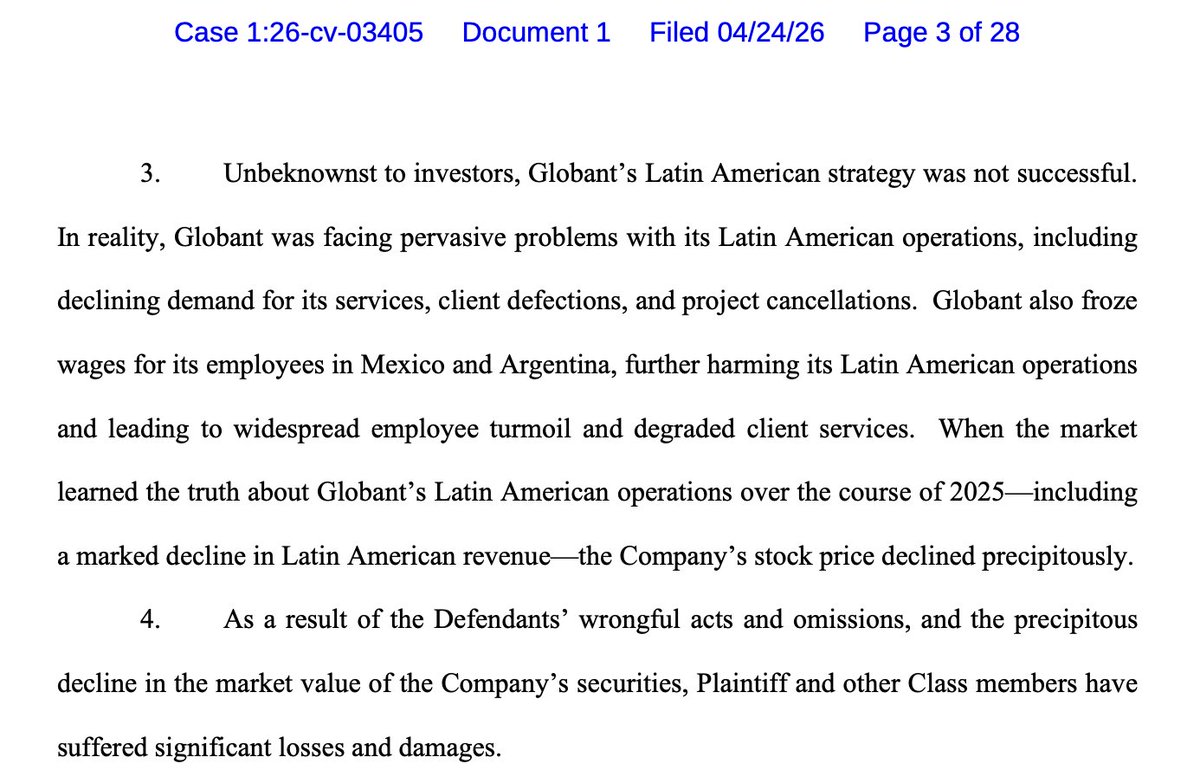
Inversores iniciaron un juicio colectivo en Estados Unidos en una corte de Nueva York contra Globant y sus directivos.
Los acusan de mentir deliberadamente para que los inversores tomen decisiones incorrectas quienes ahora sufrieron pérdidas millonarias con la caída de la acción.
Parte de las presuntas mentiras que plantean es haber inflado lo bien que le estaba yendo en la región y haber ocultado cancelaciones de contratos con clientes y que en Argentina tenían los sueldos congelados.


Español
Alejandro Pareja retweetledi

Claude Code is not AGI, but it is the single biggest advance in AI since the LLM.
But the thing is, Claude Code is NOT a pure LLM. And it’s not pure deep learning. Not even close.
And that changes everything.
The source code leak proves it. Tucked away at its center is a 3,167 line kernel called print.ts.
print.ts is a pattern matching. And pattern matching is supposed to be the *strength* of LLMs.
But Anthropic figured out that if you really need to get your patterns right, you can’t trust a pure LLM. They are too probabilistic. And too erratic.
Instead, the way Anthropic built that kernel is straight out of classical symbolic AI. For example, it is in large part a big IF-THEN conditional, with 486 branch points and 12 levels of nesting — all inside a deterministic, symbolic loop that the real godfathers of AI, people like John McCarthy and Marvin Minsky and Herb Simon, would have instantly recognized.*
Putting things differently, Anthropic, when push came to shove, went exactly where I long said the field needed to go (and where @geoffreyhinton said we didn’t need to go): to Neurosymbolic AI.
That’s right, the biggest advance since the LLM was neurosymbolic. AlphaFold, AlphaEvolve, AlphaProof, and AlphaGeometry are all neurosymbolic, too; so is Code Interpreter; when you are calling code, you are asking symbolic AI do an important part of the work.
Claude Code isn’t better because of scaling.
It’s better because Anthropic accepted the importance of using classical AI techniques alongside neural networks — precisely marriage I have long advocated.
It’s *massive* vindication for me (go see my 2019 debate with Bengio for context, or to my 2001 book, The Algebraic Mind), but it still ain’t perfect, or even close.
What we really need to do to get trustworthy AI rather than the current unpredictable “jagged” mess, is to go in the knowledge-, reasoning-, and world-model driven direction I laid out in 2020, in an article called the Next Decade in AI, in which neurosymbolic AI is just the *starting point* in a longer journey.*
Read that article if you want to know what else we need to do next.
The first part has already come to pass. In time, other three will, too.
Meanwhile, the implications for the allocation of capital are pretty massive: smartly adding in bits of symbolic AI can do a lot more than scaling alone, and even Anthropic as now discovered (though they won’t say) scaling is no longer the essence of innovation.
The paradigm has changed.
—
*Claude Code is plainly neurosymbolic but the code part is a mess; as Ernie Davis and I argued in Rebooting AI in 2019, we also need major advances in software engineering. But that’s a story for another day.
English
Alejandro Pareja retweetledi

Alejandro Pareja retweetledi

Es un ensayo de opinión con buena arquitectura narrativa, pero las conclusiones van muy por delante de la evidencia que presenta.
La tesis puede ser correcta (UY puede estar en una trampa de equilibrio mediocre) pero el artículo no lo demuestra: lo pinta con una historia bien contada.
Ibrahim Ferreyra@TurcoFerreyra
Español
Alejandro Pareja retweetledi

Like an appreciation of progress, reading and literacy are among the things that are good but cognitively unnatural. That is, they go against our evolved nature. We didn’t evolve with print; it was a recent invention. Reading, for many of us, has become so second nature that we just assume it’s the most natural way of getting information. But what we’ve seen, especially in the last 10 years, when video has become so cheap because of the cloud computing revolution and the broadband revolution, is that a lot of people, unlike us, much prefer to listen and watch than to read. You just see this: when I go to Google and ask a basic question about how to unstick my printer or solve a problem, I get like five videos. And I just want a paragraph that would solve it. I don’t want to see Seth saying, “Hi, welcome to my show. If you like it, subscribe and give it a like.” So just help me solve the problem. But clearly there’s something unusual about me, because people are going for the video. And the massive availability of video—of TikTok, of YouTube—means that people may not be getting the practice or putting in the effort into literacy, which we have reason to believe was one of the drivers of the Flynn effect and of cognitive sophistication in general.
@HumanProgress
English
Alejandro Pareja retweetledi

If you come across someone asserting there is "no scientific evidence" that social media is causing harm, please send them this link.
We lay out seven lines of evidence, including RCTs, natural experiments, and testimony from victims & perpetrators of harm
worldhappiness.report/ed/2026/social…
English
Alejandro Pareja retweetledi

Daniel Dennett: "If I gave a prize to the best idea anybody ever had, I'd give it to Darwin."
Not Newton. Not Einstein. Darwin.
In a 2015 documentary, philosopher Daniel Dennett makes a striking case for why Darwin's idea of natural selection is the single greatest intellectual achievement in human history.
His reasoning isn't just about biology.
Dennett argues that what makes Darwin's idea so extraordinary is what it unifies. Before Darwin, the world was split into two seemingly incompatible realms: the physical world of cause and matter, and the world of meaning, purpose, and consciousness. These felt like they belonged to different categories entirely. One explained by science, the other by something else.
Darwin's idea, Dennett says, is the backbone that bridges them:
"The Darwinian idea of natural selection unifies the world. It unifies the world of cause and matter and physics with the world of meaning and purpose consciousness. The whole spectrum of life depends on uniting the living with the non-living, the meaning with the non-meaning, the purposeful with the merely mechanical and merely physical."
That's not a small claim. It's a philosophical revolution disguised as a biology paper.
What Dennett is pointing to is that natural selection gives us a mechanism: a purely physical, purposeless process that generates purpose. Organisms don't need a designer to have goals. The appearance of design, the reality of meaning, emerges from the bottom up.
The best idea anyone ever had. No prize for second place.
English

@JavierdeHaedo Empresa pública se traduce como state-owned enterprise. Public company se traduce como empresa de capital abierto.
Español
Alejandro Pareja retweetledi

Os cassinos são proibidos no Brasil. Não faz sentido permitir que os Jogos do Tigrinho entrem nas casas, endividando as famílias pelo celular. Vamos trabalhar unindo o Governo, o Congresso e o Judiciário para que esses cassinos digitais não continuem endividando famílias e destruindo lares.
🎥 @ricardostuckert
Português
Alejandro Pareja retweetledi

Worst of all, gym classes are making them run miles an Uber could cover in less than a minute.
Julia McCoy@JuliaEMcCoy
We are sending our kids to school to memorize facts that AI can retrieve in 0.3 seconds. We're grading them on essays that AI writes better than their teachers. We're preparing them for jobs that won't exist by the time they graduate. The entire education system is training humans to compete with machines at what machines do best. That's not education. That's sabotage. The schools that survive will teach thinking, not memorizing. Creating, not repeating. Discerning, not obeying. Every other school is a museum that doesn't know it yet.
English