

Archit Gupta
7.4K posts

Archit Gupta
@architgupta
Building Clear✌️Founder and CEO at Clear. Our mission: Simplifying finances for India. 🥏 🇮🇳🏋️♀️⚛️. ultimate frisbee.
Bangalore and San Francisco Katılım Nisan 2009
670 Takip Edilen7.3K Takipçiler
While most are busy complaining about global uncertainty, the door has quietly swung wide open for NRIs. The real smart money move isn't just earning in dollars, but realizing that the correction in Indian markets along with a currency gap is the smart way to building long term wealth.
English
A lot is changing starting April 1st. We are finally getting rid of a lot of complexity.
There will be no more confusion over FY vs. AY and a lot less paperwork noise. Plus, AI will now be helping us flag and manage risky transactions more effectively.

English
With only 2 days left in the fiscal year, I’m looking at the red in the markets a bit differently. It’s been a tough year for stocks, especially compared to the big gains we've seen in things like gold.
This is a chance to reset through Tax Loss Harvesting. If you’ve booked a profit on gold or silver, you're looking at a high tax bill. Those negative stocks in your portfolio are actually a tool to cancel that out. It lowers your tax outgo and puts that money back into your pocket.
But this is not just about wiping out today's tax. It’s about planning ahead. Sometimes, it is smarter to pay a small tax on equity now so you can carry forward your losses to shield much higher taxes on gold or silver next year.
This way, you get to decide which stocks are still worth keeping and which ones to let go of so you can re-allocate and start fresh on April 1st. A good portfolio isn't just about knowing when to buy. It’s about knowing how to use a down market to your advantage before the clock runs out.
Are you doing smart tax loss harvesting this year?

English
English

@architgupta @_cleartax Sir cleartax ne filing facility kyu band kar di.........
As a genuine user i am asking..
English
Now the number of overnight financial wizards handing out free advice on our feeds is about to drop significantly.
Check the latest SEBI Move - (Link to press release in comments.)
English
Jensen Huang just unveiled the new Vera Rubin chips and the OpenShell toolkit, outlining a completely new architecture for the future of business.
While everyone obsesses over raw processing speed, the real story is what this new hardware unlocks. If your focus is still on getting better text answers, you are missing the bigger picture. We have officially moved past simply talking to AI.
This new architecture is built specifically to run thousands of autonomous agents at once. The bottleneck isn't how smart the AI is anymore; it is our own hesitation to let it work on its own.
Think about it: pure intelligence is getting cheaper by the day. Just having a smart chatbot isn't enough.The ability to actually let the AI execute tasks is becoming the most valuable thing in tech right now.
Once you allow that execution to happen, you are looking at a completely new operating system for business. The companies that win next year won't be the ones with the best chatbots. They will be the ones who trust their systems enough to let them work without a human watching every single move.
English
The numbers might seem high at first glance, but they are completely accurate. The government just passed the new Income Tax rules last Friday, significantly increasing the exemption limits for various salary components to finally account for inflation.
You can check the exact breakdown of the new limits here: x.com/architgupta/st…
With the new financial year starting soon, make sure to check with your HR team before April 1st to restructure your salary components and maximize these new tax savings.
English

@architgupta That exemption part seems exagerated!
Are those line items and valuea accurate?
English
With New Tax Rules of 2026 effective 1st April 2026, spending a little time on your tax planning can go a long way. Today, two people earning the exact same ₹50L CTC can now see a ₹5 lakh difference in the taxes they owe at the end of the year. The gap comes entirely from how well they structure their deductions under the updated laws. Optimizing your taxes today is the easiest 10% raise you can give yourself.

English
Everyone's building AI agents.
Few are solving how they talk to each other.
The agentic AI conversation is dominated by "what can a single agent do?" More tools. Better reasoning. Longer context.
But the real product problem isn't agent capability.
It's agent coordination.
Example: At ClearTax, we run two AI bots on WhatsApp filing — one files taxes, one handles support.
Users don't care which bot they're talking to. They just want their problem solved.
The challenge: "How much refund?" and "When will my refund come?" both contain "refund" — but need opposite bots.
Keyword matching fails. Single LLM judgment fails. We tried both.
What worked: decomposing intent into structured signals.
"How much" → calculation → Filing Bot
"When" → status check → Support Bot
We built a scoring system that sits between the user and all agents. It classifies, scores, routes — and every decision is traceable.
The LLM never decides the route. It classifies. The app does the math.
This isn't about making one agent smarter; it’s about making multiple agents feel like one, through a smarter architecture.While the newest, largest models can technically handle this coordination, they aren’t cost-effective at scale. The token consumption alone makes them impractical for high-volume platforms. To bridge the gap between performance and cost, we built this logic directly into our infrastructure. The key to scaling isn't just more reasoning power. It’s smarter routing.
English
Geopolitical uncertainty = Tax uncertainty
Here's what most people don't know:
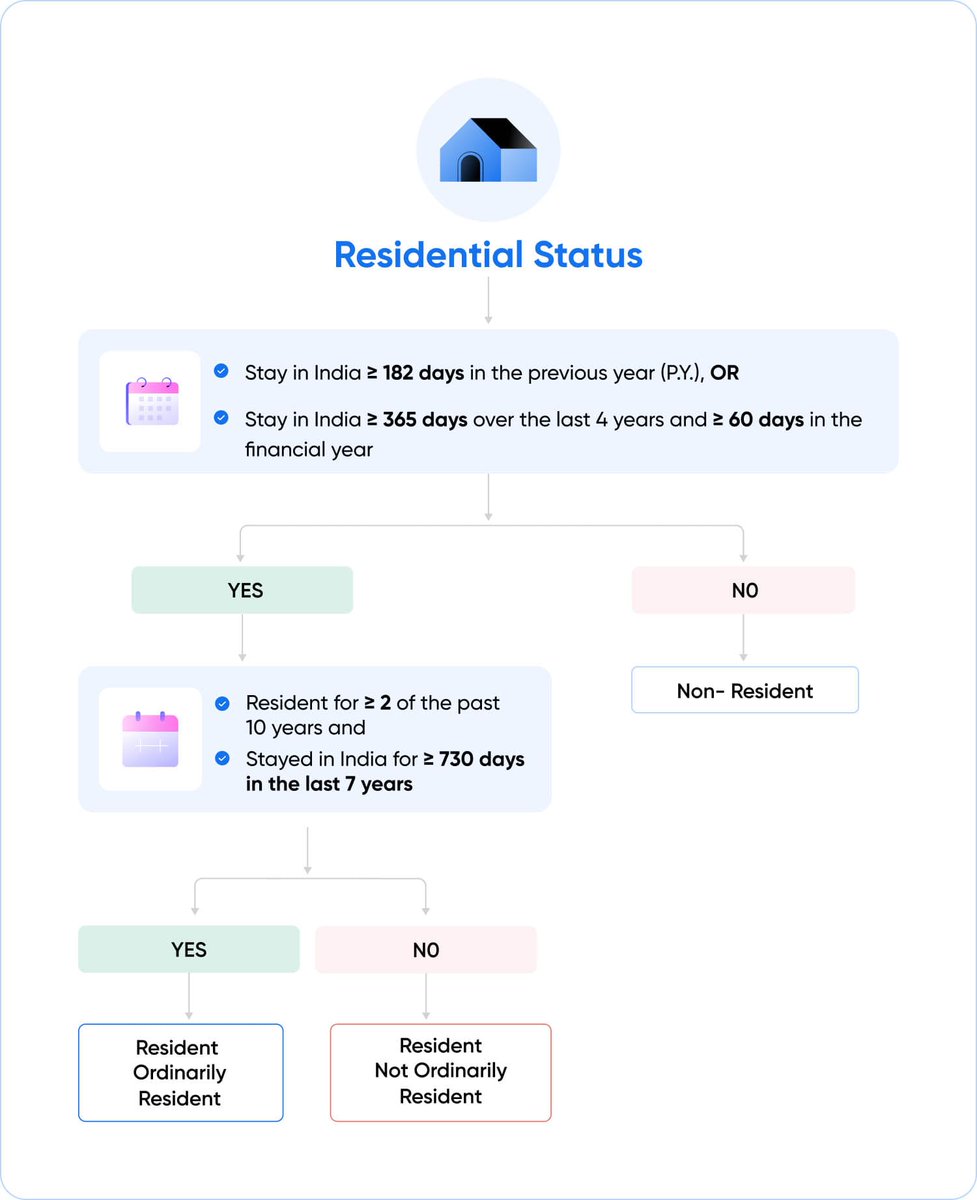
The Indian Income Tax Act has no Force Majeure clause for residency.
None. Zero. It doesn't care about wars, conflicts, or grounded flights.
If you're a UAE resident living in the 0% tax world — your entire financial life runs on a day count.
A handful of extra days in India can unravel all of it:
❌ Dubai's 0% tax benefit? Gone.
❌ Your global income? Now taxable in India.
❌ DTAA structure? A compliance nightmare.
And before you wait for CBDT to step in historically, they've granted stay exemptions only for once-in-a-century events.
COVID-19 was one. A regional conflict, so far, has not qualified.
No exemption has been announced. Plan accordingly.
I've put together an infographic breaking down exactly how these residency rules work — and what you should be doing right now if you're stuck.
English
The government doesn’t need to "Police" anymore. It has a digital bedrock.
The shift we’re seeing now isn't just a change in law. It’s a change in infrastructure. The government now has immense trust in its own AI systems.
They are looking at your:
→Bank
→Investment in Stocks, Mutual Funds, Derivatives, Commodities
→Credit Cards Spends
But instead of a Tax Notice, they’re sending a "Nudge."
One is a penalty; the other is a partnership.
The government is basically saying: "We see the data. We’ll trust you to fix it before we have to."
At ClearTax, we’re seeing this reflected in the "Financialization of India."
Our ITR-3 filings, the complex form for professionals and traders, grew by 45% last year. India isn't just a country of salary-earners but a nation of investors and entrepreneurs.
From 1st April 2026, The new Income Tax Act is an attempt to align the law with this digital reality. By extending revision windows and simplifying high-value reporting, the state is treating the taxpayer as a partner in nation-building, not a suspect.
In a world of perfect data, the honest taxpayer finally gets the "Ease of Paying Tax" they were promised.
Thanks to @alexandermats and the @NDTVProfit team for the deep dive into where the India tax story is headed.
English
Been playing around with Claude code lately. 3 features in Claude code I'm looking to try out:
→ /voice
→ /remote-control
→ /btw
/remote-control and /voice shows how the barrier between 'idea' and 'execution' is disappearing.
/btw command is my favourite. It is perfect for keeping the flow while adding critical context.
Exciting time to be a builder. What are your go-to plays?
English
Millions of transactions. GL. TDS. P&L. Tax receivables.
All moving across systems that were never built to talk.
That gap? That's where compliance risk is born.
The CFO won't see it — until it's a notice.
Your team is smart. But does your system have intelligence on every transaction before they touch it?
That's what we built with Clear Tech.
AI-native.
Transaction-level.
Every data type.
Own Audits. The AI Way.


English

@architgupta It shows that smart AI isn't about burning more power, but about designing systems where heavy reasoning is used only when it really matters.
English
AI efficiency depends on system design, not just the model.
When we started building our AI Tax Filing product, we processed our first 2,000 filings using a single large model, consuming a high token usage leading to a significant burn per tax filing.
We learned the hard way that treating every interaction like a complex case is financially unsustainable. So, we ran an internal audit of real conversations to understand what we were actually paying for.
The data was shocking:
→~80% of queries were routine: context setting, basic info, status checks.
→Only ~20% genuinely needed deep, expensive reasoning.
We realized every interaction was being priced like a complex case, so we optimized three critical layers:
1️⃣Optimized Reasoning: We switched to a multi-agent system where lightweight models handle basics and specialist agents only trigger for complex topics.
2️⃣Optimized User Flow: We implemented OCR to extract data directly from documents, removing manual typing and errors.
3️⃣Optimized Calculation: We limited AI to data collection and assigned all arithmetic to our internal tax engine to ensure 100% accuracy.
With this architectural redesign, we drastically reduced costs and turned a cash-burning experiment into a scalable business.
The result:
✅Cost: Fewer tokens, 99% lower compute.
✅Speed: Smaller models, faster replies.
✅Accuracy: Tight boundaries, fewer hallucinations.
True engineering isn't just about using the latest model. It's about knowing where exactly to use it.


English
@priyankinfinnov Actually, those 80C and HRA savings are exclusive to the Old Regime; the New Regime replaces those specific deductions with much lower tax slabs instead.
English

@architgupta Please add new tax regime to this also for us naive folks to pick the best !!
English
I’ve been reading the Draft Income Tax Rules 2026, and one thing is clear - the tax rules are finally starting to match how expensive life has become.
After the Union Budget 2026, many people thought the Old Regime was being slowly phased out. But these draft rules suggest the government is actually trying to make a few updates to the Old Regime.
Here’s what the draft is changing:
1.The Metro Upgrade: For years, the metros included only four cities. Even if you lived in Bengaluru’s Whitefield or Pune’s Baner, you were treated like you lived in a small town. The draft finally proposes tech hubs as metros, jumping the HRA exemption from 40% to 50%.
2. The 30x Allowance Jump: The draft proposes increasing Children’s Education Allowance to ₹3,000/month and Hostel Allowance to ₹9,000/month (roughly a 30x jump). This finally matches how expensive school and hostel fees have become.
We also ran the numbers for a salaried person in Bengaluru earning ₹35 lakhs. Just these two changes (higher HRA limit + higher education/hostel allowance) led to a tax saving of about ₹1.41 lakhs back in your pocket.
So, the old regime isn’t dead.

English
@Sachshiin @vijayshekhar Great Insight. This is exactly why we started our assisted plans. It’s not just about filing once a year, but having an expert in your corner for all those mid-year financial decisions too
English

@architgupta @vijayshekhar Instead why not think of assigning a personal agent to each of your users( at cost) helping them file via agents & also plan financial decisions all throughout the year !
English
While building our Agentic AI tax assistant, we had one fear: The July 31st deadline. How do we prepare for millions of Indians filing their ITR at the last minute?
To prepare for the ITR rush, we created a massive-scale simulation, mock LLM. We unleashed millions of autonomous agents, similar to the architecture of OpenClaw, on our Agentic AI Tax filing products on WhatsApp and Slack.
The outcome was :-
→It conversed: It had detailed conversations with our chatbot.
→It made mistakes: It used slang, made typos, and asked confusing questions.
→It was human: It paused to think before typing, just like a human.
We stress-tested our product until it failed.
By simulating human-like chaos at scale, we found the hidden leaks in our infrastructure. We broke our Agentic AI Tax filing product with an "AI Army" so that when the real Tax payers use ClearTax this season, it’s unbreakable.
The future of tax filing isn’t just AI-powered.
It’s chaos-tested.
And we’re ready.
English