Arishekar N

1.2K posts

Arishekar N banner
Arishekar N

Arishekar N

@arishekarn

Vice President (VP) of Marketing at AMZ Prep | "While others wait, winners launch."

Canada Katılım Ocak 2013
1.4K Takip Edilen1.5K Takipçiler
Arishekar N
Arishekar N@arishekarn·
Your Amazon marketing won't work if your logistics aren't built for 3P. Here's why. 5 logistics realities supplement brands learn when they move from 1P to 3P on Amazon: 1. Inbound lead times determine your promotional calendar - On 1P Amazon controls replenishment - On 3P you control when inventory hits the FC - If your 3PL can't turn inbound fast, you miss your own launch windows 2. Powder SKUs require purpose-built receiving - Supplement brands deal with compliance labeling, fragile seals, and strict Amazon inbound requirements - Generic 3PLs fail at this category repeatedly - Getting it wrong means stranded inventory and suppressed listings 3. IPI score is your brand's health metric on 3P - Inventory Performance Index directly affects your storage limits and visibility - Poor inbound planning tanks your IPI - Brands that manage replenishment tightly protect their ranking 4. Canada requires a completely separate logistics setup - You cannot run Canadian Amazon off your US 3PL without intentional cross-border infrastructure - Customs, labeling requirements, and FC locations are different - Most supplement brands leave Canada underdeveloped because the logistics weren't built for it 5. FBA compliance errors compound fast in supplements - Wrong label placement, incorrect case pack quantities, missing lot codes - Amazon will reject the shipment or charge disposal fees - At volume this becomes a significant cost and a fulfillment gap The brands winning on Amazon 3P treat logistics as a marketing function. What's been the hardest logistics challenge in your 3P transition?
Arishekar N tweet media
English
0
0
0
7
Arishekar N
Arishekar N@arishekarn·
The real lesson isn't Middle Mile vs SPD. It's that "Amazon handles it" is the most expensive sentence in eCommerce. The brands winning in 2026 aren't outspending competitors they're auditing the line items competitors ignore. What's the most expensive "convenience" you stopped paying for? #AmazonFBA #Ecommerce #Logistics #SupplyChain #DTC
English
0
0
0
7
Arishekar N
Arishekar N@arishekarn·
The tactical takeaway you can use today: If you're shipping more than ~150 cu ft to FBA per month, SPD is almost certainly the wrong tool. Pull your last 3 months of inbound invoices. Calculate cost per cubic foot. If it's north of $15, you're the next case study waiting to happen.
English
1
0
0
15
Arishekar N
Arishekar N@arishekarn·
Most Amazon sellers are bleeding 40-60% of their shipping budget and don't even know it. Not on ads. Not on PPC. On the boring line item nobody audits: Inbound to FBA. A supplement brand just cut that cost by 63% in 90 days. Here's exactly how,
English
1
0
0
42
Arishekar N
Arishekar N@arishekarn·
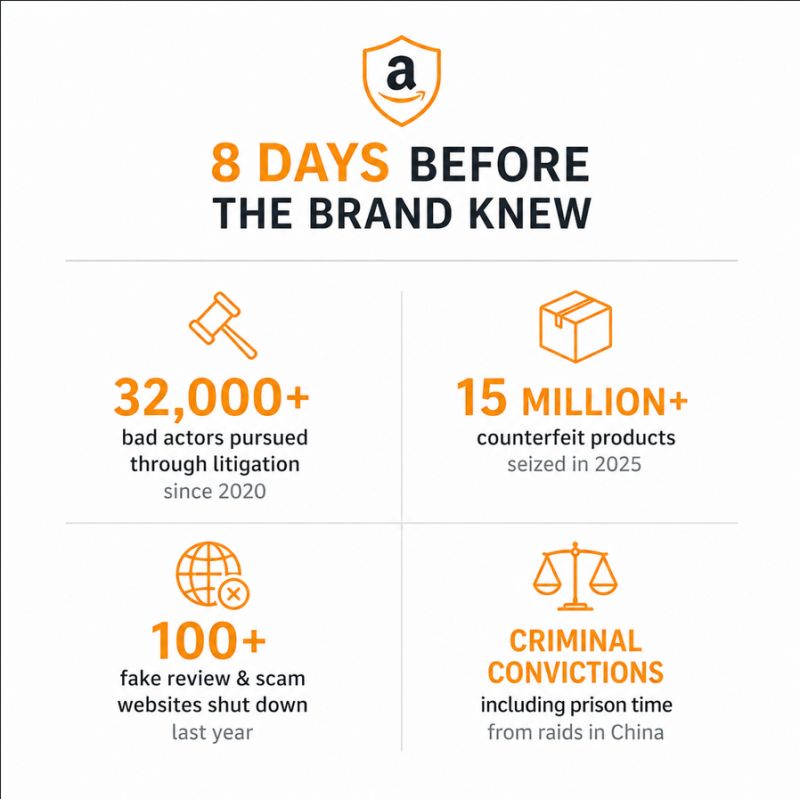
Amazon just blocked counterfeiters 8 days before the brand even knew there was a problem. Read that again. Their AI early warning system picked up a viral product trending on social media and shut down fake listings before the brand owner even submitted their IP. This is from Amazon's new Trustworthy Shopping Experience Report. The numbers: - 32,000+ bad actors pursued through litigation since 2020 - 15 million counterfeit products seized in 2025 alone - 100+ fake review and scam websites shut down last year - Criminal convictions including prison tim e from raids in China The reality? Most of this protection only kicks in if you're enrolled in Brand Registry. Without it: - No IP protection tools - No early warning system watching for knockoffs - No proactive enforcement on your behalf - You're invisible to the systems doing the heavy lifting I talk to brands every week who complain about counterfeiters but haven't even enrolled. Brand Registry is free. The protection infrastructure Amazon built behind it is not small. If you're selling on Amazon and not enrolled, you're leaving protection on the table. Are you enrolled? What's been your experience with Amazon's brand protection?
Arishekar N tweet media
English
0
0
0
23
Arishekar N
Arishekar N@arishekarn·
A brand went the entire year without getting hit with a single Amazon long-term storage fee. Not because they had fewer SKUs. Because they stopped shipping bulk into FBA and switched to drip feeding inventory. Small, frequent sends to FBA. Slow movers shifted to SFP and FBM. Stock never sat long enough to age into penalty territory. AMZ Prep handled the prep and flow on their end. The brand handled zero surprise storage charges. This is what it actually looks like when drip feeding works. youtu.be/MP-s3zh1jy4
YouTube video
YouTube
English
0
0
0
20
Arishekar N
Arishekar N@arishekarn·
Cut 25–30% off per-package shipping costs. That's what 437 achieved by adding a Texas FC with AMZ Prep and keeping Toronto for Canada via Skip Air, and fixing the margin leak. If you're a Canadian DTC brand shipping heavily into the US, one Toronto warehouse might be what's killing your margins. Cross-border fees + dim weight stack up fast. Check Out: amzprep.com/how-ecommerce-… #fourthreeseven #amzprep
English
0
0
1
48
Arishekar N
Arishekar N@arishekarn·
Amazon's April 2026 update just changed how every seller needs to manage cash. Ad spend now gets deducted instantly from your retail proceeds. Your sales revenue? Still stuck in a 12-day deferral window. No more credit card floats. No more reward points on ad spend. This creates what I'm calling the "negative settlement trap": Your costs hit immediately. Your revenue shows up almost two weeks later. If you're running heavy ad spend relative to sales, your settlements can go negative before the revenue catches up. THE OPERATIONAL CHANGES YOU NEED TO MAKE: #1 Build a cash buffer specifically for ad spend - Calculate your average daily ad spend x 14 days - That's your new minimum reserve - Don't touch it for inventory or anything else #2 Shift ad spend timing - Front-load campaigns earlier in the settlement cycle - Give revenue time to catch up before the next deduction hits - Avoid spiking spend right before settlement closes #3 Monitor settlements weekly, not monthly - You need to see the gap between deductions and revenue in real-time - By the time monthly reports show a problem, you're already underwater #4 Rethink your TACOS threshold - If ad spend is 30%+ of revenue, you're most exposed - Either improve efficiency or build a bigger buffer - This isn't about ROAS anymore, it's about cash timing The brands that adjust their operations now will be fine. The ones who keep running the same playbook are going to get caught in settlement cycles that don't make sense. Has this already hit your settlements? What's your plan to manage the gap?
Arishekar N tweet media
English
0
0
1
14
Arishekar N
Arishekar N@arishekarn·
Everyone keeps repeating the same advice on A-to-Z claims: “Use Buy Shipping and you’re protected.” That was mostly true years ago. Today, it’s an oversimplification that quietly costs sellers money. Here’s the background most people miss: Amazon introduced Buy Shipping as a liability shield. In theory, if you ship with it and deliver on time, Amazon absorbs A-to-Z risk. But as claim volume increased, the system changed in practice: A-to-Z decisions are no longer purely policy-driven. They are evidence-driven, reviewer-driven, and often time-constrained. Which creates a gap: Your order can be technically “Claim Protected”… and still lose if the reviewer doesn’t instantly see proof inside Amazon’s own interface. That’s the contradiction sellers run into: Protection exists, but it’s not always surfaced at decision time. So the common reaction is: “Amazon ignored its own policy.” But the more uncomfortable reality is: The system doesn’t “check policy” the way sellers assume. It checks what’s immediately verifiable in the appeal flow. This is why some sellers start over-documenting everything: screenshots, tracking exports, delivery confirmations. And it works. Not because Amazon is wrong. But because visibility wins over entitlement in the review process. Here’s the contrarian takeaway: Buy Shipping is not a guarantee. It’s a conditional advantage that only holds if your evidence is instantly legible inside Amazon’s review environment. The real edge isn’t using Buy Shipping. It’s assuming it will fail you anyway and building a process where that failure doesn’t matter. Most sellers optimize for protection. The best sellers optimize for reversibility.
Arishekar N tweet media
English
0
0
0
10
Arishekar N
Arishekar N@arishekarn·
Amazon just opened a distribution center in Shenzhen for US-bound inventory and the math is actually interesting for brands manufacturing in China. Storage costs are up to 45% lower than US-based Amazon Warehousing and Distribution. Inventory can reach US fulfillment centers up to 7 days faster when combined with Amazon Global Logistics. What this actually means for cash flow: Instead of shipping bulk inventory to the US and paying for storage while it sits, you can now hold it closer to your manufacturer and only move it stateside as demand builds. Less capital tied up in US warehouses. Lower storage fees. Faster replenishment when you need it. The play here is flexibility. Testing a new SKU? Store it in Shenzhen first. See if it sells before committing to full US inbound. Seasonal product? Keep bulk inventory in China during off-peak and pull it in when demand spikes. Amazon is clearly building out end-to-end supply chain services to compete with Walmart's international logistics push. About half of Amazon's active sellers are China-based, so this locks in that seller base while also giving US brands manufacturing there a tighter pipeline. The trade-off is more dependency on Amazon's logistics stack vs using independent freight and 3PLs. But for brands looking to reduce upfront inventory risk and improve cash flow timing, this is worth watching. Is anyone already testing this? Curious what the actual experience looks like.
Arishekar N tweet media
English
0
0
0
20
Arishekar N
Arishekar N@arishekarn·
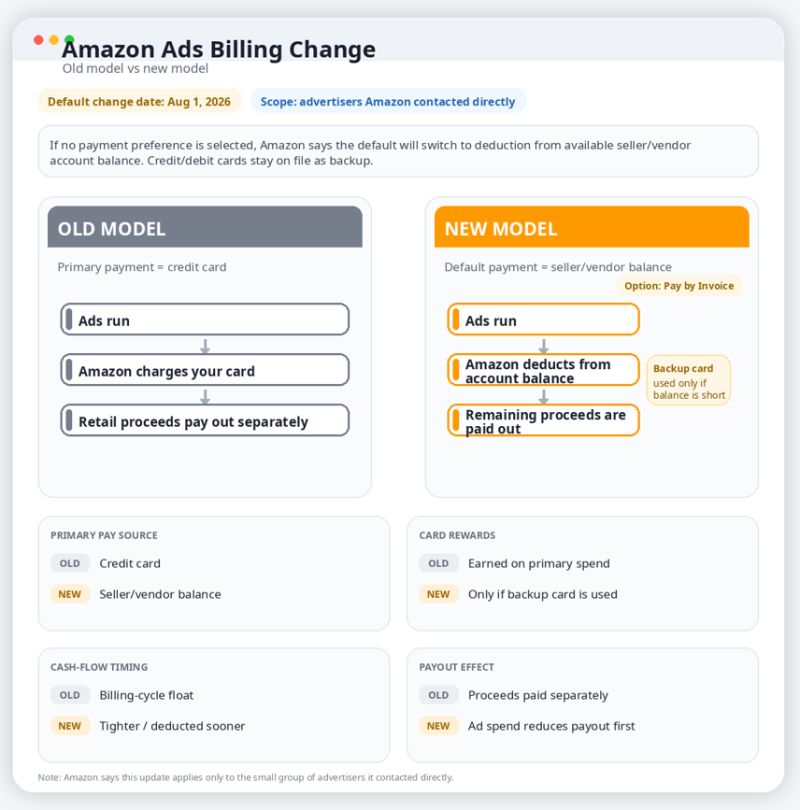
Some Amazon sellers are about to lose 3% of their ad spend margin overnight. And most don't even know it's coming. On August 1st, Amazon is changing how a subset of sellers pay for ads. Instead of charging your credit card, they'll auto-deduct from your retail proceeds. For sellers who built their margins around credit card rewards, this is a wake-up call. I've talked to sellers who treat that 3% cash back as part of their P&L. Not a perk. Actual margin. And Amazon just quietly started closing that door. This isn't the first time Amazon has tightened the screws: - FBA fee increases every year - Inbound placement fees - Low inventory fees - Now: removing credit card float from the equation The pattern is clear. Amazon is slowly eliminating every arbitrage opportunity sellers have found. The sellers who survive aren't the ones finding the next loophole. They're the ones building real margin into their operations, supply chain, and fulfillment. If your profitability depends on credit card points, you're not running a business. You're running a workaround. August 1st is coming. What are you doing to build margin that Amazon can't take away? #amazon #amazonads
Arishekar N tweet media
English
0
0
0
20
Arishekar N
Arishekar N@arishekarn·
I ran the numbers on Amazon's new ad cost deduction and realized most sellers are treating this like a payment method change. It's not. It's a cash-flow change. Starting April 15, Amazon is auto-deducting ad costs directly from your retail proceeds before payout. Your card becomes the backup, not the default. Here's why this matters: That 30-day float you've been using on your credit card? Gone. Your disbursement is now net of ad spend. So if you're running aggressive campaigns, your payout shrinks before it ever hits your bank. What to do right now: Check if your account is affected and whether Pay by Invoice is available as an alternative Rebuild your weekly cash-flow model so ad spend is no longer treated as a separate line item with a 30-day delay Update your P&L reconciliation so ad costs are matched against disbursements, not card statements Keep a buffer in your seller balance for weeks when ad spend spikes or sales dip A simple reserve rule: hold at least 7 days of ad spend or 1 week of FBA fees, whichever is higher. I built a spreadsheet to model this. It breaks down: Sales collected Amazon fees Net proceeds before ads Ad deduction (capped at available proceeds) Card backup charges Ending seller balance If your ad spend is large relative to your daily payouts, this change will feel like a working-capital squeeze. If it's modest, it's mostly an accounting cleanup. Either way, you need to see the numbers before April 15.
English
0
0
0
48
Arishekar N
Arishekar N@arishekarn·
Week 5 of analyzing 40K+ emails and 22K calls. This time: Subscription Box Fulfillment. The questions brands keep asking: "How do I make subscription boxes profitable at scale?" "Should I push monthly or yearly subscriptions?" "Why does subscription fulfillment cost more than marketplace orders?" "Can you handle variable box contents each month?" "What's the best way to kit multiple SKUs without slowing fulfillment?" "How do I reduce churn from late or damaged boxes?" Most brands already know subscriptions improve LTV. The real question now is how to make money on each box after fulfillment costs. And when brands ask these questions to 3PLs, they’re not just rate shopping. They’re trying to see if the 3PL actually understands subscription logistics or treats it like regular ecommerce. What we tell them: Subscription boxes are one of the strongest retention tools in DTC. But many brands lose money because they fulfill them like one-off orders. Why subscriptions are growing fast: The math is simple. Monthly customers are worth more than one-time marketplace buyers. No marketplace fees. Predictable revenue. Higher lifetime value. When customers see the price difference between Amazon and direct subscriptions with perks, conversions follow. We're seeing brands lock in monthly and yearly subscribers at stronger rates than before. Where most brands mess up: They fulfill subscription boxes like individual orders with separate picks, separate packaging, and multiple shipments to the same customer. That kills margin. What smart brands do instead: They batch and kit. If a customer gets 4 products, they go into one box. One pick. One pack. One label. The savings scale fast. We’ve onboarded brands paying for multiple shipments per customer each month. Moving to single kits created immediate savings. There’s also a brand benefit. One box allows for better packaging, inserts, and a premium unboxing experience. Smart brands also right-size packaging. Subscription boxes are predictable, so custom-fit packaging reduces dimensional weight and shipping costs. They also plan inventory around subscription cycles. No backorders. No split shipments. One late box can trigger churn. At AMZ Prep, we help brands build these systems by kitting products, optimizing packaging, and shipping as single units. We’ve seen brands move from $8 per box to $5 per box. That’s $3 saved × 10K subscribers = $30K saved every month. Subscription fulfillment isn’t just shipping boxes. It’s building a system where every renewal stays profitable. This is Week 5. 11 more questions coming from growing brands focused on improving operations and reducing costs. Are you running subscriptions? What’s your biggest fulfillment headache right now?
English
0
0
0
9
Arishekar N
Arishekar N@arishekarn·
"Focus on one thing" is the most overused advice in business. It's also wrong more often than people admit. Andy Jassy just dropped Amazon's 2025 shareholder letter and one line hit me: "Some companies may have decided to pursue only one of these efforts, arguing for weeks or months which one, all the while pursuing none." That's the real trap. Not doing too much. Doing nothing while debating what to do. Amazon is running Same Day Fulfillment Centers, drone delivery (Prime Air), AND 20-minute micro-fulfillment (Amazon Now) all at once. Same with grocery. Whole Foods, Amazon Fresh, perishables in same-day delivery. Multiple bets. Not one clean path. Here's the thing: we do the same at AMZ Prep. We run FBA prep, Seller Fulfilled Prime, cold chain for meltables, and DTC fulfillment. All in parallel. Early on, people told me to pick a lane. But the lanes are connected. Cold chain infrastructure lets us serve meltable brands year-round. SFP lets brands stay visible when FBA restricts inventory. FBA prep is still the bread and butter. They complement each other. So when does 2 bets > 1? Here's my framework: The bets share infrastructure (Amazon's drones launch from SSDs. Our cold chain uses the same facilities as standard fulfillment.) The timeline is multi-year (Drones don't ship in a quarter. Neither does cold chain certification.) One bet alone won't capture the full opportunity (Amazon Now does 20-minute delivery on thousands of SKUs. Prime Air does 30-minute on millions. Different use cases.) Waiting means someone else builds it first (Ultra-fast delivery was happening with or without Amazon. Cold SFP was happening with or without us.) The "focus" advice isn't wrong. It's just incomplete. Focus on one outcome. But don't limit yourself to one path to get there. Curious: are you running parallel bets right now, or going all-in on one?
Arishekar N tweet media
English
0
0
0
15
Arishekar N
Arishekar N@arishekarn·
I build demand engines for a living. Blair told me to turn everything off for 60 days. Here's why. My job is to drive awareness and pipeline for AMZ Prep. Blair told me to do the opposite. No landing page. No email blast. No social campaign. Just him, Rich, Nolan, Angelo, and a small team getting on calls with 3PL owners and logistics leaders. 80+ demos in 2 months. I watched the recordings. A head of logistics said he'd been trying to build this internally for 18 months. A public logistics company asked for an NDA before they could see more. A 3PL founder looped in her direct reports within 2 minutes. I watched Angelo's face on one of those calls when the founder pulled her team in mid-demo. Nolan told me afterwards that the reactions reminded him of what he wished he had when he was on the brand side. As a marketer, I've spent my career trying to manufacture that kind of reaction. These calls didn't need a single piece of marketing to drive engagement. The product did it on its own. Now it's my turn. This is the first post in a series leading up to the biggest announcement in AMZ Prep's history. Built for 3PL owners, warehouse directors, and logistics managers. May 1st.
English
0
0
0
18
Arishekar N
Arishekar N@arishekarn·
Your Q3 inventory might already be late. And most sellers don't realize it yet. Here's what's happening right now: The Strait of Hormuz has been closed for over a month. Ships are rerouting around Africa. That's adding 2-3 weeks to transit times from Asia. Oil is past $120 a barrel. Fuel surcharges are climbing across every carrier. 4% of global shipping is either stuck or idle. If you're sourcing from Asia and haven't shipped yet, your Prime Day timeline just got a lot tighter. This is stacking on top of what was already a tough cost environment: - Section 232 tariffs now hitting full product value - Section 301 duties still in play for China goods - FBA dimensional weight fee increases - Amazon's fuel surcharge kicking in The brands that stay ahead right now are doing a few things: 1. Adding 2-3 weeks buffer to all lead time estimates 2. Talking to freight forwarders about real-time transit updates 3. Locking in carrier rates before Q3 repricing 4. Prioritizing high-margin SKUs for Prime Day inventory 5. Re-running unit economics with updated shipping costs The sellers who plan for this will have inventory when competitors are stocked out. The ones who wait will be scrambling in June. Prime Day doesn't wait for your supply chain. Are you seeing delays yet? What's your plan? #Amazon
Arishekar N tweet media
English
0
0
0
34