Dr. Seto
25 posts


Welcome @SammyElmariahMD! Starting in Sept as Chief of Interventional Cardiology & Med Dir Cath Lab. Dr Elmariah is an expert in structural heart disease interventions & catheter-based valve therapies. He has an NIH-funded research program & is a leader in valve treatment trials.

English

Kudos again to the FAME3 investigators for a well-designed trial. Ten years, 48 sites, ? millions of $$, and probably thousands of uncompensated person-hours: this is how you create a landmark trial in NEJM. #CardsJC @wfearonmd
English

@a_h_ghoneem Agree this reiterates SYNTAX findings for low complexity patients ?meta-analysis anyone? O/W IC's have to concede that intermediate and high-complexity patients are better off with CABG if acceptable OR risk. High SYNTAX score = diffuse disease, where CABG shines. #CardsJC
English

#CardsJC Q7: Subgroup analysis: patients w/ a low Syntax score <23 had lower rate of the primary outcome in the FFR-guided PCI group compared to the CABG group. Should we use this subgroup analysis to recommend PCI over CABG to patients w/ ↓syntax scores & 3-v- CAD?
William Fearon@wfearonmd
I think we can advise patients that with low SYTAX score (and especially low functional SYNTAX score) the data suggests better outcomes with PCI and more similar to those with CABG. #CardsJC
English

@a_h_ghoneem Agree this reiterates findings from SYNTAX for low complexity patients ?meta-analysis anyone? O/W IC's have to concede that intermediate and high-complexity patients are better off with CABG if acceptable OR risk. High SYNTAX score = diffuse disease, where CABG shines. #CardJC
English

#CardsJC Q7: Subgroup analysis: patients w/ a low Syntax score <23 had lower rate of the primary outcome in the FFR-guided PCI group compared to the CABG group. Should we use this subgroup analysis to recommend PCI over CABG to patients w/ ↓syntax scores & 3-v- CAD?
Seyi Bolorunduro MD MPH@seyi_dr
@CardioNerdsJC We know we can only limit this to hypothesis generation since its a subgroup analysis, but i believe this line of thought is echoed by SYNTAX #CardsJC
English

@wfearonmd Well designed and executed trial! Dr. Fearon, can you elaborate on the 10% of patients that underwent CABG that had FFR, and the discussion that perhaps these patients with 50% DS stenosis had physiologic 1-2v dz and just had PCI instead of getting randomized? #CardsJC
English

The decision not to mandate FFR-guided CABG was partly because studies have not shown a benefit over angio-guided CABG and partly because logistically would have been challenging and would have led to exclusion of a lot of patients who otherwise would have been enrolled.
#CardsJC
English

SCAI Length of Stay after PCI link:
onlinelibrary.wiley.com/doi/abs/10.100…
Many thanks to @SVRaoMD, Adhir Shroff,, @maf204 @KDBoudoulas @jBlankenshipMD @RVSwaminathanMD, Dmitriy Feldman, Daniel Kolansky, Greg Dehmer, Kusum Lata, Joaquin Cigarroa. @RadialFirstBot #samedaydischarge twitter.com/CardioNowNews/…
Cardiology Now News@CardioNowNews
SCAI Consensus Statement for Length of Stay after PCI. Dr. Seto and Dr. Boudoulas outline the top takeaways from #SCAI2018 cardiologynownews.org/scai-consensus… @SCAI @BaimInstitute @arnoldseto @KDBoudoulas twitter.com/CMichaelGibson…
English

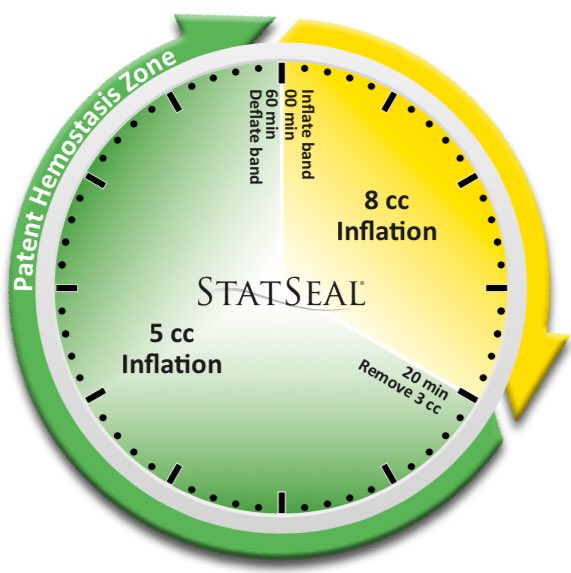
@DrSaririan @willsuh76 @fischman_david @SVRaoMD @Radial_ICG @mmamas1973 @HeartOTXHeartMD @DocSavageTJU @CardiacConsult @duanepinto @DrMauricioCohen @JonathanScharfs @rwyeh @DrQuinnCapers4 @ferdikiem @nolanjimradial Yes, there was a trend towards more small hematomas in the STAT study which had 40 minute release time. We advised company to revise protocol. Looking forward to studying it further!
English

@willsuh76 @fischman_david @SVRaoMD @Radial_ICG @mmamas1973 @HeartOTXHeartMD @DocSavageTJU @CardiacConsult @duanepinto @DrMauricioCohen @JonathanScharfs @rwyeh @DrQuinnCapers4 @arnoldseto @ferdikiem @nolanjimradial Wasn’t there a signal for increased hematoma, prompting this revised protocol?

English

Recent tweets suggest shortening hemostasis time for #RadialFirst diagnostic only. When do you wean hemoband? Pls VT/RT @SVRaoMD @willsuh76 @Radial_ICG @mmamas1973 @HeartOTXHeartMD @DocSavageTJU @CardiacConsult @duanepinto @DrMauricioCohen @JonathanScharfs @rwyeh @DrQuinnCapers4
English

@IngrassiaMD Thanks! iFR and FFR are tools to support your clinical judgment. Each test is imperfect and noninferior in outcomes c/w to the other, so if they are discordant pick the result that you like/supports your best judgment.
English

.@arnoldseto with some good, practical advice on use of iFR/FFR in stable CAD. “Two swings of the bat” #ACC18 #physiologymatters
Florida, USA 🇺🇸 English

@EJSMD @Tesslagra @CardiacConsult @agtruesdell @willsuh76 @SVRaoMD @mmamas1973 @mirvatalasnag @jedicath @DocSavageTJU @rwyeh @rajivxgulati @chadialraies @ajaykirtane @duanepinto I have Site-Rite for pacers/ICDs in my lab (best needle guide) , and Sonosite for other vascular access, echo (smaller probes). In ~500 pacemakers/devices over 7 years no pneumothoraces with the Site-Rite. US should be standard but only 2% use in CIEDs. ncbi.nlm.nih.gov/pubmed/23131025
English

@agtruesdell @RadialFirstBot I have tried this several times but could not find the right size catheter to use without causing bleeding around the sheath hole. Thanks for sharing!
English

@DavidLBrownMD @DrAnkitKPatel @ekgpdx @JReinerMD @SJcardio @SVRaoMD @SCAI @ajaykirtane Number of ABIM 1st year IC Fellows continues to increase to 297 last year.
abim.org/about/statisti…
Not clear where they are training as many programs are reducing their positions, but there is no controlling authority in US over # training slots.
English

@hmsdoctor @yadersandoval @rajivxgulati @esbrilakis @ALoboMD @MHIValveDoc @PSorajja @MHIF_Heart @MayoClinicCV @SVRaoMD @mmamas1973 @kashishgoelmd @DrArgyle @ReddyTheRobot @ErinAFender @AlhijjiM @cvinnovations Not much data to support combining the two. FEMORIS trial is only RCT of micropuncture alone (Cardiology 2014;129(1)39-43). I use micropuncture for all venous access or pericardiocentesis, but am unsure of 21g benefit if you can get single femoral artery puncture w/ US.
English

@lamelaspablo @yadersandoval @mobitz @SVRaoMD @CardiacConsult @willsuh76 That's a great thought - i suspect spasm and periadvential microhemmorhage may coexist at times. It might be hard to prove either way absent NTG and waiting for it to go away, but the focal nature makes me think spasm.
English

@yadersandoval @mobitz @SVRaoMD @CardiacConsult @willsuh76 On the other hand, after multiple attempts by the fellow, if the pulse is weaker, and the artery looks like this (spasm), it would seem that reducing the trauma would be a good idea!
English

@yadersandoval @mobitz @SVRaoMD @CardiacConsult @willsuh76 # of puncture attempts may actually just be a correlate for a small radial artery size, which is then associated with RAO, pain, and spasm. US may be most useful to tell you the 5% of the time you would be better off going to the ulnar, before you stick. ncbi.nlm.nih.gov/pubmed/26224393
English

@SVRaoMD @CardiacConsult @willsuh76 Right... helpful in first pass success and time to access, no difference in spasm, bleed,or pain. 8/10 manual palp failures rescued with US after 5 min of attempts. Sheath insertion failure rate 4.2% with palpation, 0.8% with US. If you want to be part of 1% club, you need US.
English

@SVRaoMD @nolanjimradial @DrMauricioCohen @willsuh76 Keep needle close to center of probe, use short jabs, angle probe towards needle. Overshooting proximally nonissue in radial c/w femoral.
English

@SVRaoMD @nolanjimradial @DrMauricioCohen @willsuh76 Min depth for needle guide is ~1.5 cm. Needle guide too challenging for radial, not needed as error in angulation less in shallow target.
English

@nolanjimradial @DrMauricioCohen @willsuh76 @SVRaoMD For sonosite machines: civco.com/mmi/resources/…
I found these a bit awkward.
English

@nolanjimradial @DrMauricioCohen @willsuh76 @SVRaoMD Proprietary Needle guide for Bard Site-Rite (used in FAUST trial): bardaccess.com/products/imagi…
Easy to use, but only works with SiteRite
English