Arthur van Riel

2.1K posts

Arthur van Riel banner
Arthur van Riel

Arthur van Riel

@arthur_riel

Senior Research Fellow Netherlands Scientific Council for Government Policy @WRRDenktank | Professor of Historical Political Economy Erasmus University

Katılım Şubat 2019
261 Takip Edilen285 Takipçiler
Sabitlenmiş Tweet
Arthur van Riel
Arthur van Riel@arthur_riel·
“No one can fool you as easily as you can fool yourself. We must be careful not to believe things simply because we want them to be true.” Richard Feynman
Arthur van Riel tweet media
English
2
2
11
0
Arthur van Riel retweetledi
Jesús Fernández-Villaverde
Jesús Fernández-Villaverde@JesusFerna7026·
As reflected in many of my posts over the past few months, I have been reading (and re-reading) a lot of social theory. What strikes me is that most critics of “capitalism” (whatever “capitalism” might mean, and regardless of the value of those critiques) are really critics of modernity, understood as the organization of society around technology, formal institutions, and rational criteria. I teach the economic history of the Soviet Union and socialist China, and all the pathologies (pollution, reliance on fossil fuels, inequality, depersonalization, consumerism, alienation, you name it) that you can find in a poor neighborhood of 2026 Philadelphia appeared in the same way, or even more, in a factory in Leningrad in 1970 or on a collective farm in Jiangsu in 1978. Critics seem to lack a vocabulary (or, if you prefer, a cognitive framework) for distinguishing “capitalism” from modernity. For example, people everywhere tend to link personal relationships to displays of consumption. There are likely deep evolutionary reasons for this. De Beers did not invent spending a lot of money on a useless engagement ring: it rode a pre-existing disposition into a particular form of consumption. Couples in Leipzig in 1982 were as interested in conspicuous consumption as those in Chicago in 2026. Talking about “Love and the Cultural Contradictions of Capitalism” misses the point completely. Of course, you can try, as some of the more perceptive Trotskyists did, to argue that the Soviet Union or China were not truly socialist countries, but this is just a lazy application of the “no true Scotsman” fallacy, and, consequently, their complaints failed to gain much traction outside some departments of cultural studies. But this is not just a matter of poor analytic skills, as bad as those are. More importantly, it means that 99% of the policy proposals activists put on the table to correct the problems of “capitalism” are doomed to fail because they do not understand where the root cause of the phenomena they complain about lies. I see this at the university. Do you think the corporation you deal with is self-serving and incompetent? Wait until you need to deal with the Graduate School at a private Ivy League university. The incentive problems (asymmetric information, career concerns, lack of timely feedback, pressure toward conformity) that cause dysfunction in the former are even more pronounced in the latter because of the absence of a profit motive, the sharpest disciplinary mechanism. At a very fundamental level, Marx got modernity wrong; Weber got it right. Time to spend much less time with Marx and much, much more time with Weber.
Jesús Fernández-Villaverde tweet media
English
108
282
1.4K
166.4K
Arthur van Riel retweetledi
Chris Aalberts
Chris Aalberts@ChrisAalberts·
Kan iemand aan de redactie van EW doorgeven dat dit weergaloze stuk algemeen beschikbaar moet zijn zonder betaalmuur? Fantastisch.
Chris Aalberts tweet media
Nederlands
11
20
155
21.7K
Arthur van Riel retweetledi
tonvanhaperen
tonvanhaperen@tonvanhaperen·
IJzersterk stuk van David Roelofs. Waarom kinderen steeds minder leren op school. Het hoeft niet zo te zijn. volkskrant.nl/columns-opinie…
Nederlands
11
26
76
4.5K
Arthur van Riel retweetledi
Jesús Fernández-Villaverde
Jesús Fernández-Villaverde@JesusFerna7026·
The real issue with Ha-Joon Chang’s FT op-ed last week isn’t his economics—it’s the cartoonish caricature of Catholic theology in the Middle Ages, straight out of an outdated high school textbook or a bad History Channel doc. The 12th and 13th centuries were among the most creative and intellectually rich in Western thought, including philosophy and theology. Just to name a few great Catholic theologians of the time: Anselm of Canterbury, Bernard of Clairvaux, Hildegard of Bingen, Albertus Magnus, Anthony of Padua, Bonaventure, Thomas Aquinas, William of Ockham, and Duns Scotus. These thinkers have shaped the Western perspective on reason, language, metaphysics, epistemology, ethics, the mind, mysticism, and politics to this day. Reading Aquinas—by far the deepest and most influential of them all—is breathtaking. His Latin wasn’t elegant, but his mind was. If he were alive today, he’d publish two Econometricas a year. And yes, his theology triumphed because it was better argued, despite strong resistance from entrenched interests at the University of Paris. Dismissing all this as “backward” is just absolute ignorance, pure and simple. A gentle but very well-written introduction to all this is The Bright Ages: A New History of Medieval Europe by Matthew Gabriele and David M. Perry. Read also, for a fantastic, easy narrative, Medieval Philosophy: A History of Philosophy without Any Gaps, Volume 4, by Peter Adamson.
Jesús Fernández-Villaverde tweet media
English
36
131
648
97.1K
Arthur van Riel retweetledi
Jesús Fernández-Villaverde
Jesús Fernández-Villaverde@JesusFerna7026·
One of the more frustrating trends in public life over the past decade is how people who lead failing institutions blame social media for their failures. A university president whose faculty have become political activists instead of educators and whose administrators multiply like rabbits will tell you that “misinformation on social networks” is eroding public trust in higher education. An editor whose publication lost its readership will claim that the real problem is X, rather than consider that the publication became boring, that the writing was uniformly uninspired, and that it stopped covering anything that mattered. A politician who loses an election will blame Meta algorithms rather than admit that voters simply did not like what was offered. A central banker whose institution missed the worst inflation in 40 years will worry publicly about TikTok videos spreading financial illiteracy. The pattern is always the same. The institution fails at its core mission. The public notices. The people in charge, rather than examining what went wrong, identify an external force that is “polarizing.” The diagnosis is never “we did a poor job.” It is never “we lost our audience because we gave them nothing worth reading.” The diagnosis is always “bad actors are distorting the conversation.” This is not new, of course. Before social media, talk radio was the scapegoat. Before talk radio, it was television. Before television, it was tabloid newspapers. Every generation of leaders has found a communication technology to blame for people’s loss of trust in them. What is new is the intensity and the shamelessness. Over the last few years, “social media” has become a universal excuse that requires no evidence and tolerates no scrutiny. It is deployed reflexively. The people who make this argument never seem to ask the obvious question: why are people on social networks so receptive to criticism of your institution in the first place? If your university were delivering excellent education at a reasonable price, no number of tweets would persuade parents otherwise. If your publication were covering important questions with clarity and substance, readers would not have migrated elsewhere. If the work you showcased were serious rather than trivial, people would still be paying attention. Trust is not destroyed by social media. Trust is destroyed by poor performance, and social media makes it harder to hide. That is a different thing entirely, and the people running these institutions know it, which is what makes the excuse so cynical. The honest version of the argument would be: “We used to be able to fail quietly because there was no mechanism for people to compare notes. Now there is, and we do not like it.” That, at least, would have the virtue of being true.
Jesús Fernández-Villaverde tweet media
English
30
237
708
87.8K
Arthur van Riel retweetledi
Hanno Lustig
Hanno Lustig@HannoLustig·
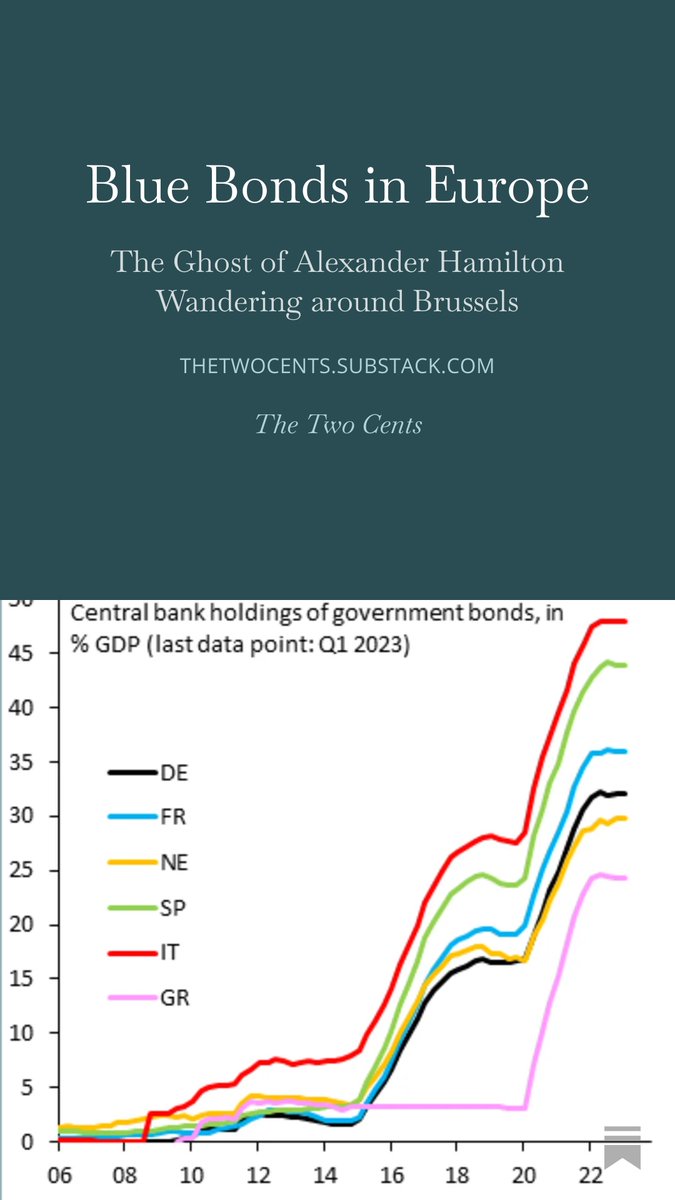
When Europeans promote the idea of joint debt issuance, they like to cite the example of Alexander Hamilton's push for deeper government debt markets in the US by having the US federal government assume the states' war debts in 1790, but they tend to leave out what happened next in the US. There are solid reasons why fiscally sovereign nations tend not to issue joint debt, unless they agree to severe and binding restrictions of their own fiscal sovereignty. Check out my post on the two cents blog I run with @RWacziarg: thetwocents.substack.com/p/blue-bonds-i…
Hanno Lustig tweet media
English
6
36
157
20.8K
Arthur van Riel retweetledi
laurence norman
laurence norman@laurnorman·
There were a lot of claims made last night by US officials including apparent intel that Iran considered attacking US first which deserve scrutiny. But on nuclear negotiations, there's every reason to believe that Tehran completely misread situation. -1- wsj.com/world/middle-e…
English
24
191
563
325.4K
Arthur van Riel retweetledi
Noah Pollak
Noah Pollak@NoahPollak·
This is the perfect European tweet. It is the Platonic ideal of contemporary European civilization. It is flawless in every way. I didn't think it could be done, but it has everything.
Ursula von der Leyen@vonderleyen

Following the ongoing situation in Iran, I am convening a special Security College on Monday. For regional security and stability, it is of the utmost importance that there is no further escalation through Iran’s unjustified attacks on partners in the region.

English
142
684
12.7K
1.1M
Arthur van Riel retweetledi
Samuel Hughes
Samuel Hughes@SCP_Hughes·
Nineteenth-century cities grew fast. Berlin’s population grew twenty times, Manchester’s twenty-five times, and New York’s a hundred times. Sydney’s population grew around 240 times and Toronto’s maybe 1,700 times. Between 1833 and 1900, Chicago’s population grew around five thousand times, meaning that on average it doubled every five years. Homes were larger and far more affordable. Vast networks of trams, buses and suburban railways were built. Running water, gas, drains and electricity was retrofitted into old fabric. Despite having been built at breakneck speed, cities in 1914 were pretty good places. How was this achieved? The short answer: vigorous interventionism about streets and drains, state-mandated monopolies for transport and utilities infrastructure, and lightly regulated permissiveness for everything else. worksinprogress.co/issue/urban-ex…
English
42
217
1.2K
375.6K
Arthur van Riel retweetledi
Hélène Landemore
Hélène Landemore@landemore·
Democracy in Classical Athens had no career politicians — and that wasn’t a bug. In this excerpt from my new book Politics Without Politicians, out now in @TPM, I examine what their system can teach us about expertise, citizenship, and democracy today. talkingpointsmemo.com/cafe/career-po…
English
4
39
81
7K
Arthur van Riel
Arthur van Riel@arthur_riel·
Mooi voorbeeld van waarom historische economie er toe doet. Met name in een tijd waarin voorstellen voor prijscontroles weer door de lucht vliegen.
Brian Albrecht@BrianCAlbrecht

I'm super excited for my new paper with @ATabarrok and Mark Whitmeyer: "Chaos and Misallocation under Price Controls" During the 1973-74 gasoline crisis, the U.S. had about a 9 percent national shortfall. But that was far from evenly spread out. Over 90 percent of stations in Connecticut were rationing fuel somehow, limiting purchase or straight up closed. In Idaho, Montana, Utah, and Wyoming? Not a single surveyed station reported any problem. Zero. Texas and the Great Plains were "virtually awash with gasoline." How does a 9 percent shortfall produce 90 percent rationing in one state and zero in another? And how big of a deal is that misallocation? Our paper does three things. First, we prove a Chaos Theorem: price controls generically push allocations to corners where some markets get everything and others get nothing, and which corner the economy lands on is unpredictable. Second, we develop a new way to find sharp robust bounds on the welfare cost of this misallocation. Price controls destroy the demand information you'd need for standard welfare analysis, so we bound the losses across all demand curves consistent with the data. Sharp bounds. Third, we apply both to the 1973-74 crisis and show that misallocation losses are 1 to 9 times the textbook Harberger triangle. Let's go through each. Why do price controls cause chaos? Price controls kill arbitrage. Normally, if gasoline is scarcer in Connecticut than Idaho, the price rises in Connecticut, attracting supply eastward. A small cost advantage captures only a marginal reallocation, because prices push back. Freeze the price everywhere and that pushback disappears. The supplier's problem reduces to pure cost minimization. Thinking of the geometry, cost is linear in quantity. A linear objective over a feasible set with corners always lands on a corner. This is the old idea, as Thomas Sowell put it, that economy loses its capacity for incremental adjustment and instead lurches between all-or-nothing extremes The figure below shows why. The blue segment is the feasible set. The dashed orange iso-cost lines are straight because cost is linear. A straight line sliding across a line segment always hits an endpoint. Flip the cost ranking by a fraction of a cent and the allocation jumps to the other end. Freeze the price everywhere and that pushback disappears. Every gallon earns identical revenue regardless of destination. The supplier's problem reduces to pure cost minimization. And cost is linear in quantity. A linear objective over a feasible set with corners always lands on a corner. Some markets get filled to capacity. Others get nothing. The figure below shows why. The blue segment is the feasible set, all the ways to split a fixed supply between two markets. It has two endpoints. The dashed orange lines are iso-cost lines, and because cost is linear, they're straight. A straight line sliding across a line segment always hits an endpoint. Flip the cost ranking by a fraction of a cent and the allocation jumps to the other end. Corners are bad enough. But which corner the economy lands on is unpredictable. When delivery costs are nearly equal, a pipeline repair, a refinery outage, a regulatory tweak can flip the entire allocation. Small parameter changes produce discontinuous jumps. We call this the Chaos Theorem. How big of a deal is it that we end up at a corner where? Every textbook draws the Harberger triangle as the cost of a price ceiling. But that triangle assumes reduced supply still goes to the right places. It didn't. The top row below shows the textbook case: supply spread efficiently, shadow prices equalized, small welfare triangles. The bottom row shows what actually happens at a corner. One market is fully served. The other bears the entire shortage. Same total supply. Look at the map again. It's natural to focus on the Northeast. The lines. That's the problem with price controls. But actually the states with abundant fuel are a sign of the misallocation. Instead of a shortage, they are getting more than they would get without a price control. How can we estimate welfare in extreme cases? Standard welfare analysis assumes a demand curve. But price controls destroy the information you'd need to pick the right one. Elasticity estimates work near the previously estimated equilibrium. In the 1974 case, rationed stations received 68 percent of baseline quantity, and many received nothing. So we developed a bounding approach. No assumed functional form. Across all demand curves consistent with the observed data and plausible demand slopes, what are the largest and smallest possible welfare losses? No assumed functional form. The key insight: efficient allocation equalizes shadow prices across markets, which collapses what would be an infinite-dimensional problem into a one-dimensional search. How large was gasoline misallocation in 1974? This is a theory and methods paper, but we show how to use it in the context of the gasoline shortages. Using station-level AAA survey data presented to President Ford during the crisis, we find exactly the corner-solution structure the chaos theorem predicts: 62.3 percent of stations operating normally, 27.6 percent limiting purchases, and 10.1 percent completely out of fuel. The shadow price maps tell the story. The Northeast is dark red, consumers valuing gas at multiples of baseline. The Mountain West is blue, below baseline. That gap is the arbitrage opportunity price controls created and simultaneously prevented anyone from exploiting. To answer that, we need to estimate "shadow price," what consumers would actually pay for one more gallon if they could. When goods are allocated efficiently, shadow prices equalize across markets. Again, we are bounding this. How do we do that? For the upper bound, give the starved markets steep, inelastic demand, so each missing unit costs a lot of welfare. Give the oversupplied markets shallow, elastic demand, so the extra units they got didn't add much. For the lower bound, do the opposite. The real novel part that makes our multi-market welfare bounds possible is that we then impose that markets add up. That pins everything down to a one-dimensional search. The shadow price maps show the result. In the upper-bound case, Connecticut's shadow price was 2.5 times baseline. Montana's was 0.7. Shipping a barrel east would have more than tripled your money. That is the arbitrage opportunity price controls created and simultaneously prevented anyone from exploiting. In terms of WELFARE, we want to look at the misallocation relative to the Harberger triangle. In our case, the misallocation loss is 1 to 9 times the Harberger triangle. Even at the lower bound, misallocation roughly equals the standard quantity-reduction loss. At the upper bound, the triangle accounts for barely one-tenth of total welfare cost. As we move into a world where price controls are back in vogue on both sides of the political aisle, let's remember the 1970s. Yes, gasoline lines. But that wasn't everything. Chicken farmers gassed, drowned, and suffocated roughly a million baby chicks. “It’s cheaper to drown ‘em than to put ‘em down and raise ‘em,” one Texas farmer explained. Dairy farmers slaughtered cows. Hog farmers culled breeding stock. In other words, chaos and misallocation. Paper: briancalbrecht.com/Albrecht_Tabar… A bit deeper write-up on Economic Forces: economicforces.xyz/p/price-contro…

Nederlands
0
0
0
33
Arthur van Riel retweetledi
John Tasioulas
John Tasioulas@JTasioulas·
Save democracy from the authoritarians and liberalism from the technocrats.
English
3
10
21
2.7K
Arthur van Riel retweetledi
Steven Pinker
Steven Pinker@sapinker·
In my 23 years at Harvard I've had to increase the proportion of A & A- grades from 25% to 65% of my large intro class (still tougher than the average Harvard class) so as not to drive away students. Finally, "Harvard Proposes Capping A’s to Curb Grade Inflation." The key: recognize that it's a collective action problem (every professor has an incentive to inflate even while recognizing that it's bad when everyone does it). Voluntary guidelines, the previous suggestion, are thus useless; only a collegewide policy can work. nytimes.com/2026/02/06/us/…
English
1
305
2.3K
401K
Arthur van Riel retweetledi
Michael Pettis
Michael Pettis@michaelxpettis·
@vtchakarova I don’t think there is a deep enough understanding of the extent to which the global system is being transformed. Europeans are hoping that with new trade deals, they can return to an earlier, happier period.
English
4
11
75
3.7K
Arthur van Riel retweetledi
Andrew Neil
Andrew Neil@afneil·
Monologue from today’s Times at One with Andrew Neil: BETRAYAL And still the revelations about Peter Mandleson’s betrayals from the heart of government come, each one more jaw-dropping than the last.  We learned earlier this week that he’d tipped off his convicted pedophile mate about an imminent €500bn bailout of the Eurozone, advance information hugely useful to a financial fixer like Jeffrey Epstein.  Even more incredibly, we saw how he’d advised America’s most powerful banker, via Epstein, to threaten the British government over plans to tax bankers’ bonuses in the wake of the Great Financial Crash, caused by said bankers.  Which the powerful banker then did in an intimidating call to then Chancellor Alastair Darling. A call inspired by the government’s very own business secretary, one Peter Mandleson.  Now we learn that the moment Mandleson was given a note about a highly sensitive meeting between Darling and then US Treasury secretary Larry Summers in March 2010, our business secretary had whisked it to Epstein within five minutes. That’s right. Five. Minutes.  Mandleson then received a second confidential note on the Darling-Summers exchanges. It took him only two minutes to send that to his pedo mate.  The reality is that Epstein had his very own mole at the heart of the British government, sending him secret and confidential information which could profit Epstein and his billionaire banker friends. And that mole was our business secretary.  He even tipped Epstein off about the state of talks between Britain and America over a £10bn aerospace contract to provide the RAF with air-to-air refuelling tankers.  At one stage Mandleson opines to Epstein that the then PM needs to be confined to a sanatorium. Remember Mandleson is saying this of the man who’d revived his political career. It doesn’t get much lower than that. No wonder Brown is seething. Let’s be blunt: the evidence is compelling that Mandleson betrayed himself, his department, his PM, his government, his country.  And let us not forget Mandleson had previously been bunged $75,000 by Epstein. He says he has no recollection of such payments though the bank statements are clear for all to see. But, hey, who hasn’t forgotten a $75,000 gift? Mandleson’s partner also had his snout in the trough. We now learn he received three payments of £4,000 each from Epstein — this on top of £10,000 to take a course in osteopathy. Of course for Epstein it was all chicken feed. He must have been laughing all the way to his insider dealing.  Whether it’s for misconduct in public office, breaching the official secrets act or dealing in insider information, it’s only right that his former lordship be the subject of the most rigorous criminal investigation. And quickly. This should not be allowed to drag on.  But Keir Starmer has almost as many questions to answer as Mandleson. Just how was it that such a snake ended up as our man in Washington? Starmer didn’t know what we now know about Mandleson. But he knew a lot. In a faltering performance at PMQs he’s just admitted he did know of Mandleson’s ongoing relationship with Epstein. But he still appointed him anyway.  Starmer now claims Mandleson lied and lied to him. But my understanding is that Mandleson was never properly quizzed about his links with Epstein, so anxious was Starmer and his chief of staff, Morgan McSweeney, to shoe-horn him into our palatial embassy on Massachusetts Avenue.  The push is on in Parliament today for the government to reveal all the details of the vetting of Peter Mandleson.  At times like this the default of British governments is to stonewall. But if Starmer truly regrets his Mandleson appointment, which has turned into a political catastrophe for him, he will sanction full disclosure of all relevant material, including who was involved in pressing Mandleson’s appointment.  Nothing less will suffice in what has become the greatest political scandal of our age.
English
279
1.1K
4.1K
334.1K