

Arturo
43 posts
Arturo retweetledi

Nurture your curiosity.
Wonder more.
Run The Experiment.
English
Arturo retweetledi

Arturo retweetledi

I got an email from a fellow who asked:
—
I’ve been trying to think about my next B2B play but everytime I think of an idea I stop myself due to how saturated the markets are. How do you still win in a packed category? I feel like it’s a lot harder to win now than it was 10 years ago.
-J.B.
—
Starting something new can definitely be intimidating. Especially when there are already lots of other people/companies with a huge head start.
But I’m going to ignore all that and focus on what I think is the bigger concern with the mindset represented in the email: This person asks “How do you still *win* in a packed category?”
Winning what? Winning who? Winning it all? Taking everything? That’s an insurmountable mountain of intimidation right there. Don’t do that to yourself.
How about just making something that can sustain itself? Why do you need to win it all? Why would you ever want to make it that hard on yourself?
Build something good, keep your costs low, keep your growth in check, hold back your expectations, find some customers, charge them money for your good/services, make more than you spend, and you’ll buy yourself another day, or week, or month, or year in business. Just aim to stay open, don’t aim to win anything from anyone. Staying afloat is a win for yourself.
Just start there. The odds are still against you, but they’re a whole lot better than trying to win it all.
English
Arturo retweetledi

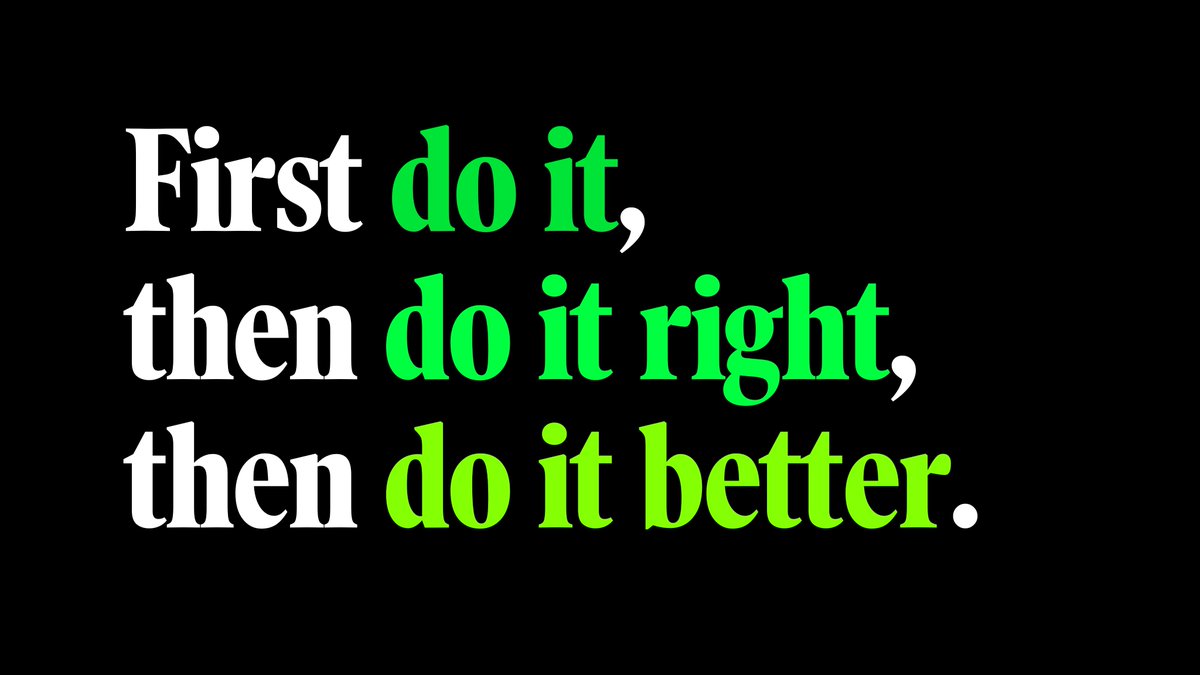
"First do it, then do it right, then do it better."
Just start. The journey to success often begins with a single step, but that first step can be the hardest to take. It's easy to get caught up in the fear of failure or the desire for perfection, but I hope this quote I first shared in 2013 can be a reminder of the importance of simply getting started as we go into 2024.
Just Start Somewhere
"Start slow if you have to. Start small if you have to. Start privately if you have to. Just start." - James Clear
Taking that first step doesn't require perfection or immediate mastery. The key is to overcome inertia and take action, as this action will lead to progress, learning, and (if you’re lucky and consistent) ultimately success.
When you start, you allow yourself the opportunity to grow, adapt, and move forward.
The Power of Starting
Beginning a new project or habit often feels daunting. According to psychologists, we tend to overestimate the pain of starting and underestimate our ability to persist.
However, studies show that "small starts" predict eventual success better than initial enthusiasm or early progress. This phenomenon is known as the fresh start effect - taking the first step energizes us and bolsters motivation.
So focus on starting without putting pressure on perfection. Progress and course corrections will follow.
First, Do It: Embrace the MVP Mindset
Doing it = get the simplest MVP out.
A Minimum Viable Product (MVP) represents the simplest version of a product or idea that allows you to test, gather feedback, and iterate.
By embracing this mindset (just get something done - it's OK if rough, a prototype, a draft), you focus on progress over perfection, understanding that getting something out into the world is far more valuable than waiting for the perfect moment.
Expand Your Comfort Zone
Venturing outside one's comfort zone can elicit fears of failure. Leaning into discomfort not only builds confidence and skills, but research shows it makes us more receptive to learning. Recognize that fear is often the mind's way of urging us to grow. Don't let it stop you from progressing.
Then, Do It Right: Refine and Correct
Doing it right = fix correctness issues.
Once you've taken that first step and put your MVP out into the world, it's time to refine and correct. This stage is about learning from feedback, identifying areas of improvement, and making adjustments accordingly.
It's a chance to iterate on your idea, ensuring that it meets the needs of your audience or customers while aligning with your vision.
Cultivate Curiosity and Resilience
Meeting new challenges with curiosity and resilience makes venturing outside our comfort zone more sustainable and enjoyable. Cultivate curiosity about growth opportunities and your capacity to rise to them. Set mini-challenges to incrementally expand your horizons.
When facing inevitable setbacks, avoid self-criticism and tap into resilience - the ability to recover, learn and continue progressing.
Self-compassion, adaptability and maintaining perspective are key here. With consistent effort, you build confidence in your ability to start, stumble, learn and work toward mastery.
Finally, Do It Better: Strive for Continuous Improvement
"Doing it better = iterate towards an ideal end-state (e.g., make it fast)."
The journey doesn't end with merely doing it right.
The final step is to continuously improve, striving for excellence and growth.
By iterating towards an ideal end-state, you demonstrate a commitment to progress, ensuring that your product, idea, or project remains relevant, innovative, and successful.
Set New Goalposts
As you improve, have a clear idea of when you are “done” or update your goalposts. Elite athletes turn small gains into competitive edges via the aggregation of marginal gains. Identify areas of potential improvement and set measurable stretch goals, from increasing efficiency to enhancing user delight.
Overcoming the Greatest Barrier to Progress
"The greatest barrier to progress is not lack of resources or talent, but fear of failure."
Recognizing that fear of failure is the most significant obstacle in the pursuit of success allows you to confront it head-on.
By acknowledging this fear, you can focus on taking that first step, knowing that once the ball starts rolling, it becomes much easier to keep it in motion.
Remember that starting is more than half the battle. Don't wait until you feel ready, because the perfect moment may never come.
The Bottom Line
Rather than striving for perfect execution, embrace the power of starting - put forth an MVP, soft launch an initiative, or set a milestone. Progress begets motivation. By simply starting, you open the door to growth and innovation. The rest will follow.
Embrace the power of starting and then iterating until you're happy.
English

Arturo retweetledi

This whole beeper situation has shown us a lot about certain people in the Apple community.
They don't want better security, they don't want better group chats and image quality when texting non-iPhone users. They don't want green bubbles to go away.
They want the feeling that buying an iPhone gives you the privilege to those things, and they don't want that to go away. Same people who didn't really want Apple to adopt RCS.
Not saying people have to support Beeper, but the way they reacted to a company trying to bring more secure messaging to all really says a lot.

English
Arturo retweetledi
The pace of innovation in Copilot's first year has been astounding. And we're not done. Looking forward to even more advanced capabilities, including responses powered by GPT-4 Turbo and Dall-E 3, Code Interpreter, and more. blogs.microsoft.com/blog/2023/12/0…
English
Arturo retweetledi

Conseguir un mejor empleo a veces no resulta bien 🫠
Yo conseguí un mejor sueldo 💵, en la ciudad que deseaba 🗺️, PERO la empresa decidió cerrar operaciones al mes de mi mudanza 💀
Esta es la historía de como me mude a Querétaro hace ya varios años y por poco tengo que regresarme a la CDMX.
Estaba yo casi recién casado viviendo en la CDMX y ante los altos costos inmobiliarios y la inseguridad, decidimos buscar mejor suerte, elegimos Querétaro, decidimos buscar trabajo y lo conseguimos.
Trabajaba en una empresa enorme de retail, ahora sería consultor en una empresa de la India para un cliente en EEUU, el sueldo era ligeramente superior, pero el costo de vida en Querétaro era menor, así que valía la pena.
Mi contratación fue toda remota, me dio desconfianza, incluso vine a visitar las oficinas para corroborar que fuera legitimo. Firme y era la única persona de mi equipo global que trabajaba en Querétaro, de México éramos 3 personas.
Se podía decir que no tenia con quien convivir en la oficina para mi proyecto, de hecho éramos pocos en la oficina, unos 70.
Llevaba 1 mes en mi trabajo y pusieron una junta de RRHH, la empresa cerraba operaciones en Querétaro!! Nos teniamos que ir todos a Guadalajara, aceptábamos o renunciábamos.
No había mas.
Decidí no irme, intenté negociar trabajar remoto pero no lo acepto la empresa, me ofrecieron irme a EEUU, pero haciendo cuentas, mi estilo de vida no iba a ser igual.
Logré cambiarme a una empresa pequeña, que me daría el mismo sueldo, en esa empresa varios meses no me pagaron a tiempo.
Algo horrible, afortunadamente mi esposa trabajaba y pudimos aguantar esa época.
Llevo 11 años viviendo en Querétaro, ha sido una buena decisión especialmente por la calidad de vida que tiene mi familia aquí.
A veces cambiar de trabajo no sale bien.
Pero de esa experiencia también se aprende.
Ustedes han vivido algo así ❓
Español
Best offer ever
Sebastián Ramírez@tiangolo
Today only, for black Friday! 🎁🖤 🤯 Get @FastAPI with a massive discount of 80% * You can pay just $0 instead of the regular price of $$$0 🎉 Includes all the easy-to-learn step-by-step tutorials and docs. 🤓 * Today only, or while stocks last. github.com/tiangolo/fasta…
English
Arturo retweetledi

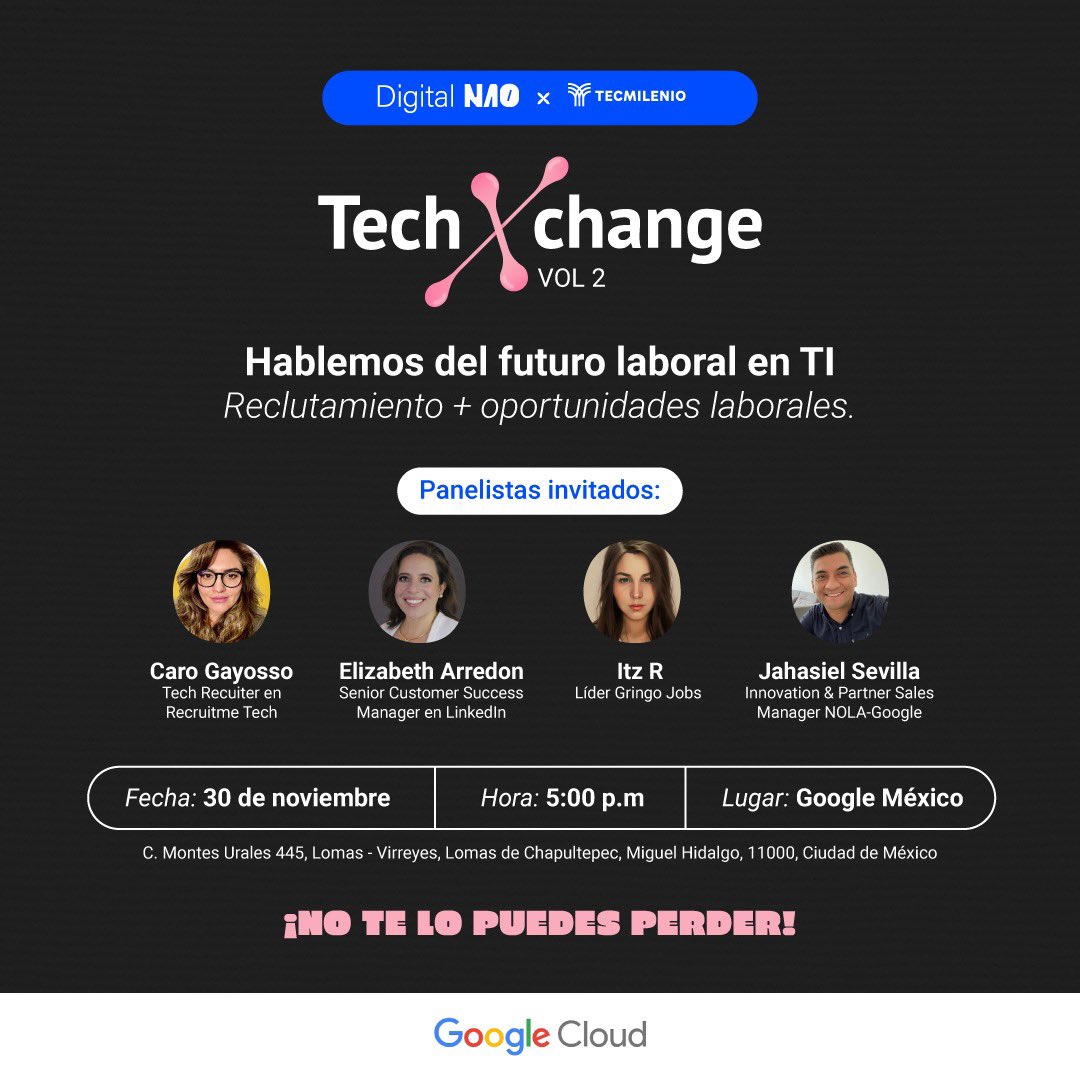
Si estás en #cdmx próximo jueves ven a este meetup increíble con @larecluIT , itz @GringoJobs, Eli @LinkedIn y @JahasielSevilla @Google
Regístrate acá : docs.google.com/forms/d/1Z2iuO…
Español

Starting out in the data field can be overwhelming. Should you be a data scientist? A data engineer? A data analyst? An ML engineer? The number of roles and titles by themself is overwhelming let alone the knowledge you have to learn to land one of these roles.
Here's some high-level guidance on how to pick between some of these roles.
You should become a data analyst if:
You like to investigate business problems. You like digging into the data like Sherlock Holmes and finding patterns that have business impact. You're fascinated by data visualization and building reports.
You should become a data scientist if:
You really like statistics. You like setting up experiments to see how different experiences impact user behavior. You have a knack for machine learning and can talk about the results from ML algorithms to less technical people.
You should become a data engineer if:
You like building things. You have a knack for seeing repeatable patterns and solving them with robust data models. You care about generating really high quality data for others to use. You like to code and have the ability to balance multiple projects at the same time.
You should become an ML engineer if:
You have a really strong software engineering skillset. You're fascinated by things like deep learning and ML. You like deploying a model into production. You have a knack for feature engineering and can find correlations between ML input and ML output.
#machinelearning
#dataengineering
#datascience
English
"in principle" if the key part here
OpenAI@OpenAI
We have reached an agreement in principle for Sam Altman to return to OpenAI as CEO with a new initial board of Bret Taylor (Chair), Larry Summers, and Adam D'Angelo. We are collaborating to figure out the details. Thank you so much for your patience through this.
English