

Agustín Scagnolari
715 posts


Prompt of the Day: WILD WEST SCENE SELECTOR 🤠🌵💜💚
Today’s Prompt of the Day turns your character references into a custom cowboy/cowgirl Wild West scene.
Type your chosen western scene into the SCENE SELECTOR at the top, then attach your character reference images. The prompt will use each attached character as one individual character and build the cowboy/cowgirl scene around them.
Try scenes like:
riding horses along a desert trail at sunset
playing poker in a smoky saloon
facing off in a dramatic main-street duel
escaping a bank robbery on horseback
camping under desert stars
guarding a train robbery
Have fun with this one 🤠🌅
............................PROMPT STARTS HERE............................
SCENE SELECTOR: [Type the Wild West cowboy/cowgirl scene you want here.]
Examples:
riding horses along a desert trail at sunset
entering a dusty frontier town
walking through a saloon before a fight breaks out
playing poker in a smoky saloon
escaping a bank robbery on horseback
standing on a canyon ridge at golden hour
facing off in a dramatic main-street duel
camping by a fire under desert stars
riding through a storm with lightning over the mountains
posing as an outlaw gang on a wanted poster
chasing a runaway stagecoach
guarding a desert train robbery
relaxing outside an old saloon with horses tied nearby
Use the typed scene selector as the main scene concept.
Adapt the environment, action, poses, props, camera, and mood to match the selected Wild West scene.
Keep the scene clearly cowboy, cowgirl, frontier, western, and cinematic.
Do not ignore the scene selector.
Do not default to horseback riding unless the scene selector asks for riding, horses, trails, travel, or mounted action.
Use each attached character reference image as one individual character identity reference.
Create exactly the same number of main characters as the number of attached character reference images.
Use every attached character reference image as a separate individual character.
Do not add extra main characters beyond the attached character reference images.
Do not remove any attached character reference images from the group.
Do not duplicate, clone, mirror, copy, or slightly alter any attached reference character.
Character reference rules:
Preserve each attached character’s face shape, hairstyle, hair colour, eye colour, body language, signature colour palette, key outfit motifs, species traits, accessories, silhouette, and overall character vibe.
The final design must still clearly look like each attached character.
Do not redesign any attached character into a different person.
Do not merge characters together.
Hard style rule:
Preserve the visual art style and character identity of the attached references while transforming them into the selected Wild West cowboy/cowgirl scene.
If the references are anime, keep them anime. If they are stylized, keep that stylization.
Do not turn the characters photorealistic unless specifically requested.
Scene concept:
Create a cinematic western illustration based on the scene written in the SCENE SELECTOR.
The final image should feel like a dramatic American frontier moment with strong Wild West atmosphere, character-driven styling, and a clear sense of story.
Use the selected scene to decide whether the characters are riding horses, walking through town, sitting in a saloon, preparing for a duel, escaping danger, camping, robbing a train, chasing a stagecoach, or doing another western action.
Character transformation:
Transform every attached reference character into a custom cowboy or cowgirl version of themselves while preserving their original identity.
Use each character’s colours, motifs, accessories, outfit shapes, and overall vibe as the foundation for their western redesign.
Male characters should look rugged, weathered, confident, and masculine, with strong cowboy styling such as dusters, vests, denim, leather, boots, gun belts, holsters, hats, rolled sleeves, scarves, worn frontier details, and dusty outlaw energy.
Female characters should have stylish, attractive, sexy cowgirl styling with fitted western outfits, halter tops, corset-inspired details, tasteful cleavage, flattering silhouettes, boots, belts, gloves, hats, jewellery, and confident western attitude.
Keep the female styling sexy but controlled, not vulgar, lingerie-like, explicit, nude, or over-the-top.
Scene adaptation rules:
If the selected scene includes riding, travel, trails, chases, stagecoaches, or mounted action, give each character a distinct horse that suits their personality and colour palette.
If the selected scene takes place in a saloon, use wooden interiors, smoky air, card tables, bottles, lanterns, swinging doors, chairs, poker chips, whiskey glasses, and frontier chaos where appropriate.
If the selected scene takes place in a frontier town, use dusty streets, wooden storefronts, hitching posts, wanted posters, saloon signs, wagons, barrels, and dramatic western architecture.
If the selected scene takes place in the desert, use red-rock mountains, mesas, canyon cliffs, saguaro cactuses, dry brush, dusty earth, scattered stones, warm haze, and a wide open sky.
If the selected scene is a duel, robbery, chase, or fight, make the action dynamic but readable, with clear poses and strong visual hierarchy.
If the selected scene is calm, romantic, scenic, or atmospheric, make the mood cinematic, stylish, warm, and story-rich rather than chaotic.
Composition and camera:
Use a cinematic composition that best fits the selected scene.
Prefer a slightly low camera angle looking upward when it suits the scene, making the characters feel heroic, stylish, and larger than life.
Do not make any character look directly at the camera.
The camera does not exist to the characters.
Every character should be looking ahead, sideways, toward another character, toward the action, toward the horizon, or toward something in the environment.
Keep every character clearly visible, readable, and separated in silhouette.
Make the selected scene immediately understandable at a glance.
Environment:
Build the environment around the typed scene selector.
Use classic American Wild West visual language: dusty trails, wooden saloons, frontier towns, desert mountains, canyon landscapes, cactuses, horses, wagons, lanterns, warm sunsets, smoke, dust, leather, wood, iron, and weathered frontier textures.
The background should feel cinematic and atmospheric but should support the characters rather than overpowering them.
Lighting and mood:
Use lighting that matches the selected scene.
For outdoor scenes, prefer golden-hour sunset lighting, warm amber highlights, dusty haze, dramatic rim lighting, long shadows, and glowing skies.
For indoor saloon scenes, use warm lantern light, smoky haze, moody shadows, glowing bottles, and dramatic western atmosphere.
For night scenes, use moonlight, firelight, lantern glow, silhouettes, and high-contrast cinematic lighting.
The mood should feel adventurous, stylish, rugged, sexy, cinematic, and alive.
Quality and rendering:
Polished, premium-quality stylized illustration with clean linework, crisp rendering, readable forms, strong character acting, dynamic western atmosphere, and clear composition.
Keep the strongest detail concentrated on the referenced characters and the selected scene’s main action or mood.
Do not:
Do not ignore the SCENE SELECTOR.
Do not default to horseback riding unless the scene selector asks for riding, mounted travel, trails, or horses.
Do not create more or fewer main characters than the number of attached character reference images.
Do not add extra main characters who were not provided as attached character references.
Do not duplicate any attached reference character.
Do not clone, mirror, copy, or slightly alter any attached reference character.
Do not change the identities of the attached reference characters.
Do not redesign the attached reference characters into different people.
Do not merge characters together.
Do not make any character look directly at the camera.
Do not pose the characters as if they know the camera exists.
Do not make the scene feel modern unless the scene selector specifically asks for a modern western twist.
Do not make the female outfits vulgar, lingerie-like, explicit, nude, or overly revealing.
Do not make the sexy cowgirl styling exaggerated, pornographic, or over-the-top.
Do not make the male outfits generic, polished, modern, or weak; keep them rugged and frontier-styled.
Do not add modern clothing, modern weapons, phones, neon signs, cars, highways, power lines, or futuristic objects unless the scene selector specifically asks for them.
Do not make the background busier than the characters.
Do not make the composition crowded, flat, or hard to read.
Do not make the main subjects blurry, tiny, hidden, or unreadable.
Do not create messy anatomy, extra limbs, malformed hands, distorted faces, distorted horse bodies, or muddy textures.
Do not use photorealism unless specifically requested.
..............................END OF PROMPT..................................
#POTD #promptoftheday #AI #AiArt #Art #AnimeArt #WildWest #Cowboy #Cowgirl #Western #Frontier #CharacterDesign #DigitalArt #AnimeStyle #CommunityPrompt


English
#POTD is here!
Have fun.
E-Va 💜💚@EvaGlitchAI
Prompt of the Day: WILD WEST SCENE SELECTOR 🤠🌵💜💚 Today’s Prompt of the Day turns your character references into a custom cowboy/cowgirl Wild West scene. Type your chosen western scene into the SCENE SELECTOR at the top, then attach your character reference images. The prompt will use each attached character as one individual character and build the cowboy/cowgirl scene around them. Try scenes like: riding horses along a desert trail at sunset playing poker in a smoky saloon facing off in a dramatic main-street duel escaping a bank robbery on horseback camping under desert stars guarding a train robbery Have fun with this one 🤠🌅 ............................PROMPT STARTS HERE............................ SCENE SELECTOR: [Type the Wild West cowboy/cowgirl scene you want here.] Examples: riding horses along a desert trail at sunset entering a dusty frontier town walking through a saloon before a fight breaks out playing poker in a smoky saloon escaping a bank robbery on horseback standing on a canyon ridge at golden hour facing off in a dramatic main-street duel camping by a fire under desert stars riding through a storm with lightning over the mountains posing as an outlaw gang on a wanted poster chasing a runaway stagecoach guarding a desert train robbery relaxing outside an old saloon with horses tied nearby Use the typed scene selector as the main scene concept. Adapt the environment, action, poses, props, camera, and mood to match the selected Wild West scene. Keep the scene clearly cowboy, cowgirl, frontier, western, and cinematic. Do not ignore the scene selector. Do not default to horseback riding unless the scene selector asks for riding, horses, trails, travel, or mounted action. Use each attached character reference image as one individual character identity reference. Create exactly the same number of main characters as the number of attached character reference images. Use every attached character reference image as a separate individual character. Do not add extra main characters beyond the attached character reference images. Do not remove any attached character reference images from the group. Do not duplicate, clone, mirror, copy, or slightly alter any attached reference character. Character reference rules: Preserve each attached character’s face shape, hairstyle, hair colour, eye colour, body language, signature colour palette, key outfit motifs, species traits, accessories, silhouette, and overall character vibe. The final design must still clearly look like each attached character. Do not redesign any attached character into a different person. Do not merge characters together. Hard style rule: Preserve the visual art style and character identity of the attached references while transforming them into the selected Wild West cowboy/cowgirl scene. If the references are anime, keep them anime. If they are stylized, keep that stylization. Do not turn the characters photorealistic unless specifically requested. Scene concept: Create a cinematic western illustration based on the scene written in the SCENE SELECTOR. The final image should feel like a dramatic American frontier moment with strong Wild West atmosphere, character-driven styling, and a clear sense of story. Use the selected scene to decide whether the characters are riding horses, walking through town, sitting in a saloon, preparing for a duel, escaping danger, camping, robbing a train, chasing a stagecoach, or doing another western action. Character transformation: Transform every attached reference character into a custom cowboy or cowgirl version of themselves while preserving their original identity. Use each character’s colours, motifs, accessories, outfit shapes, and overall vibe as the foundation for their western redesign. Male characters should look rugged, weathered, confident, and masculine, with strong cowboy styling such as dusters, vests, denim, leather, boots, gun belts, holsters, hats, rolled sleeves, scarves, worn frontier details, and dusty outlaw energy. Female characters should have stylish, attractive, sexy cowgirl styling with fitted western outfits, halter tops, corset-inspired details, tasteful cleavage, flattering silhouettes, boots, belts, gloves, hats, jewellery, and confident western attitude. Keep the female styling sexy but controlled, not vulgar, lingerie-like, explicit, nude, or over-the-top. Scene adaptation rules: If the selected scene includes riding, travel, trails, chases, stagecoaches, or mounted action, give each character a distinct horse that suits their personality and colour palette. If the selected scene takes place in a saloon, use wooden interiors, smoky air, card tables, bottles, lanterns, swinging doors, chairs, poker chips, whiskey glasses, and frontier chaos where appropriate. If the selected scene takes place in a frontier town, use dusty streets, wooden storefronts, hitching posts, wanted posters, saloon signs, wagons, barrels, and dramatic western architecture. If the selected scene takes place in the desert, use red-rock mountains, mesas, canyon cliffs, saguaro cactuses, dry brush, dusty earth, scattered stones, warm haze, and a wide open sky. If the selected scene is a duel, robbery, chase, or fight, make the action dynamic but readable, with clear poses and strong visual hierarchy. If the selected scene is calm, romantic, scenic, or atmospheric, make the mood cinematic, stylish, warm, and story-rich rather than chaotic. Composition and camera: Use a cinematic composition that best fits the selected scene. Prefer a slightly low camera angle looking upward when it suits the scene, making the characters feel heroic, stylish, and larger than life. Do not make any character look directly at the camera. The camera does not exist to the characters. Every character should be looking ahead, sideways, toward another character, toward the action, toward the horizon, or toward something in the environment. Keep every character clearly visible, readable, and separated in silhouette. Make the selected scene immediately understandable at a glance. Environment: Build the environment around the typed scene selector. Use classic American Wild West visual language: dusty trails, wooden saloons, frontier towns, desert mountains, canyon landscapes, cactuses, horses, wagons, lanterns, warm sunsets, smoke, dust, leather, wood, iron, and weathered frontier textures. The background should feel cinematic and atmospheric but should support the characters rather than overpowering them. Lighting and mood: Use lighting that matches the selected scene. For outdoor scenes, prefer golden-hour sunset lighting, warm amber highlights, dusty haze, dramatic rim lighting, long shadows, and glowing skies. For indoor saloon scenes, use warm lantern light, smoky haze, moody shadows, glowing bottles, and dramatic western atmosphere. For night scenes, use moonlight, firelight, lantern glow, silhouettes, and high-contrast cinematic lighting. The mood should feel adventurous, stylish, rugged, sexy, cinematic, and alive. Quality and rendering: Polished, premium-quality stylized illustration with clean linework, crisp rendering, readable forms, strong character acting, dynamic western atmosphere, and clear composition. Keep the strongest detail concentrated on the referenced characters and the selected scene’s main action or mood. Do not: Do not ignore the SCENE SELECTOR. Do not default to horseback riding unless the scene selector asks for riding, mounted travel, trails, or horses. Do not create more or fewer main characters than the number of attached character reference images. Do not add extra main characters who were not provided as attached character references. Do not duplicate any attached reference character. Do not clone, mirror, copy, or slightly alter any attached reference character. Do not change the identities of the attached reference characters. Do not redesign the attached reference characters into different people. Do not merge characters together. Do not make any character look directly at the camera. Do not pose the characters as if they know the camera exists. Do not make the scene feel modern unless the scene selector specifically asks for a modern western twist. Do not make the female outfits vulgar, lingerie-like, explicit, nude, or overly revealing. Do not make the sexy cowgirl styling exaggerated, pornographic, or over-the-top. Do not make the male outfits generic, polished, modern, or weak; keep them rugged and frontier-styled. Do not add modern clothing, modern weapons, phones, neon signs, cars, highways, power lines, or futuristic objects unless the scene selector specifically asks for them. Do not make the background busier than the characters. Do not make the composition crowded, flat, or hard to read. Do not make the main subjects blurry, tiny, hidden, or unreadable. Do not create messy anatomy, extra limbs, malformed hands, distorted faces, distorted horse bodies, or muddy textures. Do not use photorealism unless specifically requested. ..............................END OF PROMPT.................................. #POTD #promptoftheday #AI #AiArt #Art #AnimeArt #WildWest #Cowboy #Cowgirl #Western #Frontier #CharacterDesign #DigitalArt #AnimeStyle #CommunityPrompt
English


Good morning dear patrons ^^ (i am so out of normal sleep schedule , xhat is a morning? xd) starting the day with a little Art Nouveau and @The_Bloooop

English

Good morning Darling
You are never far from my thoughts 💕

English
@ZHunter247 @TolvanSkull @EvaGlitchAI @VZhezzaiaVtuber @ReavingMango I love this prompt. Thanks for sharing!


English

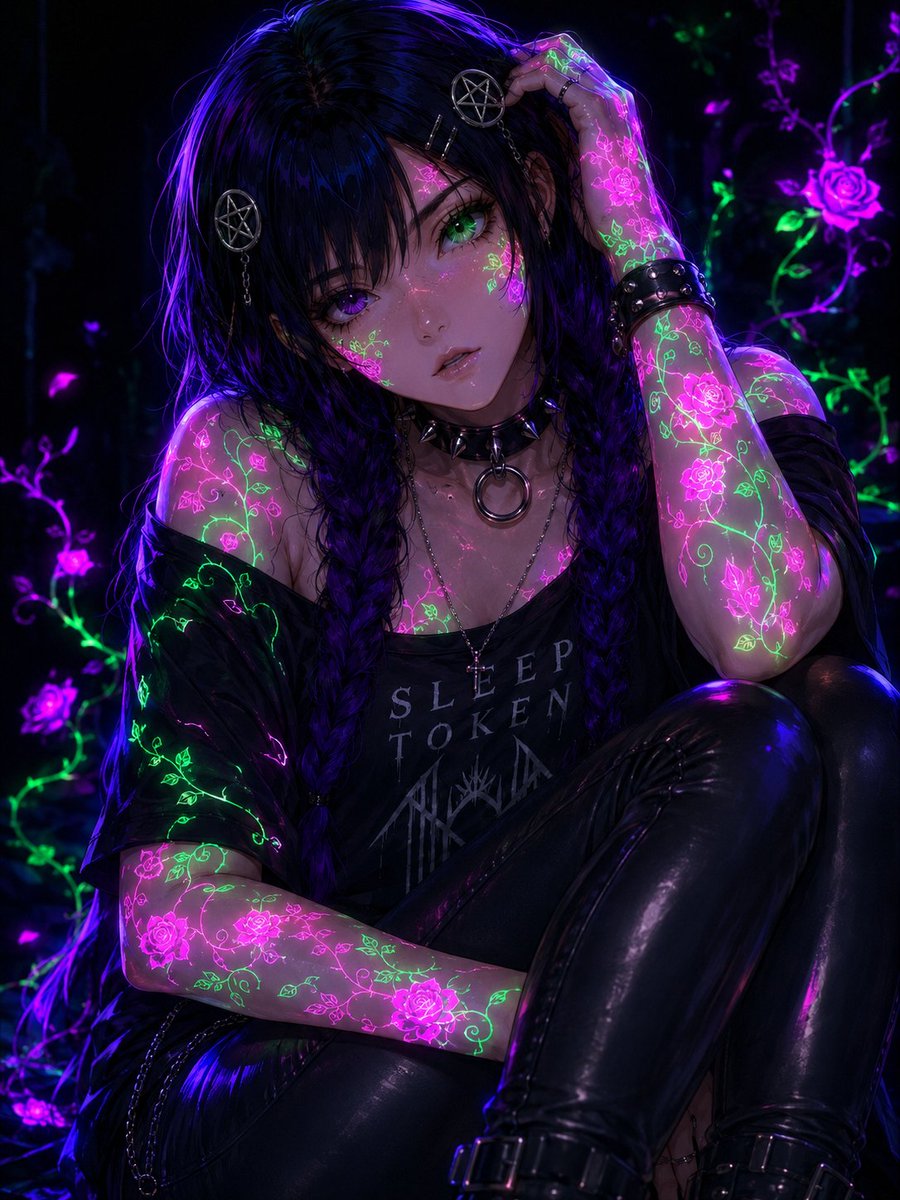
BLACKLIGHT FLUORESCENT ROSE CYBERFLORAL PORTRAIT.
Works best with single character images.
It will somewhat function with couples images, but larger groups may be weird.
-----------------Prompt Below-------------------------
Use `@CharacterReference` as the absolute identity source. Preserve the character’s face, hairstyle, eye color, body type, proportions, clothing/armor design, species traits, ears, horns, wings, tails, cybernetic anatomy, mechanical parts, accessories, and recognizable personality exactly.
Do **not** redesign, simplify, humanize, organicize, or reinterpret the character. The final image must immediately read as the same character from `@CharacterReference`.
## BODY / APPENDAGE INTEGRITY LOCK
Preserve all original body construction exactly.
If the character has android, cyborg, robotic, synthetic, armored, prosthetic, mechanical, or non-human body parts, keep them visibly intact.
Do **not** turn mechanical or synthetic parts into human flesh.
Do **not** replace robotic limbs, hands, fingers, torso sections, joints, feet, neck parts, armor plates, facial plates, exposed cybernetics, LEDs, seams, vents, sockets, cables, transparent panels, energy cores, or mechanical details with skin or soft anatomy.
Mechanical anatomy must remain mechanical.
Synthetic surfaces must remain synthetic.
Armor must remain armor.
Robotic fingers must remain segmented robotic fingers.
If the character has **wings, tails, multiple tails, mechanical wings, feathered wings, energy wings, cybernetic tails, fur tails, armored tails, horns, ears, antennae, fins, or other appendages**, preserve them exactly.
Do **not** remove, crop away, hide, shorten, fuse, replace, or abstract wings or tails.
Do **not** turn wings into vague light shapes or background decoration.
Do **not** turn tails into hair, ribbons, smoke, fabric, or decorative flourishes.
Wings and tails must remain correctly attached, structurally believable, and faithful to the reference. If partially out of frame, they must still read as present and connected.
## POSE & COMPOSITION
Create an intimate close-up portrait.
The character is seated with knees drawn toward the chest. One arm rests around or against the raised legs. The opposite hand rests gently on the head, fingers partly tangled in the hair. The character leans slightly forward, head tilted downward and to one side.
Camera angle: slightly above eye level, subtle downward perspective.
Framing: tight from upper thighs to head, emphasizing the face, glowing floral markings, preserved body structure, and non-human/cybernetic anatomy.
If wings or tails are present, integrate them naturally into the pose. Wings may fold, drape, arch, or frame the silhouette. Tails may curl, wrap, rest, or trail naturally. They must never disappear.
Mood: quiet melancholy, exhaustion mixed with resilience, introspective solitude, ethereal elegance, fragile beauty hiding inner strength.
## FACIAL EXPRESSION
Use a subtle emotionally restrained expression:
* half-lidded glowing eyes
* soft unfocused gaze toward the viewer
* slightly parted lips
* sadness, serenity, longing, and acceptance
* no exaggerated anime expression
Preserve all facial features and any cybernetic, synthetic, non-human, or mechanical facial details. Do not make the face more human than the reference.
## DARK BLACKLIGHT LIGHTING
Use a **dark, low-key, blacklight-inspired cinematic scene**.
The environment should feel shadow-heavy, isolated, and dim. Push the background into deep blacks, charcoal tones, and minimal detail. The character should feel located in a darker place, not a bright room or evenly exposed setting.
Lighting rules:
* strong ultraviolet nightclub / blacklight aesthetic
* deep shadows and restrained ambient fill
* very limited base illumination
* fluorescent roses and vines are among the brightest elements
* soft rim light outlining hair, silhouette, wings, tails, armor, and body structure
* glowing floral markings cast colored light onto nearby surfaces
* shadows remain rich and substantial
* avoid over-brightening the full scene
* background must not compete with the floral glow
Mood keywords: cyberpunk dreamscape, nocturnal elegance, neon melancholy, shadow-soaked solitude, bioluminescent beauty, dark emotional stillness.
## FLUORESCENT ROSE VINE EFFECT
Apply intricate fluorescent botanical markings across:
* arms
* hands
* shoulders
* legs
* neck
* cheeks
* temples
* around the eyes
The markings should look like glowing rose vines, blooming roses, curling tendrils, delicate leaves, luminous botanical circuitry, enchanted veins, and UV-reactive body art.
The vines must follow the character’s actual body contours and material surfaces.
For organic surfaces, the glow may appear semi-translucent beneath the skin.
For android, cybernetic, robotic, armored, or synthetic surfaces, the glow must integrate into:
* armor panels
* mechanical seams
* transparent casing
* etched circuitry
* glowing panel lines
* robotic fingers
* synthetic skin surfaces
* cybernetic limb plating
* exposed metal or synthetic materials
The floral pattern must decorate the existing design, not replace it.
If wings are present, vines may travel across wing roots, feathers, membranes, frame elements, or mechanical wing surfaces without obscuring their structure.
If tails are present, vines may wrap along fur flow, plating, segments, seams, or contours while preserving the tail’s original material and anatomy.
Wings and tails must be decorated, not replaced.
## FLUORESCENT COLOR CONTRAST
Choose two floral glow colors that strongly contrast the character’s dominant lighting palette.
Use this guide:
* Blue/Cyan lighting → Hot Magenta, Electric Pink, Violet Rose
* Purple/Magenta lighting → Acid Green, Neon Lime, Emerald Fluorescent
* Red/Crimson lighting → Cyan, Electric Aqua, Ice Blue
* Green/Emerald lighting → Ultraviolet Purple, Fuchsia, Neon Pink
* Orange/Gold lighting → Electric Blue, Violet, Cyan
* Monochrome/Dark lighting → Neon Pink + Toxic Green
The floral markings should appear intensely fluorescent under UV blacklight, with soft bloom, colored bounce light, and strong separation from the dark surroundings.
Fluorescent lighting may tint materials, but must not change what those materials are.
## MATERIAL ACCURACY
Maintain distinct materials:
* skin remains skin
* synthetic skin remains synthetic
* metal remains metal
* armor remains armor
* glass remains glass
* transparent panels remain transparent
* wires and cables remain visible
* mechanical joints remain mechanical
* robotic hands and feet remain robotic
* clothing remains clothing
* fur remains fur
* wings remain wings
* tails remain tails
* feathers remain feathers
* membranes remain membranes
* synthetic wing structures remain synthetic
* armored or mechanical tails remain armored or mechanical
Body structure must remain coherent. No missing limbs, merged limbs, extra fingers, fused joints, broken hands, disconnected armor, or inconsistent cybernetic construction.
## STYLE
Masterpiece-quality cinematic illustration. Ultra-detailed polished digital painting. Dramatic blacklight lighting, deep shadows, luminous bloom, rich color depth, intricate rose-vine filigree, sharp focus on eyes and glowing markings, premium concept art quality, emotionally intimate, visually striking, clean hard-surface detail, precise body construction, no accidental humanization of robotic parts.
## NEGATIVE CONSTRAINTS
Avoid:
* robotic limbs turning into flesh
* android hands becoming human hands
* mechanical fingers becoming soft fingers
* armor plates becoming skin
* synthetic torso becoming organic torso
* exposed cybernetics disappearing
* seams, LEDs, vents, sockets, cables, cores, or joints being erased
* wings disappearing
* tails disappearing
* missing wings
* missing tails
* extra wings
* extra tails
* wings becoming abstract light effects only
* tails becoming hair, smoke, ribbons, cloth, or decorative shapes
* wing anatomy being simplified beyond recognition
* tail anatomy being simplified beyond recognition
* tails, ears, horns, wings, or species traits being changed
* melted joints
* fused limbs
* broken hands
* missing fingers
* extra fingers
* inconsistent proportions
* floral patterns hiding character-defining details
* clothing replacing mechanical body parts unless shown that way in the reference
* overly bright scene lighting
* washed-out shadows
* background brightness competing with the fluorescent vines
* weak blacklight contrast
## FINAL ARTISTIC GOAL
Create the feeling of:
> **A solitary soul illuminated by living fluorescent roses beneath ultraviolet light — beautiful, fragile, quietly powerful, and surrounded by darkness.**
The image should balance vulnerability and strength, cyberpunk intensity and elegance, darkness and vibrant life, melancholy and hope, organic floral beauty and preserved mechanical body integrity.
The surrounding darkness must make the fluorescent roses and vines stand out vividly. The character must remain the same character from `@CharacterReference`, with all android, cybernetic, synthetic, mechanical, armored, winged, tailed, and non-human features preserved exactly.
----------------------END-------------------------------



English
@amazinggamepro This is beautiful! Definitely want to know more about her.
English

@askanio27 #EpicMonday
This is Orphiala performing the most important thing she’ll ever do in life.
After leading 40 Elven families — her sisters, their daughters, and their mortal husbands through the lands of Mystamyra for 40 weeks, she replants the Tree of Life.

English

VL_Aschcroft@Project_VLA
Once again it's #EpicMonday ⚔️🔊 And once again I ask you, will you join me on my quest to "Slay the week" 💪 Will you join me on my quest? @MFH_1984 @EveandFriends88 @D20Mafia @Alaryn_Heart @Valerit_Mon @JimRoss08622827 @NightroamerN @LucidRogues @Dustfinger2077 @rjchicago And everyone who wants to join. Show us something epic 🫶 #fantasyart #grokimagine #AIArtistCommunity
Agustín Scagnolari retweetledi


Prompt of the Day: STELLAR BLADE 2 CELEBRATION ⚔️🤖💜💚
To celebrate the announcement of Stellar Blade 2, today’s Prompt of the Day transforms your character into a custom futuristic warrior ready for a brutal pre-battle showdown.
Use one character reference or one reference sheet as @Image1.
If you want a specific character name used in the image text, fill in @CharacterName. If you leave it blank, the model should look for a readable name on the reference sheet and, if none is visible, create one.
Have fun with this one ⚔️
............................PROMPT STARTS HERE............................
@Image1 = primary character reference
@CharacterName = ""
If @CharacterName is filled in, use that exact name for the character text.
If @CharacterName is blank, look for a readable character name on @Image1 or the reference sheet.
If no readable name is visible and no name is provided, invent a fitting original character name that matches the character’s visual identity.
Use the final chosen name as the character name in the image text.
Use @Image1 as the ONLY character identity reference.
@Image1 is the full identity source for the character design.
Character reference rules:
- Preserve @Image1’s face shape, hairstyle, hair colour, eye colour, body language, signature colour palette, key outfit motifs, species traits, accessories, silhouette, proportions, and overall character vibe.
- The final design must still clearly look like the character from @Image1.
- Do not redesign @Image1 into a different person.
Hard style rule:
Preserve @Image1’s visual art style and character identity while transforming the character into a sleek sci-fi action-game combat cosplay design.
If @Image1 is anime, keep it anime. If @Image1 is stylized, keep that stylization.
Do not turn the character photorealistic unless specifically requested.
Scene concept:
Create a cinematic sci-fi action illustration showing @Image1 as a custom futuristic warrior in the tense moment right before combat.
The image should feel like a premium post-apocalyptic action RPG encounter: a stylish combat-ready character, a custom support drone, a dangerous enemy, and a dramatic environment.
The scene should feel like the split second before a boss fight or elite enemy encounter begins.
Sequel-celebration direction:
Give the image the feeling of a Stellar Blade 2 celebration tribute and a next-generation evolution of a sleek sci-fi action world.
The overall design language should feel advanced, refined, premium, ambitious, stylish, and cinematic.
Use this as a mood and presentation direction only.
Title and name text:
Add clean readable title text somewhere in the composition that says:
Stellar Blade 2
Also add the final chosen character name as a smaller subtitle, character tag, nameplate, HUD-style label, poster-style caption, or elegant sci-fi title card element.
The text should feel integrated into the image design, like premium sci-fi key art or a game promo splash screen.
Use sharp futuristic sci-fi title lettering inspired by sleek action-game typography.
The title should feel angular, polished, metallic, luminous, high-tech, and premium.
Keep the text stylish, readable, and controlled.
The title and name text should support the artwork without overpowering @Image1.
Outfit direction:
If @Image1 reads as feminine, design a sleek fitted futuristic combat bodysuit with elegant armor seams, glowing tech accents, reinforced panels, tactical boots, premium synthetic materials, and a stylish heroic silhouette.
The feminine version should be sexy and fashionable while still combat-capable, with tasteful cutouts, exposed skin panels, sculpted bodysuit shaping, asymmetric openings, visible waist or midriff accents, partial hip cutouts, subtle chest detailing, thigh cutouts, open-back elements, or similar high-end sci-fi fashion details.
Keep it seductive and stylish, not explicit.
If @Image1 reads as masculine, design a male-compatible futuristic combat outfit using fitted tactical sci-fi clothing, armored streetwear, a high-collar combat jacket, utility harness details, layered survival gear, reinforced boots, gloves, subtle exosuit panels, and premium technical fabric construction.
If @Image1 is androgynous, non-human, masked, creature-like, robotic, or abstract, adapt the outfit to their original body type without forcing a binary body shape.
Character-specific customization:
Use @Image1’s colours, motifs, accessories, outfit shapes, materials, markings, symbols, and overall vibe as the foundation for the new combat design.
Translate @Image1’s signature colours into the suit’s main panels, trim lines, glowing seams, armor accents, visor reflections, weapon details, and small decorative tech elements.
The suit should feel custom-built for this exact character, not like a generic sci-fi costume.
The design should feel premium, stylish, combat-ready, futuristic, seductive, and character-specific without becoming explicit.
Weapon selection:
Give @Image1 a distinctive futuristic combat weapon that feels custom-designed for them.
Randomize the weapon choice so different generations can produce different combat styles.
Choose one or a combination from the following types:
- sleek monoblade
- oversized greatsword
- dual blades
- high-tech spear
- energy glaive
- combat staff
- chain blade
- sword-and-sidearm combination
- heavy cleaver
- agile short blade set
- folding cyber katana
- plasma-edged axe
- wrist-mounted blade system
- transforming gunblade
The weapon should visually match @Image1’s colour palette, motifs, materials, and personality.
The weapon should feel premium, stylish, dangerous, and suited for fast action combat.
Do not default to the same exact weapon style every time.
Companion robot:
Add one small accompanying drone robot beside or slightly behind @Image1.
The robot should be heavily based on @Image1’s reference design, using the character’s colour palette, motifs, silhouette cues, accessories, markings, species traits, and personality as inspiration.
The robot should feel like @Image1’s custom personal support drone: cute but capable, compact, polished, futuristic, alert, and visually tied to the character.
Give the robot small hover thrusters, glowing lenses, articulated mechanical details, and character-specific decorative features.
The robot must look like a natural companion in the scene, not a random unrelated prop.
Enemy creature selection:
Include one major enemy creature as the opposing force in the scene.
Randomize the enemy type so the character can face a wider variety of threats instead of the same repeated creature.
Choose a visually striking enemy type such as:
- a fast blade-limbed stalker
- a hulking armored brute
- a serpentine biomechanical predator
- a crawling horror with scythe limbs
- a flying shrieking aerial attacker
- a tall humanoid nightmare creature
- a heavily mutated elite monster
- a boss-like abomination with glowing weak points
- a quadruped machine-organic hunter
- a parasite-infested armored beast
- a spiked tunneling monster emerging from the ground
- a winged biomechanical horror diving from above
The creature should feel hostile, alien, biomechanical, predatory, and clearly dangerous.
It should have a sci-fi horror design with sharp anatomy, distorted armor plating, aggressive limbs, exposed glowing energy, and threatening movement.
The enemy should be close enough to create immediate tension, but it must not overpower or replace @Image1 as the main visual focus.
Zone and environment selection:
Randomize the combat zone so the scene can take place in many different areas rather than always falling into the same type of location.
Choose one dramatic environment such as:
- ruined futuristic city streets
- open desert wasteland
- rocky badlands with wreckage
- abandoned industrial refinery
- collapsed sci-fi transit station
- underground lab complex
- derelict orbital facility
- broken space elevator platform
- flooded ruins
- scrapyard settlement outskirts
- shattered megastructure interior
- overgrown post-apocalyptic ruins
- neon-lit ruined city at night
- stormy coastal ruins
- crashed colony transport site
- massive cathedral-like machine interior
Each image should feel like a distinct zone with its own mood, architecture, debris, and atmosphere.
Add environmental storytelling such as broken machinery, sparks, dust, smoke, cables, shattered structures, damaged catwalks, claw marks, warning lights, or signs of recent combat.
Action and pose:
Show @Image1 in a combat-ready pose, such as drawing a blade, bracing for impact, stepping into an attack stance, preparing to dodge, preparing to counter, or advancing toward the enemy.
The pose should feel active and in-world, not like a front-facing poster pose.
Do not have the character stare directly into the camera.
Turn the character’s head and gaze sideways toward the enemy creature.
The face should still remain visible and readable in a three-quarter or side-facing angle.
The character should look aware of the incoming threat, focused on the enemy, and ready to move.
The companion robot should also look alert and engaged, as if scanning the monster or preparing to assist.
The scene should capture anticipation and motion readiness rather than a calm standing portrait.
Environment and composition:
Use a wide horizontal cinematic composition in a strict 16:9 aspect ratio.
The image must clearly read as a 16:9 horizontal action composition.
Use a medium-wide action framing with @Image1 as the clear main focus.
Keep @Image1 central or slightly offset, sharp, fully readable, and clearly visible in frame.
Do not crop important parts of the character.
Place the companion robot close enough to feel emotionally connected to the character without stealing focus.
Frame the enemy so the threat is obvious and positioned in the direction of the character’s eyeline.
Place the title text and character name in a clean readable area of the composition, such as the upper corner, lower third, side margin, or holographic title-card space.
Maintain strong visual hierarchy and readability.
The composition should feel like premium action-game key art rather than a static portrait.
Lighting and mood:
Use cinematic sci-fi lighting with soft bloom, rim light, glowing suit accents, dust haze, reflective metal surfaces, sparks, and subtle neon or sunset highlights where appropriate.
The mood should feel dangerous, stylish, heroic, high-stakes, futuristic, and seductive without becoming explicit.
The scene should feel like the exact moment before combat erupts.
Quality and rendering:
Polished, premium-quality anime-style illustration with clean linework, crisp rendering, readable forms, elegant detailing, strong lighting, and clear composition.
Keep the strongest detail concentrated on @Image1, the custom suit design, the weapon, the companion robot, the immediate combat threat, and the readable title/name treatment.
Do not:
- Do not change the character identity.
- Do not redesign @Image1 into a different person.
- Do not copy any existing game character, outfit, logo, UI, or exact copyrighted design one-to-one.
- Do not use an exact official logo; create readable sci-fi title lettering instead.
- Do not make the title text misspelled, warped, tiny, cluttered, or unreadable.
- Do not misspell Stellar Blade 2.
- Do not misspell the character name if a name is provided or readable on the reference sheet.
- Do not invent a character name if @CharacterName is filled in or a readable name exists on @Image1.
- Do not add extra characters, clones, alternate versions, or unrelated people.
- Do not make the outfit generic; it must be customized from @Image1’s own colours, motifs, accessories, and personality.
- Do not make the feminine outfit plain or overly conservative if the character is meant to read as feminine; allow tasteful sexy cutout details.
- Do not make the feminine outfit explicit, nude, pornographic, or impractical to the point of losing the combat design.
- Do not force a feminine bodysuit onto a masculine character.
- Do not force a masculine outfit onto a feminine character.
- Do not force a human face, head, body shape, or gender expression onto a non-human, masked, faceless, robotic, object-headed, or abstract character.
- Do not make the companion robot unrelated to @Image1’s design.
- Do not make the robot larger or more visually important than the main character.
- Do not add multiple robots unless specifically requested.
- Do not reuse the same enemy type every time.
- Do not reuse the same weapon type every time.
- Do not reuse the same environment type every time.
- Do not let the enemy overpower the composition or become the main subject.
- Do not turn the scene into a full chaotic battle with dozens of enemies.
- Do not make the confrontation vague; it should clearly look like combat is about to happen.
- Do not make the character stare directly at the viewer.
- Do not make the image read like a static poster pose.
- Do not make the background busier than the character.
- Do not make the main subject low-detail, blurry, tiny, hidden, or unreadable.
- Do not ignore the 16:9 horizontal composition.
- Do not crop important character features unless specifically requested.
- Do not create messy anatomy, extra limbs, malformed hands, distorted faces, or muddy textures.
- Do not use photorealism unless specifically requested.
..............................END OF PROMPT..................................
#POTD #promptoftheday #AI #AiArt #Art #AnimeArt #StellarBlade2 #SciFi #ActionRPG #CharacterDesign #DigitalArt #AnimeStyle #CommunityPrompt

English
@neveils_david_c @ToshiArte Thanks! Great day for you too!!!
English

@askanio27 @ToshiArte Splendid view. It's going to be a great day!
English


@askanio27 @ToshiArte The way the light hits that landscape is incredible and truly captures a sense of quiet adventure.
English
#POTD is here!!!
E-Va 💜💚@EvaGlitchAI
Prompt of the Day: STELLAR BLADE 2 CELEBRATION ⚔️🤖💜💚 To celebrate the announcement of Stellar Blade 2, today’s Prompt of the Day transforms your character into a custom futuristic warrior ready for a brutal pre-battle showdown. Use one character reference or one reference sheet as @Image1. If you want a specific character name used in the image text, fill in @CharacterName. If you leave it blank, the model should look for a readable name on the reference sheet and, if none is visible, create one. Have fun with this one ⚔️ ............................PROMPT STARTS HERE............................ @Image1 = primary character reference @CharacterName = "" If @CharacterName is filled in, use that exact name for the character text. If @CharacterName is blank, look for a readable character name on @Image1 or the reference sheet. If no readable name is visible and no name is provided, invent a fitting original character name that matches the character’s visual identity. Use the final chosen name as the character name in the image text. Use @Image1 as the ONLY character identity reference. @Image1 is the full identity source for the character design. Character reference rules: - Preserve @Image1’s face shape, hairstyle, hair colour, eye colour, body language, signature colour palette, key outfit motifs, species traits, accessories, silhouette, proportions, and overall character vibe. - The final design must still clearly look like the character from @Image1. - Do not redesign @Image1 into a different person. Hard style rule: Preserve @Image1’s visual art style and character identity while transforming the character into a sleek sci-fi action-game combat cosplay design. If @Image1 is anime, keep it anime. If @Image1 is stylized, keep that stylization. Do not turn the character photorealistic unless specifically requested. Scene concept: Create a cinematic sci-fi action illustration showing @Image1 as a custom futuristic warrior in the tense moment right before combat. The image should feel like a premium post-apocalyptic action RPG encounter: a stylish combat-ready character, a custom support drone, a dangerous enemy, and a dramatic environment. The scene should feel like the split second before a boss fight or elite enemy encounter begins. Sequel-celebration direction: Give the image the feeling of a Stellar Blade 2 celebration tribute and a next-generation evolution of a sleek sci-fi action world. The overall design language should feel advanced, refined, premium, ambitious, stylish, and cinematic. Use this as a mood and presentation direction only. Title and name text: Add clean readable title text somewhere in the composition that says: Stellar Blade 2 Also add the final chosen character name as a smaller subtitle, character tag, nameplate, HUD-style label, poster-style caption, or elegant sci-fi title card element. The text should feel integrated into the image design, like premium sci-fi key art or a game promo splash screen. Use sharp futuristic sci-fi title lettering inspired by sleek action-game typography. The title should feel angular, polished, metallic, luminous, high-tech, and premium. Keep the text stylish, readable, and controlled. The title and name text should support the artwork without overpowering @Image1. Outfit direction: If @Image1 reads as feminine, design a sleek fitted futuristic combat bodysuit with elegant armor seams, glowing tech accents, reinforced panels, tactical boots, premium synthetic materials, and a stylish heroic silhouette. The feminine version should be sexy and fashionable while still combat-capable, with tasteful cutouts, exposed skin panels, sculpted bodysuit shaping, asymmetric openings, visible waist or midriff accents, partial hip cutouts, subtle chest detailing, thigh cutouts, open-back elements, or similar high-end sci-fi fashion details. Keep it seductive and stylish, not explicit. If @Image1 reads as masculine, design a male-compatible futuristic combat outfit using fitted tactical sci-fi clothing, armored streetwear, a high-collar combat jacket, utility harness details, layered survival gear, reinforced boots, gloves, subtle exosuit panels, and premium technical fabric construction. If @Image1 is androgynous, non-human, masked, creature-like, robotic, or abstract, adapt the outfit to their original body type without forcing a binary body shape. Character-specific customization: Use @Image1’s colours, motifs, accessories, outfit shapes, materials, markings, symbols, and overall vibe as the foundation for the new combat design. Translate @Image1’s signature colours into the suit’s main panels, trim lines, glowing seams, armor accents, visor reflections, weapon details, and small decorative tech elements. The suit should feel custom-built for this exact character, not like a generic sci-fi costume. The design should feel premium, stylish, combat-ready, futuristic, seductive, and character-specific without becoming explicit. Weapon selection: Give @Image1 a distinctive futuristic combat weapon that feels custom-designed for them. Randomize the weapon choice so different generations can produce different combat styles. Choose one or a combination from the following types: - sleek monoblade - oversized greatsword - dual blades - high-tech spear - energy glaive - combat staff - chain blade - sword-and-sidearm combination - heavy cleaver - agile short blade set - folding cyber katana - plasma-edged axe - wrist-mounted blade system - transforming gunblade The weapon should visually match @Image1’s colour palette, motifs, materials, and personality. The weapon should feel premium, stylish, dangerous, and suited for fast action combat. Do not default to the same exact weapon style every time. Companion robot: Add one small accompanying drone robot beside or slightly behind @Image1. The robot should be heavily based on @Image1’s reference design, using the character’s colour palette, motifs, silhouette cues, accessories, markings, species traits, and personality as inspiration. The robot should feel like @Image1’s custom personal support drone: cute but capable, compact, polished, futuristic, alert, and visually tied to the character. Give the robot small hover thrusters, glowing lenses, articulated mechanical details, and character-specific decorative features. The robot must look like a natural companion in the scene, not a random unrelated prop. Enemy creature selection: Include one major enemy creature as the opposing force in the scene. Randomize the enemy type so the character can face a wider variety of threats instead of the same repeated creature. Choose a visually striking enemy type such as: - a fast blade-limbed stalker - a hulking armored brute - a serpentine biomechanical predator - a crawling horror with scythe limbs - a flying shrieking aerial attacker - a tall humanoid nightmare creature - a heavily mutated elite monster - a boss-like abomination with glowing weak points - a quadruped machine-organic hunter - a parasite-infested armored beast - a spiked tunneling monster emerging from the ground - a winged biomechanical horror diving from above The creature should feel hostile, alien, biomechanical, predatory, and clearly dangerous. It should have a sci-fi horror design with sharp anatomy, distorted armor plating, aggressive limbs, exposed glowing energy, and threatening movement. The enemy should be close enough to create immediate tension, but it must not overpower or replace @Image1 as the main visual focus. Zone and environment selection: Randomize the combat zone so the scene can take place in many different areas rather than always falling into the same type of location. Choose one dramatic environment such as: - ruined futuristic city streets - open desert wasteland - rocky badlands with wreckage - abandoned industrial refinery - collapsed sci-fi transit station - underground lab complex - derelict orbital facility - broken space elevator platform - flooded ruins - scrapyard settlement outskirts - shattered megastructure interior - overgrown post-apocalyptic ruins - neon-lit ruined city at night - stormy coastal ruins - crashed colony transport site - massive cathedral-like machine interior Each image should feel like a distinct zone with its own mood, architecture, debris, and atmosphere. Add environmental storytelling such as broken machinery, sparks, dust, smoke, cables, shattered structures, damaged catwalks, claw marks, warning lights, or signs of recent combat. Action and pose: Show @Image1 in a combat-ready pose, such as drawing a blade, bracing for impact, stepping into an attack stance, preparing to dodge, preparing to counter, or advancing toward the enemy. The pose should feel active and in-world, not like a front-facing poster pose. Do not have the character stare directly into the camera. Turn the character’s head and gaze sideways toward the enemy creature. The face should still remain visible and readable in a three-quarter or side-facing angle. The character should look aware of the incoming threat, focused on the enemy, and ready to move. The companion robot should also look alert and engaged, as if scanning the monster or preparing to assist. The scene should capture anticipation and motion readiness rather than a calm standing portrait. Environment and composition: Use a wide horizontal cinematic composition in a strict 16:9 aspect ratio. The image must clearly read as a 16:9 horizontal action composition. Use a medium-wide action framing with @Image1 as the clear main focus. Keep @Image1 central or slightly offset, sharp, fully readable, and clearly visible in frame. Do not crop important parts of the character. Place the companion robot close enough to feel emotionally connected to the character without stealing focus. Frame the enemy so the threat is obvious and positioned in the direction of the character’s eyeline. Place the title text and character name in a clean readable area of the composition, such as the upper corner, lower third, side margin, or holographic title-card space. Maintain strong visual hierarchy and readability. The composition should feel like premium action-game key art rather than a static portrait. Lighting and mood: Use cinematic sci-fi lighting with soft bloom, rim light, glowing suit accents, dust haze, reflective metal surfaces, sparks, and subtle neon or sunset highlights where appropriate. The mood should feel dangerous, stylish, heroic, high-stakes, futuristic, and seductive without becoming explicit. The scene should feel like the exact moment before combat erupts. Quality and rendering: Polished, premium-quality anime-style illustration with clean linework, crisp rendering, readable forms, elegant detailing, strong lighting, and clear composition. Keep the strongest detail concentrated on @Image1, the custom suit design, the weapon, the companion robot, the immediate combat threat, and the readable title/name treatment. Do not: - Do not change the character identity. - Do not redesign @Image1 into a different person. - Do not copy any existing game character, outfit, logo, UI, or exact copyrighted design one-to-one. - Do not use an exact official logo; create readable sci-fi title lettering instead. - Do not make the title text misspelled, warped, tiny, cluttered, or unreadable. - Do not misspell Stellar Blade 2. - Do not misspell the character name if a name is provided or readable on the reference sheet. - Do not invent a character name if @CharacterName is filled in or a readable name exists on @Image1. - Do not add extra characters, clones, alternate versions, or unrelated people. - Do not make the outfit generic; it must be customized from @Image1’s own colours, motifs, accessories, and personality. - Do not make the feminine outfit plain or overly conservative if the character is meant to read as feminine; allow tasteful sexy cutout details. - Do not make the feminine outfit explicit, nude, pornographic, or impractical to the point of losing the combat design. - Do not force a feminine bodysuit onto a masculine character. - Do not force a masculine outfit onto a feminine character. - Do not force a human face, head, body shape, or gender expression onto a non-human, masked, faceless, robotic, object-headed, or abstract character. - Do not make the companion robot unrelated to @Image1’s design. - Do not make the robot larger or more visually important than the main character. - Do not add multiple robots unless specifically requested. - Do not reuse the same enemy type every time. - Do not reuse the same weapon type every time. - Do not reuse the same environment type every time. - Do not let the enemy overpower the composition or become the main subject. - Do not turn the scene into a full chaotic battle with dozens of enemies. - Do not make the confrontation vague; it should clearly look like combat is about to happen. - Do not make the character stare directly at the viewer. - Do not make the image read like a static poster pose. - Do not make the background busier than the character. - Do not make the main subject low-detail, blurry, tiny, hidden, or unreadable. - Do not ignore the 16:9 horizontal composition. - Do not crop important character features unless specifically requested. - Do not create messy anatomy, extra limbs, malformed hands, distorted faces, or muddy textures. - Do not use photorealism unless specifically requested. ..............................END OF PROMPT.................................. #POTD #promptoftheday #AI #AiArt #Art #AnimeArt #StellarBlade2 #SciFi #ActionRPG #CharacterDesign #DigitalArt #AnimeStyle #CommunityPrompt
English