Abhijit Tagade

908 posts

Abhijit Tagade banner
Abhijit Tagade

Abhijit Tagade

@atagade1

PhD @LSEecon. Fellow @HarvardEcon. Innovation, networks, micro to macro. Previously @Columbia, @PSEinfo.

London, England Katılım Şubat 2019
1.7K Takip Edilen1.2K Takipçiler
Abhijit Tagade retweetledi
Marco M. Aviña
Marco M. Aviña@marcomavina·
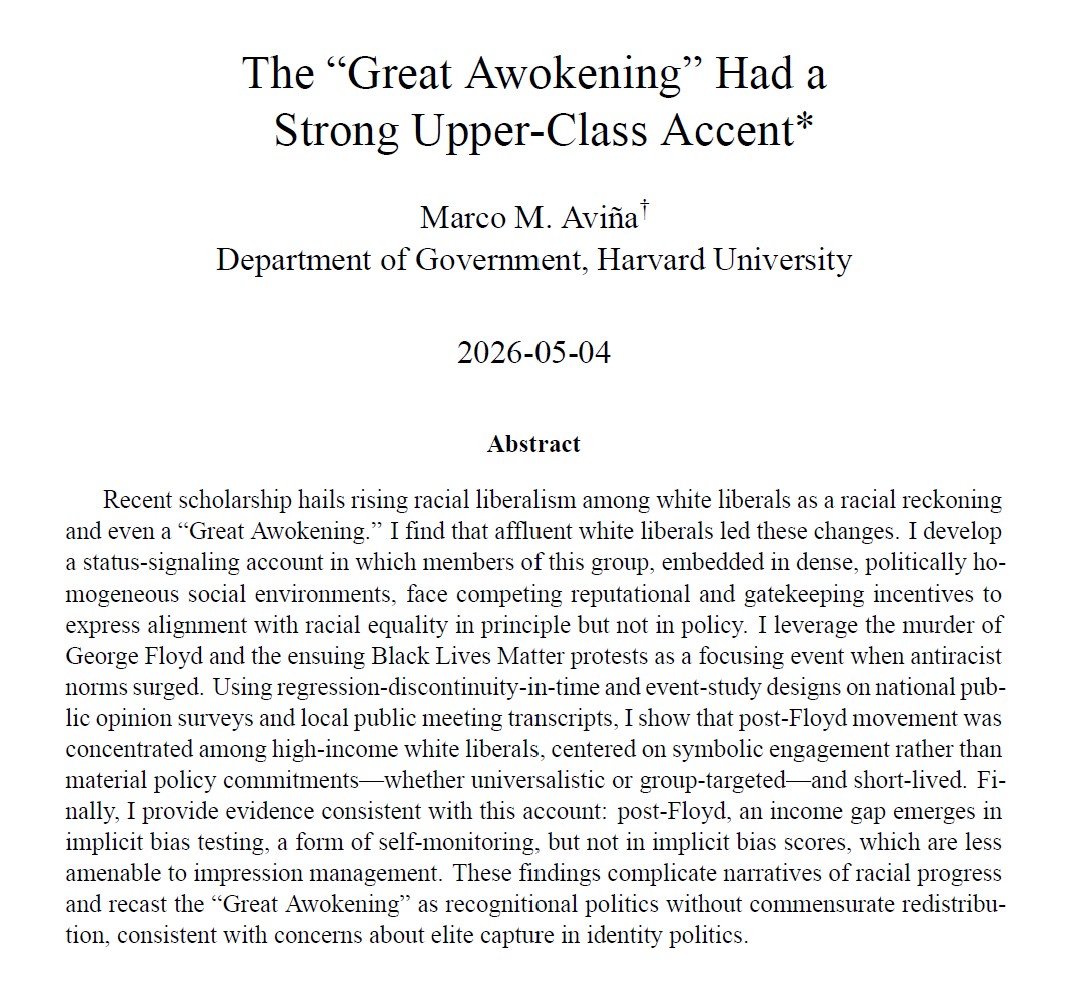
So excited to finally share my job market paper! The post-Floyd “Great Awokening” was driven by affluent white liberals and emphasized recognition over redistribution. Consistent with elite capture of identity politics. Feedback very welcome! Link below.
Marco M. Aviña tweet media
English
22
233
1.4K
151.3K
Abhijit Tagade retweetledi
Peter John Lambert
Peter John Lambert@pj_lambert·
Is GenAI causing the relative decline in early-career hiring? Our latest research finds that these effects may be conflated with another important driver: the rise of WFH arrangements (1/N)
Peter John Lambert tweet media
English
27
245
944
538.9K
Abhijit Tagade retweetledi
OpenAI
OpenAI@OpenAI·
Today, we share a breakthrough on the planar unit distance problem, a famous open question first posed by Paul Erdős in 1946. For nearly 80 years, mathematicians believed the best possible solutions looked roughly like square grids. An OpenAI model has now disproved that belief, discovering an entirely new family of constructions that performs better. This marks the first time AI has autonomously solved a prominent open problem central to a field of mathematics.
English
1.1K
3.9K
26.5K
13.2M
Abhijit Tagade retweetledi
Prashant Garg
Prashant Garg@Prashant_Garg_·
We know surprisingly little about how automation will unfold outside rich countries. So we built the Global Automation Atlas: 18,000 tasks, 124 countries, and 2.3 million task-country comparisons.
English
21
128
568
103.7K
Abhijit Tagade retweetledi
Ricardo Reis
Ricardo Reis@R2Rsquared·
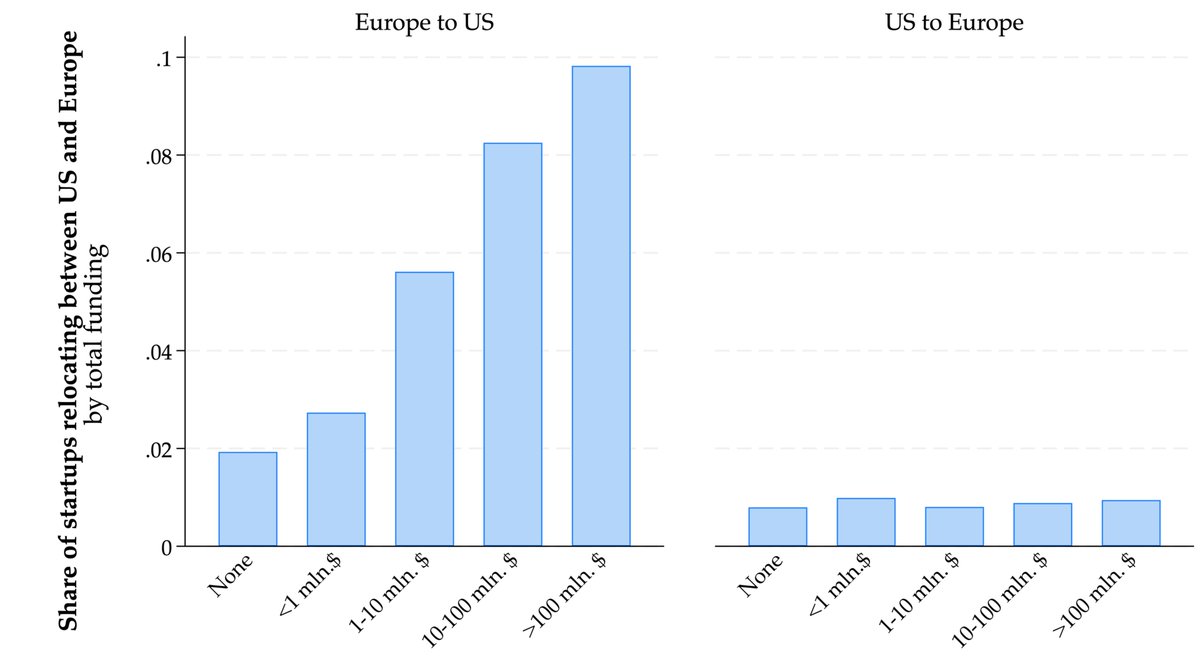
Which of the US or EU do economic agents choose to locate in? Their choice reveals how they weigh all the factors that matter. The relevant agent for productivity and economic growth are firms. So, the migration rates of startups reveals the economy where you want to be to grow and succeed:
Ricardo Reis tweet media
English
20
91
444
83.8K
Abhijit Tagade retweetledi
Luis Garicano 🇪🇺🇺🇦
We stopped everything to write an answer (link below) to Paul Krugman's two posts of today (one informal, one with a simple model) arguing that Europe is broadly not falling behind the United States. The change measured by the Draghi report, he argues, is mostly due to growth in the technology industry, which has distorted GDP numbers without actually leading to higher standards of living. We should believe our eyes when we walk around France and walk around Mississippi. Krugman is wrong. The measures he uses understate European stagnation. This matters enormously. Divergence with the United States is the strongest evidence for reform in Europe. 1. The growth numbers Krugman compares the United States, France, and Germany at purchasing power parity in current prices. On that measure, France's and Germany's position relative to America has been roughly constant since 2000. But current price comparisons miss productivity gains in sectors where prices fall. If America produces twice as much software while the price of each unit halves, the value of American software output looks unchanged even though the volume has doubled. Most economists therefore use constant prices, which fix the base-year PPP level and apply each country's real output growth on top of it. American output growth has concentrated in tech, where prices have fallen tremendously as productivity rises. In terms of the volume of things produced, America has pulled away from Europe. 2. Is it all the tech industry? Krugman concedes this tech divergence but says it is not welfare-relevant. The American growth lead is an accounting artefact of measuring more iPhones at base-year prices, not a sign that Americans are actually richer, because Europeans buy the same iPhones at the same world prices. This is not the right way to think about the world today, as an earlier Paul Krugman would have argued. His model assumes tradable goods, interchangeable workers, marginal-cost pricing, and no profits. Each assumption fails. Most of what households buy is non-tradable: housing, healthcare, childcare, education. When American tech firms bid workers from haircutting to coding, American haircut wages rise. Germany has no growing tech sector to do the bidding, so German wages stay flat. Technology is not priced at marginal cost. Apple's margins are around 40 percent. Anthropic's inference margins are at 70 percent. The major platforms enjoy network effects, switching costs, and lock-in that hold prices well above what a competitive market would deliver. A large share of the productivity gains in technology stays as profit. A lot of the value of American technology dominance shows up in equity, not in wages. Apple, Microsoft, Nvidia, Alphabet, Meta, and Amazon together are worth $21 trillion, more than the entire combined stock market value of all European stock markets. Around 60 percent of US equity is held by American households. The median French or Spanish household holds almost no equity. The median employee at Meta, a company with almost 80,000 employees, earned $388,000 in 2025. This advantage is not going to go away. Krugman's own 1991 paper, cited in his Nobel prize, showed that comparative advantage in modern industries is produced by increasing returns to scale, specialized labor markets, supplier networks and the agglomeration of suppliers, workers, and ideas in particular places. Once an industry concentrates somewhere, the concentration is self-reinforcing. Europe is being pushed away from the next round of technology industries (AI!). 3. What about inequality? Another retort is that GDP per capita hides substantial inequality, and so even if America is rich on average, this is mostly due to the super wealthy. But despite the US's high pre-tax income inequality, it also achieves higher median incomes than Europe, in part because of such a high base, and in part because it actually redistributes more than many European countries. The cleanest comparison is median equivalised disposable household income: income after cash taxes and transfers, adjusted for household size and purchasing power. According to the OECD's 2021 numbers, the median American earns 30 percent more than the median Dutchman, about 31 percent more than the median German, and about 52 percent more than the median Frenchman. 4. What about hours worked? Krugman points out that while American GDP per person is higher, most of this is because Americans work more. For this divergence to be an hours worked story, Americans must work more relative to Europeans now than they did in 2000. The opposite has happened. Birinci, Karabarbounis, and See in a 2026 NBER paper show that about half of the American-European hours gap that existed in the 1990s has reversed by the end of the 2010s. Americans work fewer hours per person than they did in 2000, while most Europeans work more. 5. Is America not a bad place to live? Walk around Alabama and France: surely the former cannot be substantially richer than the latter? American cities often have poorer centres and richer suburbs or exurbs. European cities preserve richer and more attractive historic cores. A visit to a city as a tourist in America compared with a city in France will leave one having seen different spots on the income distribution. Americans in Europe go to the nicest and richest European cities. Rather than a walking around test, do a driving around test. Go to the periphery of any modern American city and see a level of new-built material wealth that is extremely uncommon in Europe, with thousands of enormous four- or five-bedroom homes. In the South, in places like Nashville and Austin, drive around the downtowns to see hundreds of luxury apartment buildings springing from the ground. This construction boom is replicated virtually nowhere in Europe today. The other question is generational. Housing often costs more in Europe than in the United States, despite the quality of the housing stock generally being much better. Europe has nice city cores but these are inaccessible to young Europeans. Consider the salaries available to entry-level workers. The starting pay for a London police officer is $57,000. In Washington, DC, $75,000. The entry-level Deloitte consultant job in Madrid pays around €28,000, roughly $33,000 per year. In Charlotte, the entry-level Deloitte job pays $63,000. There are many things to dislike about life in America. But relative to 25 years ago, the gap in material wealth has shifted dramatically in America's favor. siliconcontinent.com/p/european-sta…
English
96
511
2.2K
1.1M
Abhijit Tagade retweetledi
Timothy Gowers @wtgowers
Timothy Gowers @wtgowers@wtgowers·
But if AI mathematics continues to progress at anything like its current rate -- which is what I expect to happen -- then we will face a crisis very soon, and mathematics departments, who owe a duty of care to their students, should be urgently preparing for it.
English
72
159
1.4K
517.1K
Abhijit Tagade retweetledi
Soumitra Shukla
Soumitra Shukla@soumitrashukla9·
Raj is such a cool economist. I’ve only had the chance to interact with him twice. The first time he was humble enough to introduce himself to me when I sat beside him at NBER Economics of Mobility organized by @Econ_Sandy and Jesse Rothstein. I obviously told him I knew who he was! The next year at the same conference I showed up late for the first talk, and sat beside him at the open seat. Not only did he recognize me, but also took time to say he owed me a response to an email of mine from a few months ago, and he regretted losing track of it but remembered the main details. I don’t care what anyone says. He’s a great person and obviously a great economist, and I’m happy he’s so immensely successful in what he’s doing.
Yale University@Yale

The American dream is fading for many in the country, but deep analyses of large data sets can point the way to how policymakers and institutions of higher education might act to change that trend, renowned Harvard economist Raj Chetty said during an appearance at Yale on Feb. 19. In an hour-long presentation in Zhang Auditorium, Chetty used a series of maps and charts to reveal the dramatic decline in upward mobility in the U.S. (especially for kids in low-income families), the factors that are the strongest determinants of economic mobility, and how these findings can be used to guide policy changes that can improve mobility. Chetty was on campus for the inaugural lecture in a new series hosted by Yale President Maurie McInnis, which will bring a leading expert to campus each semester to share ideas and inspire critical thought on some of today’s most complex topics, particularly as they relate to higher education. Learn more and watch a full recording of the talk: bit.ly/4i9Zv1Z #Yale

English
3
6
91
19.9K
Abhijit Tagade retweetledi
Jesús Fernández-Villaverde
Jesús Fernández-Villaverde@JesusFerna7026·
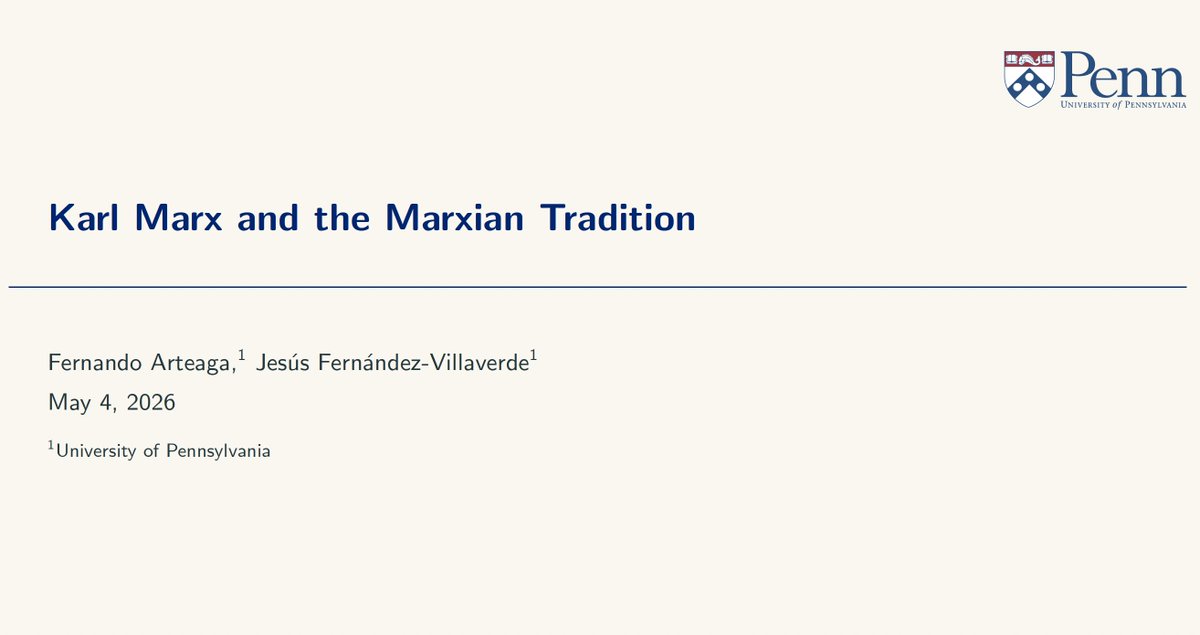
Since I have posted so much on Marx vs. Weber, modernity, and development over the last few weeks, I have posted an updated slide deck of my lectures on Karl Marx and the Marxian Tradition (together with @ferarteaga) here: sas.upenn.edu/~jesusfv/ET_3_… This is a long deck: 437 slides in the last compilation! (It also takes a few seconds to upload.) If I were to teach it carefully, with plenty of class discussion, I would require a whole semester. Even then, some topics (e.g., the Frankfurt School) receive only a cursory treatment because I focus more on economics and political economy, broadly construed. I hope to extend the discussion of those someday. However, I cover topics rarely seen in these courses, such as Hans-Georg Backhaus and the Neue Marx-Lektüre, because most of the work is not translated into English and must be read in the original German. I don’t have an equivalent slide deck on Max Weber, as I haven’t lectured on him. Hopefully, one day I will. Comments and feedback are very welcome.
Jesús Fernández-Villaverde tweet media
English
40
209
1.2K
391.6K
Abhijit Tagade retweetledi
Philippe Aghion
Philippe Aghion@Ph_Aghion·
It is an honor to welcome my dear friend and Nobel laureate Joel Mokyr (@NorthwesternU @TelAvivUni) at Collège de France for an incredible series of lectures, "The Longue Durée", sharing his "useful knowledge" with us !!!
Philippe Aghion tweet media
English
5
28
228
36K
Abhijit Tagade retweetledi
Ryan Hill
Ryan Hill@RyanReedHill·
There is great excitement about the potential for AI to reshape science, but so far very little empirical evidence about how that is (or is not??) happening in real time. I'm excited to share a new working paper with @carolyn_sms about the impact of AlphaFold on science ->
Ryan Hill tweet media
English
2
43
140
25.6K
Abhijit Tagade
Abhijit Tagade@atagade1·
@OxfordFrom Large firms with no growth? Or growth enhancing innovation policy? 🙃
English
0
0
0
49
Abhijit Tagade retweetledi
Luis Garicano 🇪🇺🇺🇦
Again the apocalypse from Amodei. Why don't you describe instead how wonderful it will be to have agents navigate bureaucracy for us, do our taxes, book our holidays, help us find fraudulent clauses in contracts, keep us healthy? Why this dumb emphasis in jobs lost?
English
9
15
140
19.8K
Abhijit Tagade retweetledi
Martin Beraja
Martin Beraja@MartinBeraja·
“The political problem of mankind is to combine three things: economic efficiency, social justice, and individual liberty.” I came across that quote by Keynes. It got me thinking about how we frame this problem in economics. We understand one part quite well. The first welfare theorem tells us that letting individuals make their own choices— preserving individual liberty — leads to economic efficiency. Liberty and efficiency are aligned. So the problem becomes: how do we introduce redistribution and social insurance (social justice) without destroying efficiency and curtailing individual freedom? Afaik, we study optimal taxation, insurance, transfers— always as a tradeoff between efficiency and redistribution/insurance. But what about individual liberty? Here, I think our frameworks are incomplete. To see why, imagine an extreme benchmark: an omniscient planner who observes everything and dictates exactly how much each person works, consumes, and saves. Such a system could, in principle, achieve perfect redistribution and insurance with no efficiency losses. But it would come at an enormous cost in terms of individual liberty. With the rise of AI-powered monitoring and surveillance systems, this benchmark may no longer purely theoretical — it can become increasingly feasible. At the other extreme, consider decentralized systems like progressive taxation. Individuals retain freedom to choose labor supply, consumption, and so on — but precisely because of that freedom, redistribution/insurance generates distortions and efficiency costs. At the same time, these systems are not purely “liberty-preserving”: enforcement ultimately relies on coercion. Failure to pay taxes can lead to fines, legal penalties, and even jail — an extreme curtailment of individual liberty. So what we typically interpret as an “efficiency cost” is, in part, the shadow of preserving individual liberty—within a system that still imposes coercion at the margins. And yet, our models rarely make this explicit. We frame the problem as efficiency vs redistribution, but not as a three-way tradeoff between efficiency, redistribution, and liberty. In other words, I don’t think we really have a framework that jointly evaluates the efficiency cost and the liberty cost of systems of redistribution and social insurance. Maybe we should... (I am sure I don't know papers that have thought about some of these question. Please point me to them!)
English
6
8
55
17.1K
Prashant Garg
Prashant Garg@Prashant_Garg_·
Call me Dr Garg as of today! 🥹🤓
English
30
0
184
6K
Abhijit Tagade retweetledi
Luis Garicano 🇪🇺🇺🇦
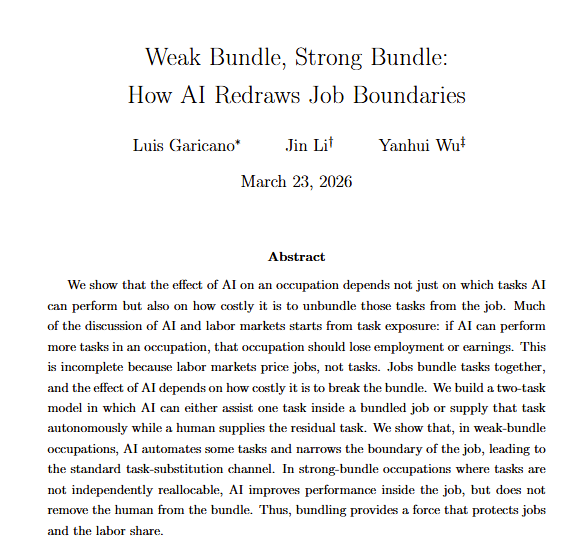
Famously (there is a beautiful Works in Progress piece on this) in 2016, Geoffrey Hinton told an audience in Toronto that medical schools should stop training radiologists, since AI would soon outperform them at reading scans. Ten years later, there are more radiologists than ever, and they earn more than they did then. Hinton was right about the task, but he was wrong (so far!) on the future of the radiology profession. Times have never been better for them. The gap between those two claims, the difference between tasks and jobs, is the subject of a paper I have written with Jin Li and Yanhui Wu, and that we release today: "Weak Bundle, Strong Bundle: How AI Redraws Job Boundaries." (Very relatedly we are also finishing the first draft of our book "Messy Jobs" on AI and Jobs!! You will be the first to hear). We start from the observation that the growing literature on AI and labor markets measures the AI shock by task exposure: people count how many tasks AI can perform in a given occupation AI can perform, and infer that more exposure means more displacement. Eloundou et al. published a paper in Science in 2024 that started this literature, and many follow the same logic. The inference they make is that the more exposed tasks, the worse the outcomes. This is incomplete, because labor markets price jobs, not tasks. A radiologist does not just sell image classification, but does many other jobs: triages cases, communicates with other physicians, trains residents, makes the difficult decisions, and signs a diagnosis. The market buys a bundled service. The question AI poses is not whether it can do one task inside the bundle. The question is whether that task can be pulled out. Thread (1/3) dropbox.com/scl/fo/689u1g7…
Luis Garicano 🇪🇺🇺🇦 tweet media
English
44
477
1.9K
431.6K
Abhijit Tagade retweetledi
Joe Hazell
Joe Hazell@JADHazell·
A look at what we are doing at LSE to integrate AI into teaching! Including by me for our first year students learning introductory macroeconomics.
Antonio Mele@antoniomele101

This is a great point, @arindube , and I am really guilty of not sharing more about what I have been up to on the teaching side of things, given that this is what they pay me for! Let's get back on track with a mega post. At @LSEEcon, we've been running a series of structured experiments to figure out exactly how GenAI changes the production function of economics education. We moved past the "cheating" panic early (although we didn't really have one in our programmes) and started actively rebuilding our pedagogy around these tools. Here's what we're doing and what we're learning, and btw we will be presenting our work at CTREE 2026 in Las Vegas in late May if you are in town. The AI Economics Professor With Ronny Razin, we built a specialised, course-aligned AI tutor. The key idea Ronny had: best way to verify if a student actually understands a concept is to ask them to explain it interactively. Clearly this does not scale to the class size we have at LSE (Ronny teaches his course to 850 first-year students). But we can scale with AI! The key pedagogical principle is that the chatbot uses a Socratic framework. It refuses to hand out final answers. Instead, students are prompted with an exercise, and the chatbot asks them to identify the next step in a mathematical or logical derivation themselves, guiding them through the reasoning rather than short-circuiting it. It adapts to the students' level, for example by clarifying concepts or notation if needed. This gives students access to 24/7 personalised tutoring, levelling the playing field for those who might hesitate to speak up in small classes or office hours, and solving Bloom's "2-sigma problem" in economics education. Notice that we didn't train the bot or fine-tuned t to our course material. We just provided a system prompt embracing the Socratic approach, and the solutions to the exercise students had to solve. That's it. Off the shelf LLM model (it was Gemini 2.5 Flash). We did run a small experiment for a game theory exercise, where students had to work out strictly dominated strategies, and pure and mixed strategy Nash equilibria. The feedback we received is overwhelmingly positive: students found it useful to work through the reasoning with the chatbot, and it helped them understand the material better. We are also in the process of establishing if the use of the chatbot improves marks in the final exam, although we don't have a full analysis yet. But I can say that this was a very good year for the distribution of marks in this course, way above the average of previous years. If this proves as good as it looks, next step is to scale this to more courses, potentially expand to similar disciplines in LSE, and potentially expand to other universities. Stay tuned. AI Feedback Experiment Providing high-quality, scalable formative feedback is one of the hardest problems in our job. It's incredibly labour-intensive, and the result is that students often get too little feedback, too late to act on it. Main problem, again, is scale. Can we use AI to enhance our feedback process? We did an experiment with @MichaelGmeiner2 in one of our MSc courses. Michael is a great teacher. In his Econometrics course, he teaches students how to write referee reports, and provides feedback to each one of them on 5 submitted referee reports. We thought, why don't we provide two feedback reports for each submission, one AI-generated and one human-generated? This will allow us to evaluate how good the AI feedback is with respect to human feedback (well, Michael's feedback, which is superhuman in my view, but ok). And so we did. We didn't say which is which to students, to avoid any kind of bias. And again, we just cooked up a prompt for the LLM to generate feedback on the referee report, we provided the AI with the paper to referee, the referee report submitted by the student, and nothing more. We found out that students rated the AI-generated feedback as less useful than the human-generated, although not by a lot. Main problem with the AI-generated feedback is that it is too generic, and does not address the specific TECHNICAL issues that the student may have missed in their report. It is also too positive, and does not provide the student with the critical feedback that they need to improve. In particular, students highlighted that the AI feedback did not enhance their critical thinking, and did not address methodological problems in the research article they were refereeing. Some of these aspects can be addressed with a better prompt, and we are working on it. The technical and methodological issues can also be addressed by providing a summary of what the teacher expects students to criticise in the paper, although there may be additional challenges in this approach (what if the student finds something else to criticise that the teacher did not think of? it happens all the time). Students also mentioned they think the two pieces of feedback are complementary, and they will be happier getting both that just one of them. This points in the direction of a hybrid approach, where AI is used to enhance the human feedback process, rather than substituting it. The caveat is, of course, that we haven't used the most recent models, we didn't try with mixture-of-experts and all the tricks in the book. Teaching Python & RELAI Principles Perhaps our biggest curriculum shift: with @JADHazell we pioneered teaching AI coding tools to first-year students. In the first year macro course that Joe teaches, we introduce students to Python coding for economic analysis. This year, we decided to move in a different direction: since the advent of AI coding agents, we believe it is more important to be able to READ and ORGANISE code than writing it. It is more important to be able to explain your intent to the AI coding agent, and verify that intent has been reflected in the code, than to be able to write the code yourself and test it. But how can you teach students that have never seen a line of code to do that? Introducing Reverse Engineering Learning with AI (RELAI). Start with a full snippet of Python code. The student is told to prompt the AI to explain what the code does. Once the student understands what the code does, it can asks about the syntax and the programming concepts behind the snippet. Then can ask a study plan for those concepts, if needed. Then can try to enquire the AI about what would happen if I change this line or this parameter. Then it can experiment itself by changing the code, and debug with the help of the AI. Finally, the student can ask the AI to produce new code, based on what was learned, and the new intent. I call this the EXPLORE approach: Examine the code, eXplain what it does, Probe deeper, Link to economics, Output prediction, Recreate understanding, Extend with modification. Once students are familiar with AI coding agents, they are assessed with a challenging coursework that Joe created. The assignment has a part that is difficult to do without AI, but should be feasible with AI. There are open ended questions where students have to go beyond the simple repetition of what was learned in the course, possibly explore new datasets and questions, etc. We think this approach can help integrate AI coding agents into the curriculum in a meaningful way, and help students develop a deeper understanding of coding tools in a faster and more efficient way. Coursework is on the way, so we will be able to evaluate the impact of this approach in the next few months. I personally believe RELAI can be adapted to other topics and subjects, and can become one of the way we interact with AI when learning something new. Read more about our approach here: python-ec1b1.vercel.app AI as a productivity tool This is where you can really go nuts. I have used AI to produce new teaching material for several workshops and courses. Slides, assignments, exercises, etc. The last few exams were written with AI tools, creating a series of questions first with suggested solutions, and then choosing the most appropriate ones. I use a coding agent (@cursor_ai ) with access to my teaching materials and past exams, so that it is aware of the content and style. You get a very good exam draft in minutes, and can edit, change questions, generate new ones, etc. It used to take me days to write a good exam, now it takes me a few hours in the afternoon. I used Cursor to do deep research about a new course I wanted to design. I asked for topics, examples, current research in the field that I may not have been aware of, similar courses' syllabi, and in general what was the state of the art in the field. I got a very long list of topics that I could choose from to design my own course, based on my taste, interest and what I think my students should know. I could generate different versions of the same course for different levels (UG, MSc and PhD). Conclusion We are still at the early stages of this journey. We are learning a lot, and we are still figuring out how to best use AI to enhance our teaching. One important thing you may have noticed is that we first define our pedagogical approach and then we integrate AI tools to support it. The other principle should be, design not for the tools you have now, but the ones you will have in a few months or years. If you have comments, or have been running similar experiments, I will be happy to hear from you.

English
3
12
80
14.9K
Abhijit Tagade retweetledi
Quan Le 🗞️
Quan Le 🗞️@qlquanle·
My colleagues at HBS and I are looking for predoctoral researchers, starting Summer 2026! The ideal candidate recognizes that the traditional RA role in econ research is obsolete with coding agents, yet loves econ so much that they want to learn how to do it with new tools. 1/2
English
4
35
253
47.2K
Abhijit Tagade retweetledi
Jesús Fernández-Villaverde
Jesús Fernández-Villaverde@JesusFerna7026·
Every time I discuss the economic and social disruptions caused by the worldwide decline in fertility, I hear the same response: artificial intelligence (AI) and robots will make this issue irrelevant. I find the answer deeply paradoxical because, despite being an economist, I am compelled to point out that the argument suffers from the mistake of “economism”: thinking that all social interactions in life are solely about productivity. Most of the problems caused by declining fertility are largely unrelated to productivity: the depopulation of rural areas, the collapse of public services, and inverted family structures in which one child supports four grandparents. Reducing all of this to purely economic terms is an extremely narrow view of society and life. A robot cannot visit your grandmother in a nursing home in a depopulated town in Korea. But there is an even more fundamental question: how do you know that societies will permit the deployment of artificial intelligence on a large enough scale? If we have learned anything from economic history, it is that societies repeatedly create barriers to wealth and hinder the adoption of new technologies. The Roman Empire had a working steam device, the aeolipile, and never developed it beyond a toy. The Ming dynasty burned Zheng He’s fleet and turned inward. Spain expelled its Jewish and Moorish populations at the height of its imperial power, gutting its merchant and artisan classes. The Ottoman Empire resisted the printing press for nearly three centuries after Gutenberg. Tokugawa Japan had firearms in the 1500s but chose to abandon them. The Qing restricted all foreign trade to a single port in Canton for over a century. Argentina was one of the ten richest countries in the world in 1910 and spent a century in relative decline through self-inflicted policy choices. The Soviet Union had world-class mathematicians and physicists but could not produce a decent pair of shoes because the institutional framework would not allow it. India’s License Raj strangled industrial development for four decades after independence. Closer to our own time, much of Europe spent decades resisting genetically modified crops despite the technology being available. Right now, the EU is drafting some of the strictest AI regulations in the world. And these problems will hit hardest where people least expect them. The conversation about aging and AI tends to focus on rich countries like the U.S. or Japan, but the most acute disruptions will come in emerging economies. Latin America and the Middle East have experienced some of the deepest and fastest declines in fertility on the planet. Colombia’s TFR is 1.06, Jamaica’s 1.20, Turkey’s 1.48, and Mexico’s 1.60. These countries are getting old before they get rich. On top of that, they face a double blow: not only are fewer children being born, but their most skilled and ambitious young workers are leaving. The doctors, engineers, and entrepreneurs who might drive AI adoption are moving to the US, Canada, or Europe. And let’s be honest: these are not exactly countries known for getting out of the way of innovation. The political economies of Latin America and the Middle East are riddled with extractive institutions, captured regulators, powerful incumbents who block competition, and states that struggle to deliver basic public services, let alone manage an AI transition. If Argentina could not reform its economy in a hundred years of trying (perhaps it is doing it now, but the jury is still out on whether this reform will be sustainable), if Mexico cannot keep its own engineers from leaving, if Egypt cannot fix its educational system, I am not sure why we should expect them to seamlessly deploy the most disruptive technology in human history. The countries that most need technological dynamism to offset demographic decline are precisely the ones least equipped to make it happen. There is nothing inevitable about adopting new technologies. It requires political will, institutional flexibility, and social acceptance. Aging, fiscally strained democracies dominated by elderly voters are not obviously the best candidates for any of those three. So when someone tells me “don’t worry, AI will fix it,” I hear an argument that assumes the best possible technological outcome, assumes societies will actually adopt it, assumes it will be deployed fast enough, and assumes the only thing that matters is productivity. That is four enormous assumptions stacked on top of each other. And I am sorry, but since I teach global economic history for a living, I have learned that optimistic assumptions are rarely validated by the crooked timber of humanity.
Jesús Fernández-Villaverde tweet media
English
32
180
532
59.3K