

avesda
591 posts





I get that in reality there are payrolls, cloud bills, institutions, researches that can't accept ETH
but
why is EF making this decision? why not send in ETH and let recipients decide whether to sell or not? Do all recipients require stables/fiat?
Did EF ever share what % of recipients actually requested stablecoins vs would've taken eth?
English

English

1/ Today, The Ethereum Foundation will convert 5000 ETH to stablecoins via @CoWSwap's TWAP feature as a part of our ongoing work to fund R&D, grants and donations.
English
Crazy that I can't buy the book called "Freedom of Money" just cuz there is no freedom in amazon nor the money they accept.
Why no crypto storefront? The book will be leaked as pdf on day 1 anyways. No matter if you use kindle book or not.
Also charity would be much more transparent.

English

If you are curious about the book name “Freedom of Money”, it was the Binance mission statement from the beginning: to increase the freedom of money.
It was in the Binance year end review of 2018 (the first full year end)
binance.com/en/blog/all/28…
It was mentioned and quoted publicly in early 2018:
bitcoininsider.org/article/40950/…
It was in my 2019 Father’s day X post:
x.com/cz_binance/sta…
Mentioned in 2020 as part of Binance’s Core Values
binance.com/en/blog/ecosys…
It was mentioned in 2020:
binance.com/en/blog/all/30…
And many many times in many of the Binance blogs or posts...
The Chinese name '币安人生' is a meme coin someone started. I thought it is very fitting too. Very organic. Couldn't find a better Chinese name.
I may post some snippets of the book in the next few days, before it goes live.
Let's increase the Freedom of Money. All book sale proceeds go to charity. Thank you for all your support! 🙏
I may sign your copy one day if you are an early buyer of the book. 😉
Wick李🔶 BNB@SuperL9
freedom of money不仅是CZ新书的名字 也是当初创立币安时候的初心 就像今年元旦币安致用户的一封信的结尾 不管世界怎么变,Binance的初心其实很简单:Freedom of money @cz_binance
English
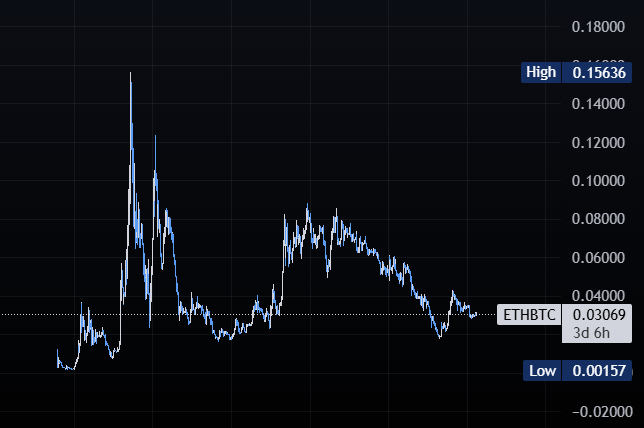

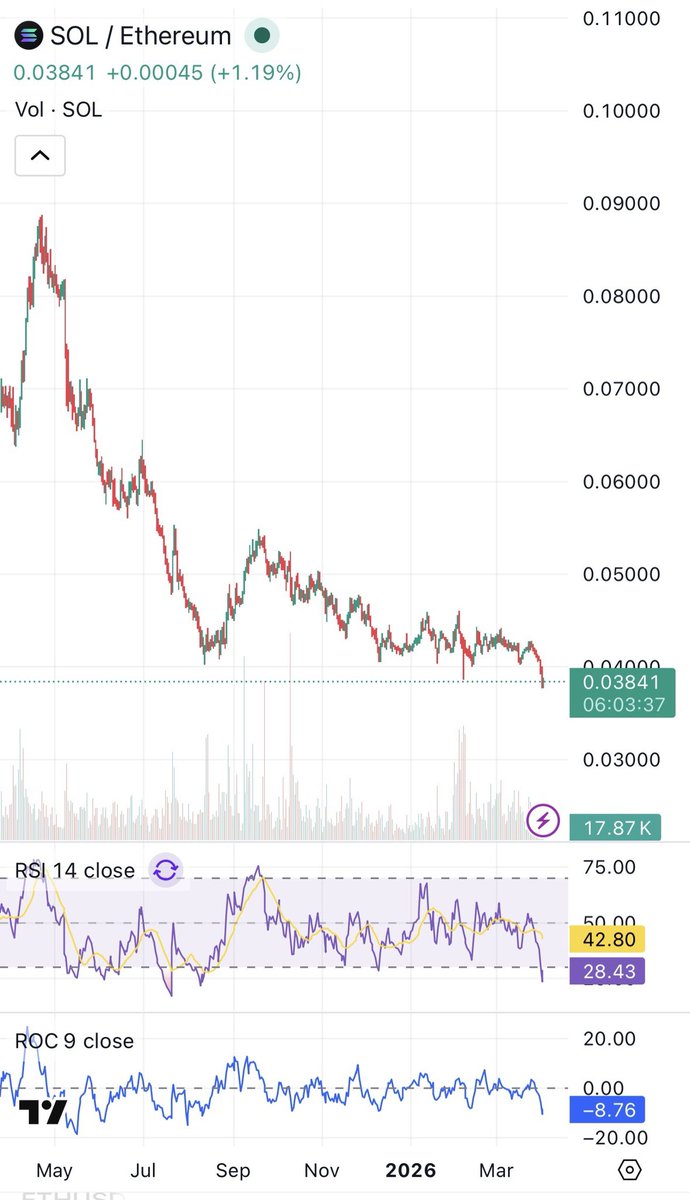
Remember when @toly put all his energy into trolling ETH instead of building his own shitcoin? We like the result.
English
@cz_binance BNB database is well positioned in this regard with only 21 computers to update once ETH team figures it out, better put a scraper on the repository so that BNB can become first db to be achieve quantum resistance
English
Saw some people panicking or asking about quantum computing's impact on crypto.
At a high level, all crypto has to do is to upgrade to Quantum-Resistant (Post-Quantum) Algorithms. So, no need to panic. 😂
In practice, there are some execution considerations. It's hard to organize upgrades in a decentralized world. There will likely be many debates on which algorithm(s) to use, resulting in some forks.
And some dead project may not upgrade at all. Might be a good to cleanse out those projects anyway.
New code may introduce other bugs or security issues in the short term.
People who self custody will have to migrate their coins to new wallets.
This brings to the question of Satoshi's bitcoins. If those coins move, then it means he/she is still around, which is interesting to know. If they don't move (in a certain period of time), it might be better to lock (or effectively burn) those addresses so that they don't go to the first hacker who cracks it. There is also the difficulty of identifying all his addresses, and not confuse with some old hodlers. Anyway, it's a different topic for later.
Fundamentally:
It's always easier to encrypt than decrypt.
More computing power is always good.
Crypto will stay, post quantum.
English


Try the Grok Imagine Chibi template!
grok.com/imagine?templa…
Dogan Ural@doganuraldesign
Okay, I’ll bite. This is Chibi me. Now show me yours! No SuperGrok? Drop your profile pic below. I’ll Chibify some of you.
English

@PeterDiamandis Reminds me of that old joke.
AI engineers keep building a better and better AI, asking the same question: “Is there a God?”
Eventually, the AI answers: “There is now!”
English

Demis Hassabis told world leaders: AGI will be 10x the impact of the industrial revolution at 10x the speed.
There's no way around it besides taking action now.
English
And it’s getting better
Beff (e/acc)@beffjezos
I didn't realize Grok imagine was *this* good holy... 😳
English
There is a product which is a basically a button hidden in keychain, necklace, etc u press it and it alerts police, family and sends gps location.
But yeah u might not have the chance to press it.
But also with a listener type of device u might not be able to speak out of fear xd.

English

@LamXBT @moneydogeth @n13 it's listening and the input gets directly passed through an LLM in real time, that's the only place where the listening input goes
theoretically you could encode this into hardware and make it very verifiable that nothing else is going on
English
One tool that seems to me would lead to large wins for safety at very low cost to civil liberties, is that everyone should have easy and deniable on-hand ways of calling the police.
Think: you pre-select a few secret words, and when your watch or phone or local device in your house hears these words, it silently auto calls 911, and temporarily streams to the police your real-time location.
This could work very well for eg. crypto holders who are worried about getting kidnapped / robbed. If we create an environment where if you rob someone (whether at home or outside), there is at least a 20% chance that the police will be on their way immediately, so you won't have time to take anything from them and you don't even realize whether or not the alarm got triggered, then that type of crime flips to being very non-viable.
And because this requires deliberate action from the victim in order to function, the risk that this can be used by the government against people seems relatively quite low.
English
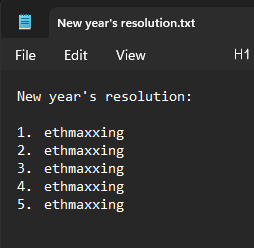
I actually do the whole new year's resolutions thing, and it actually works.
The key thing to understand is that humans are creatures of habit. Doing the same action you've already done regularly takes very little mental effort, whereas inserting a new one-time task takes much more. And so if you want yourself to do certain things more, you need to make it a habit.
The year boundary is as good a place as any to evaluate the habits that you're chosen to impose on yourself, and see whether they are effective and sustainable, and adjust, add or remove any.
My style is to make them measurable, trackable, and targeted to exactly the level of effort that I know will not make me want to abandon them, even during my months of busiest work, most intensive travel schedule or call schedule, etc.
Examples I've done:
* Walk an average of >= 6km/day each month
* Run >= 50km each month
* Write >= 1 blog post each month
* Study some language for 30 min each week
* Do >= 2 major cryptography programming projects each year
At every year boundary, re-evaluate your old list, and decide on your new list. And yeah I have txt files for tracking this (sorry, not gonna use some corposlop app that makes me dependent on third-party servers)
You actually want each one to be relatively trivial, so that you can stack multiple, and because the benefits of maximizing are less important than the risk that you will give up on the whole thing.
This has worked well for me and I recommend it.
English
@VitalikButerin @Fatalmeh Are you moving away from usdc? why swap into so many different stablecoins?
English
@Fatalmeh Yes this is all important and we should support projects in that category more
English
Defi is a central part of the value that Ethereum provides. Financial empowerment is a central part of what it means to have agency and freedom in our current world. Finance is far from the only thing that Ethereum is good for, but it is an important thing. This post discusses how the Ethereum Foundation is approaching defi.
Defi today makes the world's best savings, risk management and wealth-building opportunities permissionlessly available worldwide. We need to build on that.
Ethereum's early defi era was great because it dared to dream and innovate and come up with totally new paradigms (eg. AMMs). Defi tomorrow will bring back that spirit. Don't just "make a better stablecoin", dig a layer deeper, and think about the underlying problem (risk management, hedging one's future expenses), and come up with an even better solution.
But also, as the EF, we are not interested in supporting "onchain finance" or even "defi" indiscriminately. We have a specific vision of what we want to see out of defi: permissionless, open-source, private, security-first global finance that maximizes people's control over their own assets, minimizes centralized chokepoints and trusted third parties, and democratizes risk management and wealth building (the two key goals of finance according to modern portfolio theory) as well as payments. We want protocols that pass the walkaway test: that keep working even if the original team suddenly disappears without warning (or even: becomes hostile / compromised without warning).
Bringing this vision to reality will inevitably take a lot of work. Defi is a complex toolchain, including various onchain components, user-side offchain components (ie. wallet, local agent...), other offchain components, etc.
The things that we care about include areas like:
* Improving security of defi through "traditional" means, eg. audits, standards, wallet-side safeguards
* Improving security of defi through "new" means, eg. AI-assisted formal verification, user-side agents as safeguards
* Oracle security and decentralization (there's A LOT of skeletons in the closet here, we as an ecosystem really need to point a big eye of sauron at it for a while)
* Privacy. Both privacy-preserving payments, and privacy of more complex use cases (eg. what does it mean to have a maximally privacy-preserving CDP? there are clearly benefits in reducing liquidation-sniping risk, but it requires hard tech to get there)
* Open source, and improving the licensing / forkability situation in defi
Ethereum is a permissionless protocol, and nothing stops people from deploying insecure protocols, protocols that enshrine ultimately unneeded centralized trust in the name of convenience, or dopamine-maximizing gambleslop. However, we *are* interested in working with anyone aligned to make permissionless, open-source, intermediary-minimizing and security and user-agency-maximizing defi ecosystem as strong as possible, so that it can be not just individuals and institutions' first choice in Ethereum, but also a globally compelling way to manage funds for anyone who needs its properties.
charles (csl) ᛋ@CharlieStLouis
1/ Today the EF is sharing a bit more about how it's approaching DeFi going forward:
English