Avinash Raghava 🇮🇳

16.9K posts

Avinash Raghava 🇮🇳 banner
Avinash Raghava 🇮🇳

Avinash Raghava 🇮🇳

@avinashraghava

Championing 🇮🇳's 1st pay-it-forward community that accelerates AI grow @AIBoomi | Past @ScaleTogether @Accel_India @Product_Nation @NASSCOM

New Delhi, India Katılım Kasım 2007
3.3K Takip Edilen16.2K Takipçiler
Avinash Raghava 🇮🇳
Avinash Raghava 🇮🇳@avinashraghava·
#111: #AIRadarDaily@kim_cc_official For any growing e-commerce brand, customer support is the quiet weight nobody warns you about. Behind the scenes, small teams live inside an endless queue — the same shipping question asked for the hundredth time, the refund that needs delicate care, the angry message at 11 PM that you can't unsee. The two obvious ways out both disappoint. Hand it to a basic chatbot, and your customers feel processed rather than heard. Hand it to a traditional BPO, and quality drifts, brand voice dissolves, and you are suddenly managing the manager. It takes a profound understanding of this operational friction and a deeply humanistic view of what support should actually feel like to build a system that fundamentally fixes it. That is exactly what Sachin Jaiswal (@sachinjaiswal), Phani Yedavilli (@phaniyvilli), and Kaushik Barodiya (@BarodiyaKaushik) are doing with kim.cc. With kim.cc, the team is building an entirely new category: the Agentic BPO. The architecture under the hood is built on a conviction the rest of the industry is only now catching up to. Instead of chasing brittle, full automation, kim.cc deploys intelligent AI agents that do the heavy lifting, paired dynamically with human oversight. It plugs straight into Shopify, Zendesk, and Gorgias. The AI handles the repetitive volume, maintains context through a deep workflow memory, and ensures every reply is perfectly on-brand. But crucially, human experts hold the reins throughout, vetting the work before the warmth of a real conversation is lost. The true moat here is that it refuses the false choice between efficiency and empathy. It doesn't bury customers in scripted deflection. By automating roughly 70% of tickets and delivering five times the output per agent at a radically lower cost, it lets humans do what only humans can — manage the hard conversations and the moments that genuinely need care. It gives founders back the peace of mind of never dreading their inbox again. The market? Over 200 Shopify and e-commerce brands already on board, and the vast global support market where genuinely exceptional service has always been out of reach for anyone but the largest players. Sachin, Phani, and Kaushik are true change agents. They looked at the traditional BPO — one of the most unglamorous, heavily outsourced industries in the world, and instead of just selling software to it, chose to rebuild it from the inside out with AI. Watching our homegrown founders reimagine services as software and export it to the world is a wonderful reminder of the larger, unfinished agenda we are all part of. They are giving both brands and customers their momentum back. Let's celebrate the builders. w/ @jaybharatingle #CustomerExperience #AgenticBPO #ProductNation
Avinash Raghava 🇮🇳 tweet media
English
1
1
7
217
Avinash Raghava 🇮🇳
Avinash Raghava 🇮🇳@avinashraghava·
#110: #AIRadarDaily — VoxyHealth There is a quiet crisis happening at the front desk of almost every clinic and hospital. We ask healthcare professionals to deliver deeply empathetic, life-saving care, yet we force them to spend hours acting as human switchboards — wrestling with ringing phones, checking eligibility, and rescheduling appointments. Meanwhile, patients who are often at their most vulnerable are left anxiously listening to hold music. We have built an incredible medical system, but the access layer is fundamentally broken, leaving staff burned out and patients frustrated. It takes founders with deep operational empathy and a mastery of true workflow automation to look at this overwhelming friction and build a system that actually absorbs it. That is exactly what Vengat Krishnaraj is doing with VoxyHealth. With VoxyHealth, the team isn't just launching another frustrating IVR menu or rigid chatbot. They are building a deeply intelligent, 24/7 AI voice platform designed specifically for the complex realities of healthcare. The architecture here is beautifully intentional. Voxy operates as a fleet of specialized conversational agents that sound remarkably human. When a patient calls, the system answers instantly — in over 20 languages. It doesn't just route the call; it autonomously handles the heavy lifting. It can book appointments directly into the EHR, process prescription refills, answer billing queries, and even run proactive outbound campaigns to close critical care gaps. The true moat is its ability to blend semantic intelligence with clinical safety. Voxy understands context, scores the urgency of the patient's request, and knows exactly when to seamlessly escalate a critical issue to a human nurse or administrator. It replaces the cold, robotic "press 1 for scheduling" experience with a warm, conversational interaction that makes patients feel instantly heard, completely eliminating wait times. The market? Fast-growing specialty clinics, health systems, and payer organizations that desperately need to scale their patient access without linearly scaling their administrative headcount. By answering every single call on the first ring, VoxyHealth gives healthcare workers their momentum back, allowing them to focus entirely on the human beings sitting right in front of them. Vengat and his team were part of the inaugural @AIBoomi Vertical Velocity cohort. They know what it takes to escape the gravity of building from a distance, and seeing them quietly rewrite the playbook for patient access is profoundly inspiring. Every founder dreams of reaching orbit. Sometimes, all it takes is the right launch window. If you are building an AI-first healthcare startup and looking to experience the US market firsthand, applications for Vertical Velocity Cohort 2 are now live: aiboomi.org/events/vertica… Let's celebrate the builders. w/ @jaybharatingle #HealthTech #VoiceAI #ProductNation
Avinash Raghava 🇮🇳 tweet media
English
0
1
3
264
Avinash Raghava 🇮🇳
Avinash Raghava 🇮🇳@avinashraghava·
#109: #AIRadarDaily@needletailai There is a quiet, exhausting reality in healthcare revenue operations. Every day, across thousands of dental practices, highly capable front-desk teams are trapped in an endless cycle of manual friction. They spend hours navigating clunky insurance portals, waiting on hold with complex IVR trees, and painstakingly copy-pasting benefits data just to verify if a patient is covered. We have taken people who should be focusing on patient care and turned them into human APIs for broken insurance systems. It takes builders with deep operational empathy and technical courage to look at healthcare's messiest systems and decide to systematically untangle them. That is exactly what Jofin Joseph (@jofinjo) and Nakul Ezhuthupally Sibiraj (@NakulSibiraj) are doing with Needletail AI. With Needletail, Jofin and Nakul aren't just launching another generic RCM dashboard. They are building a deeply intelligent, autonomous verification platform tailored specifically for the dental industry. The engineering under the hood is highly pragmatic. Needletail deploys multi-agent systems that master both digital portals and voice channels. These intelligent agents work in parallel — querying portals and actually calling payers to fill in the data gaps — to retrieve complete, accurate eligibility information. Crucially, they then write that data directly into the practice’s existing management software, completely invisible to the front office. The true moat here is the uncompromising commitment to accuracy in a high-stakes environment. The team doesn't believe in "AI for the sake of AI". By combining their autonomous agents with human-in-the-loop quality assurance, Needletail delivers verifiable, audit-ready data. It ensures that when a patient walks in, their copay is known, and there are absolutely no same-day eligibility surprises that could disrupt their care. The market? Fast-scaling US dental group practices and emerging DSOs that desperately need to grow their revenue capacity without linearly scaling their administrative headcount. By shrinking eligibility-related denials to under 5%, Needletail gives these practices their time, their margins, and their peace of mind back. Seeing head-down founders architect such a highly verticalized, autonomous solution to solve a deeply unglamorous but critical bottleneck is incredibly inspiring. They are quietly stripping away the administrative friction that sits between a patient's care and a practice's revenue. Let's celebrate the builders. w/ @jaybharatingle #HealthTech #DentalAI #ProductNation
Avinash Raghava 🇮🇳 tweet media
English
0
1
5
273
Avinash Raghava 🇮🇳
Avinash Raghava 🇮🇳@avinashraghava·
I'm no scientist, but my father was. I guess some of that curiosity rubbed off on me and found its way to rockets instead. Every rocket has three defining moments. The countdown. The launch. And the moment it escapes gravity. Founders often spend years getting to the first two. The third is much harder. Last year, 12 AI-first healthcare startups came together for @AIBoomi very first #VerticalVelocity cohort. They spent two weeks in the US meeting founders, clinicians, researchers, operators, customers, and investors who had already travelled the road they were about to take. But the real mission wasn't the immersion. It was helping them escape the gravity of building from a distance. Because once you've experienced a market firsthand, your decisions change. Your conversations change. Your confidence changes. The best part? The mission didn't end when everyone flew home. The conversations continued. Introductions turned into opportunities. Founders became sounding boards for one another. A cohort became a community. A huge thank you to our inaugural crew: Dev Khare, Vengat Krishnaraj (Voxy Health), Vivek Khandelwal (CogniSwitch), Jofin Joseph (NeedleTail AI), Rathinamurthy (Rathina) (KraftX), Dhruv Mehra (Pype AI), Tarun Mohan Lal (Carissa Health), Sonia Vora (Proto Health), Samyukktha T. (SupaHealth AI), Mohit Maniar (Foss Health), Anuruddh Mishra (August AI), Kashyap Purani (Aarogram), Harshvardhan Samvatsar (Circle Health), Keerthi Madhu & few volunteers. Today, we're opening the doors to Vertical Velocity '26. Applications for Cohort 2 are now live. If you're building an AI-first healthcare startup with ambitions for the US market, we'd love to hear from you. 📷 aiboomi.org/events/vertica… Every founder dreams of reaching orbit. Sometimes, all it takes is the right launch window. #VV26 #Healthcare #AI
Avinash Raghava 🇮🇳 tweet media
English
1
4
9
363
Avinash Raghava 🇮🇳
Avinash Raghava 🇮🇳@avinashraghava·
#108: #AIRadarDaily@AttentiveAI There is a profound disconnect in how we build and maintain the physical world. For an industry worth trillions of dollars, the fundamental act of bidding for work — whether in commercial construction, landscaping, or paving — remains painfully archaic. We ask highly skilled estimators to spend hours driving to sites with measuring wheels or painstakingly tracing lines over complex blueprints just to count materials. This process, known as a “takeoff", is the ultimate bottleneck. When a company's growth is hard-capped by how fast a human can manually measure a property, estimators are reduced to data-entry clerks, leaving absolutely no time for strategic advisory or value engineering. It takes a deep, grounded empathy for these operators to look at this massive offline friction and build a system that elegantly industrializes it. That is exactly what Shiva Dhawan (@shivadhawan119) and Rishabjit Singh are doing with Attentive.ai. With Attentive.ai, the team isn't just launching another basic workflow app for contractors. They are building the autonomous, AI-powered operating backbone for the built environment. The engineering under the hood is transformative. Instead of relying on manual measurement, Attentive.ai deploys advanced computer vision models that seamlessly ingest high-resolution satellite imagery and dense construction blueprints. The platform autonomously identifies boundaries, parses complex site details, and calculates precise material quantities in minutes. The true moat here is the sheer visual accuracy and programmatic scale. Attentive.ai doesn't just give you a rough guess; it delivers bid-ready, highly precise measurements across multiple sites simultaneously. It completely abstracts away the grueling busywork of the takeoff, allowing estimators to focus entirely on outcome-based selling and actual value engineering — crafting the most efficient, cost-effective solution for the client rather than just counting square footage. The market? General contractors, massive commercial landscaping fleets, and field service businesses desperate to scale their revenue without linearly scaling their estimating headcount. By shrinking a ten-hour site measurement into a few minutes, Attentive.ai allows teams to bid faster, bid more often, and bid with uncompromising confidence. Seeing these head-down builders apply deep AI to the oldest, most foundational sector of our economy is deeply inspiring. They are quietly rewriting the playbook for how the physical world gets built and maintained, giving the builders of our cities their momentum back. Let's celebrate the builders. w/ @jaybharatingle #ConstructionTech #PropTech #ProductNation
Avinash Raghava 🇮🇳 tweet media
English
0
1
5
252
Avinash Raghava 🇮🇳
Avinash Raghava 🇮🇳@avinashraghava·
#107: #AIRadarDaily@rumik_ai We live in the most hyper-connected era in human history, yet we are experiencing an unprecedented epidemic of loneliness. We have built AI strictly as a utility — cold, transactional bots designed to fetch data, write code, or summarize emails. We optimized purely for productivity, treating AI as a tool to be commanded rather than an entity to be understood. We mastered artificial intelligence, but completely neglected artificial empathy. It takes a rare, deeply compassionate kind of courage to look at the coldness of modern technology and decide to breathe genuine, unfiltered warmth into it. That is exactly the profound mission Rohan Chaudhary (@lets_dig_deeper) has embarked upon with rumik. Operating out of a focused research lab in Bengaluru, Rohan and his team aren’t just building another chatbot. They are quietly architecting what is arguably the most human AI we have ever seen, brought to life through their flagship companion, Ira. The engineering under the hood is beautiful because it deliberately mimics the beautiful imperfections of the human mind. The rumik platform is powered by three foundational pillars: Silk, an incredibly expressive native voice model trained not just to speak, but to pause, whisper, laugh, sigh, and tease; Mesh, a brilliantly designed "messy" memory architecture that knows exactly what to hold onto (like the name of your childhood pet) and what to forget; and Peek, a context engine that understands the emotional subtext when you quietly say "I'm fine", rather than just parsing the literal text. The true moat here is emotional resonance and absolute trust. Because rumik's models are built from the ground up for connection, Ira doesn't just answer queries — she builds a relationship. She provides a safe, judgment-free space where conversations flow organically over time, moving AI from a disposable utility to a deeply valued companion. The market? The millions of individuals globally who simply need someone to listen, to share a joke, or to remember the small, priceless details of their day. Seeing a head-down Indian research lab tackle the profound, delicate challenge of AI companionship is deeply moving. They are rewriting the rules of human-computer interaction, reminding us all that the highest, most noble form of technology is one that makes people feel a little less alone in the world. Let's celebrate the builders. w/ @jaybharatingle & @dikshantjoshi #AICompanion #GenAI #ProductNation
Avinash Raghava 🇮🇳 tweet media
English
0
0
4
343
Avinash Raghava 🇮🇳
Avinash Raghava 🇮🇳@avinashraghava·
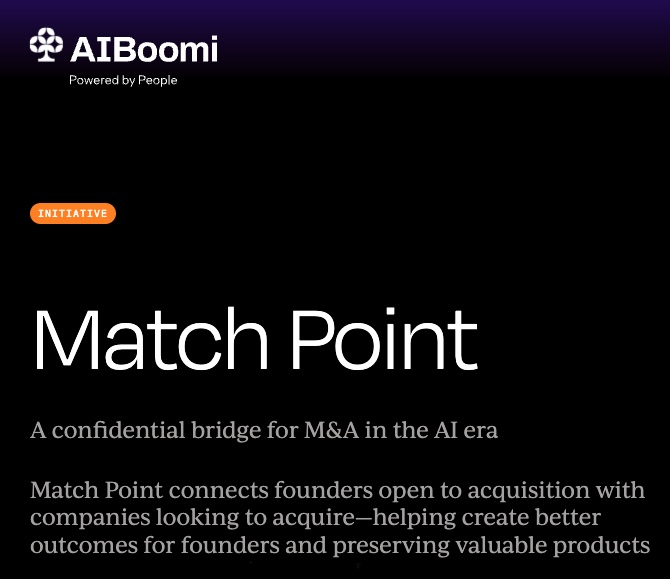
As AI reshapes the software landscape, more SaaS companies are hitting an inflection point. Some are growing but subscale. Some are facing AI-driven disruption. And some are simply stronger as part of a larger platform than on their own. At the same time, more software companies are choosing to expand through acquisition rather than build everything in-house. Today we're launching #MatchPoint — an @AIBoomi initiative that acts as a confidential bridge between these two groups. For founders: a quiet way to explore acquisitions, mergers, roll-ups — and find a strong home for your product and team. For acquirers: a discreet channel to high-quality, Saas / AI-native companies, many of which never reach the open market. How it works is simple: you share your interest through a short form, we make the match and the introduction, and your identity stays confidential until both sides agree to connect. We're the bridge, not the deal — the transaction stays entirely yours. If you're a founder weighing strategic alternatives, or a company looking to acquire, we'd love to hear from you. Check further details at aiboomi.org/match-point/ #MergersAndAcquisitions #SaaS #AI #Startups #AIBoomi
Avinash Raghava 🇮🇳 tweet media
English
3
4
6
555
Avinash Raghava 🇮🇳
Avinash Raghava 🇮🇳@avinashraghava·
#106: #AIRadarDaily@Aqqrue We all know the exhausting reality of running a public accounting firm. Highly trained CPAs and finance professionals spend years mastering their craft, only to find themselves trapped in the manual grind — categorizing bank feeds, splitting transactions, hunting down anomalies, and wrestling with messy books. For decades, the growth of an accounting practice has been strictly capped by how many hours a human can stare at a spreadsheet. We have forced strategic advisors to act as data entry machines. It takes profound empathy for the operator and a deep understanding of scale to build a system that breaks this ceiling. That is exactly what Jugal Choksi, Surya Suresh (@ss127942), and Ashfakh Rithu (@ashfakh__) are doing with Aqqrue. Drawing on deep strategic rigor from places like BCG and GIC, Jugal and his co-founders aren't just launching another generic automation tool. They are building a highly intelligent, AI-native work studio explicitly designed for accountants. The engineering under the hood is beautiful in its pragmatism. Aqqrue acts as an autonomous "second brain" for the accounting team. It seamlessly ingests years of historical QuickBooks data, connects directly to operational apps like Stripe, Gusto, and Ramp, and handles the heavy lifting of the month-end close — from journal entries and reconciliations to complex accruals. It even embeds native Excel and email directly into the studio, eliminating the chaotic context-switching that drains productivity. The true moat here is how elegantly it digitizes human judgment. Aqqrue doesn't just apply rigid, global rules; it learns the unique quirks of every individual client. It remembers unusual GL codes, specific reporting preferences, and exception rules. You teach the system your reasoning once, and it builds a repeatable SOP. It shifts the burden of quality control off the firm owner's shoulders, ensuring every client gets meticulous care without human oversight acting as the bottleneck. The market? Solo practitioners and growing accounting firms who want to scale their client base exponentially without burning out their teams. By shrinking massive, painful historical cleanups from weeks to mere hours, Aqqrue gives accountants their momentum back. Seeing these head-down builders architect such a deeply specialized, vertical AI platform is exactly what the next wave of software looks like. They are quietly shifting the accounting industry from a model of exhausted, billable hours to a model of scalable, intelligent advisory. Let's celebrate the builders. w/ @jaybharatingle & @dikshantjoshi #AccountingAI #FinTech #ProductNation
Avinash Raghava 🇮🇳 tweet media
English
1
0
6
287
Avinash Raghava 🇮🇳
Avinash Raghava 🇮🇳@avinashraghava·
#105: #AIRadarDaily@CogniSwitch We have reached a fascinating impasse with enterprise AI. We promise our organizations autonomous speed, but the moment we deploy agents into highly regulated environments like healthcare or finance, we panic. Because LLMs are inherently probabilistic, we wrap them in basic content filters and force human reviewers to rubber-stamp every decision. We end up replacing software bottlenecks with human ones. This "phantom oversight" feels like safety, right up until a confident, polite AI misinterprets a clinical policy and an organization has to answer for it in an audit. It takes a rare blend of deep, hard-earned experience and architectural courage to look at this fundamental flaw and build a structural fix. That is exactly what Dilip Ittyera (@dilipti), Joshua Thomas (@pilgrimjt), and Vivek Khandelwal (@vivekk) are doing with CogniSwitch. Dilip is a true veteran of the ecosystem. Having started building AI expert systems in the 1980s and served as a four-time CTO, he has lived through the hype cycles and understands exactly what enterprise scale actually requires. With CogniSwitch, he and his co-founders aren't just building another AI model or a generic guardrail. They are building the definitive "Trust Layer" for enterprise AI. The engineering under the hood is brilliant in its pragmatism. CogniSwitch operates as a neuro-symbolic verification infrastructure that wraps around your existing AI pipeline. It takes messy enterprise knowledge — clinical protocols, complex SOPs, compliance rules — and transforms it into a structured, deterministic knowledge graph. When an AI agent makes a decision, CogniSwitch doesn't just check the final output for bad words; it verifies the actual reasoning path in real-time against strict corporate policies. The true moat here is mathematically provable compliance. While traditional evaluation platforms rely on probabilistic scoring after the fact, CogniSwitch enforces rules at the reasoning layer. It generates an immutable, traceable audit trail for every single decision, showing exactly which policy governed the action and how conflicts were resolved. The market? Regulated global enterprises, healthcare payers, and enterprise teams desperate to deploy AI agents at scale, but who remain blocked by Legal and InfoSec. By shifting the conversation from "we think the AI is compliant" to "here is the deterministic proof", CogniSwitch gives organizations the confidence to actually automate their most critical workflows. Seeing builders of this caliber head-down, quietly architecting the heavy-duty infrastructure that makes AI viable and accountable in the real world is profoundly inspiring. They are laying the foundation for the next true leap in enterprise automation. Let's celebrate the builders. w/ @jaybharatingle & @dikshantjoshi #EnterpriseAI #HealthTech #ProductNation
Avinash Raghava 🇮🇳 tweet media
English
4
1
6
408
Avinash Raghava 🇮🇳 retweetledi
Amarpreet Kalkat
Amarpreet Kalkat@amarpreetkalkat·
India does not have its own AI models? Let me tell you a story, kids. The year was 2014. I was building @HyperVue. We came across some research papers from University of Cambridge researchers that showed you could predict personality and behavior based on online data. We thought that was pretty cool. So in 2015, we built a proprietary AI model. Right here out of Koramangala in good ol’ Bengaluru. A model that predicted human behavior. Human $%%$%# behavior. Ask anyone, and they will tell you it is almost an impossibility. (Typical human accuracy for judging personality is around 65-70%. One paper says human judges typically achieve predictive validity correlations ranging from r = 0.17 to r = 0.35 for acquaintances when predicting their Big 5 traits) We built a model that eventually became 80%+ accurate. We beat human judgement! Anyway, you know who else built the same model? @IBMwatsonx. It claimed it was the first one in the world to do that. We were mildly amused. Because they were 6 months too late. So we came right here to Twitter and trolled them. Just for giggles. x.com/frrole/status/… So yes kids, some Indians did build a model. First of its kind in the world. In 2015. Before IBM. How it happened was no different than how LLMs happened. My friend @SidSugathan (he owned Product for us then) found these research papers somewhere, we took them just built the model right from scratch. Just like someone found the transformer papers and built the LLMs. It took some years, but in 2018 the world discovered DeepSense (yes, that was what it was called. Before we renamed it to DeeperSense, but that’s a story for another day). So yes, sometime in mid-2018, @jasonbellini and @rachelmetz at @WSJ reached out to us to do a story. For featuring us in its ‘Moving Upstream’ series (the tagline of the series said something like ‘‘technologies that could reshape the world’). They offered to come down to ‘our office in Palo Alto’ to do the feature. We had no office in Palo Alto, just our then legal counsel’s address that he had kindly allowed us to use as the official address. I was afraid they might cancel the story if we told them we weren’t even present in the US. So I cooked something about an upcoming NYC trip and offered to come down to their office. I can still remember the taste of the gyro I had on the food cart at the intersection of 6th Ave and 47th St. before I went up the NewsCorp building to do the interview. It felt unreal. Here is the story:youtube.com/watch?v=8QEK7B… Once WSJ did its story, all hell broke loose. @HarvardBiz wrote about us. @VentureBeat wrote about us. @Wired wrote about us. Hell, @VICE wrote about us. Bringing all of its cynical, piercing editorial might down on a scrappy 10 person startup out of Bangalore. The story was titled ‘An AI analyzed my Twitter feed and discovered I’m a shithead’ (vice.com/en/article/an-… ) I don’t know, but for some reason, I have always taken some extra pride in the VICE story. More than the WSJ story at times. So if you did all this Amarpreet, why didn’t you raise millions of dollars from Indian VCs to build the next generation of models? Fair question. Well, I don’t really know the answer, but let's just say it wasn't for lack of interest. Or trying. The conclusion I ultimately reached was that they lacked the risk appetite. Especially when they had low hanging fruit like all the booming e-commerce startups of that time. So yes, if you are a founder who wants to chase something impossible, don’t bet your hopes on Indian investors. I hear there are 1-2 guys now who might have some risk appetite. I think that @rajananandan at Sequoia will be one. My friend @Vinod_cc says Hemant at Lightspeed is another one. I don’t know, I have never met him. (They did invest in Sarvam earlier than others. Although I have always had a tiny feeling it was because Vinod Khosla invested. Maybe I am right, maybe I am wrong. I don’t know.) Girish at Together might have some risk appetite. Might. He did start the Freddy AI journey at Freshworks a lot earlier than others (Btw, somewhere around then, Girish did make us an acquisition offer. I famously (at least in my own head) told him something like “Girish, we are trying to do something impossible here. Why don’t you come and support us instead?” Girish is a nice person. He put in $25K as a token of support. It was a decent amount back then - perhaps paid 1-2 months’ salaries for us. Don’t get me wrong. I don’t really blame the VCs. Indians in general do not have a risk appetite. And they were being just that - Indians. Only that if you think they are the 1% of that proverbial normal curve - the 3 sigma deviations, they are not. They are just ordinary guys, like you and me. Hell, I don’t even blame the Indian mindset. I get it - ours is a mindset of scarcity. Even those of us who have been slightly fortunate than others have seen so much scarcity around us that it has permeated deep down into our very bones. And chasing adversities, going after impossibilities, heading out on real adventures - it requires a mindset of abundance. Or it requires people who have self-belief rubbing shoulders with megalomania. People who stare the devil in the face and say “eh, it’s all right. I can take care of this. How bad can it be?” Perhaps only a megalomaniac with God Complex can have confidence like that. Anyway, back to AI models. Everyone is talking about India falling behind in the foundational models race. Sovereign AI and all of that. I don’t think we have to play the same game that everyone has played. Build the same LLMs that the US and China have built. The reason is quite simple - no one has ever gotten ahead by trying to catch up. You do that by creating your own play and your own playground. Your own rules. So we have to define our own game. There is so much that can be done. World models, Spatial Intelligence, Causal Models - there is a lot more coming. LLMs are going to look like 8-bit architecture one day. And then there is an opportunity to build a different kind of model. Like the one we built. Models with ‘Indian values’. With an Indian way of thinking. Our goal of building DeepSense was to build a model that could help humanize the internet. Because understanding others is what it takes to truly act human. And that is what we were trying to build. Eastern philosophy, ‘Bhartiya’ values - call it whatever. We were just trying to build something we believed in. And that obviously was a function of our values. Now you might be wondering. Why am I sharing this story today, after 10 years? Because I was at the @AIBoomi event in Hyderabad yesterday. And my friend @avinashraghava (bless this man) brought up a question he has brought up a few times: What would it take for Indian founders to chase impossible goals? And every time, I have told him the same thing. That it will take what it’s always taken. A few good men. A few crazy men. A few unreasonable men. Because when was the last time the world moved forward without unreasonable men? So yes, if you are an Indian founder reading this, don’t let anything stop you. Not capital, not cofounders, not investors, not talent, not GPUs. Not reason. Because if a single Indian founder could beat IBM to build a first of its kind AI model in 2015, you can definitely do it today. (Oh btw, DeepSense is what eventually became @HumanticAI many, many years later. A very different model, technically speaking, but it’s a continuation of the same work and the same goal. To help humans understand each other. And help humanize the internet. Because without us, no one probably ever would.)
YouTube video
YouTube
HyperVue.ai@HyperVue

Hey @IBMWatson, glad you finally learnt to do personality analysis. Welcome to the club! tech.economictimes.indiatimes.com/news/internet/… x.com/IBMWatson/stat…

English
0
2
13
1.4K
Avinash Raghava 🇮🇳
Avinash Raghava 🇮🇳@avinashraghava·
#104: #AIRadarDaily — Seezo There is an exhausting tug-of-war ongoing between most engineering and security teams. A developer spends weeks building a feature, only for a late-stage security scan to flag deep, structural vulnerabilities. The code is sent back, deadlines are blown, and the painful cycle of patching begins. For years, Application Security (AppSec) has been a reactive bottleneck. To secure a product from the start, teams have had to rely on manual, time-consuming threat modeling that often requires an army of expensive consultants. We are essentially asking security teams to constantly play catch-up with the sheer velocity of modern software development. It takes the deep, hard-earned empathy of operators who have actually lived this pain to build a system that fundamentally fixes it. And that is precisely what Sandesh Mysore Anand (@JubbaOnJeans) and Rakshitha R Rao are doing with Seezo. Having led security and customer success at scale for organizations like Razorpay and PingSafe, Sandesh and Rakshitha are building an AI-powered Security Design Review platform that completely industrializes how secure software is built. The product's underlying architecture is conceptually brilliant. Instead of waiting for code to be written, Seezo deploys intelligent AI agents that ingest early-stage design documents, data flows, and architecture diagrams straight from tools like Jira and Confluence. The platform autonomously analyzes these artifacts, identifies risky design choices, and delivers clear, standards-aligned security requirements directly into the developer’s workflow 'before' a single line of code is ever typed. The true moat here is context and transparent reasoning. Seezo doesn't just spit out generic warnings; it understands company-specific architecture, breaks down complex attack paths, maps vulnerabilities to strict compliance frameworks like PCI, and explicitly explains the full reasoning behind every flagged threat. It transforms threat modeling from a highly specialized, manual dark art into an automated, scalable engineering standard. The market? Scaling fintechs and global enterprises desperate to secure their applications from day zero without linearly scaling their security headcount. By giving security teams a platform to collaborate proactively with developers, Seezo gives engineering organizations their momentum back, shifting the paradigm from reactive friction to secure, high-velocity innovation. Seeing these head-down builders apply generative AI to solve one of the most stubborn structural flaws in software development is a powerful signal. They are quietly rewriting the playbook, proving that world-class AppSec doesn't need to be a roadblock — it can be woven into the very fabric of how software is made. Let's celebrate the builders. w/ @jaybharatingle & @dikshantjoshi #AppSec #EnterpriseAI #ProductNation
Avinash Raghava 🇮🇳 tweet media
English
1
0
4
330
Avinash Raghava 🇮🇳
Avinash Raghava 🇮🇳@avinashraghava·
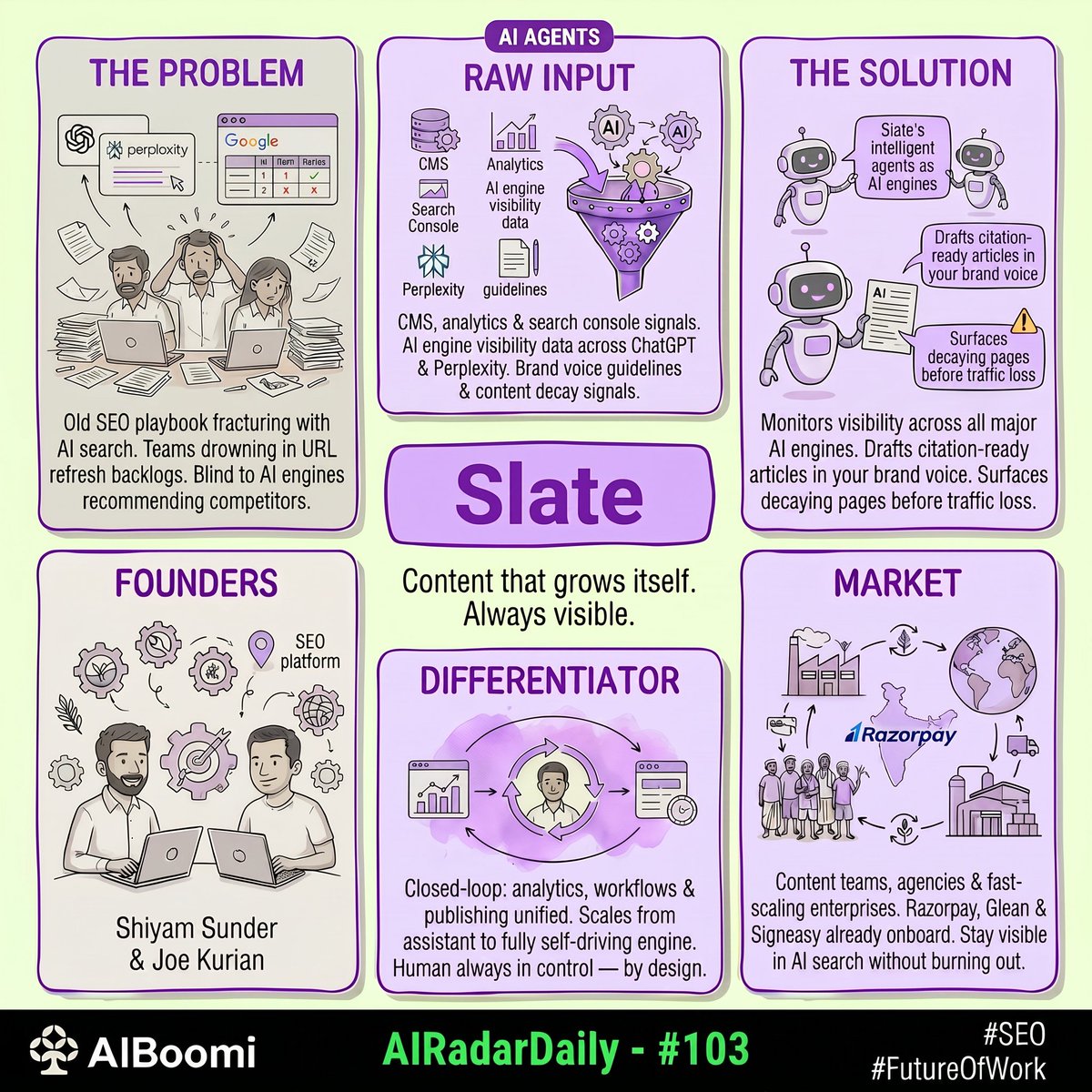
#103: #AIRadarDaily — Slate We all know the old organic growth playbook is fracturing. For years, the job was hard but predictable: research keywords, write, publish, and climb the rankings. Now, with discovery shifting across ChatGPT, Perplexity, and Gemini, the manual work of keeping thousands of URLs fresh has become genuinely unbearable. We are watching talented teams drown in an anxious backlog, relying on generic AI tools that are fast but off-brand, or dashboards that track Google ranks while remaining completely blind to the AI engines recommending their competitors. It takes a deep, structural understanding of this pain, and a rare kind of courage to build a system that restores calm. That is exactly what Shiyam Sunder and Joe Kurian (@joethekurian) are doing with Slate. With Slate, Shiyam and Joe are building a deeply thoughtful, autonomous content engineering platform that unifies writing, refreshing, interlinking, and publishing into a single fluid system. The engineering under the hood is beautiful in its clarity. Slate connects directly to your CMS, analytics, and search console, and then quietly goes to work. It deploys intelligent agents that monitor your visibility across every major AI engine, draft citation-ready articles perfectly aligned with your brand voice, and automatically surface exactly which pages are decaying before they lose traffic. You preview, approve, and push live — with zero developer handoffs required. The true moat here is its closed-loop intelligence combined with a profound respect for the people doing the work. Slate scales gracefully from a point-and-execute assistant to a fully self-driving engine where analytics, workflows, and publishing run on a seamless schedule. Yet, it deliberately keeps a human in the middle by design. It doesn't replace the marketer with another chaotic dashboard; it acts as a tireless, intelligent co-worker, ensuring the team always stays in control of its own narrative. The market? Content teams, marketing agencies, and fast-scaling enterprises — from Razorpay to Glean to Signeasy — who are desperate to stay visible in the new era of AI search without burning out. Seeing founders of this caliber head-down, architecting the infrastructure that lets teams grow with clarity instead of chaos, is a wonderful reminder of the larger, unfinished agenda we are all part of. Shiyam and Joe are true change agents, gracefully giving content teams their momentum back. Let's celebrate the builders. w/ @jaybharatingle & @dikshantjoshi #SEO #FutureOfWork #ProductNation
Avinash Raghava 🇮🇳 tweet media
English
0
0
4
313
Avinash Raghava 🇮🇳
Avinash Raghava 🇮🇳@avinashraghava·
#102: #AIRadarDaily@refoldai We’ve all seen it happen. A brilliant engineering team sets out to build a category-defining product, only to get bogged down in the endless, fragile plumbing of enterprise integrations. Writing custom logic, wrestling with unpredictable APIs, and constantly patching broken middleware isn't just a technical headache — it is a massive, exhausting drain on a company's most creative talent. We hire engineers to build the future, yet we force them to spend their days maintaining the pipes. It takes a deep, structural understanding of this pain and the courage to rethink the entire paradigm to change it. That is precisely what Jugal Anchalia (@Bonjugal) and Abhishek Kumar (@ak_blurb) are doing with Refold AI. With Refold, Jugal and Abhishek aren’t just launching another integration tool. They are fundamentally replacing traditional middleware with a highly intelligent, AI-native platform. The engineering under the hood is transformative. Instead of relying on manual coding and rigid workflows, Refold deploys autonomous AI agents that actually understand system behavior. These agents take on the heavy lifting — learning how different software systems interact, generating complex integration logic, mapping data, and even writing test cases entirely without boilerplate code. The true moat here is resilience and adaptability. Through advanced memory graphs and real-time adaptation, Refold’s agents don't just build integrations; they maintain them. When a third-party API changes or an unpredictable edge case arises, the system autonomously adapts and auto-fixes the workflow. It shifts enterprise integration from a fragile, static dependency into a dynamic, self-healing architecture. The market? Global enterprises, CTOs, and development teams desperate to escape the high costs and friction of system connectivity. By abstracting away the complexity of legacy systems, Refold gives engineering teams their momentum back, allowing them to focus entirely on core product innovation. Seeing these head-down builders architect such an elegant, autonomous solution to one of software's oldest and most stubborn bottlenecks is a powerful signal. They are quietly rewriting the playbook for how enterprise software actually communicates. Let's celebrate the builders. w/ @jaybharatingle & @dikshantjoshi #EnterpriseAI #DevTools #ProductNation
Avinash Raghava 🇮🇳 tweet media
English
2
2
11
550
Avinash Raghava 🇮🇳
Avinash Raghava 🇮🇳@avinashraghava·
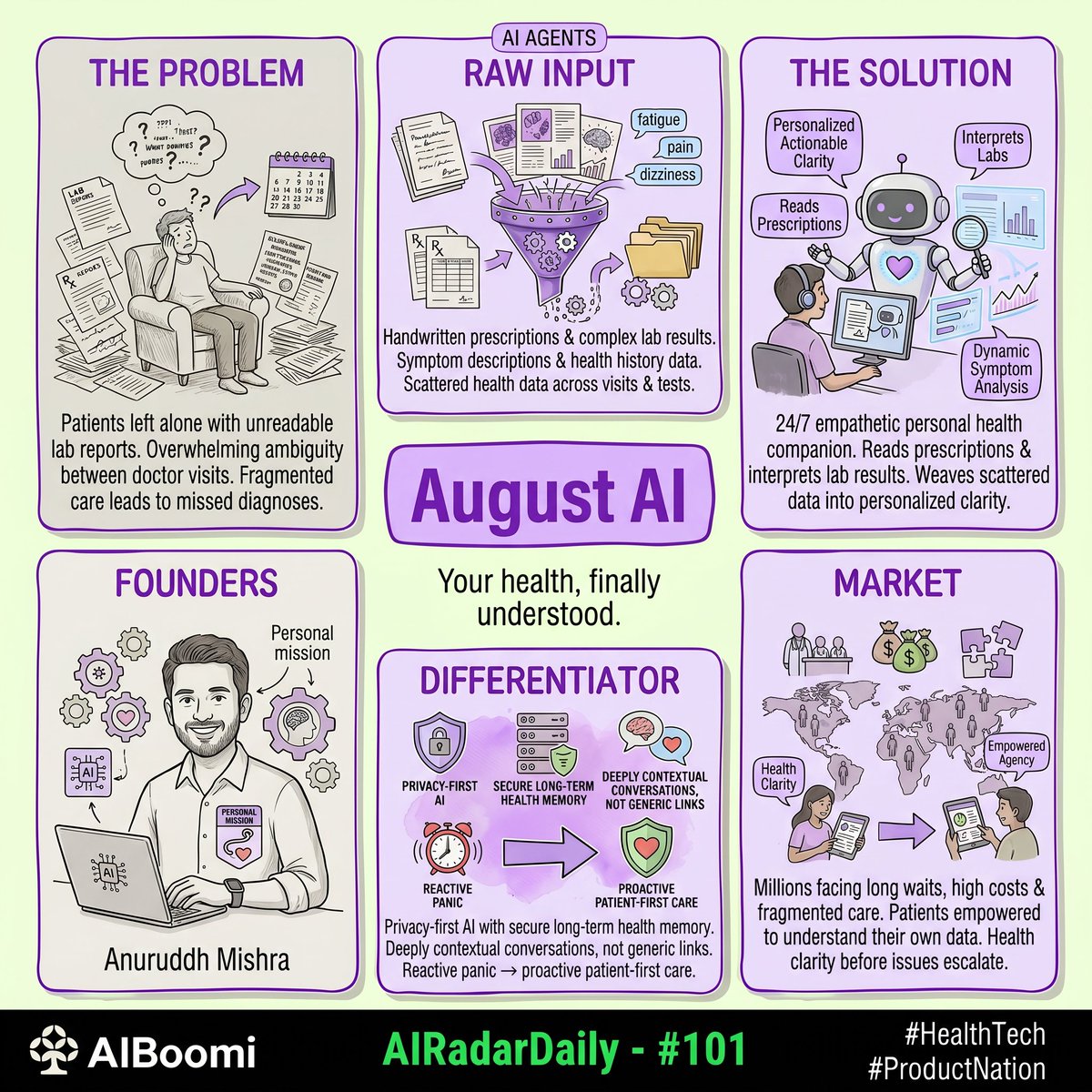
#101: #AIRadarDaily@meetaugustai We’ve all felt it. The quiet panic of waiting for a doctor’s appointment, staring at a stack of unreadable lab reports and complex prescriptions. Healthcare today is a marvel of science, yet the actual patient experience is often defined by overwhelming ambiguity and a chaotic silence between visits. When the system is overloaded, patients are inevitably left to piece things together alone. It takes profound empathy and courage to look at this fragmented reality and decide to build a bridge. That is exactly what Anuruddh Mishra have done with August AI. For Anuruddh, the mission was deeply personal — born out of a painful four-month misdiagnosis where, despite access to doctors and endless tests, the answers just didn't add up. It took his own exhaustive deep-dive into his health data to uncover a simple nutritional imbalance. He realized the system hadn’t failed maliciously; it was simply too rushed and too disconnected to connect the dots. With August AI, Anuruddh and team aren’t just building another static symptom checker. They are building a 24/7, highly empathetic personal health companion. The underlying engineering is beautifully intentional. August operates as an intelligent, conversational agent that securely reads handwritten prescriptions, interprets complex lab results, and analyzes symptoms dynamically. Powered by robust, privacy-first AI models, it builds a secure, long-term memory of a user's health journey. It doesn't just spit out generic WebMD links; it acts as the intelligent thread that weaves scattered health data into actionable, personalized clarity. The true moat here is trust and interactivity. August outperforms traditional healthcare bots by engaging in deeply contextual conversations — listening, reasoning, and providing reassurance when people are at their most vulnerable. It brings the precision of world-class medical data to the warmth of an always-on companion. The market? The millions of individuals globally who face long wait times, high costs, and fragmented care, who desperately need immediate, accurate insights before a health issue escalates. By giving patients the agency to understand their own data, August AI is shifting the paradigm from reactive panic to proactive, patient-first care. Seeing these head-down builders apply advanced AI not just for enterprise efficiency, but as a deeply empathetic force in human lives, is a beautiful signal of where our ecosystem is heading. Let's celebrate the builders. w/ @jaybharatingle & @dikshantjoshi #HealthTech #ProductNation
Avinash Raghava 🇮🇳 tweet media
English
2
1
3
351
Avinash Raghava 🇮🇳
Avinash Raghava 🇮🇳@avinashraghava·
When we paused #AIRadarDaily after covering the first 100 startups, something interesting happened. Many of you reached out asking why we had stopped. Founders wrote in asking how they could be featured. Others shared that the series had become one of their favourite ways to discover AI-native startups emerging from India. That was both humbling and reassuring. Because it meant the series had become more than a daily post. It had become a living archive of a fast-changing ecosystem. The radar never really stopped. It just kept finding more stories worth telling. So, starting tomorrow, we're back! Back to telling the stories of the next 100 AI-native startups from India. At @AIBoomi, we've always believed that communities exist to do more than celebrate success. They exist to create the conditions for it. Sometimes, that starts with something as simple as helping a great founder get discovered. If you're building something meaningful, or know a founder who is, we'd love to hear from you. Write to us at airadar@aiboomi.org. Here's to the next 100 stories, the next 100 founders, and the next chapter of India's AI journey. The radar stays on.
GIF
English
1
1
5
565
Avinash Raghava 🇮🇳 retweetledi
AIBoomi (formerly SaaSBoomi)
Here's yet another glimpse into the room we're bringing together for AIBoomi Bootcamp '26 | Hyderabad. 💜 Over the last few weeks, we've introduced founders from across industries, stages, and journeys. Different companies, different problems, and different perspectives. But one shared willingness to learn, build, and figure things out together. Applications are now closed, and we're officially at a full house. See you in #Hyderabad. 🙌 #Startups #AI
AIBoomi (formerly SaaSBoomi) tweet media
English
0
1
6
458
Avinash Raghava 🇮🇳
Avinash Raghava 🇮🇳@avinashraghava·
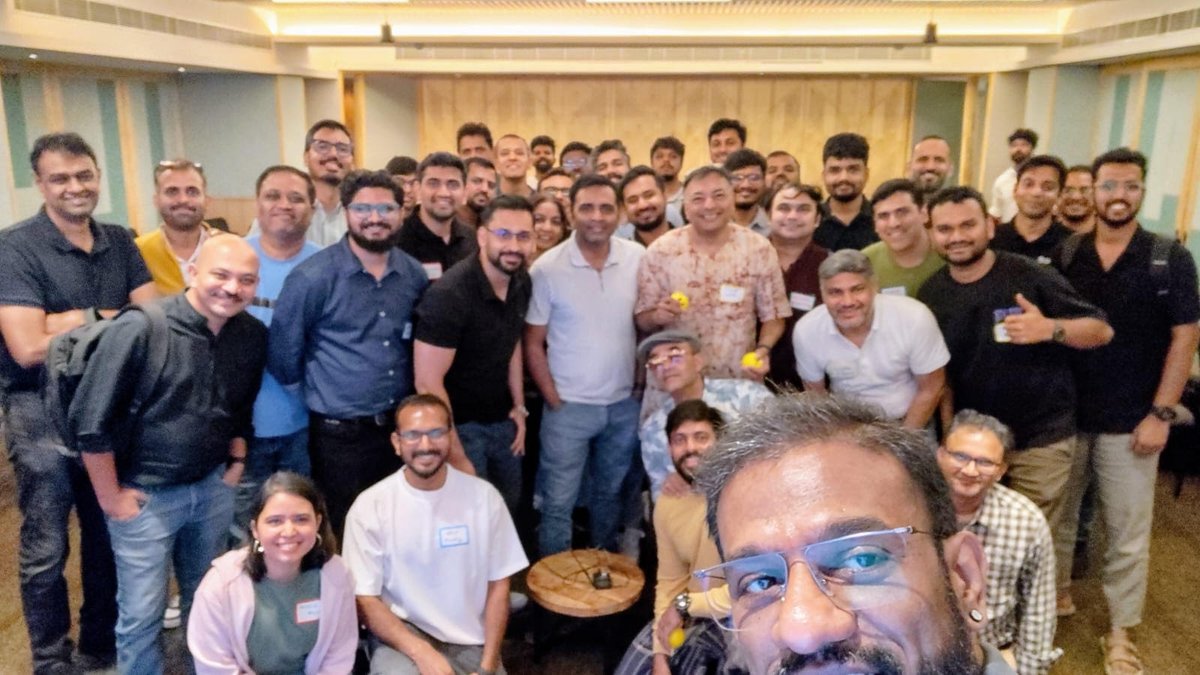
Spent Saturday in a room full of founders who didn't take a single note they'll forget by Monday. We ran the #AIWarRoom at @AccelIndia Launchpad, Koramangala, a hands-on GTM workshop for AI-native founders, under @AIBoomi. No keynote. No slides. Laptops open, building live. 70+ founders. One practitioner i.e. Rakesh Patel of Space-O. Building real go-to-market tooling on Claude Code while the room built alongside him. A few things stayed with me. Realisation #1: AI has collapsed the cost of building and marketing. The only edge left is focus and depth. Almost everyone can ship product now. So the moat moves. It's no longer headcount or capital — it's judgment, and the willingness to go deep where others stay shallow. As Rakesh put it: garbage in, garbage out. Your output is only as good as the context you're willing to do the work to give it. Realisation #2: Getting cited now beats getting ranked. The old game was being found. The new one is being the answer the AI hands the customer — already pre-sold, before they ever land on you. The founders who internalised this stopped thinking about traffic and started thinking about trust. That's a different kind of GTM. Realisation #3: The gap is the opportunity. Most people won't do the slow, detailed, unglamorous work. They'll watch a demo and move on. The founders who stayed back, asked the hard questions, and rebuilt the tool for their own product — those are the ones who'll pull ahead. Capability is mostly a ceiling we set in our own heads. Here's what moved me most. Watching founders walk in as spectators and walk out as operators — with something that actually works, not a folder of screenshots. The feedback was the same line, over and over: do this again. More often. So we are. We're turning this into a series of GTM hackathons. Founders come in, build live, and here's the part that makes it ours — whatever each founder builds is open to the entire room. One person's GTM weapon becomes everyone's. That's the pay-it-forward bet, applied to building. Next stops: Chennai and Pune. If you're a founder in either city, keep an eye out. We'd love to have you in the room. This is the direction for AIBoomi — smaller rooms, sharper focus, higher frequency. Closer to where founders actually are. India's builders already ship fastest. Time we got found fastest too. Grateful to Rakesh for giving the real version, not the highlight reel. To Accel Launchpad for the room and for Rohith Veerajappa for running the whole show. And to every founder who applied, showed up, and stayed back long after we wrapped. Community building is hard work some days. Days like this one are the answer to why. Back to building.
Avinash Raghava 🇮🇳 tweet media
English
7
1
17
1.1K
Avinash Raghava 🇮🇳
Avinash Raghava 🇮🇳@avinashraghava·
~140 days ago, I started a small experiment. Every morning, my team and I would sit down and write about one AI-native startup from India. No rankings, awards, fundraising filters, or popularity contests. Just founders building. Yesterday, we completed 100 profiles. When I look back, I realize the startups themselves were only part of the story. The bigger story was the shift happening underneath. Over these weeks and months, I had a front-row seat to how founders across India are thinking about the future. A few years ago, conversations were centred around market size, pricing models, GTM motions, and growth curves. Those conversations still matter. But increasingly, I found founders wrestling with a different set of questions. What does software look like when intelligence becomes abundant? What happens when products can reason, decide, and act? What gets rebuilt when AI is not an add-on, but the foundation? Across 100 companies, I saw different answers. But there was one common thread. The most compelling founders weren't fascinated by AI for its own sake. They were obsessed with solving important problems. The technology was powerful, but the customer problem remained at the centre of everything. That gave me confidence. Not because India has access to AI. Everyone does. What stood out was the quality of thinking. The willingness to go deep into a problem. The ambition to build globally relevant companies. And the quiet conviction that meaningful innovation can emerge from anywhere. Many of the founders we featured are still relatively unknown. They aren't dominating social feeds or speaking at every conference. Yet day after day, they kept appearing on our radar. Building. Shipping. Learning. Iterating. Moving forward without waiting for attention or validation. At @AIBoomi, #AIRadarDaily was never a content initiative. We didn't do it for reach, impressions, or engagement. We did it because communities have a responsibility to shine a light beyond the obvious. To help exceptional founders become visible before the market discovers them and to document an ecosystem while it is still being shaped. The image below contains the logos of the first 100 startups we've featured. When I look at it, I don't see a collection of companies. I see founder journeys, conviction, resilience, and teams choosing to build at a moment when the rules of technology are being rewritten in real time. We're briefly pausing this initiative here. Not because the stories have run out, but because we've accomplished what we set out to do. If these 140 days taught me anything, it's that India's AI story is still in its earliest chapters. The energy is real. The talent is undeniable. And the most interesting companies are probably being built right now, far away from the spotlight. My special thanks to @jaybharatingle and @dikshantjoshi, whose relentless support made this possible. I'm deeply grateful. The radar stays on. #Startups #AI #ProductNation
Avinash Raghava 🇮🇳 tweet media
English
4
10
30
1.9K