@JakeMGrumbach calling a paper "garbage" is bad form even if you do understand it imo. research is hard
English
Adam Visokay
2.5K posts

@avisokay
phd student @UW and @MPIDRnews affiliate || AI/ML - networks - sociology of science and tech | model multiplicity | former @UVA @MaxwellSU @sciencespo | runner

@PippengerHarlo The paper said that a city’s low population growth automatically meant it had low demand, suggesting there is little demand to live in…San Francisco It’s garbage, which of course you love to munch on



@davidPinAZ @JakeMGrumbach Congress makes laws on how USAID spends our money? Show me where Congress signed a law allocating billions to the Taliban. And, if so, then they’re corrupt too.


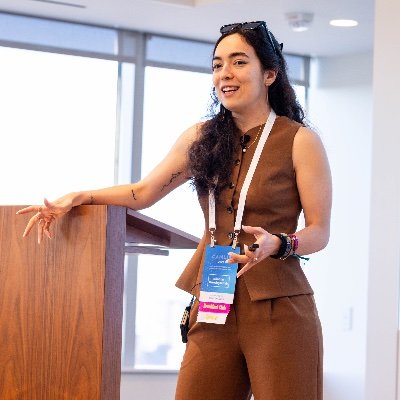



New year --> new adventures! Next quarter @StanfordGSB I’m thrilled to be teaching a PhD seminar on “Theoretical Computational Social Science.” We will explore the possibility of shifting away from a methods-based definition of CSS to one grounded in a unifying theoretical inquiry - the nature of social computation and organization – drawing from analytic sociology, cognitive science, and economics. We will discuss not only how computational theory can provide new ways of understanding social systems as computational systems, but also how social systems can provide new ways of understanding the nature of computation itself, both foundationally and in its current applications via AI and LLMs. I am profoundly honored to have the opportunity to explore this topic with the next generation of CSS scholars, and I am eager to learn from the students and the broader CSS community as this adventure unfolds. Please reach out if you’re interested in seeing the full syllabus.
Machine Learning is not just (glorified) statistics! Sure, in its most basic form, ML doesn't seem that far removed from fancy statistics... But ML is its own thing! Steve Brunton, @eigensteve of the University of Washington, in his fabulous short lecture series on probability and statistics (look for it on YouTube), gives these clear-eyed definitions: Probability: Assuming you have a known probability distribution that describes your data (say, a Gaussian), probability theory allows you to say something about samples of data you might observe in the future. So, one can calculate the probability that a random variable, X, takes on some value, given the parameter theta that describes the probability distribution (theta for a gaussian would be the mean and variance). Statistics: It's the flip side of the above. Now, we have in hand the data or samples. We are trying to say something about the probability distribution that best models the data; or given the data we want to say something about the probability of the parameter theta of the distribution Machine Learning / Deep Learning: Sometimes, we have the data, but the underlying distribution is unknown, or impossible to characterize analytically, using parameters specified by some theta. ML is used to learn the (empirical) distribution by examining the data. This is the point at which someone will say, but, that is just statistics! Here's why it's not: Take the problem of learning the probability distribution over the millions of images of the natural world. And not just that: once you have learned the distribution, you have to sample from it, and generate new data that looks like an image from the original dataset. Try doing this with standard statistical methods in some tractable way. It's near impossible. But diffusion models, heavily influenced by the physics of non-equilibrium thermodynamics, do exactly that. That's deep learning at its best. Also, take large language models (LLMs). Of course, LLMs learn the statistics of human written language from an enormous corpus of training data, and generate new text by estimating and then sampling from conditional probability distributions, given some input text. Again, while it sounds like it's just statistics, standard statistical methods could not pull off what an LLM can. The chapter on probability and statistics in WHY MACHINES LEARN was one of the most difficult to write (it involved getting across the basics of two large fields of math and tying them to ML, all in the space of 30 pages). Nearly killed me. But it was also one of the most satisfying chapters to write, not least because I got to understand so much while trying to make sense of these issues. More here: US: penguinrandomhouse.com/books/677608/w… UK: penguin.co.uk/books/446849/w…


Announcing the NeurIPS 2024 Best Paper Awards: blog.neurips.cc/2024/12/10/ann…