Andy Wells

1.2K posts

Andy Wells banner
Andy Wells

Andy Wells

@awells10000

Chief Investment Officer, SanJac Alpha LP; Bonds; Macroeconomics; Rates; Statistics; Convexity; Ⲁ; Exuma; Baseball

Houston, TX Katılım Mart 2012
1K Takip Edilen937 Takipçiler
Andy Wells
Andy Wells@awells10000·
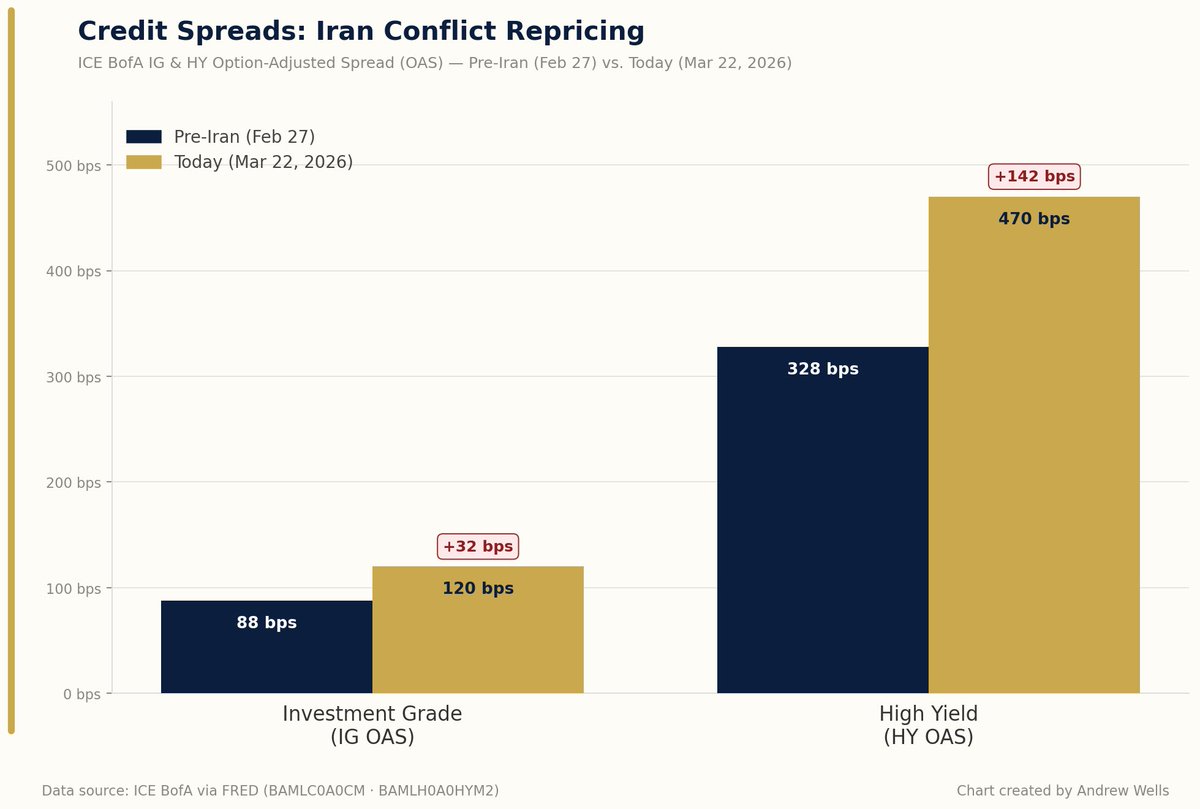
𝗖𝗥𝗘𝗗𝗜𝗧 𝗦𝗣𝗥𝗘𝗔𝗗𝗦: 𝗜𝗿𝗮𝗻 𝗖𝗼𝗻𝗳𝗹𝗶𝗰𝗧 𝗥𝗲𝗽𝗿𝗶𝗰𝗶𝗻𝗴 📊 Credit markets are finally starting to price what the geopolitical calendar has been screaming for three weeks. Investment-grade spreads (OAS) have widened from 88 bps to 120 bps since the Iran conflict broke out February 28, a 36% move in less than four weeks. High yield has been hit harder; HY OAS has surged from roughly 328 bps to 470 bps, a 142 bp move that reflects genuine risk-off repositioning, not a blip. Here is the structural problem. Credit spreads typically widen during geopolitical stress, then recover when the shock fades and the Fed provides cover. That second part is not available this time. The Fed cannot ease into an energy-driven inflation spike. There is no policy backstop for spread widening when the same conflict generating fear is also generating CPI pressure. The spread-compression trade that worked in every prior geopolitical episode since 2001 relies on a rate cut that is not coming. Add a refinancing wall, where billions in corporate debt locked in at 3 to 4% is now rolling over at 6 to 7%, and the fundamental case for tight spreads starts to erode. IG at 120 bps is wider than January but still historically tight. It is not pricing a hard landing. HY at 470 bps is getting there. The question is not whether spreads widen further. It is whether the pace matters before the Fed blinks. #FixedIncome #CreditMarkets #MacroViews #BondMarket #CreditSpreads
Andy Wells tweet media
English
0
0
0
18
Andy Wells
Andy Wells@awells10000·
@LeylaKuni Fantastic! Though I would hate to see this video marked to market😅
English
1
0
1
315
Leyla
Leyla@LeylaKuni·
Blackstone: "Let's do some cringey holiday videos to appeal to retail investors" KKR: "hold my beer"
English
58
36
469
318.4K
Andy Wells
Andy Wells@awells10000·
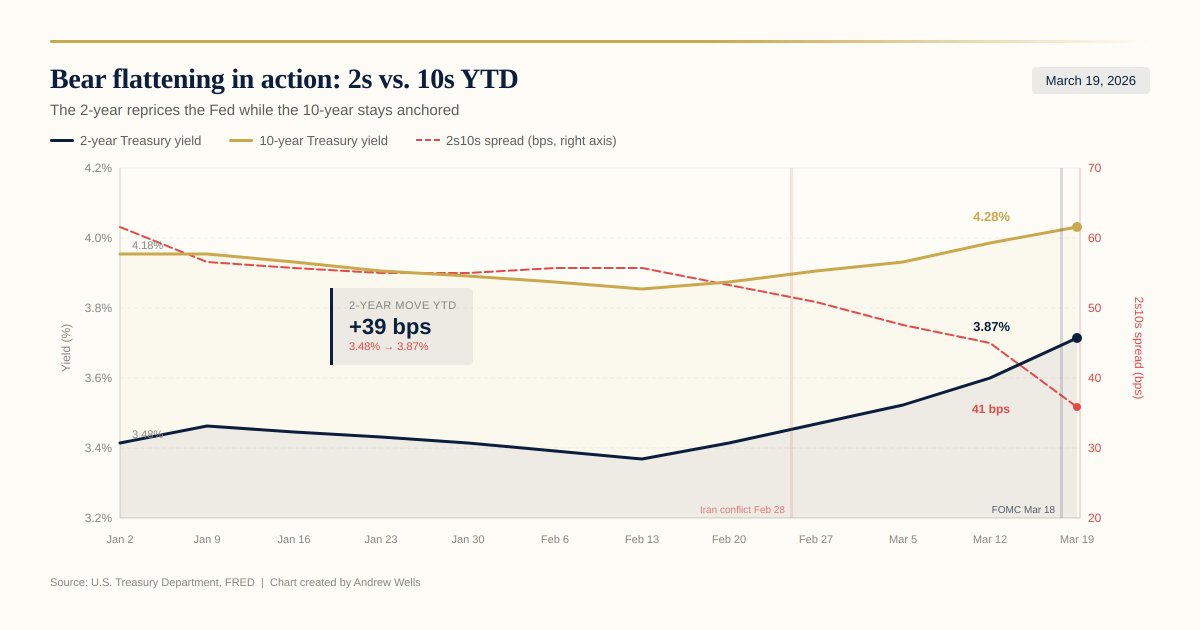
📊 The 2-year Treasury just jumped 6 bps to 3.87% today. It's up nearly 40 bps since early January. The 10-year? Up about 10 bps over the same period. That's not a coincidence, it's a signal. BEAR FLATTENING VS. BEAR STEEPENING: WHY THE DIFFERENCE MATTERS When the yield curve flattens because short-term rates rise faster than long-term rates, that's bear flattening. It's the bond market telling you the front end is repricing Fed policy, not growth expectations. Compare that to bear steepening, where long-term yields rise faster than the front end. Bear steepening says the market is worried about inflation or fiscal sustainability down the road while the Fed holds or cuts. Think term premium. Think supply. What we're seeing right now is textbook bear flattening. Coming into 2026, markets priced two rate cuts. Yesterday's dot plot made the shift official: the median still shows one cut, but the distribution moved meaningfully hawkish. Seven FOMC members now see zero cuts this year, up from six in December. Four or five members downgraded from two cuts to one. Powell put it plainly: inflation hasn't come down as much as the Fed had hoped. The 2-year is the part of the curve most tethered to Fed policy expectations, and it's absorbing the full brunt of that repricing. Meanwhile, the 10-year has been comparatively anchored, pulled in two directions: hotter inflation pushing yields up, slowing growth expectations pulling them down. For fixed income allocators, bear flattening compresses the carry advantage of extending duration. It narrows the reward for taking term risk. When the front end sells off this aggressively relative to the belly and the long end, it's telling you to be patient and disciplined with duration, not heroic. Bottom line: the 2-year prices the Fed. The 10-year prices everything else. Right now, the 2-year is saying expect no rate cuts until mid-2027. #FixedIncome #BondMarket #RatesStrategy #MacroViews #CreditMarkets
Andy Wells tweet media
English
0
0
0
32
Andy Wells
Andy Wells@awells10000·
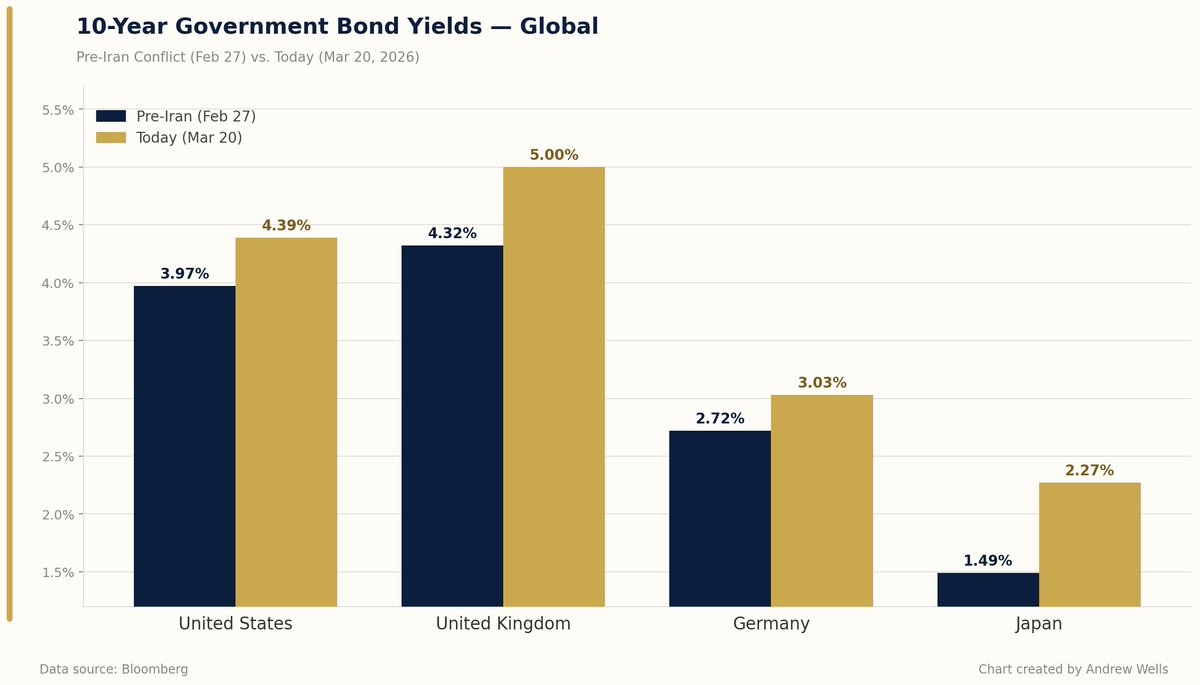
📊 For decades, the world could export inflation to someone else. Not this time. The US 10-year sits at 4.39% today, with the 30-year knocking on 4.95%. The UK 10-year gilt crossed 5.00% for the first time since 2008, up 68 basis points in just 15 trading sessions. Germany's Bund hit 3.03%, a 15-year high. Japan's JGB holds at 2.27%, with a BOJ board member dissenting toward a hike for the second straight meeting. Here is what makes this environment unusual. Geopolitical turmoil is normally a gift for duration. When risk rises, investors historically flee into long-term government bonds, yields fall, and fixed income acts as the portfolio ballast it was designed to be. That playbook is not working this time. The turmoil comes packaged with an energy shock, and the energy shock comes with inflation. Duration is not a safe haven when the catalyst for fear is also a catalyst for higher prices. There is no low-rate anchor anywhere in the G4. The US, UK, Europe, and Japan are all repricing simultaneously. The traditional cross-border escape valve, cheap money somewhere else absorbing the pressure, is closed. Higher for longer is not a Fed policy choice anymore. It may be the only available global equilibrium. #FixedIncome #GlobalRates #MacroViews #BondMarket #Inflation
Andy Wells tweet media
English
0
0
0
30
Polymarket
Polymarket@Polymarket·
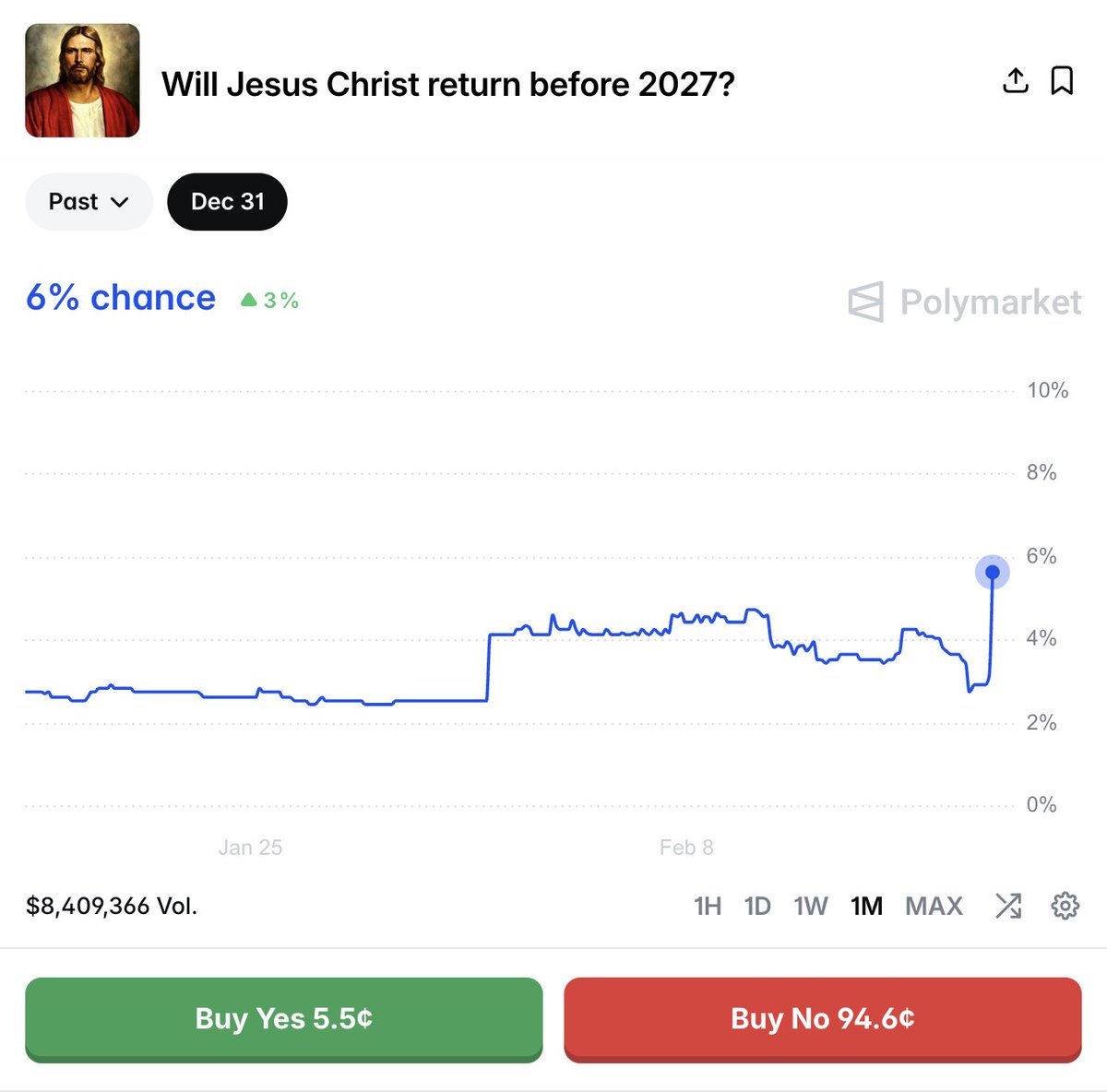
BREAKING: The odds of Jesus returning this year have doubled, reaching historic highs. 6% chance He returns.
Polymarket tweet media
English
661
299
3.5K
3.3M
Andy Wells retweetledi
ₕₐₘₚₜₒₙ
ₕₐₘₚₜₒₙ@hamptonism·
It finally happened, The Bloomberg Terminal just dropped its own LLM: Bloomberg just launched AskB<GO>, it’s very own in-house Ai agent. This chatbot assists users navigate massive, high-quality, and proprietary dataset that is extremely expensive and practically out of reach:
English
49
99
1.1K
217.7K
Andy Wells retweetledi
Dustin
Dustin@r0ck3t23·
Elon Musk thinks coding dies this year. Not evolves. Dies. By December, AI won’t need programming languages. It generates machine code directly. Binary optimized beyond anything human logic could produce. No translation. No compilation. Just pure execution. Musk: “You don’t even bother doing coding.” Code was never the point. It was friction. A tax we paid because machines didn’t speak human. AI just learned fluent human. The tax is gone. Now plug that into Neuralink. No syntax. No keyboard. No screen. Musk: “Imagination-to-software.” Thought becomes executable. You imagine an outcome, the system architects and compiles it into reality instantly. We’re not automating programming. We’re erasing it from existence. The entire profession collapses into a thought. Decades of training reduced to irrelevance. The gap between idea and instantiation hits zero. You don’t build anymore. You imagine, and it materializes. Not incremental progress. Total phase shift. The way humans have created things for ten thousand years just became obsolete. Welcome to a world where the limiting factor isn’t skill, resources, or time. It’s whether you can picture what you want clearly enough for a machine to birth it into existence.
English
2K
3K
15.9K
4M
The Capital Mind
The Capital Mind@Capital_Mind_·
@LynAldenContact The spread between "Conspiracy Theory" and "Breaking News" has compressed to zero. It is now just a settlement issue (T+6 Months). At this point, if Bigfoot walked into the FOMC meeting, I wouldn't panic, I'd just ask if he's hawkish or dovish.
The Capital Mind tweet media
English
5
6
126
9.8K
Lyn Alden
Lyn Alden@LynAldenContact·
The Epstein stuff is so bad that it basically gave all conspiracy theorists a pass for the next couple decades. They can say the craziest stuff and you have to be like, “yeah, maybe.”
GIF
English
383
1.1K
10.1K
360.3K
Andy Wells
Andy Wells@awells10000·
morningconsult.com/articles/the-d… Predictive markets aren’t niche anymore, they’re becoming a new information layer. I know people who now literally use predictive sites as their news feed. And why not? Information is being crowdsourced from efficient betting markets from thousands of real-time inputs. Predictive markets are here permanently and will likely only grow in liquidity and mainstream adoption. Remember we we all found the magic of ChatGPT a few years ago and now ask it what we should have for lunch? Now when we are having a conversation about whether this or that will happen we ask, "What does Polymarket say?" It's all about odds now, and the fact that the market is real-time and fairly efficient seemingly makes the information usable and trustworthy--seemingly. From a dystopian perspective, the least probable outcome (longest odds) on a bet also includes the greatest incentive to make it happen. Have improbable outcomes actually been engineered to occur based on a powerful trader bet? 🤔 Great article here by Morning Consult. No clear dominant force in this market yet, as sports betting and knowledge-based news betting have yet to converge. But they likely will. Who will win? #PredictionMarkets #MarketStructure #BehavioralEconomics #InformationMarkets #AlternativeData #RiskManagement #PriceDiscovery #FutureOfFinance #SportsBetting
English
0
0
0
57
Andy Wells
Andy Wells@awells10000·
Heading to #SFVegas2026, the can’t-miss event of the year. app.ingo.me/q/89car Join me in Las Vegas from February 22–25, 2026, to connect with over 10,000 structured finance leaders, attend engaging sessions, and explore exclusive industry insights. See you there!
English
0
0
0
39
Andy Wells retweetledi
Alexandra Semenova
Alexandra Semenova@alexandraandnyc·
wealth managers putting your money in an index fund
English
856
6.9K
113.5K
6.3M
Andy Wells
Andy Wells@awells10000·
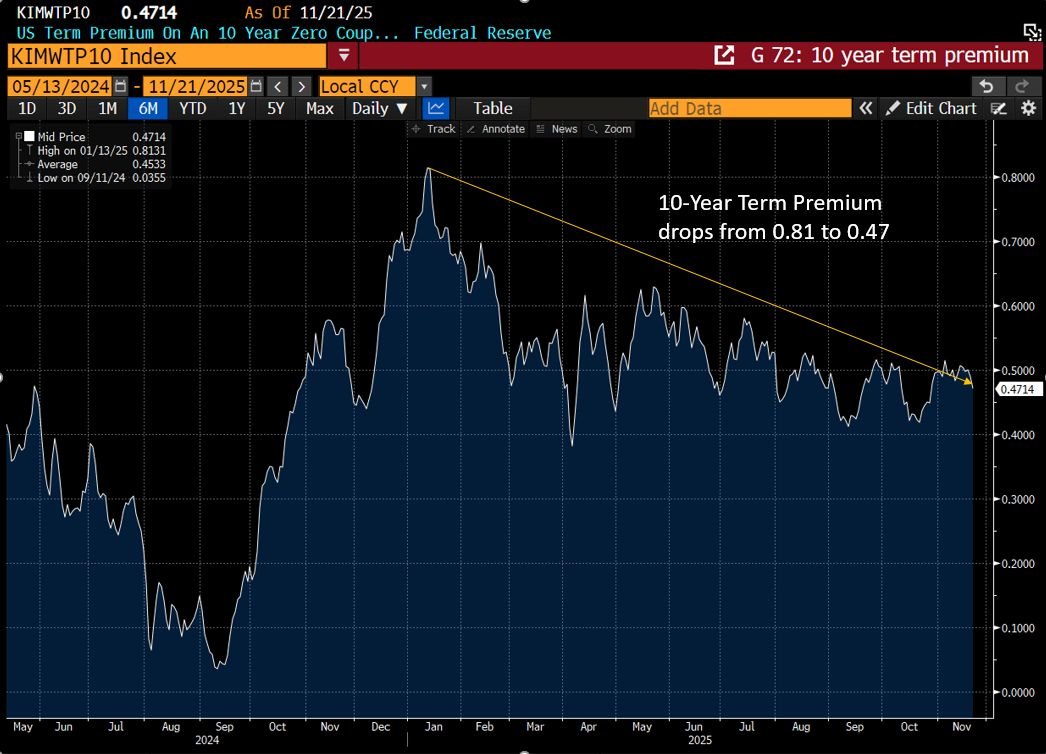
What is the collapse in term premium telling us? Historically term premium signals a market that is far more certain about the future than not. Hasn't 2025 been anything but certain? If we were predicting anything at the beginning of 2025 (and some of us were) it would be that term premium would rise, steepening the rate curve and capturing much of the uncertainty that the year would hold. Instead the opposite has happened, as term premium quietly rolled over, dropping from 0.81% in January to its current 0.47% Let's ask the questions, does the market feel: ▶ more confident about inflation's path? (breakevens are spot-on) ▶ less anxious about Fed missteps? (bonds agree with Fed moves) ▶ better about absorbing Treasury supply? (lower fiscal deficits) ▶ more willing to take risk from here? (equities and credit to the 🌛) Lower term premium effectively loosens financial conditions and stabilizes discount rates Equities and credit are supported, duration is attractive and there are fewer tail risks to be worried about. Is that what lower term premium is telling us? Or perhaps this a setup for the tail we don't see? #bonds #fixedincome #credit #macro #rates #fed #economy
Andy Wells tweet media
English
0
0
2
61
Andy Wells
Andy Wells@awells10000·
@SleeperAstros TBH the most realistic and solid add for the Astros would be a 2yr/30MM deal for Merrill Kelly; still hanging around 1.10-1.15 WHIP and eats innings. 18 quality starts in 2025 which is exactly what you want from a 2-3 guy.
English
0
0
3
115
SleeperAstros
SleeperAstros@SleeperAstros·
Here’s a look at what the cost of the pitching market will be like in the offseason: Framber Valdez - 6/190m Ranger Suarez - 6/164m Dylan Cease - 6/187m Michael King - 3/75m Zac Gallen - 5/135m Merrill Kelly - 2/30m Shane Bieber - 3/75m Pricey, pricey, pricey 😬
SleeperAstros tweet media
English
59
12
248
28.3K
Andy Wells
Andy Wells@awells10000·
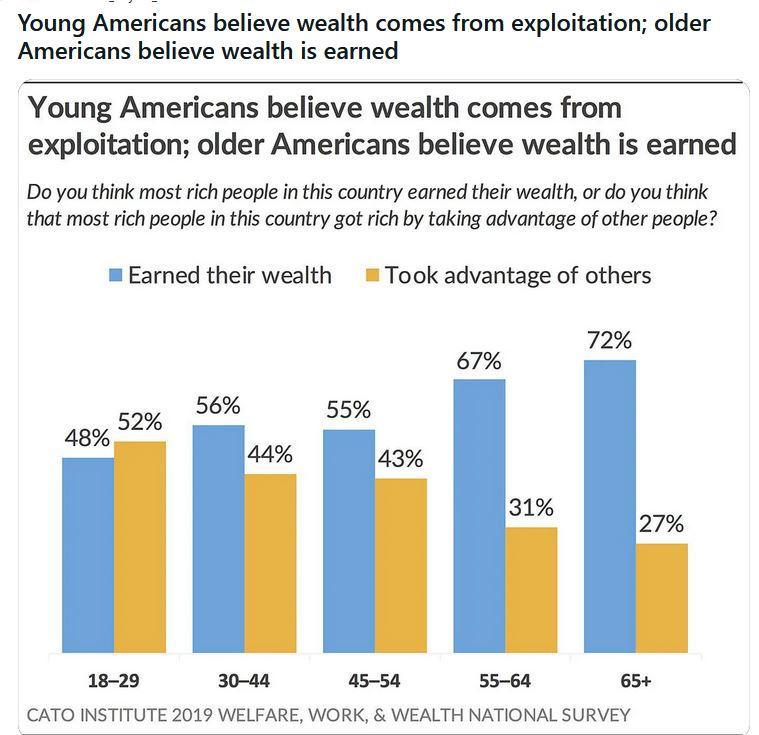
The Cato Institute poll is from 2019 and seems like a lifetime ago. Imagine taking this poll today in late 2025. Younger generations have ALWAYS thought there was something that felt unfair about the older generations having accumulated so much more wealth than their generation. I'm Gen-X and I remember having those thoughts. In reality, what we complained about was the simple math of time and compounding performing its magic. But when you're young, having near infinite time is something that seems more of a problem than a blessing. You can't wait to get to the good part where you have a pile of valuable assets. So the advice we were given is invest responsibly, buy some hard assets (a starter home maybe?) and you'll be fine. Post-2020 Gen-Z is staring at the same thing, but this time they have a legitimate beef. Where is their on-ramp to wealth building? Homes are out of reach both in price and in borrowing cost. By the way, the home historically is where a majority of Americans have held their long-term wealth. The stock market is at all-time highs, and margin accounts are all-time levered. Stock markets are at all-time highs and yet Gen-Z talks about the terrible economy. How can the S&P generate returns of 26% in 2023, 25% in 2024 and 17% to date in 2025 and the economy be terrible? Could it be because all of the money printing from 2021-22 caused a massive wealth inequality event through inflation in the real economy and enormous nominal stock market returns? Could it be that wages have not kept pace with asset growth? Could it be that the average American does not feel like they are exposed to the stock market boom yet overexposed to the highest inflation in decades? We are simply in a market cycle that rewards capital far more than labor. As Thomas Sowell says "there are no perfect solutions, only trade-offs". Is wealth inequality an existential problem today and if so, what trade-offs will we have to make to address it? #WealthInequality #Economy #GenerationalDivide #Stocks #Inflation
Andy Wells tweet media
English
0
0
2
42
Andy Wells retweetledi
Jim Bianco
Jim Bianco@biancoresearch·
1/5 Over the weekend I posted the thread below noting that liquidity was getting “worrisome.” On Thursday, SOFR was 4.30%, for a spread over IOR of 12 bps (the widest such spread since March 2020, not shown). (All this is explained in the reposted thread.)
Jim Bianco@biancoresearch

1/6 Are Banks Having a Liquidity Problem? tl:dr, Liquidity in the plumbing of the financial system is getting scarce. It is not a crisis now, but it has been moving in this direction for weeks, and it is now at a worrisome point. When the financial plumbing gets stressed, it is when bad loans (aka "cockroaches") get noticed. (long thread, tried to write it so "normies" can follow.) --- Wall Street is famous for diagnosing symptoms, not causes. I believe they are doing this again with the banking issues of the last few days., I do not think this is a "cockroach" problem (bad credit/loans) waiting to get disclosed publicly. It is a liquidity problem that makes the "cockroaches" matter. Banks (all 4,000+) hand out a trillion in loans. So, they will always have "cockroaches." So, it is not an issue of whether cockroaches exist; they always do. Instead, it is the environment in which such disclosures are made. Does the market care or not? Now it cares. Why? --- @NickTimiraos said below: How to define "temporary" and "modest." Repo rates in the last two days have moved up to the top of the fed-funds range and around 10 bps above IORB, but it's only been two days. --- I would argue it has not "only" been two days; worsening liquidity in the funding market has been unfolding for weeks. It just got noticed in the last two days. This chart shows Secured Overnight Financing Rate, or SOFR (orange), and Interest on Reserves, or IOR (blue). The bottom panel shows the spread between these two, along with some metrics (dashed line = average, shaded area = standard deviation range). See the arrow; this spread (3-day average, so it is less noisy) has been tightening for weeks. This spread moved to positive territory in early September and has remained there for weeks. The last time it was positive for this long was in March 2020 (not shown).

English
16
62
293
110.4K