Asif Rahman

78 posts

Asif Rahman banner
Asif Rahman

Asif Rahman

@axrahman

All things private equity @brexHQ

New York, NY Katılım Şubat 2011
694 Takip Edilen147 Takipçiler
Asif Rahman
Asif Rahman@axrahman·
I’m calling it now: 2026 is going to be the year of operating leverage. It’s why I believe operator-heavy funds will outperform investor-only funds over the next cycle. For years, returns could be driven by: - Cheap leverage - Multiple expansion - Aggressive underwriting That environment masked a lot of operational gaps. But today, those crutches are gone. What’s become increasingly obvious, especially across mid-market and upper middle market portfolios, is how uneven operating benches actually are. Smaller funds often can’t afford deep operator teams. That’s understandable. But what’s more surprising is how much variation exists even at the mega-fund level. Some firms have Executives-in-Residence, functional experts in finance, procurement, HR, and GTM, and repeatable playbooks across portfolios. But others still rely on ad hoc help and expect management teams to “figure it out.” That difference shows up after the close. As hold periods extend and exit windows narrow, value creation itself is the job. And PE funds that internalize operating expertise compound advantages across every new acquisition. In 2026, the edge will come from knowing what to do once you close the deal.
Asif Rahman tweet media
English
0
0
2
11
Asif Rahman retweetledi
Pedro Franceschi
Pedro Franceschi@pedroh96·
I’m incredibly proud to share that @OpenAI chose Brex to power their global spend and financial operations. When you're building at the frontier of AI and scaling global teams and infrastructure at an unprecedented pace like OpenAI is, Finance can't be the thing that slows you down. You need spend visibility the moment it happens, controls that enforce themselves, and agentic workflows that eliminate the manual work so your team stays focused on driving the business forward. We were so impressed by OpenAI’s rigor in evaluating every solution in the market, and whether they align to the agentic future OpenAI is building. Their decision to run on Brex is a huge testament to our AI roadmap and vision for the future of Finance. We started @brexHQ around a simple idea: companies shouldn't have to choose between speed and control. There's no company in the world where that tradeoff matters more than OpenAI. We are honored to support them as they build the future. The best AI companies in the world, including OpenAI, Anthropic, Cursor, Vercel, Granola, Sierra, and Mercor choose Brex over every alternative for that exact reason. If you want to understand who’s truly building the future of AI in Finance, follow the customers you admire the most – not the hype.
English
22
20
378
61.8K
Asif Rahman
Asif Rahman@axrahman·
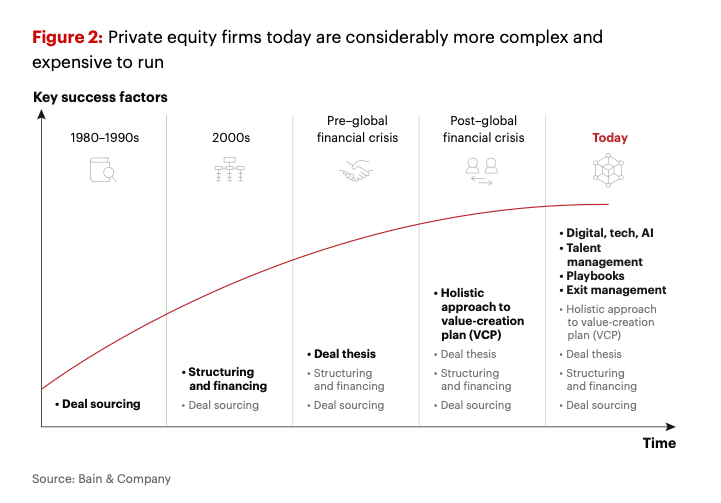
Bain's report shows private equity firms need 12% annual EBITDA growth to hit target returns, up from 5% a decade ago. This chart explains how you actually get there. In the 1980s, you could win in PE with deal sourcing alone. By the 2000s, add structuring and financing. Pre-financial crisis, add deal thesis. Post-crisis, add holistic value creation planning. Today, you need all of that plus digital infrastructure, AI deployment, talent management systems, proven playbooks, and sophisticated exit management. The complexity curve keeps going up. The cost of competing rises with it. Here's why this matters for the 12% requirement: You can't generate 12% annual EBITDA growth with incrementally better execution. I've seen a portfolio company cut month end close from 15 days to 3 by deploying AI powered finance automation in the first quarter post-acquisition. A financial review agent that flags out-of-policy spend and autonomously resolves 78% of expense cases. In the old days, operating partner teams consisted of ex-functional leaders like former CEOs and CFOs. As online channels became a major distribution channel, more go-to-market leaders started getting added to operating partner benches. In a world where 12% EBITDA growth is the baseline, CTOs are the next big addition to the operating partner bench in a far more meaningful way than they were before. Sending in a consultant to run a pricing study doesn't move the needle enough anymore. To hit 12%, you need to deploy AI, automation, and modern infrastructure at portfolio companies within 90 days of close. Not six months. Immediately. To move that fast, the best firms maintain a curated list of preferred tools and vendors they can deploy out of the box post-acquisition. And they have an in-house technical expert constantly evaluating new tools, adding capabilities, and swapping out legacy SaaS before it becomes dead weight. The firms winning from here are building operating teams with the technical depth to execute on Day 1.
Asif Rahman tweet media
English
0
0
0
35
Asif Rahman
Asif Rahman@axrahman·
In 2015, a typical PE deal needed 5% annual EBITDA growth to generate a 2.5x return over five years. Today, that same deal needs 12%. That's from Bain's Global PE Report, and it's not a typo. The required EBITDA growth to hit target returns more than doubled. Here's what changed: In 2015, you could borrow 50% of the purchase price at 6-7% rates. Entry multiples were climbing, so you could count on some multiple expansion at exit. 5% annual EBITDA growth got you there. Today, leverage is 30-40% of the deal. Rates are at 8-9%. Entry multiples are still near record highs, but they're flat. So now you need 12% annual EBITDA growth to generate the same 2.5x return over five years. You can see this hasn't sunk in yet. Average holding periods are now seven years, up from five to six. Distributions as a percentage of NAV have been below 15% for four straight years (an industry record). There are 32,000 unsold companies in portfolios worth $3.8 trillion. The old playbook assumed incremental improvements would work because cheap debt and rising multiples did half the work. The new playbook requires something different: 1. Full potential diligence on Day 1. 2. Operating teams that can actually execute instead of present. 3. Exit planning that starts at deal signing, not when you need liquidity. If you had another take on the report, drop it below and let's chat.
Asif Rahman tweet media
English
0
0
0
38
Asif Rahman
Asif Rahman@axrahman·
You can believe this, or the facts. Brex launched its PE channel from 0 to 1 less than a year ago and we’ve successfully closed well over $100 million and signed numerous partnerships with tier 1 funds. To be fair, this is true: Executing this play is much harder than simply “getting in the door” with one portfolio company. The deal often happens at the firm level. And when it does, PE firms don’t want to take a chance trying unproven products or hear a generic sales pitch. There has to be substance there. To have a chance at making the sell-through motion via PE successful, companies must deeply understand how PE investments work and bridge their product outcomes with quantifiable ROI. That means immense up front work, multiple meetings with multiple stakeholders, and a crystal clear definition of how your product or service generates more revenue or makes them more efficient. Simple, but not easy!
villi@villi

I often see founders thinking they can sell into private equity firms through which they can get access to their portfolio companies. It never works.

English
0
0
0
86
Fivos Aresti
Fivos Aresti@fivosaresti·
Companies are going to start paying GTM Engineers $150K+/year. They can do it all: 1. Set up email infrastructure 2. Build targeted lists 3. Enrich data from multiple sources 4. Score leads into tiers 5. Route leads to reps 6. Run automated outbound 7. Build awareness scores 8. Orchestrate inbound systems That said... I put together a full cheatsheet that covers the entire role from start to finish... • Strategy plays for warm, signal-based, and cold outreach. • Data aggregation across CRM, 1st party, 2nd party, 3rd party, and database sources. • Data enrichment workflows to filter, normalize, score, qualify, and segment. • Data activation across outbound, RevOps, content, and ads. Plus full outbound and inbound sales workflow breakdowns... KPIs for production, distribution, and conversion... And a curated book list to go deeper. Whether you're a GTM engineer, sales leader, or founder doing outbound yourself... This is the only reference guide you need. If you want it for free: Comment "GTME" And I'll send it over ASAP. PS - This cheat sheet includes 20+ tools, 8 book recommendations, and frameworks used by top GTM teams generating millions in pipeline.
Fivos Aresti tweet media
English
667
67
927
86.7K
Asif Rahman
Asif Rahman@axrahman·
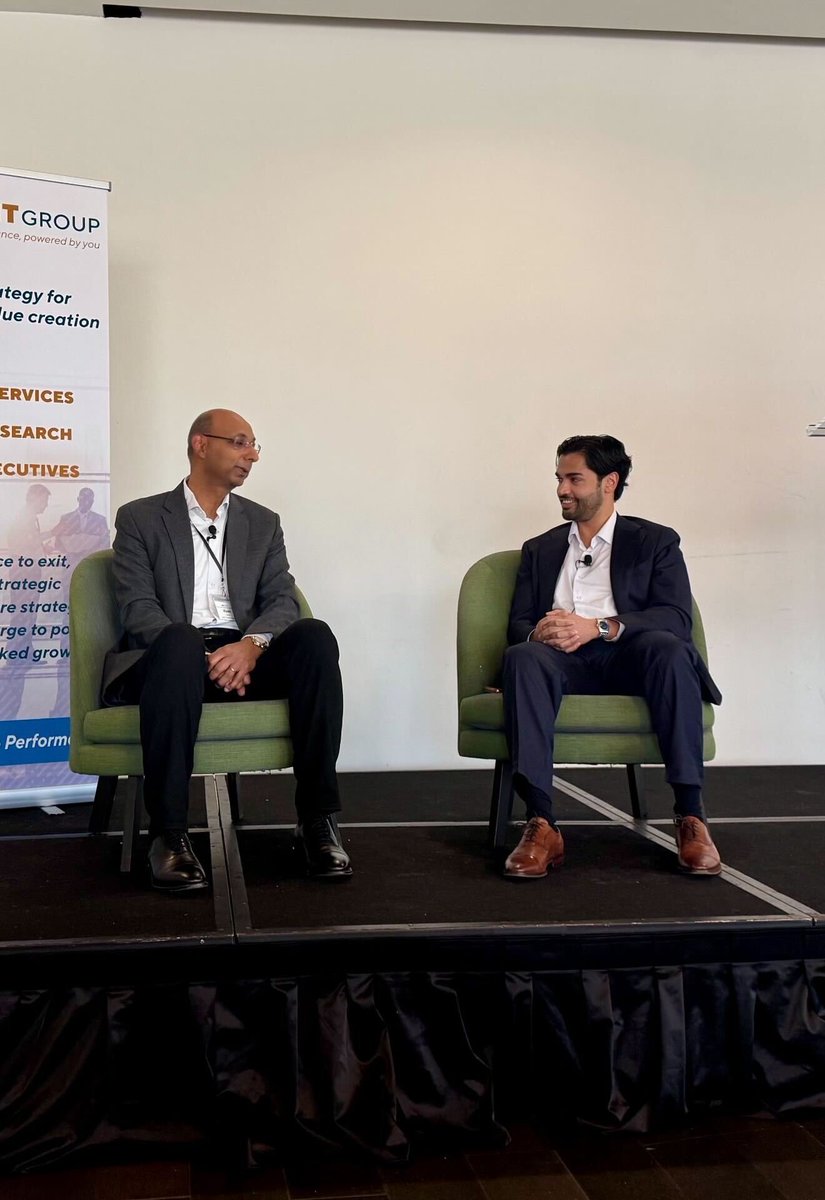
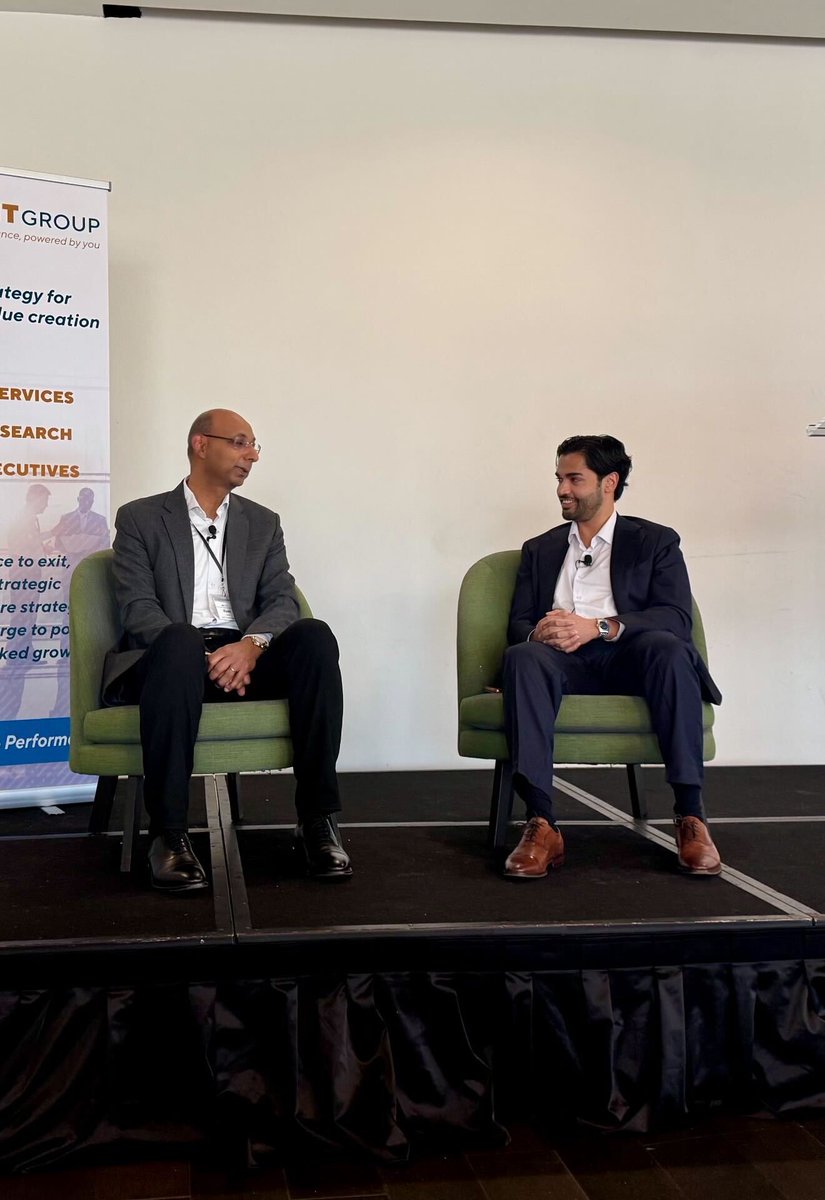
I moderated a fireside chat yesterday morning with Vivek Mohindra, Special Advisor to Dell's Vice Chair & COO and former Operating Partner at TPG, in front of a group of Austin-based PE operating partners, CFOs, and portfolio executives. One question I asked: what separates a disciplined AI value creation initiative from innovation theater? He answered that the companies extracting real value from AI share one thing: they tied every use case to their core business strategy first. The companies that don't run 800 unsanctioned projects simultaneously, burn resources, and conclude AI “has no ROI”. More than that, there are five things he sees working in practice: 1. Strategy first: AI use cases must connect to the specific levers that define your competitive edge 2. Data before tools: clean the data for your chosen use cases before deploying anything 3. Governance from the top: without CEO or COO buy-in, it fails every time 4. Leading indicators over lagging ones: track adoption rate and process automation % before you expect EBITDA impact 5. Board-level literacy: get someone on the board who actually understands AI, or you're flying blind The proof point from Dell's own journey: 18 months after starting, revenues grew and opex shrank resulting in over a 10% improvement in financials. My take: the gap between PE firms creating real value through AI and those still running pilots is widening fast. The ones winning aren't necessarily smarter, but are certainly more disciplined. Thanks to Vivek for a candid, practitioner-level conversation. And to PCG Private Capital Global for hosting - strong room, strong dialogue!
Asif Rahman tweet media
English
0
0
0
53
Asif Rahman
Asif Rahman@axrahman·
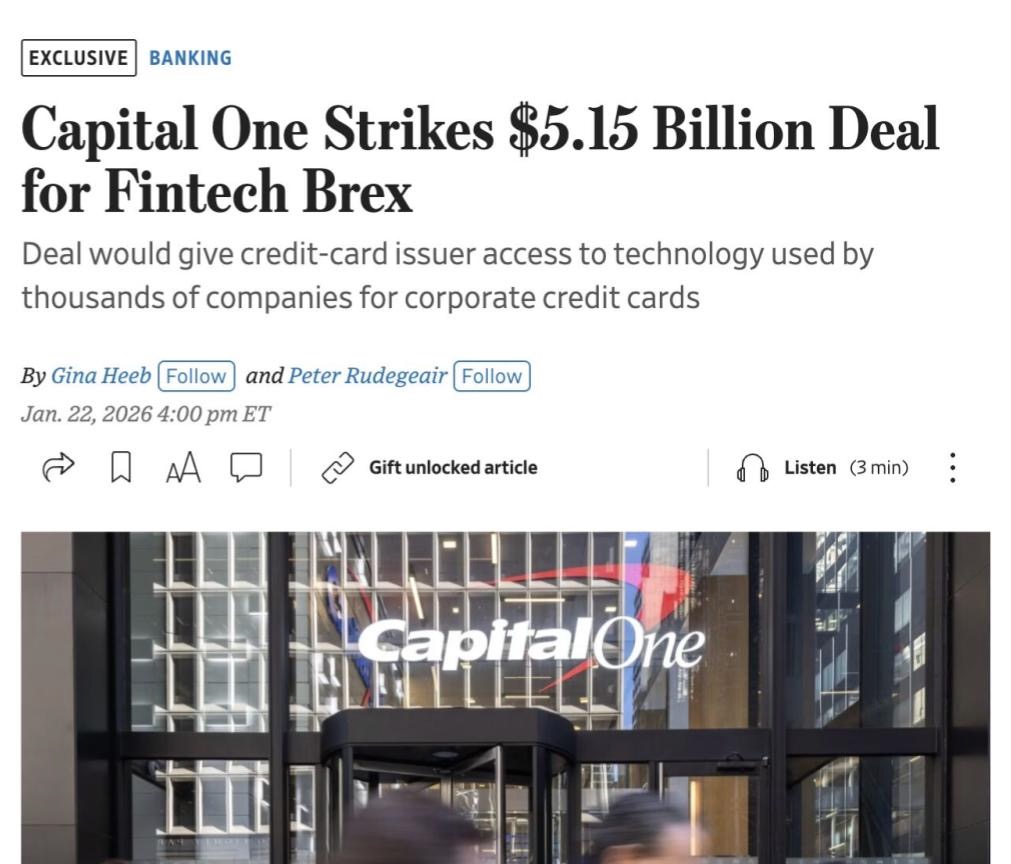
Two weeks ago, Brex and Capital One announced an agreement for Capital One to acquire Brex for $5.15 billion. This is the largest bank-fintech deal in recent history. I've spent the last two weeks thinking about what this means for the PE firms and portfolio companies I work with. The short answer is that everything just changed in terms of what's possible. Brex and Ramp combined had about 3% of the corporate card market. The real fight was never between us and other fintechs. It was always against American Express, JP Morgan and the big banks who control 90%+ of the market. We've been building great products, but we've been doing it with a fraction of their resources and balance sheet capacity. That constraint just disappeared. On day one, we become the #3 corporate card issuer in the US. We gain access to $700 billion in assets, a $6 billion R&D budget, and the ability to offer credit limits that are 10-20x higher than what we could do before. Our AI roadmap just accelerated by 2-3 years because we now have the infrastructure and capital to move faster than anyone else in the market. What makes this work is that Capital One understands how to acquire without destroying what made the company valuable in the first place – or as Pedro has repeated over the last two weeks, “don’t crush the butterfly.” They did this after acquiring ING Direct and they're doing it with us. Pedro stays as CEO, the team stays intact, the culture stays unchanged. Rich Fairbank built Capital One in the 90s by using data and technology to disrupt credit cards. He sees the same DNA in Brex. This isn't about cost cuts. It's about giving us the resources to win the market outright. For the PE firms I work with, this changes the equation significantly. You now get institutional-grade underwriting capacity with the product innovation and service model you've come to expect from us, all backed by a top-10 bank. Same team, same partnership approach, just with Fortune 50 resources behind every relationship. The future of corporate finance isn't American Express or JP Morgan with a better app. It's AI-powered corporate cards from the people who invented it, spend management, real-time compliance, and embedded banking built on infrastructure that can actually support it at scale. That's what we're building now, and we just got a 50x multiplier on our ability to execute. If you're a PE firm interested in how this impacts your portfolio companies, let's talk.
Asif Rahman tweet media
English
0
0
0
67
Asif Rahman
Asif Rahman@axrahman·
Annual planning across a PE portfolio comes down to one thing: Forcing trade-offs. When you have 20 portfolio companies, the process usually starts the same way. You look at last year’s EBITDA, then at this year’s target, and see how to bridge the gap between the 2. For example, if a company did $10M last year and needs to get to $12M, the real question to ask is, “Where do we get the $2M from?” Operators will break it down quickly into 3 categories: 1 - Revenue growth (realistic, not aspirational) 2 - Margin expansion (usually operational) 3 - Cost structure changes That’s where the hard conversations start. Common bridges tend to fall into a few buckets. - Automation - Headcount efficiency - Vendor renegotiation - Real estate optimization But the difference in 2026 is how those decisions are getting made. Because AI tooling is no longer a side experiment, it’s become a default lever. Especially in finance. Close cycles tend to be too slow, manual reconciliation is still common, and leaders are still flying blind on current data. So the best operators are past looking at AI as a potential solution. Their only concern is how AI removes friction immediately. Just goes to show how annual planning is more about discipline than ambition. The firms that treat it that way tend to compound faster.
English
0
0
0
26
Asif Rahman
Asif Rahman@axrahman·
Most PE value creation plans have great strategy. But they still fail because the first step never actually happens. On paper, the plans look perfect. - Revenue growth initiatives - Margin expansion targets - Tech modernization - Operational efficiency goals The deck is clean, and the investment committee signs off on it. But nothing really changes from that point on. And the problem is execution in the first 30-60 days after the deal closes. In theory, the plan is: 1 - Acquire the company 2 - Stablize operations 3 - Implement systems 4 - Drive efficiency 5 - Scale But in reality, step 2 never fully happens because the foundation isn’t stable and every improvement initiative becomes harder than it should be. I’ve seen teams try to roll out sophisticated reporting, automation, or performance management tools before they’ve even standardized how expenses are tracked or how cash moves through the business. My advice would be to start with something way more basic. Visibility. The best-performing PE operators I’ve worked with don’t rush to optimize. They’d rather focus on building a clean, reliable operational baseline. And once that foundation is in place, everything else moves faster. But without it, even the best value creation plan becomes a Powerpoint exercise.
English
0
0
1
41
Asif Rahman
Asif Rahman@axrahman·
“The hardest part of post-acquisition integration is choosing the right software” is the biggest misconception in PE. The hardest part is getting people to actually change how they work. Even if you invest in best-in-class tools, you can still struggle to move the needle because the org isn’t ready to migrate. When a company is acquired, especially founder-led businesses, you’re likely disrupting habits that have existed for years. In many cases: - The founder has approved every payment personally - The finance team has built workarounds instead of systems - Reporting lives in spreadsheets that only one person understands When a new owner suddenly says, “We’re standardizing everything” it sounds reasonable. But from the inside, it feels like absolute chaos. But if I’ve learned anything from my time in PE, change starts with sequencing and trust, not from introducing new software. The firms that are great at change management focus on 3 things early. 1 - Clarity - explaining why change is happening and what success looks like 2 - Pacing - taking their time and not ripping out every existing process all at the same time 3 - Support - giving teams the tools and time to adapt to the new processes Alignment is the key to change management. Speed is secondary.
English
0
0
1
33
Asif Rahman
Asif Rahman@axrahman·
Since launching our PE channel, I’ve had the privilege of connecting with over 100 firms (from the deal teams finding the alpha to the operating partners building it). The common thread among all of our conversations was that things are moving faster than ever and the real alpha is found in off-the-record, real conversations between peers. As such, I’m a big believer in bringing people together to talk about what they’re actually seeing on the ground. To that point, in past dinners, we were joined by VPs and leaders from Hellman & Friedman, @generalatlantic, and others for some incredibly sharp dialogue. Later this month, we’re hosting our next intimate PE dinner at Torrisi. We already have investors confirmed from firms like Kohlberg and AEA Investors. We have one spot potentially remaining, and I'd love to fill it with someone from the NY PE community who is passionate about the intersection of tech and value creation. If you’re interested in joining this or future sessions in our ongoing dinner series, please DM me or drop a comment below. (Preference for our existing Brex partners, but always looking to meet new leaders in the space). Looking forward to hosting this group in NYC. 🥂
Asif Rahman tweet media
English
0
0
0
31
Asif Rahman
Asif Rahman@axrahman·
A lot of people in private equity think moving into tech means you’ll finally get a “better lifestyle.” I’ll tell you the truth upfront. I work more now than I ever did in PE. But it’s less about hours and more about structure. In private equity, your entire workflow is designed around process. - Monday → review CIMs - Mid-week → modeling - Friday → IC prep - Diligence → checklist-driven - Decision-making → structured, repeatable, predictable It’s stable and controlled. But when you step into a startup, none of that exists. There’s no, “this is what your week looks like” or handbook for making decisions. Because you are the process. That’s a huge shock for people who make the jump. The skills that make you great at investing are not the skills that make you effective in a high-growth environment where speed trumps perfection. I’ve seen incredibly talented former investors struggle because they waited for clarity, direction, or structure. None of it showed up. I’ve seen others thrive because they embraced ambiguity, moved fast, and built their own scaffolding. Here’s the advice I’d give my younger self and anyone else thinking about making the transition: - If you need the comfort of predictable workflow, high growth tech will frustrate you. - If you need perfect information to make decisions, tech will overwhelm you. - If you need someone to tell you what to do, tech will eat you alive. But if you enjoy creating structure where there is none, and you can move before the data is perfect, then the jump is worth it. Tech will force you to grow in ways PE never will.
English
0
0
0
29
Asif Rahman
Asif Rahman@axrahman·
If you want to understand the operational health of a portfolio company, don’t start with the income statement. Start with the close process. A controller told me she spends an hour a day manually reconciling transactions. Can you imagine spending an hour a day analyzing thousands of transactions that inevitably cause little fires everywhere? Still, so many firms overlook it because they underestimate how damaging that is. But a slow close means: - Decisions made on outdated numbers - No real cash visibility - Inaccurate forecasting - Delayed value-creation initiatives - Inability to spot margin leakage early And more importantly, PE operators can’t steer what they can’t see. The firms I see moving fastest in today’s market all have the same operational foundation. - Spend visibility in real time - ERP + card + expense systems connected - Automated reconciliation - Financial hygiene across every entity - A close process measured in days, not weeks People treat that as a finance-team problem, but it’s not. I view it as a portfolio-execution problem. Because if you can’t trust your numbers until mid-month, you’re reacting to problems, not operating a thriving company. A 2 day close is strategic at its core. It gives PE teams the one advantage you can’t buy: Clarity.
English
0
0
0
29
Asif Rahman
Asif Rahman@axrahman·
A controller at a lower middle market told me she spends an hour a day manually reconciling transactions. Every single day. One hour a day. Five days a week. Fifty-two weeks a year. That’s ~260 hours of manual categorization annually. At a $120K salary, that’s ~$12,000/year of cost, and that’s just for the time spent reconciling. It doesn’t include: - The delayed close - The backlog of uncategorized spend - The lack of real-time reporting - The CFO “flying in the dark” - The opportunity cost of everything she didn’t have time to analyze That’s the hidden cost almost nobody models. And when diligence is rushed (and deals today are absolutely rushed) finance operations get overlooked. And before you know it, the controller becomes the only “integration platform” the business has. That’s not sustainable or scalable. And it certainly isn’t where finance talent should be spending its time. When books don’t close quickly, leadership makes decisions based on outdated numbers, partial data, and/or gut feel. And in PE, that lag compounds exponentially. All of that stems from one simple root cause: The financial infrastructure wasn’t built for scale. Usually, when this happens, founders operate the way they’ve always operated. Controllers do the only thing they can do. And then PE firms inherit the problem. But when you standardize spend, automate categorization, and reduce manual work, the results are awesome. Books close in days, decision-making speeds up and is based on more accurate data, and cash cycle visibility improves. In middle market companies, that makes a huge difference. If you’re a founder, stop operating by accident. Set up your financial infrastructure from the start and operate intentionally. It’ll set you up for a higher valuation later on.
English
0
0
2
49
Ankur Nagpal
Ankur Nagpal@ankurnagpal·
If you have any self-employment income, set up a Solo 401k by December 31: - $70K tax deduction - $1,500 in tax credits - Tax-free compounding - Invest in almost any asset - Contribute it all to a Roth IRA - Borrow up to $50K from yourself Comment SOLO & I'll DM you my guide
English
733
70
1K
165.6K
Asif Rahman
Asif Rahman@axrahman·
For years, PE-backed companies carried a stigma in credit underwriting. They were seen as “over-leveraged” or high-risk, all because the balance sheet showed debt. But there’s a huge problem with that view. It completely ignores how private equity actually works. At the most fundamental level, PE firms buy high-quality, high cash-flow business precisely because those businesses can support leverage. Debt is a tool layered on top of durable fundamentals. But some banks will see it purely as weakness. Over the past six months, I’ve had dozens of conversations with operating partners who told me a similar story: “Our portfolio companies get penalized for the very thing that makes them attractive investments.” And honestly, they were right. Many traditional credit teams took a simplistic view of risk: High leverage = bad. But sophisticated underwriting understands context. Because when you look at PE-backed companies through the right lens, you see: - Strong recurring revenue - High free cash flow generation - Recession resistance through cycles - Strong asset bases that protect downside - Clear value creation plans that guide the next 3–5 years And when you start to see these signs, you start seeing some of the most predictable companies in the market. Which means that PE backing is a strength. It’s a great signal. In our world, sponsor involvement is a leading indicator of stability. It means someone with deep sector expertise, capital, and a playbook is actively guiding the business. It also means faster access to financials, cleaner governance, and more consistent decision-making. PE brings structure, accountability, and a plan. When you underwrite the plan and don’t get blinded by the leverage, you see the full picture.
English
0
0
0
40
Asif Rahman
Asif Rahman@axrahman·
In PE, waiting for data is normal. In tech, waiting for data costs you momentum. As I’ve made the transition from PE to tech, I’ve noticed the fastest operators tend to be the ones who know how to work with data before it’s perfectly packaged. So I don’t wait for data requests. I make my own charts. It may not be the most glamorous part of my job, but it removes a layer of organizational friction. If your workflow depends on data requests, dashboard refreshes, analyst handoffs, or waiting for perfect alignment, you’re always operating one step behind the opportunity. In PE, it makes sense to wait because accuracy matters more than velocity. But in tech, velocity is what uncovers the accuracy. And to be clear, building your own analysis is less about becoming a “numbers person” and more about reducing dependency claims. The advantages are countless. - Faster insight loops - Cleaner internal narratives - Better cross-functional credibility - More informed strategic options And most importantly, it gives you momentum, which is currency in a fast-moving business. Just something I've noted during my transition!
English
0
0
1
30
Asif Rahman
Asif Rahman@axrahman·
A mid-market portco unlocked $200,000+ without cutting headcount or raising prices. It’s one of my favorite kind of wins. It has nothing to do with “big strategy” decks and everything to do with operational precision. We ran a vendor acceptance analysis on the company’s non-T&E spread. It turns out that a significant portion of their ACH and wire payments could actually be migrated to card. 2 things happen when you make that shift at scale: 1. Working Capital Unlock You extend payables, which means you’re paying off the statement, not the invoice. That’s a built-in cash buffer. 2. Rebates 1-2% on millions in spend adds up fast. On $20M, that’s $200k-$400k back into the business. All without having to launch a new product, without having to layoff team members, and without any price increases. That’s the kind of margin expansion lever most PE firms underestimate, for the simple fact that it’s not “sexy.” But when you roll it out across a 10-15 company portfolio, you’re talking about meaningful basis points of EBITDA improvement. If you have any additional thoughts, or have seen this first-hand yourself, drop a comment and add to the conversation.
English
0
0
1
50