
Ayesha Riaz

162 posts

Ayesha Riaz banner
Ayesha Riaz

Ayesha Riaz

@ayriaz

Asst Prof Genetics, University of Karachi, Pakistan | PhD @OKaneCahir Lab @GeneticsCam | @Gates_Cambridge | @FulbrightPrgrm | @[email protected]

Karachi, Pakistan Katılım Temmuz 2014
684 Takip Edilen208 Takipçiler
Ayesha Riaz retweetledi

eLife Community
eLife Community@eLifeCommunity·
Ben Barres Spotlight Award winner, Ayesha Riaz (@ayriaz), invites you to join their seminar on "Dissecting axonal endoplasmic reticulum continuity and organization in Drosophila atlastin mutants". Held online on May 6, 11am PKT/ 6am GMT, register below 👇 buff.ly/SlO1RW5
eLife Community tweet media
English
0
1
1
276
eLife Community
eLife Community@eLifeCommunity·
Join us today in congratulating the 10 winners and 4 runners-up of this year’s Ben Barres Spotlight Awards! 🎉 Learn all about them and their work here 👇 1/19 elifesciences.org/inside-elife/b…
eLife Community tweet media
English
3
22
70
53.9K
Ayesha Riaz retweetledi
eLife Community
eLife Community@eLifeCommunity·
The first-ever winner in Pakistan, early-career group leader Ayesha Riaz (@ayriaz) will use her funds to bring fluorescence microscopy techniques to her lab that researches the nervous system in fruit flies. 4/19
eLife Community tweet media
English
5
4
16
1.9K
Ayesha Riaz retweetledi
JJ Pérez-Moreno
JJ Pérez-Moreno@jjperezmoreno·
From today, I start a permanent position at @unisevilla as an Associate Professor!!! I must say it is a relief to look ahead just focused on science and teaching 🙏 Thanks a lot to all the people who helped me along the way 🙇‍♂️ More good news coming soon!
English
6
3
42
3.1K
Ayesha Riaz retweetledi
The Royal Society
The Royal Society@royalsociety·
Born #OnThisDay in 1799 was botanist and photography pioneer Anna Atkins. Atkins is famous for her cyanotype images which used light & a simple chemical process to create blueprints of botanical specimens. bit.ly/3MS8FkP #BritishScienceWeek
English
2
23
45
8.7K
Ayesha Riaz retweetledi
Niko McCarty.
Niko McCarty.@NikoMcCarty·
Cells are fast and crowded places. Numbers help us make sense of them. Here are five of my favorite "bionumbers." 1. ATP synthase spins 134 times/second. That is much faster than the propeller on most piston airplanes, and about half the r.p.m. of a Boeing 737 jet engine.
GIF
English
22
494
2.3K
416.9K
Ayesha Riaz retweetledi
HHMI | Janelia
HHMI | Janelia@HHMIJanelia·
🦟 Researchers @HHMIJanelia & @Caltech are studying fighting female fruit flies -- who headbutt, shove & fence each other to guard prime egg-laying territory -- to better understand aggressive behavior in humans. 🥊 🔗janelia.org/news/fighting-…
GIF
English
1
5
27
17.8K
Ayesha Riaz retweetledi
USEFP
USEFP@USEFP·
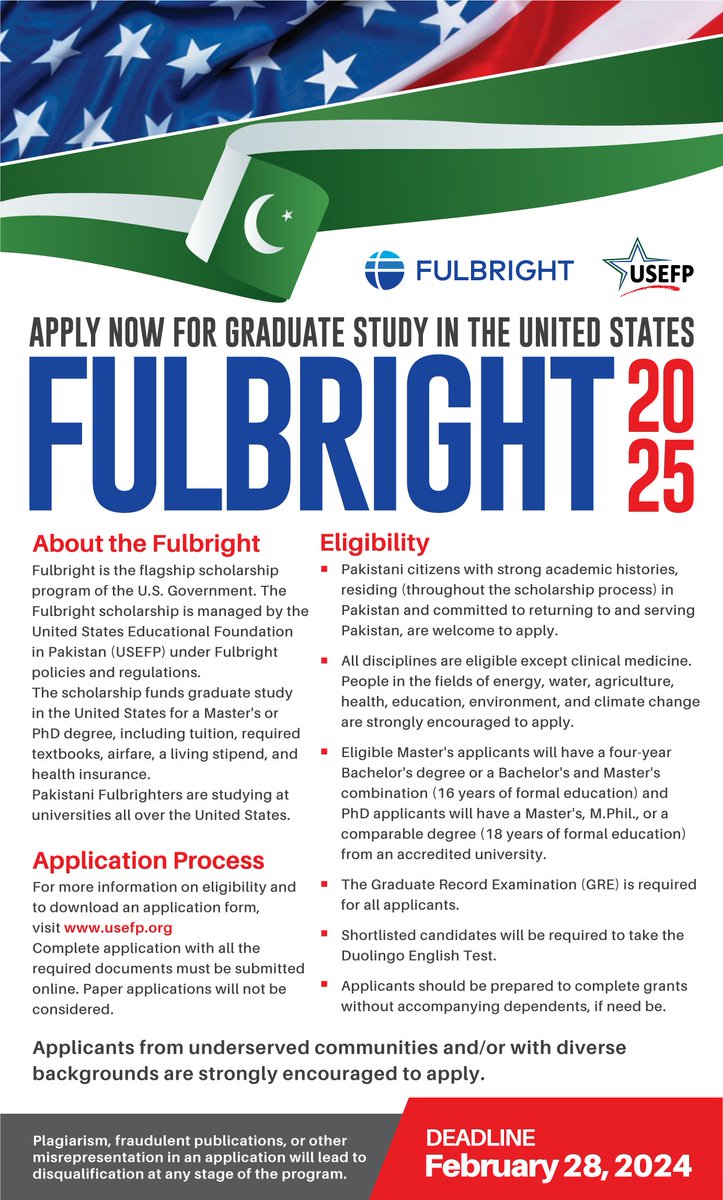
The 2025 Fulbright Student Program is now open! #USEFP is accepting applications for the #Fulbright (Master’s and PhD) Program, which fully funds graduate study in the United States. The deadline is February 28, 2024. To apply, visit usefp.org #USPAK #StudyInUSA
USEFP tweet media
English
5
119
266
53K
Ayesha Riaz retweetledi
EducationUSA Pakistan
EducationUSA Pakistan@EdUSAPakistan·
Are you on the lookout for master's and PhD degrees in the United States? Join EducationUSA's information session in Karachi to explore researching U.S. graduate programs and funding your studies! Date: September 08 Time: 2:30 pm Register at ➡️ bit.ly/45w7T62 #StudyWithUS
EducationUSA Pakistan tweet media
English
0
5
10
1.4K
Ayesha Riaz retweetledi
USEFP
USEFP@USEFP·
Calling undergraduate students in Pakistan! #USEFP is currently accepting applications for the 2024 Undergraduate Semester Exchange Program. Application Deadline is September 27, 2023 To apply, visit usefp.org 📧undergraduate@usefp.org #UGRAD #USPAK #Scholarship
USEFP tweet media
English
11
141
344
59.5K
Ayesha Riaz retweetledi
Niko McCarty.
Niko McCarty.@NikoMcCarty·
Day 14 of great synthetic biology papers. Storing a video in DNA. “CRISPR–Cas encoding of a digital movie into the genomes of a population of living bacteria,” by Shipman et al. (2017). This is the GIF that made synthetic biology go viral. But how did it actually happen? ***** DNA is an incredible way to store information. It is information dense (it can store nearly 1.5 terabits per square millimeter of space, 800-times more dense than a hard drive) and extremely durable (last year, scientists sequenced a 2.4 million-year-old DNA sequence from an ice sheet in Greenland.) Another way to think about this, from my prior essay: "a coffee mug filled with nucleic acids could store all the data produced in the last two years.” (readcodon.com/p/biotech-grat…) Despite the promise of DNA storage, this 2017 paper is the first demonstration of a movie being encoded in a living cell. The video itself is a recreation of Eadweard Muybridge’s running horse movie, which was made by stitching together still images in the late 1800s. But how was it made? *** To encode a video inside of living cells, we must first make the DNA. DNA includes four letters, or nucleotides: A, T, G, and C. Each letter can be used to encode a distinct color, such as white, light gray, dark gray, or black. That is four colors in total; one for each letter. It is possible to encode more colors if you use pairs or triplets of nucleotides. So that’s our colors sorted. But how do we know which color goes where in the image? In other words, how do we encode spatial information in DNA? The secret is that DNA itself contains spatial information. We often say things like, “Gene A is encoded on Chromosome 6,” or “Gene B is located upstream of Gene C.” We can take advantage of DNA's natural spacing to encode our video. If you wanted to encode a 50 x 50 pixel image in DNA, for example, you would first map out the color of each pixel. Let’s say A = white, T = light gray, and so on. Then, you would synthesize a DNA strand, 50 letters long, for each row in the image. Next, you would insert these DNA strands into the genome in the order of their rows, such that the sequence located furthest upstream corresponds to row 0, and the strand located furthest downstream in the genome corresponds to row 49. The challenge, of course, is getting the DNA snippets into the genome in the correct order, so that this spatial information is preserved. But there's an easy way to do that, too. *** If you insert all the strands into the genome at random places, there will be no way to read them back out and reconstruct the image. The spatial information will be lost. But there is a solution for this. In a 2016 Science paper, Shipman and co. figured out a clever way to insert DNA into the genome in a specific order. This technology has made all the difference for embedding videos in DNA. (science.org/doi/10.1126/sc…) The 2016 paper shows that two proteins, called Cas1 and Cas2, can grab onto snippets of DNA that are electroporated into cells (literally, a pulse of electricity forces DNA into the cell) and then integrate them in the genome. These special proteins ALWAYS insert DNA in the same location, such that the first DNA snippet is inserted at position 0. A second DNA snippet is inserted at position 0, and the first DNA snippet moves to position 1. And so on. After Cas1 and Cas2 have inserted dozens or hundreds of DNA strands into the genome, the final outcome is that the DNA snippet located furthest from position 0 must have been the first one to be acquired by the cells! For the 2017 paper, Shipman synthesized all the DNA needed to encode the various pixels for each frame in the running horse paper. He then "shocked" this DNA into a population of cells. These cells took in the DNA snippets, embedded them in their genomes, and went about their day as if little had happened. When the researchers later sequenced these DNA arrays and averaged the results over mllions of cells, the team was able to retrieve the video’s information with >90% overall accuracy. This paper is a beautiful demonstration of how a simple discovery (DNA acquisition via Cas1 and Cas2) can be used to capture and inspire people’s imagination. I like it a lot.
GIF
English
49
549
2.9K
1.2M