Academy of Business Negotiations

65 posts

Academy of Business Negotiations banner
Academy of Business Negotiations

Academy of Business Negotiations

@b2bnegotiations

Training the best B2B negotiators in the world. Elevate your business by joining us at https://t.co/JT1ZhjULgC.

Katılım Mart 2026
558 Takip Edilen16 Takipçiler
Academy of Business Negotiations retweetledi
Christopher Voss
Christopher Voss@fbinegotiator·
Lay out the other side’s reasons and then stay silent. When people feel understood, they are more willing to adjust without being pushed.
English
1
5
95
3.9K
Christopher Voss
Christopher Voss@fbinegotiator·
Focus on how to be involved in projects that shape the company’s future and build your career instead of just negotiating salary.
English
1
5
64
3.4K
Academy of Business Negotiations
Academy of Business Negotiations@b2bnegotiations·
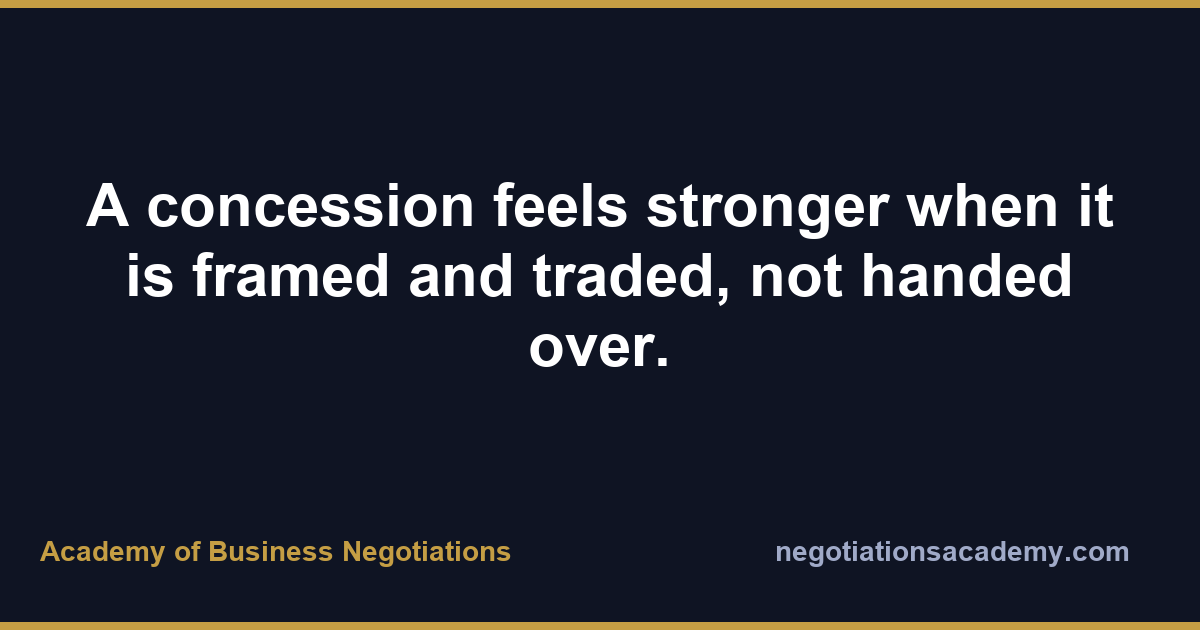
Concessions get expensive when they look automatic. In most B2B deals, they tend to carry more weight when you frame them, slow them down, and tie them to a return. That helps protect margin without turning the conversation adversarial. negotiationsacademy.com/how-to-m...
Academy of Business Negotiations tweet media
English
0
0
1
30
Academy of Business Negotiations retweetledi
eCommKen
eCommKen@eCommKen·
It's been a while since I shared this. Hope you get some value from it.
eCommKen@eCommKen

My top 13 tips for negotiating. I've managed P&Ls exceeding $500M, and I've negotiated many, many 7-8 figure deals in ecommerce. These points come from my experience. 1. You don't get what you don't ask for. 2. Always be willing to walk away. 3. Negotiate from a position of strength. If you don't know what your position of strength is, step back until you find it. 4. Anchor carefully. Once YOU provide a number, it's very difficult to make large adjustments. 5. It's easier to move the other party's anchor than it is to move your own. 6. Always let the other party anchor first. 7. Practice the art of the eyebrow raise (or the "oh, wow" if you're on the phone). When the other party shares their number, raise your eyebrows (or say "oh wow") as if surprised at how far off it is from your expectations. You'd be amazed at how often people will concede immediately just from this tiny act. 8. Bracket. If they want to sell you a widget for $100, and you want to buy that widget for $90, then you offer $80. People naturally want to meet in the middle, so make sure the middle is the number you want. 9. Nibble. Like little kids going to bed who just want a story, then a drink of water, then to be tucked in. Every ask is reasonable by itself, until you realize that bed time was 30 minutes ago. Nibble for the little stuff. If you're buying a car, AS you're signing paperwork, look up and say, "You'll fill the tank up for me too, right?" No car salesman in the history of car selling would ever tell you no to that if it means they might miss the sale. Nibble, nibble, nibble. 10. Only concede if it means more to the other party than it does to you. 11. Ultimatums rarely work. Most of the time, they just kill the deal. Only use them as a last resort when you're ready to walk away from the deal. 12. If you can identify the REAL value the other party is looking for (beyond the ask they present to you), you can frame the negotiation around their goals. This makes your ask much more compelling because you've appealed to what they're really after. 13. Negotiate EVERYTHING. See point 1. Bonus story: I was negotiating with a children's toy/furniture vendor who wanted my team to make a $4M buy of inventory (no small investment). We were confident we could be profitable with about $3.4M of this inventory, but we would be taking a risk on the remaining $600k. But it was a package deal. All or nothing. We could have just taken the deal and probably been fine. But probably isn't a very good business strategy. I came back to the vendor with a very specific ask: I wanted exclusive access to a high velocity product to offset the risk of taking that $600k of questionable inventory. After some back and forth, the vendor agreed. That product alone ended up being a $15M+ product that first year, and it added millions in net profits while we had exclusivity (before it was eventually discontinued). I used most of the tips I outlined above in that negotiation, but first and foremost was point 1. We never would have landed that exclusive product had we not simply asked for it. What are your favorite negotiation tips and tools? 👇

English
0
1
2
39