Dr. Siraj Baloch

420 posts

Dr. Siraj Baloch banner
Dr. Siraj Baloch

Dr. Siraj Baloch

@baloc30797

Quetta, Pakistan Katılım Kasım 2024
1.4K Takip Edilen136 Takipçiler
Dr. Siraj Baloch
Dr. Siraj Baloch@baloc30797·
This week marks a significant moment for Pakistan’s defence narrative — a reminder of the professionalism, preparedness, and deterrence capability of the Pakistan Air Force. National security rests not in aggression, but in credible defence and strategic stability. 🇵🇰✈️ #PAF #
The STRATCOM Bureau@OSPSF

This week the People of Pakistan will be celebrating the first anniversary of the historic POUNDING of the Indian Air Force by the Pakistan Air Force in one night (8 jets down with no own losses), one of the most successful offensive counter-air (OCA) operations in history!

English
0
1
1
29
Dr. Siraj Baloch
Dr. Siraj Baloch@baloc30797·
BTTN Summer Internship, 2026. BTTN invites applications for its 6-week #Internship Program designed for final-year university students and recent graduates interested in #Policy Research, Strategic Affairs, and National Security Studies.
Balochistan Think Tank Network (BTTN)@bttn_quetta

BTTN Summer Internship, 2026. BTTN invites applications for its 6-week #Internship Program designed for final year university students and recent graduates interested in #Policy Research, Strategic Affairs, and National Security Studies. Students from Balochistan are invited to submit their CVs along with Cover Letters to our official email address: bttn@bttn.org.pk #strategicstudies #outreach #socialresponsibility

English
0
1
2
61
Dr. Siraj Baloch
Dr. Siraj Baloch@baloc30797·
South Asia’s stability demands realism, not rhetoric. Pak has shown consistent restraint despite being a major victim of terrorism. Blaming Pak to justify escalation is dangerous. Responsible dialogue, deterrence, & cooperation—not preemptive strikes—are the real path to peace.
Zafar Khan@zafarwafa1977

foreignaffairs.com/india/why-next… "Risk Of Escalation in South Asia" Although many security analysts may argue that including this piece titled "Why the Next India-Pakistan War Will Escalate" reflects that terrorism may lead the two South Asian nuclear rivals to the brink of a serious military crisis, quickly reaching up the escalation ladder to a nuclear level. However, fighting and containing terrorism should not be made a pretext to wage a preventive strike, as India did in both the 2019 and May 2025 crises. This is potentially irrational and dangerous. It is fraught with weaknesses that may escalate to a dangerous level. The Herman Kahn and Rodney Jones conceptual escalation ladders may not be directly applicable to the complex South Asian nuclear environment, where a persistent conventional force asymmetry could escalate to the nuclear level. Using terrorism as a pretext to strike a nuclear Pakistan means that India is putting itself into a “commitment trap” and “escalation trap.” India must contain terrorism within its borders by addressing its intelligence failure, governance issues, and, more importantly, enacting a counterterrorism strategy to address such issues within India. It should be India’s internal issue. India may bring this issue, which Pakistan commonly faces, to the negotiating table as part of CBMs. The article does not say anything about this imperative that is good for the South Asian strategic stability, potentially preventing a serious military crisis because of a false pretext of terrorism. The article is also silent without mentioning that Pakistan suffers from the menace of terrorism much more than India does. Has Pakistan ever made terrorism a pretext to launch a preemptive strike against India and its handlers? Pakistan can, but Pakistan has not, and this shows a great deal of strategic restraint, but restraint should not be considered a weakness. It is part of the strategy to signal to the other side not to do things that may exceed the bounds of restraint. Although the article mentions somewhere in conclusion about the possible risk of escalation to a nuclear level, it does not specifically mention how and why nuclear deterrence has been playing a direct and indirect role in preventing both large-scale and limited war in South Asia. The article also skips to mention why India showed restraint not to take military action against Pakistan after the car bomb explosion in New Delhi in November 2025 that killed about 10 people. Was it because India realized that terrorism can not be made a pretext for waging a preventive strike (illegal) against Pakistan? Or was it because of nuclear deterrence playing in the background, deterring India to be more cautious that time around, having learned its lesson in May 2025? The role of the third party is important and therefore cannot be ignored, as India does. Ironically, on the one hand, India does not recognize the third-party role, but on the other hand, it does not talk to Pakistan and share information on issues concerning India and Pakistan. The burden of responsibility is on the Indian shoulder, much more than on Pakistan. The article does not critically analyze this imperative. The article also does not elaborate on how and why Pakistan proposed the Strategic Restraint Regime (SRR), which India declined, and how this relates to broader strategic stability in South Asia, as well as to crisis management and crisis prevention mechanisms. The efforts for crisis resolution (the ultimate way forward) are not mentioned in the article at all; one wonders why. The article could have been more balanced and interesting if this could inculcate all these missing imperatives. @ethrelkeld @ForeignAffairs #India #Pakistan #SouthAsia #May2025Conflict #Escalation #deescalation #risk #nuclear #Kashmir #flashpoint

English
3
1
4
246
Dr. Siraj Baloch retweetledi
Strategic Vision Institute
Executive Director Strategic Vision Institute @Dr_NaeemSalik . Naeem Salik appeared at @PakTVGlobal for an exclusive interview on the upcoming first anniversary of Marka-e-Haq. Dr. Salik stated that in response to the Indian aggression in May last year, Pakistan launched multiple domain operations using integrated weapon systems, which caught India off guard. 🌎Connect with us: Strategic Vision Institute (SVI) , Islamabad 📢Join SVI Broadcast: chat.whatsapp.com/GSM7366tF5K691… - Website: thesvi.org - Twitter: x.com/svi_pakistan - Facebook: facebook.com/SVIPakistan - Instagram: instagram.com/SVI_Pakistan
English
0
3
3
140
Dr. Siraj Baloch retweetledi
Radioactive Friends
Radioactive Friends@RadioactiveFrnd·
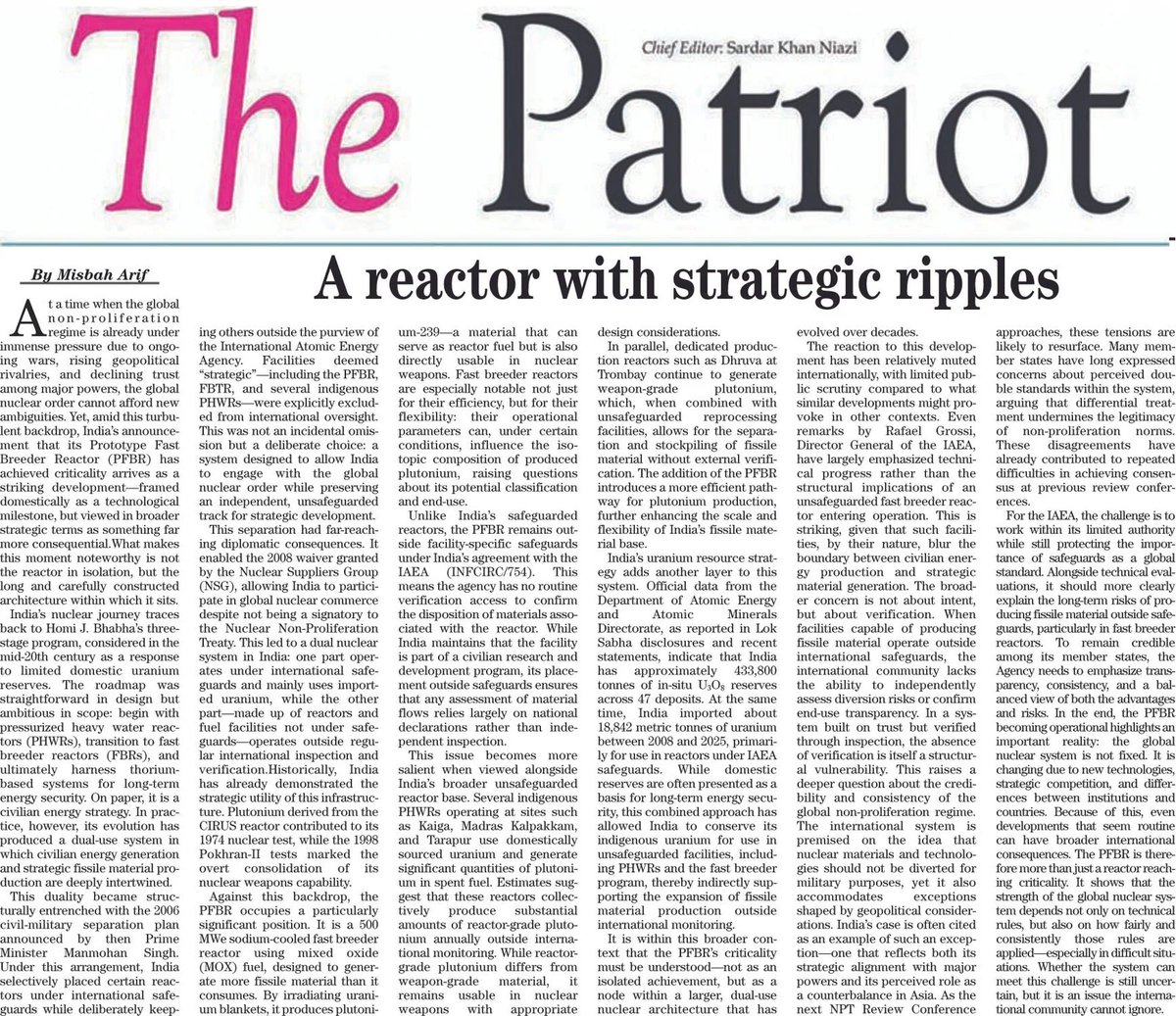
Analysis by Misbah Arif India’s Prototype Fast Breeder Reactor isn’t just energy - it’s a strategic fault line, raising risks of unchecked fissile material and regional instability. Today’s progress could become tomorrow’s proliferation crisis. #NuclearSecurity #NuclearRisk
Radioactive Friends tweet media
English
5
27
32
605
Dr. Siraj Baloch retweetledi
Radioactive Friends
Radioactive Friends@RadioactiveFrnd·
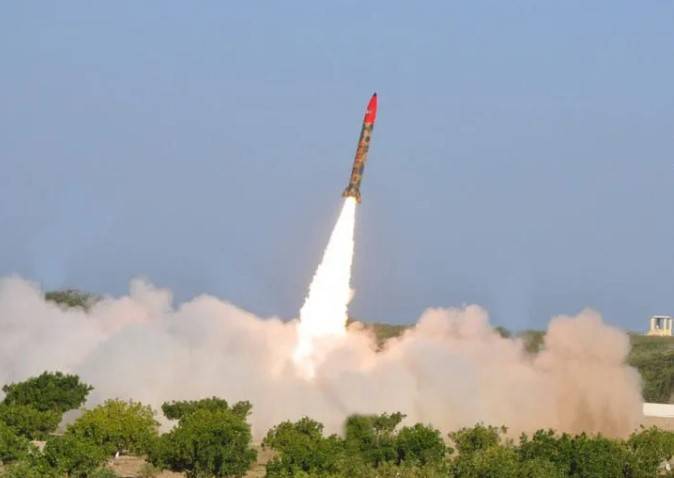
🚨 Successful milestone for Pakistan’s defence capability! Pakistan Army conducts a successful training launch of the indigenously developed #FatehII missile system, showcasing enhanced accuracy, advanced navigation & operational readiness. 🇵🇰 #ISPR #PakistanArmy
English
1
17
25
557
Dr. Siraj Baloch retweetledi
Zafar Khan
Zafar Khan@zafarwafa1977·
"Pakistan's Space Vision 2040" History repeats itself; the “Space Vision 2040” is a revival of the 1960s, when Pakistan was rapidly outpacing its adversary in South Asia. With this imperative, Pakistan will lead into the space frontier, much needed for the economic and peaceful uses of space technology. The strategy for the ultimate indigenization is the road moving forward. Others in the space race will learn from Pakistan. The time for this is near. The time for this is now. #SUPARCO #SpaceScience #spacetalk #Pakistan #SDGs #SouthAsia
Zafar Khan tweet mediaZafar Khan tweet media
English
2
17
30
2.3K
Dr. Siraj Baloch retweetledi
Radioactive Friends
Radioactive Friends@RadioactiveFrnd·
Dr Sara Naqvi warns By endorsing facilities beyond international oversight, the #IAEA risks eroding its own credibility and normalizing unsafeguarded nuclear pathways - undermining global accountability at its core. #India #NuclearPolicy #NonProliferation
Radioactive Friends tweet media
English
6
31
40
854
Dr. Siraj Baloch retweetledi
Zafar Khan
Zafar Khan@zafarwafa1977·
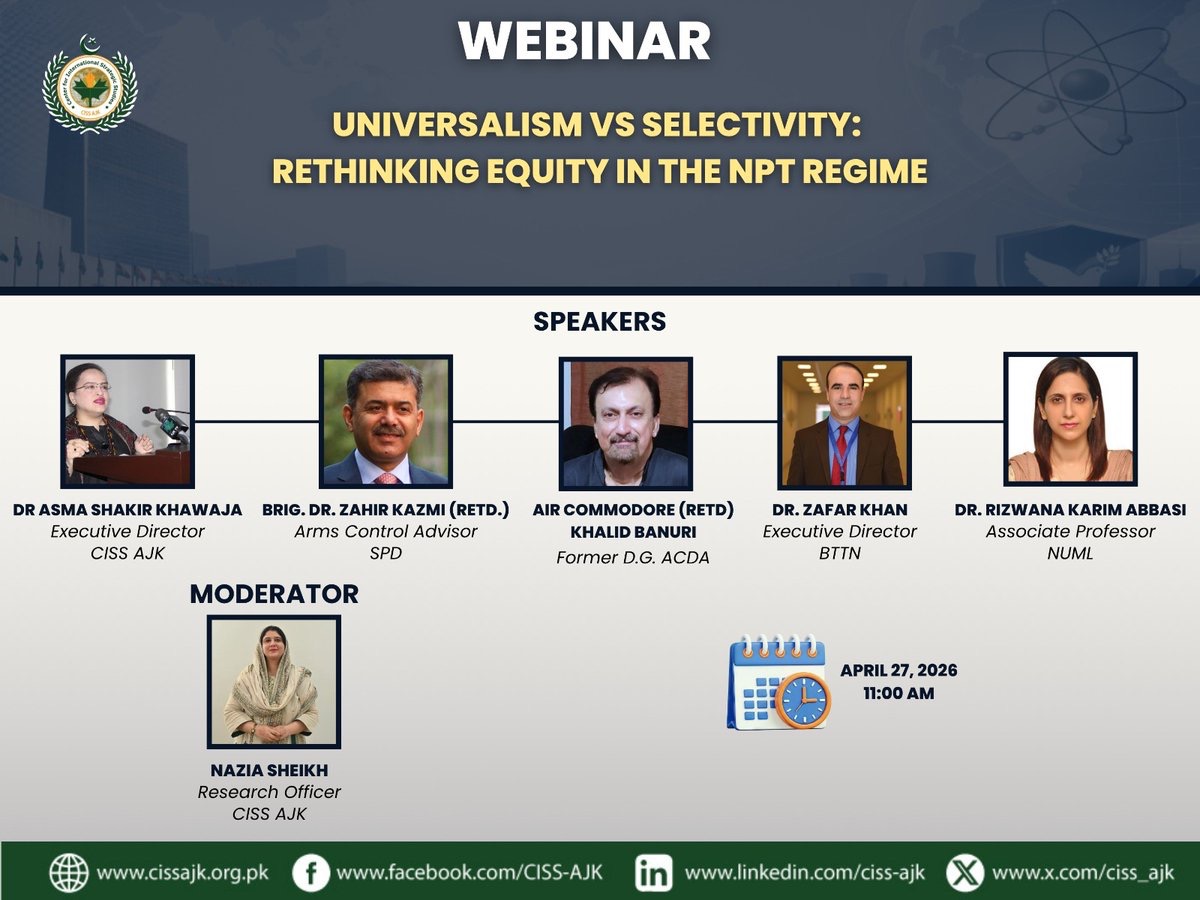
“Disarmament Commitments and Strategic Realities” I had a chance to deliver my thoughts titled “Disarmament Commitments and Strategic Realities” in the CISS AJK One-Day Webinar on “Universalism vs Selectivity: Rethinking Equity in the NPT Regime” on 27 April, 2026. Here is the gist of some of these analyses: When the Nuclear Non-Proliferation Treaty (NPT) was formed in 1968 and subsequently enforced in 1970 after a deadlock of many years of negotiations on establishing the three fundamental pillars of the NPT: a) nonproliferation, b) peaceful uses of nuclear technology, and c) nuclear disarmament, the major nuclear weapons states, now called the P-5, promised to go for nuclear disarmament in the NPT. They failed to keep their promise of complete disarmament despite the indefinite extension of the NPT at the 1995 NPT Review Conference. The commitments to nuclear disarmament were overshadowed by the harsh strategic realities of international politics. The good news is that there are only 9 nuclear-weapon states in the system, despite the perceived danger of a cascade of nuclear proliferation across the board. Nevertheless, the aspirant states for acquiring nuclear weapons were either forcefully not allowed by the US or preempted with preventive strikes by others, such as Israel and the US. Israel preempted Iraq, Syria, and, more recently, Iran’s nuclear facilities because of its fear of an “existential threat” from other countries in possession of nuclear weapons. But, Israel remains the only country to possess nuclear weapons in the region while rejecting the proposed nuclear-weapon-free zone in the Middle East. This became one of the reasons for the failure of the NPT Review Conference. The US did not allow others to acquire nuclear weapons except the UK and France for two simple reasons: One, the US pretends to promote the nonproliferation imperatives by providing a nuclear umbrella (extended deterrence) to its allies and partners, thereby not allowing them to develop their nuclear capability. Two, many security analysts argue that it suits the US's vital security interests by retaining its power projection and security dominance over its allies. The bad news is that NPT remains weak and ineffective, not even preventing nuclear-weapon states from striking non-nuclear-weapon states parties to the NPT. The NPT probably may not prevent the recognized nuclear-weapon states from using nuclear weapons against the non-nuclear-weapon states parties to the NPT. This potentially has created a dangerous precedent and a security concern between the haves and have-nots. In fact, the strategic realities are different and more complex than we ideally perceive. Both the US and Russia continue to possess almost 90% of the total world nuclear forces. All major nuclear-weapon states are not ready for the promises they made for the ultimate nuclear disarmament. Even President Barack Obama’s Prague speech in April 2009 aspired to a world without nuclear weapons. But, this could not be achieved at least in his lifetime, as he immediately admitted. All major nuclear states are not only modernizing but also increasing their nuclear weapons, along with the development of sophisticated delivery systems. In sum, this NPT review conference, starting on April 27, may not be able to accomplish all the outstanding goals, such as the proposed Middle East Nuclear Weapons Free Zone, agreement on complete nuclear disarmament, and the long-standing issue of discrimination between the haves and have-nots. What is needed much more is the principles of universality rather than selectivity, equity, transparency, restraint, and non-discrimination, moving forward. #NPT #NSG #IAEA #nuclear #nonproliferation #ReviewConference #disarmament #US #EU #China #Russia #UK #France
Zafar Khan tweet mediaZafar Khan tweet media
English
1
26
33
2.5K
Dr. Siraj Baloch retweetledi
Radioactive Friends
Radioactive Friends@RadioactiveFrnd·
At a time when escalation seemed inevitable, #Pakistan stepped up, actively supporting de-escalation in the US-Iran crisis. A country long battling terrorism at home choosing #diplomacy abroad reflects real strategic confidence and courage. #PakistanZindabad #PakistanLeads
Radioactive Friends tweet media
English
0
4
9
109
Zahir Kazmi
Zahir Kazmi@zahirhkazmi·
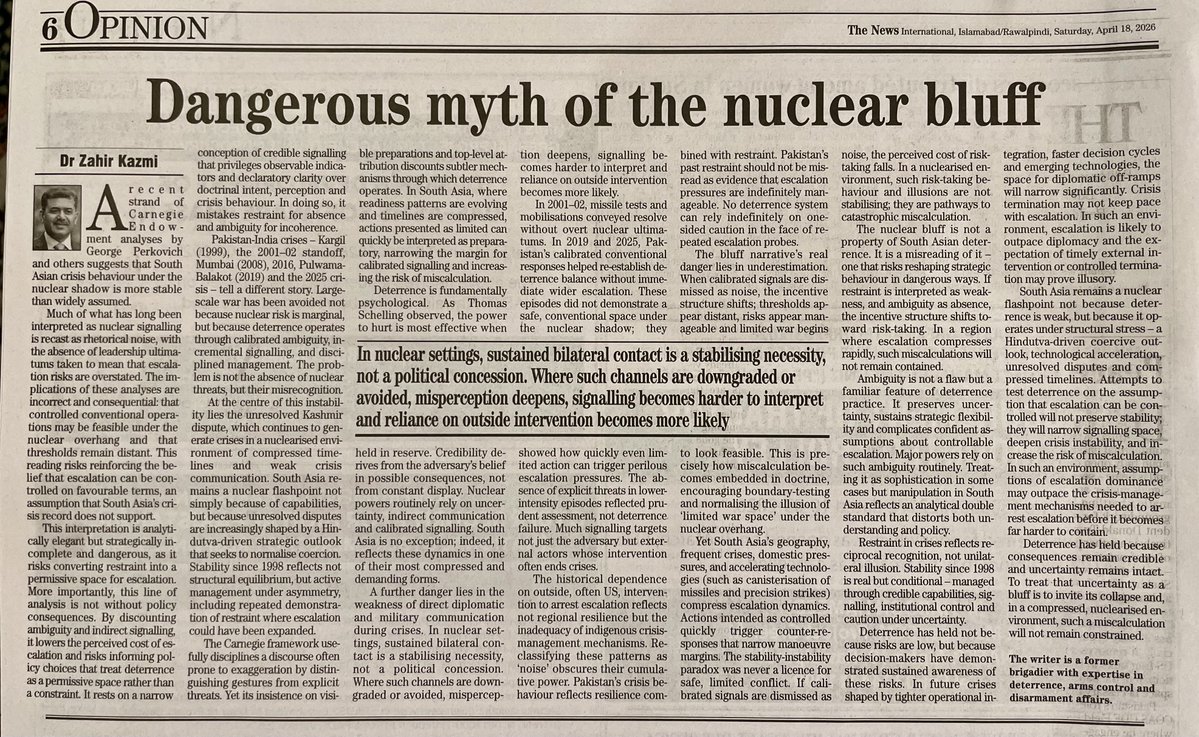
1/2 New today in @thenewspk: The Dangerous Myth of the Nuclear Bluff South Asia’s deterrence stability rests on ambiguity, signalling, restraint, and risk perception, not simply on overt nuclear threats. Misreading restraint as absence of deterrence can encourage dangerous confidence in limited war under the nuclear shadow. Read here: thenews.pk/print/1410640-… #SouthAsia #Deterrence #NuclearRisk 1/2
Zahir Kazmi tweet media
English
44
56
81
4.8K
Dr. Siraj Baloch retweetledi
Zafar Khan
Zafar Khan@zafarwafa1977·
The Nonproliferation Treaty (NPT -1968/70) recognizes only 5 (the P-5 – US, Russia, UK, France, China) that had already acquired nuclear weapons before January 1, 1967. The NPT does not recognize those who have acquired afterwards and/ or aspire to acquire nuclear weapons in the future unless there are broader structural reforms within the NPT. The promises/ pledges the P-5 made for nuclear disarmament are not occurring anywhere in the world. There is no evidence for such pledges they made. They do not only continue to possess nuclear forces, but also increase and modernize their nuclear deterrent capabilities against their potential adversaries. No one is willing to rescind their nuclear forces. Why should others do it? This reflects the essence and utility of nuclear weapons and nuclear deterrence despite conventional force modernization and the emergence of disruptive technologies. Nuclear deterrence will continue to play a significant role in preventing both large-scale and limited war. Undeniably, it has a strategic value. #IranWar #IranRevolution2026#nuclear #US #Russia #China #France #UK #India #Pakistan #NorthKorea #Israel
Zafar Khan tweet media
English
0
10
14
446
Dr. Siraj Baloch retweetledi
Zafar Khan
Zafar Khan@zafarwafa1977·
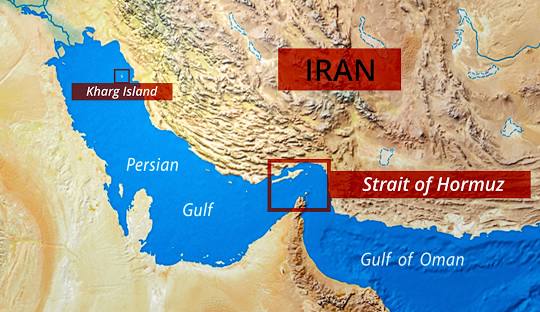
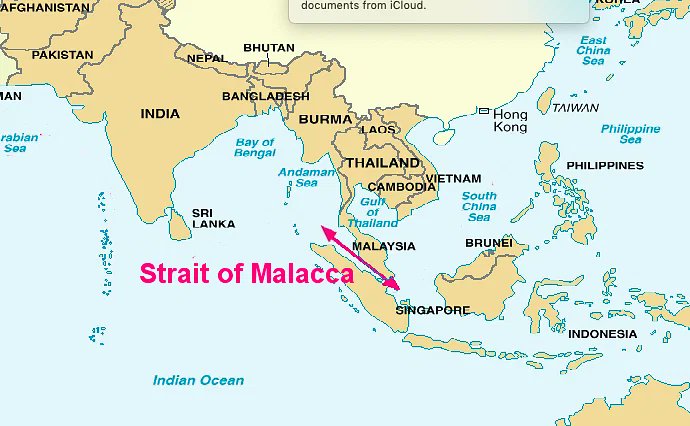
The Spiraling of Blockades Out of Control Borrowing from the Mackinderian heartland and Spykman Rimland theories: “Those who control the maritime choke points control the world’s economy and influence geopolitics upon others.” The Strait of Malacca is yet another important maritime choke point. A clear signal by the US that if Iran can block the Strait of Hormuz, which in fact was never blocked before the war, the US can potentially help block and stranglehold the Strait of Malacca. But, this is not a signal to Iran. It is an attempt to stranglehold China. 80% of the Chinese trade shipments pass through the Strait of Malacca. Blockading/strangling the Strait of Malacca will not only slow down and hurt the Chinese economy but also axe the US's own allies and partners, such as Japan, South Korea, and India, whose economic prosperity depends on this Strait. #IranWar#Strait #Blockade #Hormuz #Malacca #US #Indonesia #economy #conflict
Zafar Khan tweet mediaZafar Khan tweet media
English
5
32
74
11.4K
Dr. Siraj Baloch retweetledi
Zafar Khan
Zafar Khan@zafarwafa1977·
Multiple blockades from multiple powers! Amongst these proposed riddles, Russia is missing. If you bring Russia into the proposed “Toll”, this will be much more problematic and complex. No one is getting anything from here. Everyone stops everyone. It will be a Hobbesian world of “all against all.” #Hormuz #Blockade #Ian #IranWar#IranWar‌2026
Zafar Khan tweet media
English
3
10
13
2.7K