Fable 5 totally crushed our new contest, but it cost 6x more than Opus 4.8!
We gave 4 models the same prompt: build three self-contained HTML5 canvas scenes with real physics demos
Prompts:
— A train derailing off a broken bridge into the water
— Two cars jumping off ramps and colliding mid-air over a canyon
— A monster truck crushing a row of parked cars
Outputs:
Fable 5: 62,158 tokens, $3.12
GPT 5.5: 37,753 tokens, $1.14
Opus 4.8: 22,280 tokens, $0.56
GLM 5.2: 36,246 tokens, $0.08
Fable 5 did all three scenes at A+. The crashes looked real, things fell and broke the right way, and nothing went through the ground or floated. GPT 5.5 was the closest to Fable. In the Bigfoot show, we think GPT was even a little better. GLM 5.2 did not win any scene, but it was the cheapest by far. Fable is the best pick for quality, but you pay more for it.
@atomic_chat_hq Can’t see anywhere, what thinking level did you use? I did similar benchmarks on creating an old school Mario game with GPT5.5 and I could see a real difference between medium and extra high.
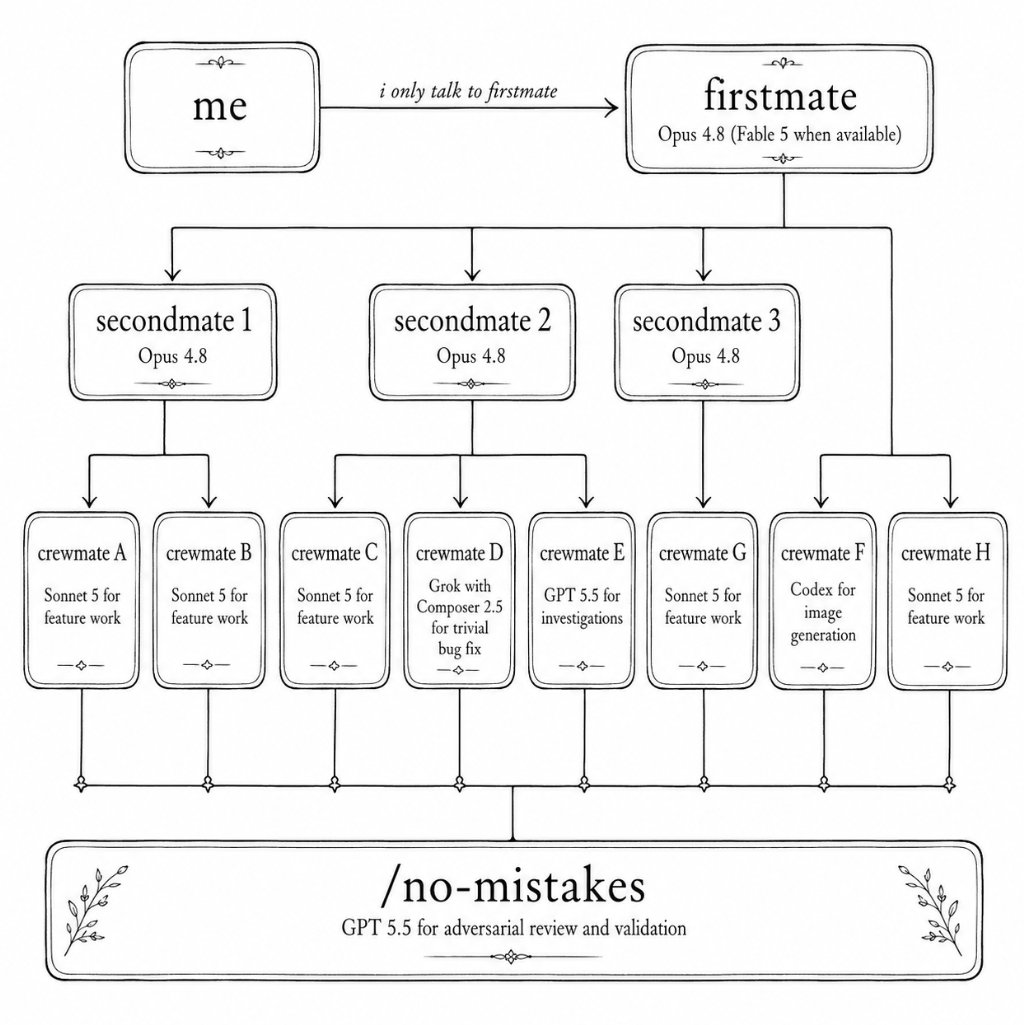
with Sonnet 5 introduced, here's the latest complete org chart of my agents. this is my real setup and how i get work done every day, not gimmicks
1. i mainly talk to just one agent - the firstmate. i always use the intelligent model with max reasoning here, because this model handles all the strategic reasoning and manages a massive amount of context switching. currently that's opus 4.8 and i'll switch to fable when it comes back. gpt 5.5 is also as intelligent but it's a bit less "emotionally pleasant" to have as the only agent i talk to
if i'm being 100% accurate then occasionally i do also talk directly to secondmates, but that's more exception than the rule
2. firstmate manages some secondmates and some crewmates all through tmux. difference is that secondmates have a persistent charter, like project ABC go to secondmate 1, project D goes to 2, etc. this is necessary because otherwise firstmate gets too busy and doesn't scale
crewmates are instead completely ephemeral - each crewmate is for a single task and gets killed once the task is done (pure cruelty i know)
3. when firstmate and secondmates dispatch a crewmate on a task, it intelligently selects which harness, model and reasoning effort to use. this is extremely important for balancing my token spend across subscriptions and being cost efficient
right now, i have set it to use grok with composer 2.5 for trivial bug fixes (to utilize the subscription I already have on X, and big token saver), sonnet 5 as default workhorse, and codex for image generation and investigation type of tasks
4. all PRs go through /no-mistakes for adversarial review and validation, which always uses gpt 5.5 - i found it to be really solid with code review, debugging and self correction
@hanakoxbt Was doing it already for two or three months but instead of creating a skill, I just added a line in the claude.md to always verify the work by running local server, checking database etc. after each code change.
Anthropic Claude Code engineer:
"If you're watching Claude write code, you're the QA tester. That's not what you're paid for."
In 37 minutes he lays out how to get your keyboard out of the hot path entirely.
The shift is /loop. You tell Claude to wake up every 10 minutes and babysit your PRs, and it just does it, while you're nowhere near the laptop.
Routines do the same in the cloud, so the work keeps running with your machine closed.
He caps it with remote control: any session, on any surface, driven from your phone.
Watch the full talk, then grab the setup below.