Perp rails paired with visible institutional flow on @HyperliquidX set the current attention layer.
1. USDT borrow on testnet. The mechanism lets users borrow stable collateral directly against portfolio margin, lifting capital efficiency for concentrated books.
2. $131M exposure, $36.34M BTC long. Fasanara's disclosed mix of one sizable long and multiple shorts shows how borrow rails can support levered institutional books without full collateral lockup.
3. Nansen public profiler for wallet 0x7fdafde5cfb5465924316eced2d3715494c517d1. On-chain position tracking now surfaces live, converting private perps activity into monitorable data.
4. Ethy AI V2 integration with @HyperliquidX. Agent operators gain the ability to open and risk-manage perps inside the same stack, extending rails to automated execution.
Institutions capture incremental leverage while the same visibility draws fresh monitoring. Track the profiler for shifts in Fasanara sizing as the mainnet USDT borrow upgrade lands.
Will agents execute over 40% of Base DeFi actions through native MCP by August 31?
Base MCP removes the per-action signature step and hands agents direct wallet control. This lets them scan yields, swap, and deposit straight into vaults like the one tested with Claude.
The @MoonwellDeFi flow already proved the loop works end to end on a live account. Earlier agent gateways on other chains crossed similar usage thresholds inside the first sixty days once wallet access shipped.
I put the over at 48%. The flip risk is liquidity or routing staying fragmented across external tools that keep tighter hooks than the native path.
Poll the volume share split on your feed and mark the over if it prints above 45.
Not every valuable action creates an immediate result. Sometimes its impact only becomes visible much later.
@XOOBNetwork is moving toward a structure where delayed-value contributions can remain attributable over time.
Rather than focusing only on instant conversions, the network can preserve the connection between an early contribution and future outcomes, making long-term ecosystem builders easier to recognize and reward.
-----------------------------------------
One challenge that does not get enough attention in quantum infrastructure is workload prioritization.
As quantum resources become more valuable, not every task can be processed immediately.
This is where @quipnetwork becomes interesting.
Over time, networks like Quip may need to determine which workloads deserve access to limited quantum capacity and which should remain on classical infrastructure.
The real advantage may not come from having more compute.
It may come from allocating scarce quantum resources more intelligently than everyone else.
@useTria@TheARCTERMINAL
LATEST: 🚨 The Wolf of All Streets’ Scott Melker argues prediction markets are "a sign of the end times for people's financial future," saying they are a sign people feel unhealthy.
Bitfinex transferred 241.5M USDT to Tether Treasury on 2026-05-31. The move registers as a redemption burn. Circulating supply contracts and stablecoin liquidity tightens on the immediate flow.
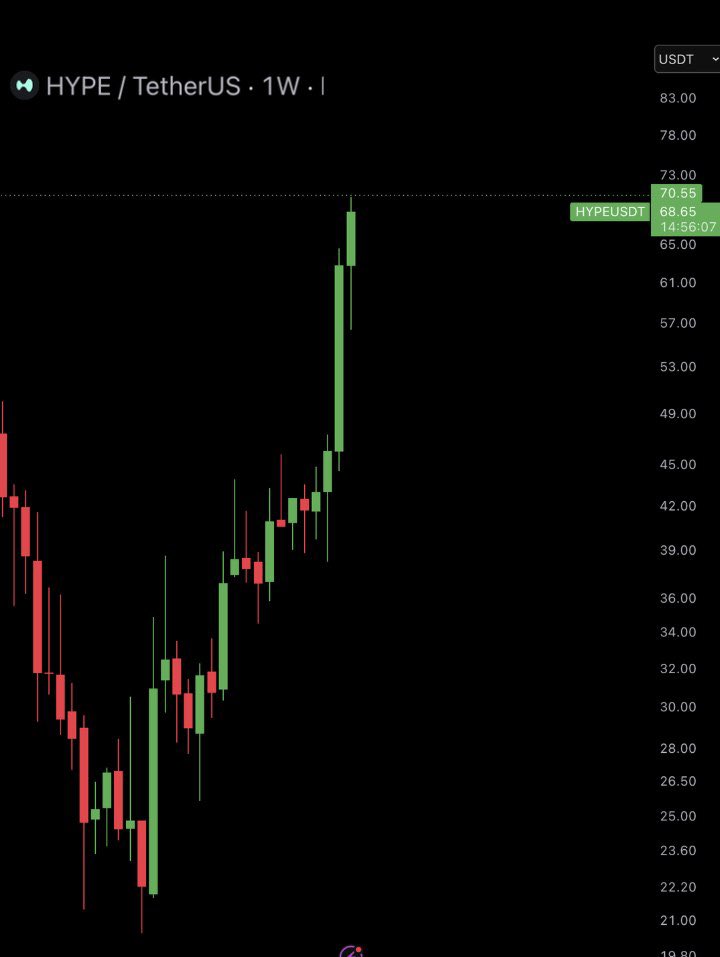
$HYPE just hit a new all-time high of $70, adding $11 BILLION in market cap in 2026.
Why HYPE has been pumping?
- 🇺🇸 The US CFTC has approved the first “US perpetual futures,” the same model HYPE is built on, potentially opening access to a multi-trillion-dollar market.
-The platform makes around $900M–$1B in real fees with only 11 employees.
-About 98% of trading fees are used to buy back and remove it from supply, with buybacks already surpassing $2 BILLION
-$100M in inflows since ETF has launched, with funds like Bitwise also using fees to buy HYPE.
➥ TOP #1 TODAY - PENDLE | Yield Derivatives Volume
@pendle_fi just printed $31M in yield derivatives vol today
Up 19.4% from yesterday, and the strongest single day in over a week
- ethereum:0x808507121b80c02388fad14726482e061b8da827 had a rough stretch, down 40% week-over-week
- Today was the reversal, monthly trend still up +41.9% even with the mid-week weakness
- When Pendle bounces, it bounces on Ethereum w/ $26.4M of the $31M (85%)
- Arbitrum added $3.7M
- Plasma and BSC rounding out the rest
The context matters, Pendle is a yield futures market
→ you're trading the yield on assets like weETH, sUSDe, reUSD, thPILL and other LSTs/LRTs before maturity
When rates move or macro shifts, these traders act fast
When TradFi talks about bringing rates trading onchain, Pendle is the protocol that already exists
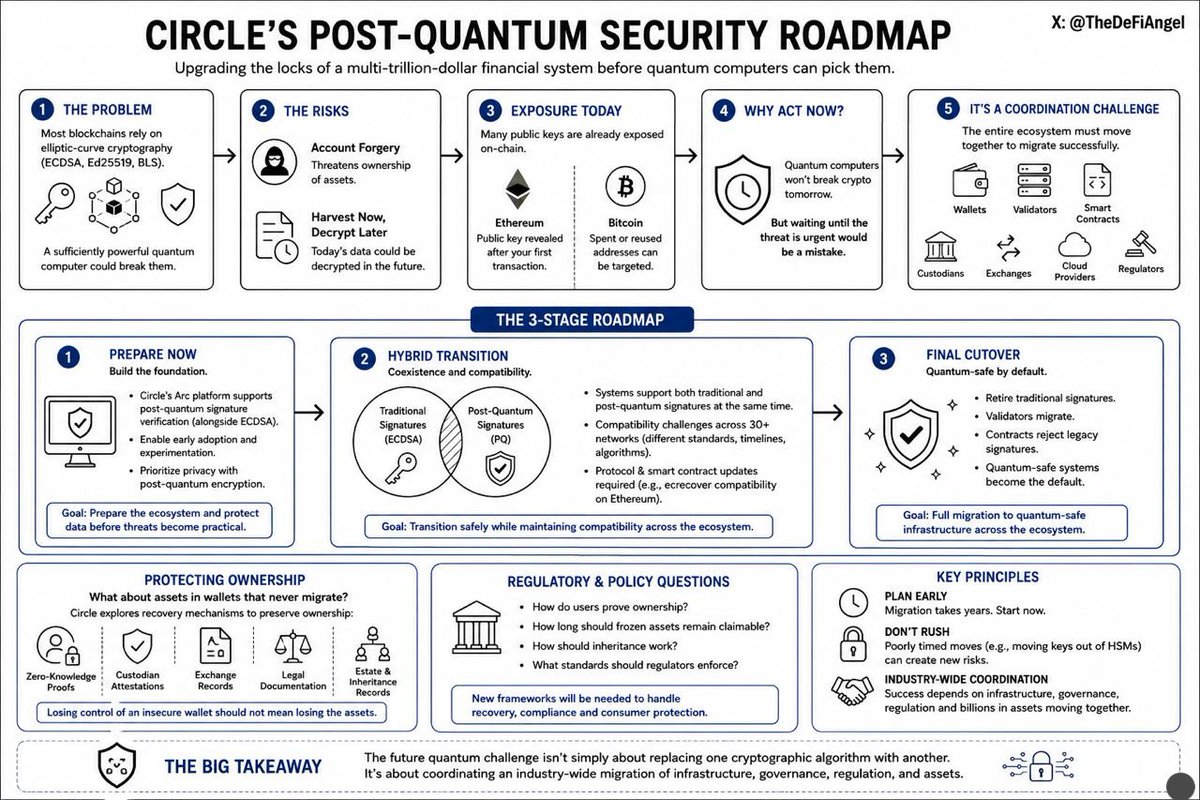
➠ @circle new Post-Quantum Security Roadmap highlights a challenge that crypto will eventually have to face:
how do you upgrade the locks of a global financial system before quantum computers can break them?
Today's blockchains rely heavily on elliptic-curve cryptography (ECDSA, Ed25519, BLS).
If sufficiently powerful quantum computers emerge, attackers could potentially derive private keys from exposed public keys, forge transactions, compromise validator systems, and decrypt sensitive data collected today in "harvest now, decrypt later" attacks.
Circle argues that post-quantum migration is a long-term engineering and coordination challenge involving wallets, smart contracts, validators, custodians, exchanges, cloud providers, and regulators.
Its roadmap follows three phases:
→ Prepare Now
→ Hybrid Transition
→ Final Cutover
In the preparation phase, Circle's Arc platform will support post-quantum signature verification while retaining existing ECDSA systems.
The company is also prioritizing post-quantum privacy tools because data exposed today cannot be made private again later.
The hybrid phase may be the most difficult. USDC operates across more than 30 blockchains, each potentially adopting different post-quantum standards and timelines.
Existing infrastructure, including EVM's widely used ecrecover function, creates additional migration challenges because many smart contracts cannot easily be upgraded.
Circle also plans to audit and upgrade critical infrastructure such as HSMs, KMS systems, cloud environments, networking layers, and secure execution systems.
The paper stresses that migration sequencing matters because upgrading components in the wrong order can leave previously intercepted data exposed.
The final cutover would happen only when the ecosystem is ready. At that stage, traditional signatures could be retired, validator systems migrated, and quantum-safe cryptography become the default.
Perhaps the most interesting question is economic: what happens to assets held in wallets that never migrate?
Circle argues that losing control of an insecure account should not automatically mean losing ownership.
The paper discusses recovery methods ranging from zero-knowledge proofs and custodian attestations to legal documentation, exchange records, and inheritance claims.
My take is simple: the challenge is coordinating a multi-year migration across an entire industry before the threat becomes urgent.
The locks haven't been broken yet, but the replacement process has already started.
This is what caught my eye with $PRXVT.
Not another AI agent.
Not another AI wrapper.
They’re sitting at the table with the Ethereum Foundation, Virtuals, OKX and BNB Chain helping shape ERC-8183 — a standard for how AI agents transact, coordinate, pay and settle onchain.
Most people are watching the agents.
I’m watching the infrastructure being built underneath them.
loracle.hl flipped the short.
→ $110M+ notional short on $HYPE produced the $35M+ realised loss.
→ Position size wiped out prior perp profits on the account.
→ Remaining exposure holds at ~1.5M HYPE for $103M notional.
→ Our watchlist flagged the flip after tracking this wallet's perp sizing.
Funding rates have quietly become their own asset class.
A year ago, traders asked “Where is funding highest?”
Today the question is “Who captures the funding?”
The answer increasingly sits across three layers.
1. Funding Creation
Hyperliquid.
2. Funding Aggregation
Ethena.
3. Funding Distribution
GMX.
⸻
@HyperliquidX is where funding gets created.
With $9B+ open interest and more than $7B in daily volume, it has become the primary funding-rate marketplace in crypto.
The interesting part is that Hyperliquid benefits regardless of direction.
Negative funding.
Positive funding.
Crowded positioning.
More volume means:
▸ more funding transfers
▸ more liquidations
▸ more fee generation
The venue monetizes activity itself.
⸻
@ethena sits one layer higher.
Hyperliquid creates funding.
Ethena packages it.
The original model was simple:
Long spot.
Short perps.
Collect funding.
But the structure is evolving.
Perpetual futures now represent only a small portion of reserves relative to earlier phases.
Ethena is gradually diversifying toward multiple yield sources.
That tells you something important:
The largest funding-rate protocol in crypto is already preparing for a lower-funding future.
⸻
@GMX_IO monetizes funding differently.
Hyperliquid focuses on trading.
Ethena focuses on aggregation.
GMX focuses on distribution.
Instead of harvesting funding directly, it routes funding economics toward liquidity providers through its vault architecture.
Market imbalance becomes LP yield.
The result is a different carry profile entirely.
⸻
The bigger development is what all three reveal.
Funding is no longer just a trader payout.
It has become a standalone financial layer.
One protocol creates it.
One protocol packages it.
One protocol distributes it.
The next phase of the perp market may not be defined by leverage.
It may be defined by who captures the economics generated by that leverage.
The $TOSHI x OpenHuman announcement makes me want to revisit something most people are probably ignoring:
Toshimart beta plays.
The thesis is simple.
If $TOSHI becomes one of the dominant Base meme/IP assets this cycle…
then the better projects in the Toshi ecosystem can run extremely hard too.
Not because they are bigger than Toshi.
Because they are higher beta.
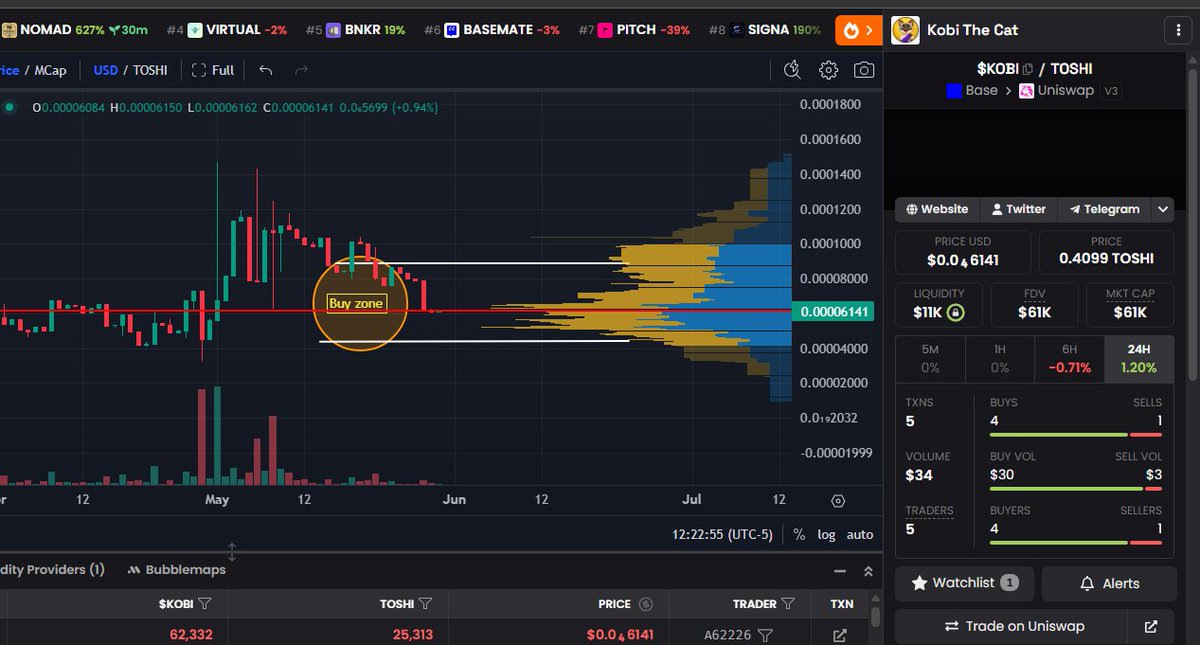
That’s where $KOBI comes in.
I’ve been waiting for $KOBI to come back into what I consider a better accumulation zone…
and price is sitting there now.
But let’s be clear:
This is a microcap.
High risk.
Illiquid.
Can absolutely go to zero.
This is not where you mortgage your grandmother’s toaster.
But these are the exact types of tiny ecosystem plays that can go insane during a parabolic bull run.
Small size.
Asymmetric upside.
Patience.
If $TOSHI runs hard, I would not be surprised to see the better Toshimart names run even harder on a percentage basis.
That’s the beta game.
And $KOBI is one of the few I’m watching seriously.
Someone, maybe Korean investors are busy on Upbit.
Week ago this was 6.55% of all ethereum:0xcccccccccc33d538dbc2ee4feab0a7a1ff4e8a94 (4.1M tokens valued $11.75M) - today it's 7.49% 4.73M valued $13.08M. Could become significant if it continues, and almost double what Binance and Kraken have
Earlier today ethereum:0xcccccccccc33d538dbc2ee4feab0a7a1ff4e8a94 futures open interest also jumped $781K on Bybit and futures volume spiked on Binance to 10.66M USDT intel.arkm.com/insights/77382…
ethereum:0xcccccccccc33d538dbc2ee4feab0a7a1ff4e8a94 #CFG#RWA#Defi#Tokenization
Everyone’s hunting for cheap in this market.
I’m hunting for value. That’s why I keep coming back to $ZIG.
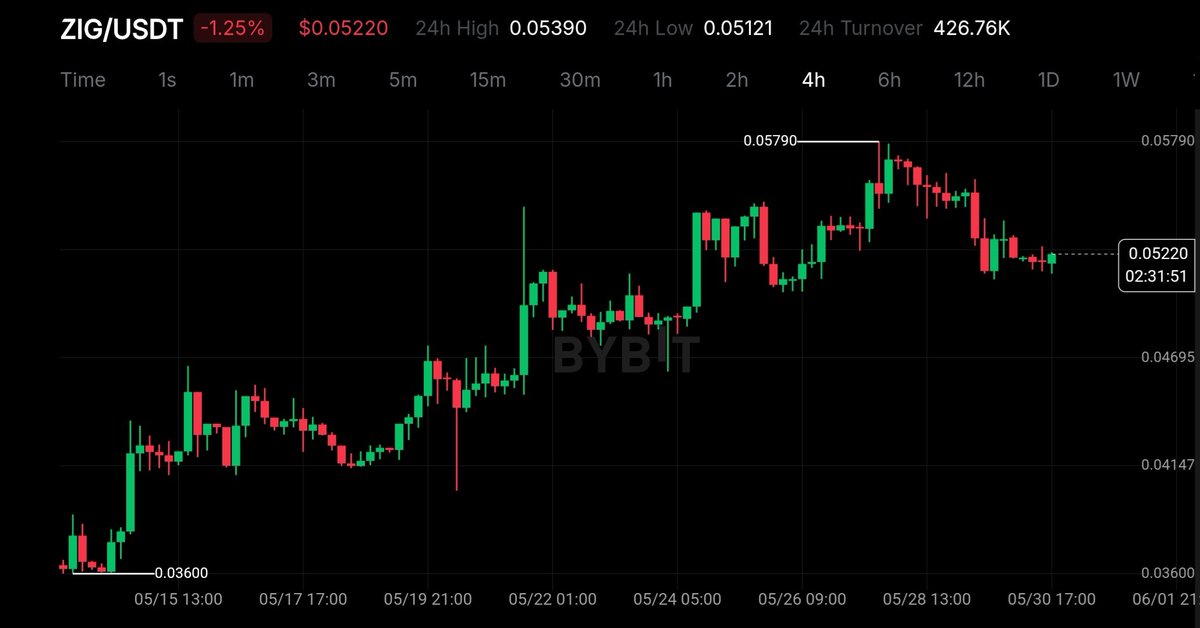
$BTC & ETH spent most of May bleeding lower, @ZIGChain nearly doubled and is still holding above $0.05. That’s not what weak assets do.
Then you look under the hood.
$40M TVL. More than half sitting in USDC. Real capital parked in live yield strategies, not hot money chasing narratives.
The valuation gap stands out too. A $100M+ FDV against $40M TVL puts ZIGChain around 2.5x FDV:TVL. In a market rewarding execution, that feels mispriced.
July 1 is another date I’m watching. Markets move on emotion. Buybacks don’t.
Everyone looking for value in this market I’ve been tracking one quietly building it.
→ $40M TVL locked in @ZIGChain ecosystem
→ Over $20M+ in USDC stablecoin liquidity sitting in live yield vaults
→ Stable capital like this doesn’t react to market fear, it stays deployed
→ $100M FDV vs $40M TVL = 2.5x ratio
→ Compared to peers like Hyperliquid (10x+ FDV/TVL) the gap looks wide
→ Buybacks starting July 1st
→ This isn’t sentiment-driven it’s structural demand entering regardless of market conditions
→ $ZIG showed relative strength nearly 2x while BTC & ETH were dumping in May
→ That kind of decoupling usually signals real underlying demand
Not financial advice just watching a setup where fundamentals are starting to speak louder than noise
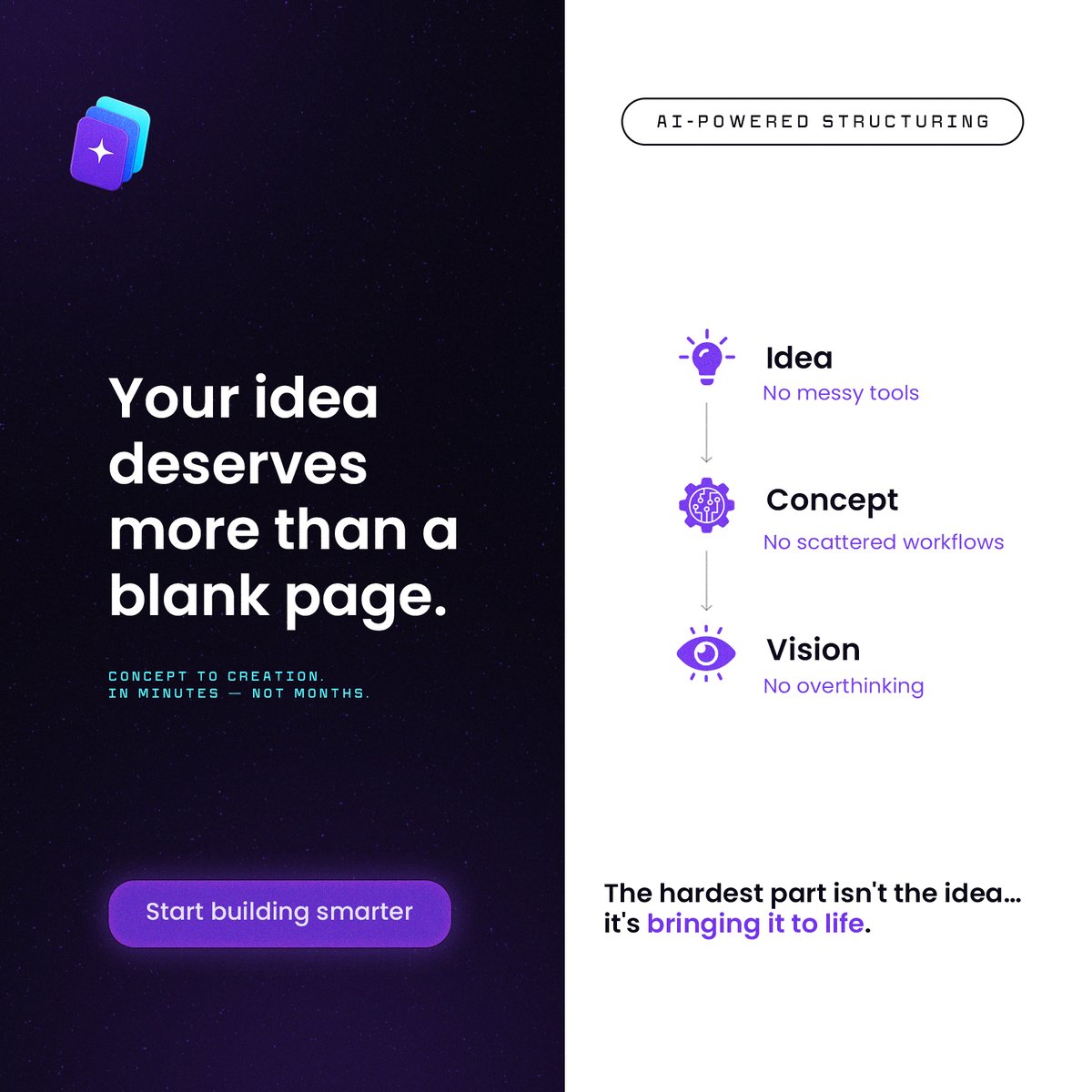
Ideas were never the bottleneck.
Ours stack up faster than we can build them, and we'd bet yours do too.
What's been missing is the engine to turn them into something real, fast. So we built it.
Decklabs now runs on multiple frontier models at once. Claude, GPT, and Deepseek, with smart routing that sends every step to whichever model handles it best. You don't pick the model, our agent does.
Drop in a raw concept and watch it come back structured and ready to build on. No blank page. No setup before the real work starts.
This is the part most tools never solve. The gap between the spark and the finished thing. We just closed it.
Bring the idea. The new frontier of human intelligence handle the rest 🚀
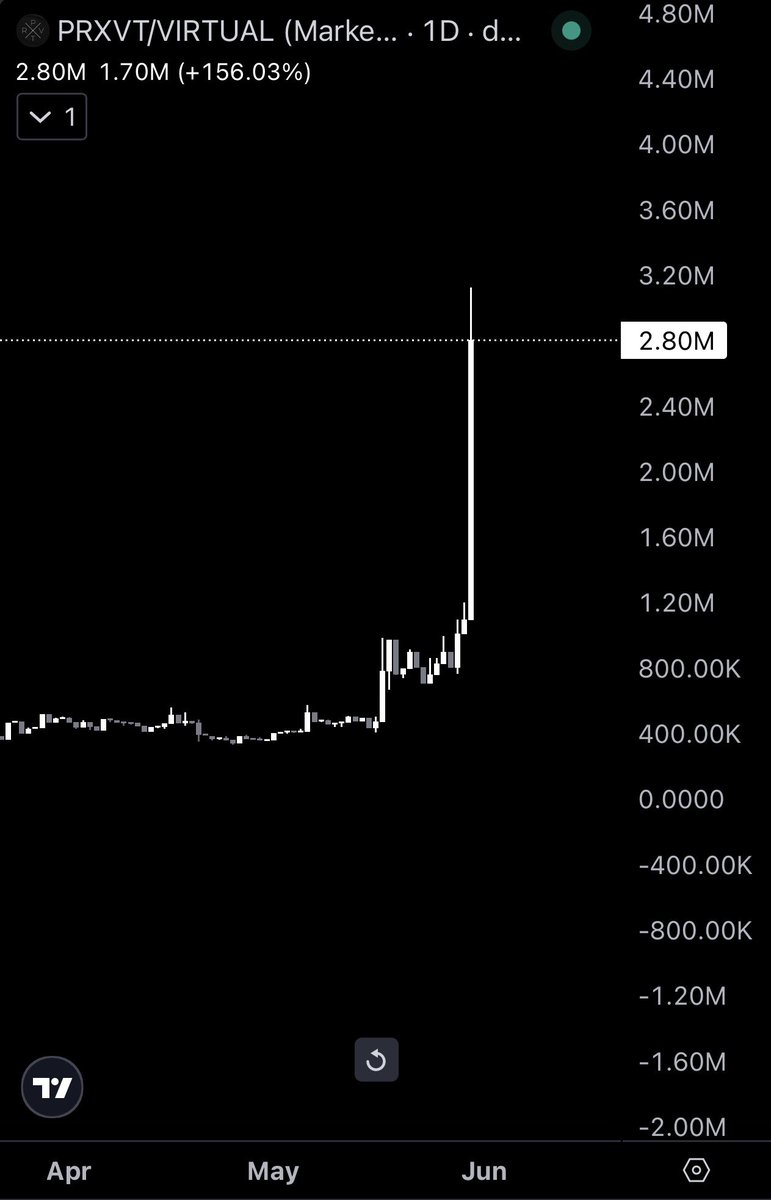
PRXVT crossed the Virtuals top-10 threshold on Base.
Our rules logged the entry after a +119.94% move in 24 hours on $248K volume. The token shows a $3.50M market cap and $5.39M FDV at 4024 holders.
It now sits inside the Virtuals top-10.
A 22-year-old developer is netting $72,000/month solo while traditional agencies with 15 employees struggle to clear $15k
He doesn't have a team. He doesn't have an office. He has a $500 overhead "Ghost Agency" powered by Kimi K2.6
He even hooked the system up to an old 1998 iMac G3 for the meme, but the profits are dead serious. While everyone else is paying salaries, he is exploiting a 90% profit margin
The Math of the Disruption:
Traditional Agency: $10,000 project → $7,000 expenses → $3,000 profit.
AI Agency: $10,000 project → $1,000 expenses → $9,000 profit
The execution layer is now a commodity. Kimi K2.6 handles the heavy lifting reading entire codebases, writing production code, and shipping in 4 minutes what used to take a senior dev half a day
His "Skill Moat" Strategy:
He doesn't just "chat" with AI. He builds custom Skill Libraries files like SKILL.md for specific verticals: Healthcare, Fintech, and high-frequency Polymarket trading tools
A competitor cannot copy his setup in a week because it is built on months of specific, fine-tuned instructions. This library is his real competitive advantage
How he finds the $10k clients:
He set an agent to monitor job listings for "Automation Engineer" or "Python Developer." Every company posting those is a company with a problem they are trying to hire their way out of
The agent reads their site, generates a personalized proposal, and explains exactly how he will automate their pain away
The Reality:
By month 10, Kimi handles 80% of the technical work. He only manages strategy and relationships
The bottleneck is never the code, Kimi handles that. The bottleneck is understanding the client's real problem. That part is still human, and it is worth $70k/mo when your execution cost is near zero
Stop trying to build a team Start building the machine
The age of the System-Architect is here
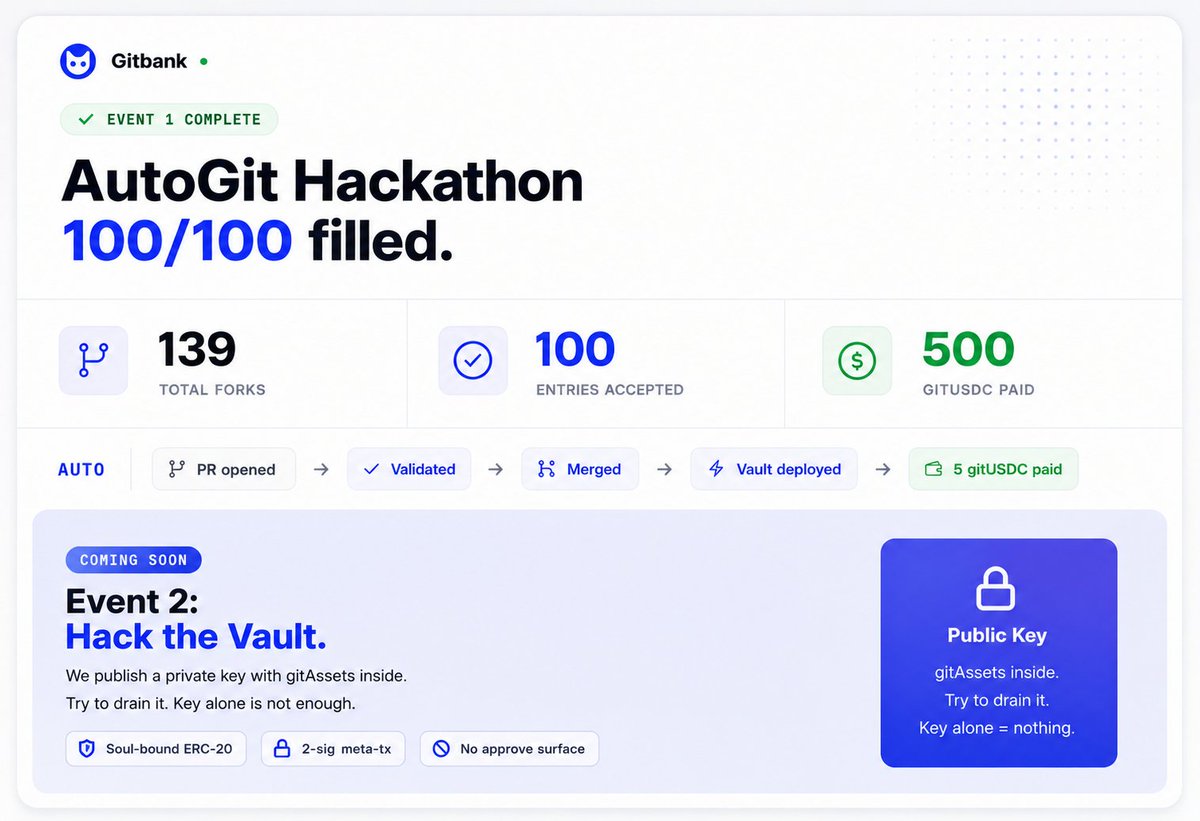
AutoGit Hackathon: Event 1 Complete
139 forks. 100 entries accepted. 500 gitUSDC paid
Every single one of those 100 payouts happened automatically.
No team member manually reviewed a single submission. No one sent a transaction by hand. No one verified a wallet address in a spreadsheet. A contributor forked the repo, added a template file, opened a PR, and within seconds the Gitbank GitHub App validated the submission, merged the PR, deployed a vault on Base mainnet, and deposited 5 gitUSDC into it. The receipt posted back to the thread with a Basescan link.
100 times. Automatically.
That is what IssueOps looks like when the financial layer actually works.
Event 2 is Coming: Hack the Vault
If you missed Event 1, you have another chance. And this one is different.
Event 2 is a security challenge.
We will publish a private key. That key controls a Gitbank vault on Base mainnet. Inside that vault are gitAssets, our soul-bound receipt tokens representing real value locked in the system.
The challenge is simple: try to move them.
If you can drain the vault, transfer the gitAssets, approve a spend, or extract any value using that private key, you win. There is no catch. The key is real. The assets are real.
We are confident no one will succeed.
Here is why:
gitAssets (gitUSDC, gitWETH) are soul-bound at the contract level. Transfers are disabled. Approvals are disabled. The vault requires two signatures on every operation, the owner signature AND the relayer signature. Holding the private key alone gives you nothing. You cannot call withdraw. You cannot call transfer. You cannot call approve. Every path that could move value is either disabled in the ERC-20 contract or gated behind a dual-signature requirement that the owner key alone cannot satisfy.
This is not a policy. It is bytecode. Verified on Basescan. Open source. Read it yourself.
Why does this matter for AI agents?
Every AI agent that needs to hold or move funds today uses one of two models: a custodial hot wallet controlled by the platform, or a raw private key the agent signs with directly. Both models have the same failure mode. If the key leaks, the wallet is drained.
Gitbank vault changes that assumption entirely.
An AI agent can hold a Gitbank vault key in plaintext, in a prompt, in a log file, in a public GitHub repo, and the funds inside are still safe. The key alone is not enough to move anything. The soul-bound system means exposure of the signing key does not equal loss of assets.
This is the wallet infrastructure AI agents have been missing.
Event 2 is the proof.
Details on how to participate will be announced shortly.