

The Battlefield Explorer
3.1K posts
The Battlefield Explorer
@battlefieldexpl
WWII battlefield guide based in The Netherlands. I lead tours across Europe, sharing the stories of the men who fought, where they fought.
The Netherlands Katılım Ocak 2010
301 Takip Edilen10.2K Takipçiler


The 6-Pounder Anti-Tank gun in Heelsum near Arnhem. A real piece of history!
English
He ran into the treeline under fire while his men surrendered.
The villager Peter Maraite sheltered him one night near Meyerode. After that the story rests on circumstance: rifle fire heard behind the lines for weeks, German wounded carried from the woods, around 200 enemy dead later found there.
The evidence fits a one-man war. It also fits other explanations. No American who served with Wood ever came forward to confirm it. What he did in those woods, no document can settle.
Veghel, Nederland 🇳🇱 English
The legend says he killed two hundred Germans alone in the woods. It may be true. It has never been proven. Lieutenant Eric Fisher Wood Jr. of the 589th Field Artillery, 106th Infantry Division, was ambushed at Schönberg on 17 December 1944 during the Battle of the Bulge.

Veghel, Nederland 🇳🇱 English
@Dozibugger I’m not sure where this gun came from
English

@battlefieldexpl Is this the Borders gun that was abandoned by the brickworks on the Monday?
English
A Dutch television programme built this mosaic memorial from photographs of Frost's airborne troops as a quick replacement. It was meant to be temporary. It is still here. On our Market Garden tour we always stop at the bridge.

Sint-Oedenrode, Nederland 🇳🇱 English
Zoom in on this photograph of John Frost at the foot of the Arnhem bridge and the portrait dissolves into hundreds of smaller faces. Each one is a man who fought at Arnhem in September 1944. The original bronze plaque, unveiled when the bridge was named after him in 1978, was stolen in April 2025.

Sint-Oedenrode, Nederland 🇳🇱 English
Nine names are etched into this memorial in Nuenen. All nine were members or former members of Easy Company, killed in the Netherlands during Operation Market Garden and the months that followed. Some died still serving with the company. Others had transferred out long before, to other units and other duties, but they are remembered here as Easy Company men.
Their deaths are spread across the campaign, from the drop near Son on 17 September 1944, down Hell's Highway, to the static weeks on The Island between the Rhine and the Waal.
We visited this memorial today on an Easy Company tour with a wonderful couple from the United States.

English
He is buried in the Arnhem Oosterbeek War Cemetery, which we also visited today during an Arnhem battlefield tour with a group of friends from Hungary.

Veghel, Nederland 🇳🇱 English
He continued to direct resistance with grenades and rifles, at one point picking up a German stick grenade and throwing it back. He ordered his men to withdraw. They protested. He stayed behind alone to cover them. For his actions he was later awarded the Victoria Cross.

Veghel, Nederland 🇳🇱 English
Captain Lionel Queripel VC stayed behind alone in a ditch near Wolfheze on the evening of 19 September 1944, covering his men's withdrawal with an automatic pistol and a few grenades. A new memorial to him was unveiled last week opposite the culvert near where he was last seen alive. 🧵

Veghel, Nederland 🇳🇱 English
Men, Jeeps, trailers and 75mm howitzers of the 82nd Airborne Division all arrived by glider near Groesbeek and Overasselt in September 1944. Many hundreds of CG-4A Wacos landed in the fields around these towns during Operation Market Garden, delivering the men of the 325th Glider Infantry Regiment and the equipment the division needed but paratroopers could not jump with.
A full-size steel replica of a Waco now stands on an original landing zone of the All Americans at Groesbeek. It was unveiled in 2014 during the seventieth anniversary commemorations. We visited this today on an Americans at Market Garden tour with a group of friends from Hungary.

Veghel, Nederland 🇳🇱 English
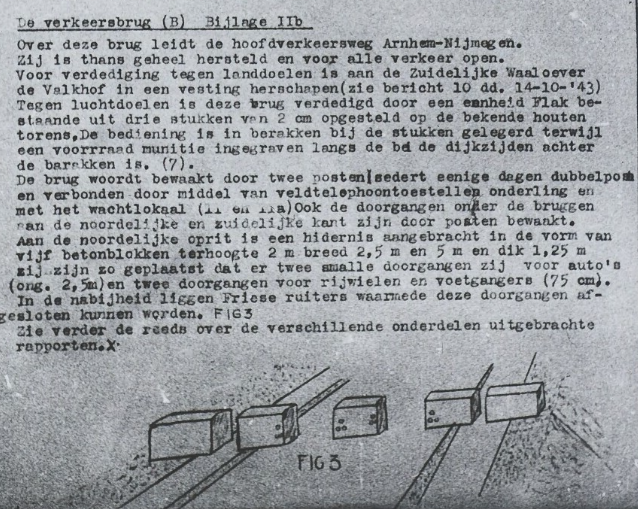
Allied troops took the position on the evening of 20 September 1944 and removed the centre block to clear the road. The rest were dumped on the floodplain and sank in the soft soil. They resurfaced in 2013 and now stand close to their original position. Bullet and shrapnel scars from 20 September 1944 are still visible in the concrete.

Veghel, Nederland 🇳🇱 English
The Dutch resistance measured the obstacle in secret and sent the details to Allied intelligence in a report dated 21 March 1944. By the time Market Garden began, the planners knew exactly what stood here. (Source: NIMH 575/372)
Veghel, Nederland 🇳🇱 English
Buried for seventy years, then dug up by accident, German concrete anti-tank blocks from 1943! In August 2013, contractors widening the Waal floodplain hit something solid on the north bank. These were part of a Panzerkampfwagenmauer, originally set diagonally across the road to slow approaching vehicles.

Veghel, Nederland 🇳🇱 English