Arjun Behura

13.6K posts

Arjun Behura banner
Arjun Behura

Arjun Behura

@behura_arjun

Engineer | #Author of two adorable kids and three books. Columnist for https://t.co/aB9wPJO6sC. Husband of 1 wife #writing #Amwriting #novel #books #fiction.

India Katılım Ağustos 2017
1.1K Takip Edilen1.3K Takipçiler
Sabitlenmiş Tweet
Arjun Behura
Arjun Behura@behura_arjun·
Happy to announce the publication of my third book of novel- The whispering songs of love. Please read & share it widely. Thank you! amazon.in/dp/B0F7G8CX3G
English
1
1
9
2.1K
Arjun Behura
Arjun Behura@behura_arjun·
@Nishant_Bliss With literally zero stakes, Pakistan has nothing to lose. They can indulge in a bit of errand job here and there to get a pat on the back by their masters. Or a few bucks may get thrown their way for the job well done. India doesn't have that luxury.
English
0
0
0
71
Nishaant Bhardwaj
Nishaant Bhardwaj@Nishant_Bliss·
Last night I wrote a post appreciating how Pakistan is handling the situation, and if they manage to pull off the peace talks successfully, they absolutely deserve credit. The post did well, got a lot of engagement and likes. I deleted it. What I noticed was that almost 90% of the comments turned into mocking India, bringing up things like chaiwala, Rafale, and calling India weak. Let me make one thing very clear. I can appreciate another country’s efforts, but that does not mean I will tolerate disrespect towards my own country just for engagement or likes. Respect goes both ways. Yes, Pakistan might be doing a good job here, and if they succeed, credit where it’s due. But India is also doing exceptionally well diplomatically, just in a different way. There are strong, calculated reasons why India is not stepping in, and those decisions are made keeping long-term national interests in mind. So appreciate where it’s deserved, but don’t confuse that with weakness.
English
261
57
849
149.2K
Arjun Behura
Arjun Behura@behura_arjun·
@MohanMOdisha bjp has scant regard for common man's problems. Vote-bank politics is where their sole interest is vested in.
English
0
0
0
15
Arjun Behura
Arjun Behura@behura_arjun·
@MohanMOdisha Swachh Odisha mission is doomed to fail given the absolute apathy with which it is being managed. You disregard valid concerns of those associated with the mission, and yet hope it to become a success. It's not going to happen.
English
0
0
0
16
Arjun Behura retweetledi
Rakesh Krishnan Simha
Rakesh Krishnan Simha@ByRakeshSimha·
Jehadi Economies vs Dharmic Economy BANGLADESH: Population - 175 million. Introduced fuel rationing. Only 10 days of oil reserves left. Daily, weekly sales limits. Long lines at pumps. Army deployed at depots. Buys 180,000 tons of diesel annually from India. PAKISTAN: Population - 250 million. Schools closed. No spectators allowed at stadiums. 50% fuel cut for Government vehicles. 4 day week. Pakistan Day parade cancelled. INDIA: Population - 1,400 million. No rationing. No crisis. IPL. Multi state elections. Fuel prices cut.
English
3
65
316
13.7K
Arjun Behura retweetledi
Mahesh Jethmalani
Mahesh Jethmalani@JethmalaniM·
There is a deeper sickness here in this vocabulary of hatred. It is vile, dangerous, and utterly unacceptable from the president of a national party. Mallikarjun Kharge saying BJP and RSS are like a poisonous snake that must be killed is not normal political rhetoric. This kind of language does not belong in a democracy. And this is not some isolated slip of the tongue. The Congress ecosystem has a long memory of this kind of politics. Sonia Gandhi's infamous "maut ka saudagar" statement or Rahul Gandhi's chosen derision over seriousness is a confusing construct because time and again, Congress leaders reach for language meant not to persuade, but to dehumanise. And then they lose, elections after election. Congress no longer seems capable of fighting political battles without hysteria. It cannot debate without demonising. It cannot oppose without vilifying. And then it wonders why the voter keeps rejecting it. Because the Indian voter understands something very simple: a party asking for votes cannot keep sounding like it wants vengeance; the bitterness of a frustrated party. Every election, this pattern repeats. Abuse dressed up as ideology. Personal vilification dressed up as political clarity. And almost every time, the people of India answer the same way: with a defeat Congress pretends not to understand. Mallikarjun Kharge’s remark deserves the strongest condemnation. Not just because it was offensive, but because it reveals a larger truth about Congress. Beneath the slogans and sermons is a party so consumed by its opponents that it has forgotten how to speak the language of democratic politics at all.
English
311
1.4K
2.7K
48.6K
Arjun Behura
Arjun Behura@behura_arjun·
@MohanMOdisha I am a small service farm providing services for music systems of BMC garbage collection trucks. I am yet to get the payment for Jan & Feb 2026 bills. The agency, Vikash, isn't making the payment saying that BMC hasn't paid them. Pl help.
English
0
0
0
26
Arjun Behura
Arjun Behura@behura_arjun·
@bmcbbsr kindly help.
Arjun Behura@behura_arjun

@bmcbbsr I am providing repair/maintenance service of music systems of bmc garbage collection trucks. I am yet to get payment for January and February 2026 bills. The agency, Vikash, isn't making the payments saying that BMC hasn't paid them.

English
0
0
0
38
Arjun Behura
Arjun Behura@behura_arjun·
@CMO_Odisha kindly help.
Arjun Behura@behura_arjun

@CMO_Odisha I am a small service farm providing repair/ maintenance service of music systems of bmc garbage collection trucks. I am yet to receive the payment for Jan & Feb 2026. The agency, Vikash, isn't making the payment saying that BMC hasn't paid them.

English
0
0
0
48
Arjun Behura
Arjun Behura@behura_arjun·
@CMO_Odisha I am a small service farm providing repair/ maintenance service of music systems of bmc garbage collection trucks. I am yet to receive the payment for Jan & Feb 2026. The agency, Vikash, isn't making the payment saying that BMC hasn't paid them.
English
0
0
0
102
Arjun Behura
Arjun Behura@behura_arjun·
@bmcbbsr I am providing repair/maintenance service of music systems of bmc garbage collection trucks. I am yet to get payment for January and February 2026 bills. The agency, Vikash, isn't making the payments saying that BMC hasn't paid them.

English
0
0
0
82
Arjun Behura retweetledi
Sonam Mahajan
Sonam Mahajan@AsYouNotWish·
Now that Iran has made it clear that it was never part of any Pakistan-led diplomatic effort to end the war, and that it had no interest in negotiating with the US in the first place, one has to ask a fairly obvious question: whose interests was Pakistan actually serving? This is precisely why India’s foreign minister was not exaggerating when he called Pakistan a dalal, a broker-nation. Because what else do you call a state that does not mediate, does not de-escalate, does not build trust, but merely delivers messages on behalf of others? By now, it looks less like Pakistan was trying to bring Iran and the US to the table, and more like it was acting as a courier, passing on Washington’s and Israel’s talking points to Tehran, with the arrogance of a self-appointed peacemaker. And it is almost comical, if it were not so dangerous. Pakistan has been punching far above its weight, selling itself to international media as some serious diplomatic player in a high-stakes war, even though it has neither the credibility nor the capability to lead anything remotely consequential. A country that cannot control its own militias, cannot stabilise its own economy, and cannot stop exporting chaos to its neighbours suddenly wants to be seen as a neutral peace broker between Iran and the US.
English
18
119
534
13.3K
Arjun Behura retweetledi
GAURAV C SAWANT
GAURAV C SAWANT@gauravcsawant·
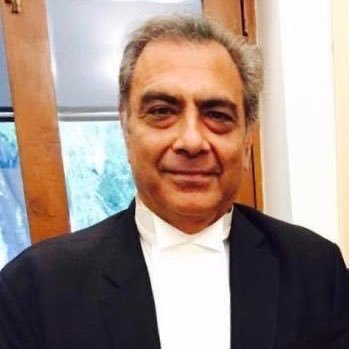
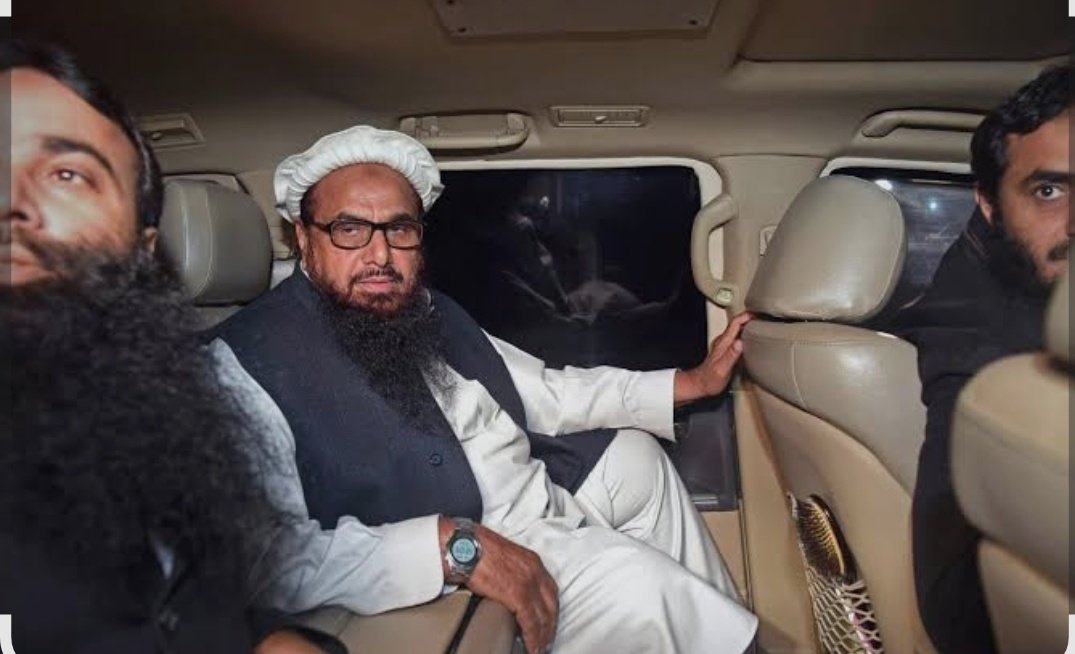
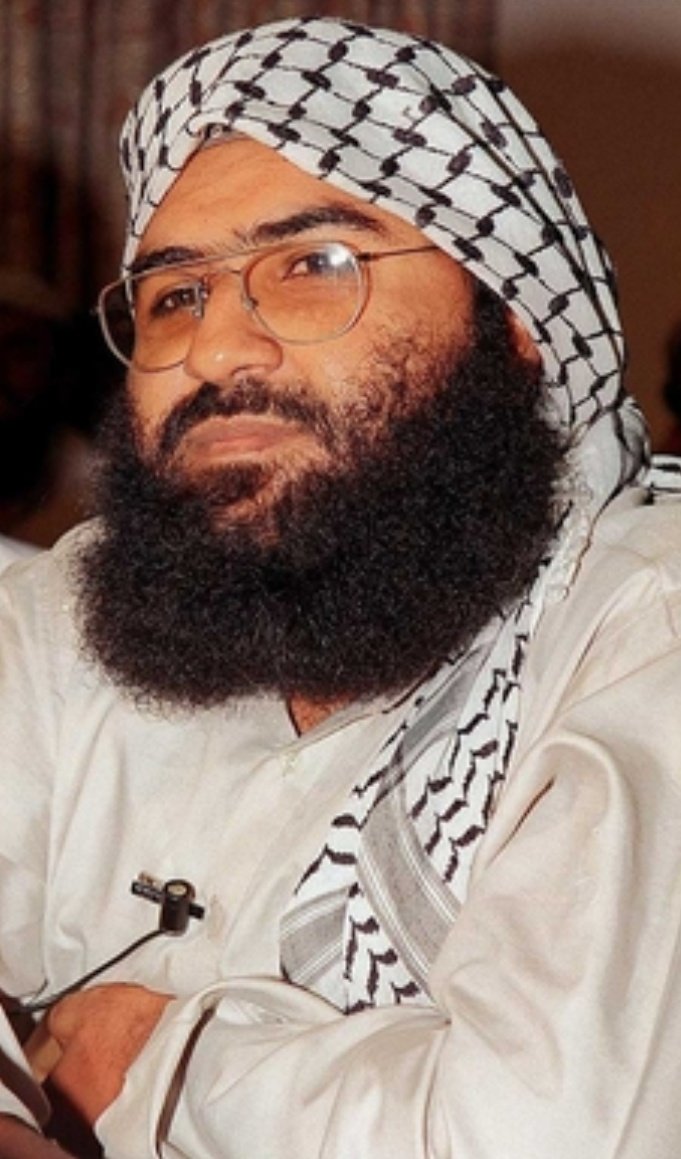
An entire region is being held hostage by these men: rabid radical Islamist terrorists/sponsors. Pakistan is a state sponsor of radical Islamist terror & a 'Dalal' that failed because Pak approach is dishonest. & Birkin bag diplomacy can't hide this obnoxious reality of Pakistan.
GAURAV C SAWANT tweet mediaGAURAV C SAWANT tweet mediaGAURAV C SAWANT tweet mediaGAURAV C SAWANT tweet media
Hina Rabbani Khar@HinaRKhar

Wow. Talk about a new low. Sad to see an entire region hostage to such men and their political theatrics.


English
22
474
2K
132.6K
Rupa Murthy
Rupa Murthy@rupamurthy1·
#Mamata Banerjee fears BJP/Modi winning means Bengalis won’t be allowed to eat fish. #Nirupama Menon opposes Modi because he didn’t support Iran and refuses to reopen dialogue with Pakistan. #Madhu Kishwar is upset she didn’t send her to Rajya Sabha. #ArfaKhanum Sherwani opposes him because he’ll keep Pakistan in its place. #Swara Bhaskar is unhappy he didn’t WhatsApp her the NRC draft. #Priyanka Gandhi objects because he’s “pro-USA.” #Dia Mirza thinks UCC means everyone will have to wear uniforms. With such “hard-hitting” arguments, India clearly has a formidable opposition…and an even more formidable Leader of the Opposition in Rahul Gandhi.
English
47
459
1.6K
31.4K
Arjun Behura retweetledi
Tattvam Asi ( तत् त्वं असि!)
Given the lady blocked me... I write my response here and hope that some kindhearted should send it to her... Madam Rao, your essay on statecraft is eloquent, but it rests on a selective reading of history—particularly your own tenure. Let us examine your four-point framework against the record. On deterrence without sentimentality: You rightly call for raising terrorism's cost. Yet during your time as Foreign Secretary (2009-11), India responded to the 26/11 Mumbai attacks, Parliament assault, and multiple train blasts not with calibrated strikes but with dossiers, 10 in total handed to Pakistan. These were dutifully received, filed, and forgotten, as LeT's Hafiz Saeed mocked from Lahore rallies. Where was the "relentless exposure" or "calibrated military response" then? The infrastructure of proxy violence you now decry thrived under that approach.. On denying Pakistan veto power: Agreed—India must outgrow its neighbour's shadow. But your consistent advocacy framed talks as the singular path forward, as if dialogue were an end rather than a means. Post-26/11, post-Sharm el-Sheikh, you and your cohort emphasised "composite dialogue" even as Pakistan's army fêted the very terrorists India buried. This was not denying veto power; it was handing Islamabad a perpetual seat at the table, diluting India's leverage. On managing conflict: Ceasefires and hotlines are pragmatic, yes. But your record prioritised de-escalation over consequences. Mumbai's 166 dead yielded no FATF grey-listing then, no Uri-style surgical strikes, no Balakot, no Operation Sindoor. Pakistan's economy tanked not from sermons but from India's coercive diplomacy—sanctions, trade curbs, global isolation. These worked precisely because New Delhi under later leadership inflicted costs Pakistan could not bear. Your "channels of communication" kept the costs theoretical; real statecraft made them unbearable. On the endgame: You dismiss "rubble" as fantasy while proposing containment via "selective engagement." But the true endgame, as events proved, belongs to Pakistan's choices under pressure. It cannot sustain terror when strikes hit deep (Uri, Balakot, Sindoor), when its IMF pleas falter, when its army's bluff is called. Nuclear geography disciplines both sides, but India's growing asymmetry—economic, military, diplomatic—means deterrence flows from demonstrated strength, not backchannels. Fury is no policy, indeed. But neither is mollycoddling, dressed as sophistication. Peace endures not from women's caucuses or Track II pleasantries, but from the quiet certainty that violation invites retribution. Your sermons might soothe op-ed pages; India's actions since 2014 have reshaped the board. That is statecraft's real measure.
Tattvam Asi ( तत् त्वं असि!) tweet media
English
7
99
222
5.6K
Arjun Behura retweetledi
Sridhar Vembu
Sridhar Vembu@svembu·
"Fury is a mood. It is not a policy." I am sorry this is a caricature. Our past policy was "we will appeal to the international community while producing copious moral lectures." We imagined ourselves to be a moral superpower but all we earned was occasional pity and never respect. I would characterize our present policy as "speak softly and carry a big stick and don't be afraid to wield it when necessary." This has earned us respect.
Nirupama Menon Rao 🇮🇳@NMenonRao

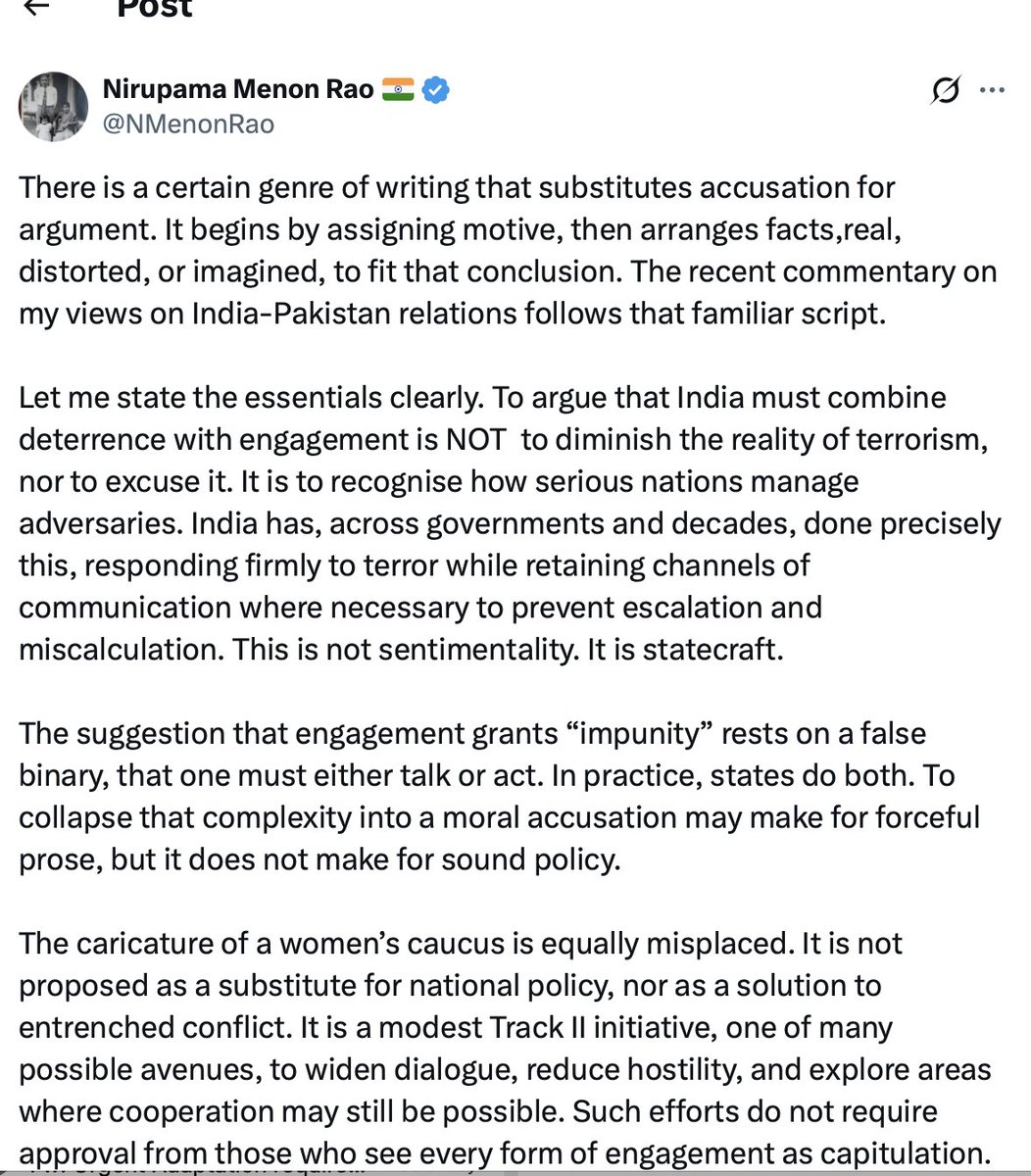
There is a certain genre of writing that substitutes accusation for argument. It begins by assigning motive, then arranges facts,real, distorted, or imagined, to fit that conclusion. The recent commentary on my views on India-Pakistan relations follows that familiar script. Let me state the essentials clearly. To argue that India must combine deterrence with engagement is NOT to diminish the reality of terrorism, nor to excuse it. It is to recognise how serious nations manage adversaries. India has, across governments and decades, done precisely this, responding firmly to terror while retaining channels of communication where necessary to prevent escalation and miscalculation. This is not sentimentality. It is statecraft. The suggestion that engagement grants “impunity” rests on a false binary, that one must either talk or act. In practice, states do both. To collapse that complexity into a moral accusation may make for forceful prose, but it does not make for sound policy. The caricature of a women’s caucus is equally misplaced. It is not proposed as a substitute for national policy, nor as a solution to entrenched conflict. It is a modest Track II initiative, one of many possible avenues, to widen dialogue, reduce hostility, and explore areas where cooperation may still be possible. Such efforts do not require approval from those who see every form of engagement as capitulation. Invoking the suffering of victims of terrorism to argue against any form of dialogue is particularly troubling. Their loss demands seriousness, not rhetorical deployment. Accountability is not strengthened by narrowing the space for thought. The claim that an idea is discredited because it is welcomed by a Pakistani voice is also a curious standard. If the merit of an argument is to be judged by who agrees with it, then independent judgment itself is surrendered. Ideas must stand or fall on their own logic. Beyond the rhetoric lies a more fundamental question: what is India’s end game with Pakistan? If it is to reduce Pakistan to rubble, that is fantasy dressed up as toughness. It is not going to happen, and any attempt to move in that direction would risk catastrophe for the entire region, not least for India. Nuclear geography is a stern schoolmaster. It does not indulge chest-thumping. The real end game has to be containment, deterrence, internal strengthening, and selective engagement. In plain words: India’s objective should be to make Pakistan’s use of terror too costly to sustain, while preventing the relationship from sliding into permanent uncontrolled escalation. That means four things. First, raise the cost of terrorism. Through intelligence, border management, diplomatic isolation where warranted, calibrated military response when necessary, and relentless exposure of the infrastructure of proxy violence. No illusions there. Second, deny Pakistan veto power over India’s future. We should not let our growth, our diplomacy, our regional ambitions, or our internal confidence be held hostage by a single hostile neighbour. The greatest strategic answer to Pakistan is a stronger, more cohesive, more prosperous India. Third, manage the conflict, not romanticise it. There will be no grand reconciliation in the near term. But neither can every interaction be reduced to rage. Ceasefire mechanisms, back channels, water safeguards, crisis hotlines, and limited functional engagement are not signs of softness. They are instruments of control. Fourth, keep open the possibility of a different future without betting on it. That is where dialogue belongs. Not as wishful thinking, not as “aman ki asha” balloon releases, but as disciplined statecraft. You talk not because you trust, but because you must understand, signal, warn, probe, and occasionally de-escalate. So the end game is not rubble. It is a Pakistan that is deterred, constrained, denied easy success, and unable to derail India’s future. Fury is a mood. It is not a policy.

English
66
569
2K
51K
Arjun Behura retweetledi
Dr Poornima 🇮🇳
Dr Poornima 🇮🇳@PoornimaNimo·
Watch this clip of 30 seconds. Home Minister Amit Shah demolished years of propaganda of the likes of Suzanne Arundhati Roy, Kanhaiya Kumar, Nandini Sundar, Nivedita Menon, Human Rights Organisations and Naxal sympathiser Gang of JNU in four sentences. "When naxal girls were rehabilitated by us as part of the rehabilitation program run by certain NGOs and voluntary organisations, the young girls used to weep tears of joy while putting on nailpolish, mehendi as they had not enjoyed this luxury ever." "Grown men while meeting their parents, would start fighting with them, blaming them for destroying their life &future by keeping them in the custody of naxals." Amit Shah : "It is very convenient to talk about the human rights of Urban Naxals sitting in AC premises, writing articles on them or in universities with police protection, but one should visit these rehabilitation camps to fully comprehend that your baseless prejudiced support for the urban naxals, destroyed the lives of more than 15000 young kids."
English
24
951
2.4K
33.9K
Arjun Behura retweetledi
Akhilesh Mishra
Akhilesh Mishra@amishra77·
There are various ways to look at this post. One obvious way people are looking at is the naivety or cluelessness of our elite foreign policy mandarins that, despite galactic evidence to the contrary, they still think Pakistan is amenable to reason or talks. If you look at it closely, it is not naivety. Or cluelessness. Or reason amid chaos. Or a calm and sensible approach. It is, instead, plain and simple self-interest, even if it compromises national interest. All these formulations to somehow engage Pakistan serve just one cause: self-interest of conflict entrepreneurs. 1. Think of Kashmir and the galaxy of 'experts' who had mushroomed - from 'Interlocutors' to Hurriyat types, and from TV anchors to assorted busybodies in conferences - who presumed to solve the internal dimension of Kashmir for us. For decades they existed, and yet Kashmir festered. Local terrorists thrived; stone pelting was the only form of communication; schools closed; local elected bodies were non-existent. The day we (Modi Government) stopped listening to them is the day we succeeded. Article 370 done and dusted. Ladakh converted into a separate UT. Hurriyat dismantled. State government functioning within the confines of the Indian Constitution. Grassroot-level elected officials share the democratic power structure. Stone pelting, a decade-old, forgotten and dismantled industry. 2. Or think of the Maoists and Naxals and the galaxy of liberals in Delhi who sprouted wisdom in TV studios and conferences on how to tackle Maoism. All this while, in the real world, the Naxals butchered our security forces, destroyed infrastructure, burnt down schools, and strangulated the future of the tribals. The day we (Modi government) stopped listening to the 'sane and sensible liberals' is the day we succeeded. Naxals have been wiped out. Economic growth and opportunities have returned to those troubled lands. In each case, the troubles and mayhem persisted till the conflict entrepreneurs had their jobs and their debauched lifestyle. The day we stopped funding them is the day India started succeeding. Pakistan is the same story of 'conflict entrepreneurs'. Every such formulation - including the latest one of 'Women of South Asia' - is designed to create just one thing and one thing alone: perpetual jobs and other people-funded lifestyles for the elite mandarins. It would do precisely zero to advance any agenda. History tells us so. Remember the almost monthly Track-II talks during the UPA period, the same period during which @NMenonRao was in active service. The same period when there were monthly terror attacks. The Track-IIs have ended. And so has the ability of Pakistan to strike India at will. So what Ms. @NMenonRao is proposing here is not a sensible way forward to deal with Pakistan. All that she is pleading for is to find a way back into the job market for herself and her ilk. Incidentally, this phenomenon of promoting self-interest at the cost of national interest is a uniquely Third World phenomenon, ingrained in the mindset after centuries of colonisation. It afflicts Pakistan as much as it does India, with one exception. In the elite Pakistani mindset, they have no delusions when it comes to India. They want our total destruction, and they see Indian elites (of the ancien régime) as useful idiots, while Indian elites are happy to partake in the conferences and the junkets. Finally, we should never imagine that the dangers of the thought process of the Congress years have permanently passed. Just look at Ms. Menon's timeline to notice the concerted attempt to mobilise support for her agenda. What is needed is vigilance so that these agendas don't ever make a comeback. As an aside, there is an interesting chronology of the India Initiative launched at Brown University when Ms. Menon was India's Ambassador to the USA, and Ms. Menon joining Brown as a fellow soon after retirement.
Nirupama Menon Rao 🇮🇳@NMenonRao

The women of India and Pakistan need to deploy our ingrained common sense and suggest ways forward in our relationship. We need a women’s caucus. Not to throw accusations against each other but to think calmly and sensibly about the future ahead. For the sake of our children. We need to bring in the counterpoint: without naming it, without sounding defensive, but making it impossible to dismiss. For decades, India–Pakistan engagement has been trapped in a single script: territory, terror, recrimination. We repeat it with ritual precision, but it yields diminishing returns. What if we widened the frame? In West Asia, especially the Gulf, our interests often run in parallel: energy security, diaspora welfare, maritime stability, crisis response. These are not abstractions since they affect millions of lives and the resilience of both economies. Engaging here need not dilute our positions, create false parity, or reopen familiar disputes. It can remain tightly bounded, issue-specific, and without prejudice to core differences. Skeptics will argue that Pakistan cannot compartmentalise, that any engagement risks being instrumentalised, and that peripheral cooperation has never altered core hostility. But the purpose here is not transformation, it is insulation. Not to resolve the conflict by other means, but to prevent it from defining all means. Some may also say Pakistan has found a “role” in the Iran crisis and India should not be seen as seeking one. But this is not about visibility or mediation. Our interests are structural not transitory. If anything, the moment underscores a larger truth: even adversarial states operate beyond their disputes when interests demand it. When the central track is blocked, responsible statecraft does not stand still. It explores parallel ones, carefully, deliberately, and on its own terms. Sometimes, widening the field is not weakness. It is strategy. The women must speak.

English
45
167
435
27.4K
Arjun Behura retweetledi
Minhaz Merchant
Minhaz Merchant@MinhazMerchant·
Jaishankar was being both polite & accurate when he said last week that “India cannot act as a dalal nation.” Those who assume he was referring to Pakistan’s attempt to thrust itself into the position of an interlocutor, EAM could have been sharper. Pakistan is a state sponsor of terrorism run by an openly jihadist army chief. It’s time we did plain speaking about Pakistan instead of whinging about diplomatic niceties. With Pakistan they do NOT apply.
Lt Gen H S Panag(R)@rwac48

A sophisticated diplomat has been reduced to a caricature of his former self .

English
31
233
1.1K
65.9K
Arjun Behura retweetledi
sushant sareen
sushant sareen@sushantsareen·
The obsession of some Indian diplomats to "make our voice heard, stand by our principles, make the moral argument" tells us how ill-equipped they were in understanding the ruthless and unforgiving reality of international relations. Any surprise that under their watch India was constantly being attacked by Pakistani terrorists and all this moralising brigade could do was retaliate by threatening to retaliate and then scurrying back to a desultory dialogue with the Pakistanis. Having been epic failures in protecting India's interests, they should now sit down and keep their moral science IR to themselves because no one in India or rest of the world is interested in hearing what they say, no one gives a damn about their principled stand and their moral arguments evoke a derisive yawn.
English
182
1.2K
4.1K
105.3K
Arjun Behura
Arjun Behura@behura_arjun·
We must abolish upsc system altogether, if this is the nonsense our nation has to wear as an albatross around her neck. We would have been better placed without these worthies deciding the things for us.
Nirupama Menon Rao 🇮🇳@NMenonRao

The women of India and Pakistan need to deploy our ingrained common sense and suggest ways forward in our relationship. We need a women’s caucus. Not to throw accusations against each other but to think calmly and sensibly about the future ahead. For the sake of our children. We need to bring in the counterpoint: without naming it, without sounding defensive, but making it impossible to dismiss. For decades, India–Pakistan engagement has been trapped in a single script: territory, terror, recrimination. We repeat it with ritual precision, but it yields diminishing returns. What if we widened the frame? In West Asia, especially the Gulf, our interests often run in parallel: energy security, diaspora welfare, maritime stability, crisis response. These are not abstractions since they affect millions of lives and the resilience of both economies. Engaging here need not dilute our positions, create false parity, or reopen familiar disputes. It can remain tightly bounded, issue-specific, and without prejudice to core differences. Skeptics will argue that Pakistan cannot compartmentalise, that any engagement risks being instrumentalised, and that peripheral cooperation has never altered core hostility. But the purpose here is not transformation, it is insulation. Not to resolve the conflict by other means, but to prevent it from defining all means. Some may also say Pakistan has found a “role” in the Iran crisis and India should not be seen as seeking one. But this is not about visibility or mediation. Our interests are structural not transitory. If anything, the moment underscores a larger truth: even adversarial states operate beyond their disputes when interests demand it. When the central track is blocked, responsible statecraft does not stand still. It explores parallel ones, carefully, deliberately, and on its own terms. Sometimes, widening the field is not weakness. It is strategy. The women must speak.

English
0
0
0
13