Beth Darnall, PhD

7.5K posts

Beth Darnall, PhD banner
Beth Darnall, PhD

Beth Darnall, PhD

@BethDarnall

Professor • Director, Stanford Pain Relief Innovations Lab • Chief Science Advisor: AppliedVR • Writing about pain, stress, health & solutions

Stanford University Katılım Haziran 2014
1.3K Takip Edilen10.3K Takipçiler
Sabitlenmiş Tweet
Beth Darnall, PhD
Beth Darnall, PhD@BethDarnall·
Effective pain treatment is meaningless if people can’t access it
English
42
152
652
0
Stanford Anesthesiology
Stanford Anesthesiology@stanfordanes·
We’re pleased to share that Dr. @BethDarnall has been elected President-Elect of the United States Association for the Study of Pain (@US_ASP)! Over the next four years, she will help guide the organization’s leadership, support their growth, and advance strategic priorities.
Stanford Anesthesiology tweet media
English
2
1
12
565
omusicth
omusicth@omusicth·
@BethDarnall Look forward to seeing your work! I'm sure it moves the ball forward!
English
1
0
0
11
Beth Darnall, PhD
Beth Darnall, PhD@BethDarnall·
Just turned in my latest book manuscript. 300 pages 🥵
English
2
0
6
272
Beth Darnall, PhD
Beth Darnall, PhD@BethDarnall·
Also do not carpetbomb 50 people on a generic outreach message and expect engagement. thoughtful, personal and respectful inquiries get attention. If you want people to give you time, show them that you’ve taken the time to understand why you are a good fit
English
0
0
2
205
Beth Darnall, PhD
Beth Darnall, PhD@BethDarnall·
If you are a high school student or undergrad blasting cold emails to university professors in pursuit of a faculty mentor, word of advice: Do not begin your email with “Hey there!”
English
1
0
1
262
𓆩𓆪
𓆩𓆪@u14s_·
@NTFabiano Actually, empirical data suggests the opposite. Structured cognitive offloading to AI significantly improved critical thinking scores. The risk isn't AI, but unstructured use. Outsourcing syntax frees up cognitive resources for high level reasoning doi.org/10.30564/fls.v…
English
2
0
4
431
Nicholas Fabiano, MD
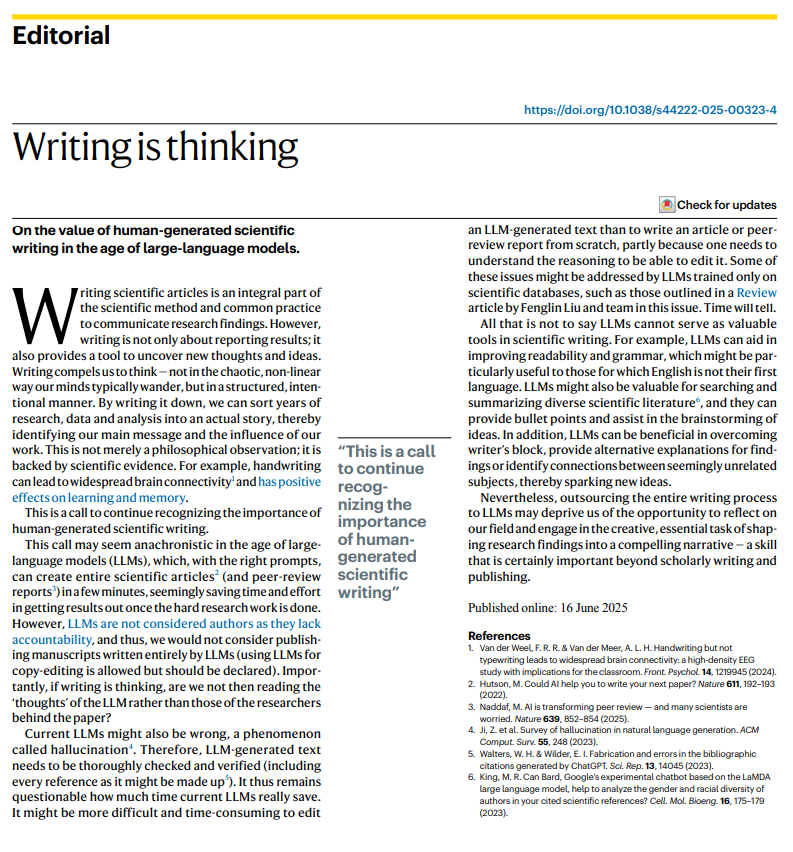
Nicholas Fabiano, MD@NTFabiano·
Writing is thinking. Don't let AI do it all.
Nicholas Fabiano, MD tweet media
English
127
2K
9.3K
443.5K
Beth Darnall, PhD retweetledi
Stanford Anesthesiology
Stanford Anesthesiology@stanfordanes·
Dr. Theresa Lii is studying how ketamine can “reprogram” the brain’s pain pathways for patients whose chronic pain hasn’t responded to other treatments. Her work is helping uncover who benefits most and how relief can last. Read more: stanford.io/40kN90s
English
0
1
3
553
Beth Darnall, PhD
Beth Darnall, PhD@BethDarnall·
@EmpoweredRelief @MarfanFdn This was a single-arm study and larger controlled studies are needed. We show a model for how to treat large groups of patients with rare disease in a single online cohort
English
0
0
0
73
Beth Darnall, PhD retweetledi
Stanford Pain Medicine
Stanford Pain Medicine@StanfordPain·
What’s new: A team led by @DesAzizoddin tested Cancer Pain 101, a single-session 90-minute telehealth class with pharmacist, social worker, and psychologist educators.
English
1
2
3
343
Faheem Ullah
Faheem Ullah@Faheem_uh·
Last week, I received reviews from a journal. 2 of the 3 reviewers pointed out the same issue. 𝑇ℎ𝑒 𝑓𝑜𝑙𝑙𝑜𝑤𝑖𝑛𝑔 𝑝𝑎𝑝𝑒𝑟 𝑖𝑠 𝑚𝑖𝑠𝑠𝑖𝑛𝑔 𝑓𝑟𝑜𝑚 𝑡ℎ𝑒 𝑙𝑖𝑡𝑒𝑟𝑎𝑡𝑢𝑟𝑒 𝑟𝑒𝑣𝑖𝑒𝑤. Upon checking, I realized the paper was very relevant. I was surprised how I missed this paper. I re-run the search terms on Google Scholar. The identified paper still went missing. Then I tried searching using @RsrchRabbit ResearchRabbit picked the paper. 𝐇𝐞𝐫𝐞 𝐢𝐬 𝐡𝐨𝐰 𝐈 𝐮𝐬𝐞𝐝 𝐑𝐞𝐬𝐞𝐚𝐫𝐜𝐡𝐑𝐚𝐛𝐛𝐢𝐭. 1. I logged into researchrabbit.ai 2. I searched 2-3 papers I already knew 3. ResearchRabbit built a visual map of related papers. 4. Then I explored the map → x-axis shows the publication date → y-axis shows the citation count 5. On each paper in map, I clicked “𝑓𝑖𝑛𝑑 𝑟𝑒𝑙𝑎𝑡𝑒𝑑 𝑝𝑎𝑝𝑒𝑟” 6. This way, each paper becomes a seed 7. With each round, I identified more papers. This way I identified papers that I totally missed before. I saved the papers within the library. I also included the missing papers in my review. You don’t want to miss any relevant papers? Try @RsrchRabbit: researchrabbit.ai
English
1
26
140
16.9K
Beth Darnall, PhD
Beth Darnall, PhD@BethDarnall·
Wishing everyone an amazing 2026 🙌🏼
English
1
0
1
138
Beth Darnall, PhD
Beth Darnall, PhD@BethDarnall·
📢VOTING IS OPEN for the United States Association for the Study of Pain (USASP) election!! Learn more about USASP at usasp.org and be sure to vote for all open Board of Directors positions
Beth Darnall, PhD tweet media
English
0
1
5
323
Beth Darnall, PhD
Beth Darnall, PhD@BethDarnall·
@aander1987 Burden prevents patients from participating in research and even receiving basic health care. Because of burden, those with the least means cannot participate in research, and studies yield homogenous data/results that are not inclusive We must meet patients where they are
English
1
1
4
147
Andrea Anderson
Andrea Anderson@aander1987·
@BethDarnall This is such an urgent observation. Thank you for pointing out the issues patients face when participating in clincial trials.
English
1
0
4
46
Beth Darnall, PhD
Beth Darnall, PhD@BethDarnall·
Also, clinical trials can be quite burdensome to patients and far from “ideal” in many ways. Studying outcomes of routine care gives a clearer picture of what works and for whom
Stanford Pain Medicine@StanfordPain

A new review in @PAINthejournal by @DrSeanMackey and colleagues explains how data from everyday care — called real-world data — can help us understand what truly works for people living with pain. Why it matters: Clinical trials are done under ideal conditions, but everyday care is far more complex. Real-world evidence fills this gap, showing how treatments work across diverse patients, clinics, and communities.


English
2
0
6
715
Beth Darnall, PhD
Beth Darnall, PhD@BethDarnall·
Really enjoyed speaking at the Colorado Pain Society 2025 annual meeting in Vail this weekend. Energized after connecting with so many fantastic colleagues. Thank you CPS for the invite!
Beth Darnall, PhD tweet media
English
0
1
8
629