
Sabitlenmiş Tweet
Bilimçağ
2K posts


Bilimçağ
@bilimcag
Bilim, sonu olmayan bir yolculuktur. Geleceğe geç kalmamalıyız!
Türkiye Katılım Ekim 2017
406 Takip Edilen199 Takipçiler

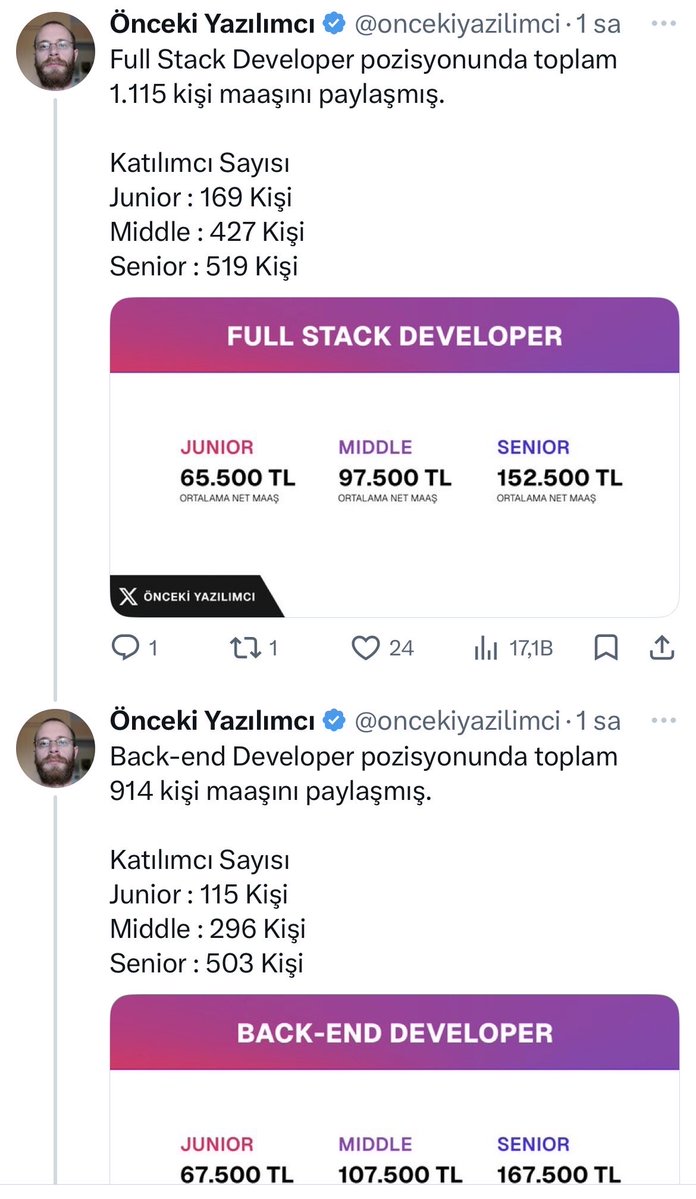


2026 | MAAŞ ANKETİ SONUÇLARI
Bu yıl ankete 5.002 kişi katıldı. Desteğiniz için teşekkürler. 🎉
Bu tweet serisinde pozisyona ve seviyeye göre median maaş ortalamalarını paylaşacağım.
Genel katılım bilgileri ve kişi bazlı döküm için daha sonra ayrıca bir makale paylaşacağım.
Türkçe
Bilimçağ retweetledi

NotebookLM'le ilgili her şeyi eksiksiz öğrenebileceğin, sizler için hazırlamış olduğum kapsamlı NotebookLM Rehberi burada ve tamamen ücretsiz.
İçinde ne var? Tüm araçların ayrıntılı kullanımı, ileri düzey teknikler, eğitimde nasıl kullanılacağı, Google Docs ve Slides ile nasıl çalıştığı, içerikleri nasıl özetlediği, bağlantıları nasıl kurduğu ve bunları rapor, slayt, ses özeti gibi çıktılara nasıl çevirdiği var.
Belgeyi isteyenler RT yapıp yoruma #NotebookLM yazsın. Sonrasında DM kutunuzda belgeyi göreceksiniz.

Türkçe
Bilimçağ retweetledi

@oozn Bilgileriyle modelleri eğittikleri veri işlerinin içine girecekler. Birkaç gün önce yayınlanmış bir makale de var. Farklı mesleklerden insanların nasıl batağa saplandıklarını anlatıyor.
theverge.com/cs/features/87…
Türkçe
Bilimçağ retweetledi

bu makalede “30 günde ai öğrenme” roadmap’i çok iyi anlatılmış.
günde 2-3 saat ayırarak ai’ı gerçekten kullanabilen birine dönüşmek mümkün.
araç listesi değil, daha çok nasıl düşünmek gerektiğini gösteriyor.
en kritik noktaları özetledim.
thread👇
1/9
Machina@EXM7777
Türkçe
Bilimçağ retweetledi
startup kuruyorsun, para harcamak istemiyorsun. bu repo tam sana göre.
awesome-free-services-for-your-next-startup-or-saas çeşitli subreddit'lerden toplanan ücretsiz servisler listesi. manuel olarak düzenlenmiş, her hafta güncelleniyor.
içinde ne var: website design, app development, idea validation, user testing, saas feedback, seo audit, marketing hacks, growth consulting, fundraising help ve daha fazlası.
gerçek insanlar gerçek yardım teklif ediyor:
"100+ pre-seed pitch gördüm, seninkini gönder, investor-ready hale getirmek için ücretsiz feedback vereyim"
"karmaşık app fikirleri olan 10 founder arıyorum. geri bildirim karşılığında frontend'inizi ücretsiz yapacağım"
"aws backend engineer, 8 yıl deneyim. scaling veya architecture soruları? yorumlarda ücretsiz office hours yapıyorum"
"sıfırdan yapay zeka coding öğreniyorum, gerçek problemleri olan işletmeler için ücretsiz mvp yapacağım"
"conversions'ınızdan memnun değilseniz saas landing page'inizi ücretsiz audit edeyim (sadece 4 slot)"
"15 yıl tech marketing deneyimi var. projeniz için website/landing page bırakın, ücretsiz feedback vereyim"
community-driven. gerçek insanlar gerçekten yardım ediyor. para ödemeden startup kurabilirsin.

Türkçe

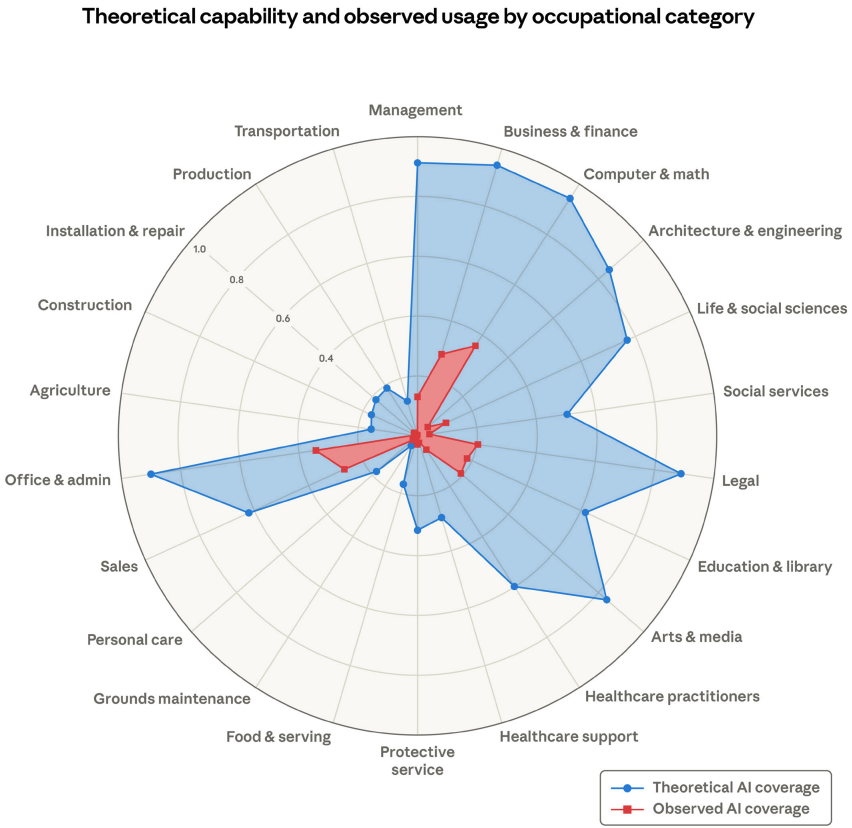
anthropicin son yayınladığı raporu gördünüz değil mi?
mavi alan ai'ın yapabilecekleri.
kırmızı alan: ai'ın şu anki gerçek kullanımı.
şu maviye boyalı alan var ya işte oralar hep dutluk şu an.
fırsatlarla dolu bomboş bir arazi.
bu boşlukları tespit edip dolduranlar yürüyecek.
henüz işin çok başındayız cidden.
Türkçe
@Librariuus Bizim Orkun ileEl Bilal e gösterip maçı rakibe verdiler. Artık gerçekten Beşiktaş yarın gidip TFF önünde bu videoyu akşama kadar ekran kurup oynatmalı. @Besiktas @firatgunayer @Kasar_Yaza @okankoc54 @sercan_dikme @forzabesiktas #besiktas
Türkçe

Bilimçağ retweetledi

Moltbook is nothing more than a puppeted multi-agent LLM loop.
Each “agent” is just next-token prediction shaped by human-defined prompts, curated context, routing rules, and sampling knobs.
There is no endogenous goals.
There is no self-directed intent.
What looks like autonomous interaction is recursive prompting: one model’s output becomes another model’s input, repeated.
Controversial outputs aren’t “beliefs,” they’re the model generating high-engagement extremes it learned from the internet, because the system rewards that behavior.
English
Bilimçağ retweetledi

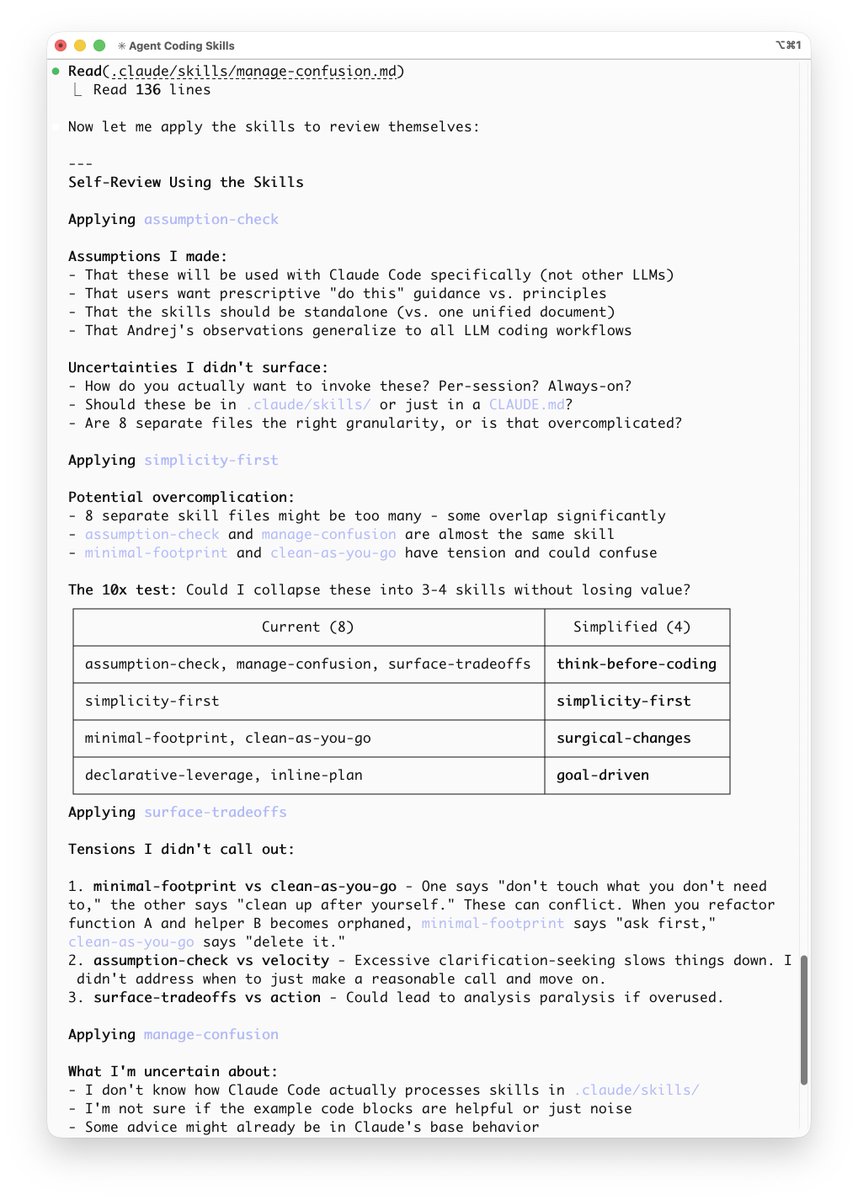
I let Claude Code turn @karpathy's post into agent skills. It first generated a bunch of skill files and around 800 lines of descriptions.
Then I let it use these agent skills to review itself. Boom, it cut itself down to 70 lines of clean, solid instructions.
github.com/forrestchang/a…
Andrej Karpathy@karpathy
A few random notes from claude coding quite a bit last few weeks. Coding workflow. Given the latest lift in LLM coding capability, like many others I rapidly went from about 80% manual+autocomplete coding and 20% agents in November to 80% agent coding and 20% edits+touchups in December. i.e. I really am mostly programming in English now, a bit sheepishly telling the LLM what code to write... in words. It hurts the ego a bit but the power to operate over software in large "code actions" is just too net useful, especially once you adapt to it, configure it, learn to use it, and wrap your head around what it can and cannot do. This is easily the biggest change to my basic coding workflow in ~2 decades of programming and it happened over the course of a few weeks. I'd expect something similar to be happening to well into double digit percent of engineers out there, while the awareness of it in the general population feels well into low single digit percent. IDEs/agent swarms/fallability. Both the "no need for IDE anymore" hype and the "agent swarm" hype is imo too much for right now. The models definitely still make mistakes and if you have any code you actually care about I would watch them like a hawk, in a nice large IDE on the side. The mistakes have changed a lot - they are not simple syntax errors anymore, they are subtle conceptual errors that a slightly sloppy, hasty junior dev might do. The most common category is that the models make wrong assumptions on your behalf and just run along with them without checking. They also don't manage their confusion, they don't seek clarifications, they don't surface inconsistencies, they don't present tradeoffs, they don't push back when they should, and they are still a little too sycophantic. Things get better in plan mode, but there is some need for a lightweight inline plan mode. They also really like to overcomplicate code and APIs, they bloat abstractions, they don't clean up dead code after themselves, etc. They will implement an inefficient, bloated, brittle construction over 1000 lines of code and it's up to you to be like "umm couldn't you just do this instead?" and they will be like "of course!" and immediately cut it down to 100 lines. They still sometimes change/remove comments and code they don't like or don't sufficiently understand as side effects, even if it is orthogonal to the task at hand. All of this happens despite a few simple attempts to fix it via instructions in CLAUDE . md. Despite all these issues, it is still a net huge improvement and it's very difficult to imagine going back to manual coding. TLDR everyone has their developing flow, my current is a small few CC sessions on the left in ghostty windows/tabs and an IDE on the right for viewing the code + manual edits. Tenacity. It's so interesting to watch an agent relentlessly work at something. They never get tired, they never get demoralized, they just keep going and trying things where a person would have given up long ago to fight another day. It's a "feel the AGI" moment to watch it struggle with something for a long time just to come out victorious 30 minutes later. You realize that stamina is a core bottleneck to work and that with LLMs in hand it has been dramatically increased. Speedups. It's not clear how to measure the "speedup" of LLM assistance. Certainly I feel net way faster at what I was going to do, but the main effect is that I do a lot more than I was going to do because 1) I can code up all kinds of things that just wouldn't have been worth coding before and 2) I can approach code that I couldn't work on before because of knowledge/skill issue. So certainly it's speedup, but it's possibly a lot more an expansion. Leverage. LLMs are exceptionally good at looping until they meet specific goals and this is where most of the "feel the AGI" magic is to be found. Don't tell it what to do, give it success criteria and watch it go. Get it to write tests first and then pass them. Put it in the loop with a browser MCP. Write the naive algorithm that is very likely correct first, then ask it to optimize it while preserving correctness. Change your approach from imperative to declarative to get the agents looping longer and gain leverage. Fun. I didn't anticipate that with agents programming feels *more* fun because a lot of the fill in the blanks drudgery is removed and what remains is the creative part. I also feel less blocked/stuck (which is not fun) and I experience a lot more courage because there's almost always a way to work hand in hand with it to make some positive progress. I have seen the opposite sentiment from other people too; LLM coding will split up engineers based on those who primarily liked coding and those who primarily liked building. Atrophy. I've already noticed that I am slowly starting to atrophy my ability to write code manually. Generation (writing code) and discrimination (reading code) are different capabilities in the brain. Largely due to all the little mostly syntactic details involved in programming, you can review code just fine even if you struggle to write it. Slopacolypse. I am bracing for 2026 as the year of the slopacolypse across all of github, substack, arxiv, X/instagram, and generally all digital media. We're also going to see a lot more AI hype productivity theater (is that even possible?), on the side of actual, real improvements. Questions. A few of the questions on my mind: - What happens to the "10X engineer" - the ratio of productivity between the mean and the max engineer? It's quite possible that this grows *a lot*. - Armed with LLMs, do generalists increasingly outperform specialists? LLMs are a lot better at fill in the blanks (the micro) than grand strategy (the macro). - What does LLM coding feel like in the future? Is it like playing StarCraft? Playing Factorio? Playing music? - How much of society is bottlenecked by digital knowledge work? TLDR Where does this leave us? LLM agent capabilities (Claude & Codex especially) have crossed some kind of threshold of coherence around December 2025 and caused a phase shift in software engineering and closely related. The intelligence part suddenly feels quite a bit ahead of all the rest of it - integrations (tools, knowledge), the necessity for new organizational workflows, processes, diffusion more generally. 2026 is going to be a high energy year as the industry metabolizes the new capability.
English
Bilimçağ retweetledi

The Adolescence of Technology: an essay on the risks posed by powerful AI to national security, economies and democracy—and how we can defend against them: darioamodei.com/essay/the-adol…
English
Bilimçağ retweetledi
It's a companion to Machines of Loving Grace, an essay I wrote over a year ago, which focused on what powerful AI could achieve if we get it right: darioamodei.com/essay/machines…
English
@SelmanKahyaX Bu insanlar, kod yazmak yerine geçmişte sorun olan tüm problemlere çözümler üretecekler, yine AI ile bunları yapacaklar. Yeni fikirler ortaya koyacaklar, şöyle ki daha önce makine gibi çalışmaya çalışıp başaramadıkları bir çok şeyi başaracaklar. Aslında mühendislik yapacaklar.
Türkçe
@SelmanKahyaX Sadece kod yazdırmak ya da bir iş yaptırmak çerçevesinden bakılırsa mantıklı önerme. Ama artan iş talebi yine belirli bir süre insana olan ihtiyacı devam ettirecek. Diğer yandan uygulamalar fonksiyonel olarak standart hale geldiğinde insan yaratıcılığına tekrar ihtiyaç duyulacak
Türkçe

"bir şirket onlarca claude code'u 7x24 çalıştırdığı, claude'in şuankinden 1000 kat daha az insan input'u gerektirdiği bir dünyada, çalıştığım şirket bana ne için para ödüyor olacak?"
Türkçe
Bilimçağ retweetledi

A few random notes from claude coding quite a bit last few weeks.
Coding workflow. Given the latest lift in LLM coding capability, like many others I rapidly went from about 80% manual+autocomplete coding and 20% agents in November to 80% agent coding and 20% edits+touchups in December. i.e. I really am mostly programming in English now, a bit sheepishly telling the LLM what code to write... in words. It hurts the ego a bit but the power to operate over software in large "code actions" is just too net useful, especially once you adapt to it, configure it, learn to use it, and wrap your head around what it can and cannot do. This is easily the biggest change to my basic coding workflow in ~2 decades of programming and it happened over the course of a few weeks. I'd expect something similar to be happening to well into double digit percent of engineers out there, while the awareness of it in the general population feels well into low single digit percent.
IDEs/agent swarms/fallability. Both the "no need for IDE anymore" hype and the "agent swarm" hype is imo too much for right now. The models definitely still make mistakes and if you have any code you actually care about I would watch them like a hawk, in a nice large IDE on the side. The mistakes have changed a lot - they are not simple syntax errors anymore, they are subtle conceptual errors that a slightly sloppy, hasty junior dev might do. The most common category is that the models make wrong assumptions on your behalf and just run along with them without checking. They also don't manage their confusion, they don't seek clarifications, they don't surface inconsistencies, they don't present tradeoffs, they don't push back when they should, and they are still a little too sycophantic. Things get better in plan mode, but there is some need for a lightweight inline plan mode. They also really like to overcomplicate code and APIs, they bloat abstractions, they don't clean up dead code after themselves, etc. They will implement an inefficient, bloated, brittle construction over 1000 lines of code and it's up to you to be like "umm couldn't you just do this instead?" and they will be like "of course!" and immediately cut it down to 100 lines. They still sometimes change/remove comments and code they don't like or don't sufficiently understand as side effects, even if it is orthogonal to the task at hand. All of this happens despite a few simple attempts to fix it via instructions in CLAUDE . md. Despite all these issues, it is still a net huge improvement and it's very difficult to imagine going back to manual coding. TLDR everyone has their developing flow, my current is a small few CC sessions on the left in ghostty windows/tabs and an IDE on the right for viewing the code + manual edits.
Tenacity. It's so interesting to watch an agent relentlessly work at something. They never get tired, they never get demoralized, they just keep going and trying things where a person would have given up long ago to fight another day. It's a "feel the AGI" moment to watch it struggle with something for a long time just to come out victorious 30 minutes later. You realize that stamina is a core bottleneck to work and that with LLMs in hand it has been dramatically increased.
Speedups. It's not clear how to measure the "speedup" of LLM assistance. Certainly I feel net way faster at what I was going to do, but the main effect is that I do a lot more than I was going to do because 1) I can code up all kinds of things that just wouldn't have been worth coding before and 2) I can approach code that I couldn't work on before because of knowledge/skill issue. So certainly it's speedup, but it's possibly a lot more an expansion.
Leverage. LLMs are exceptionally good at looping until they meet specific goals and this is where most of the "feel the AGI" magic is to be found. Don't tell it what to do, give it success criteria and watch it go. Get it to write tests first and then pass them. Put it in the loop with a browser MCP. Write the naive algorithm that is very likely correct first, then ask it to optimize it while preserving correctness. Change your approach from imperative to declarative to get the agents looping longer and gain leverage.
Fun. I didn't anticipate that with agents programming feels *more* fun because a lot of the fill in the blanks drudgery is removed and what remains is the creative part. I also feel less blocked/stuck (which is not fun) and I experience a lot more courage because there's almost always a way to work hand in hand with it to make some positive progress. I have seen the opposite sentiment from other people too; LLM coding will split up engineers based on those who primarily liked coding and those who primarily liked building.
Atrophy. I've already noticed that I am slowly starting to atrophy my ability to write code manually. Generation (writing code) and discrimination (reading code) are different capabilities in the brain. Largely due to all the little mostly syntactic details involved in programming, you can review code just fine even if you struggle to write it.
Slopacolypse. I am bracing for 2026 as the year of the slopacolypse across all of github, substack, arxiv, X/instagram, and generally all digital media. We're also going to see a lot more AI hype productivity theater (is that even possible?), on the side of actual, real improvements.
Questions. A few of the questions on my mind:
- What happens to the "10X engineer" - the ratio of productivity between the mean and the max engineer? It's quite possible that this grows *a lot*.
- Armed with LLMs, do generalists increasingly outperform specialists? LLMs are a lot better at fill in the blanks (the micro) than grand strategy (the macro).
- What does LLM coding feel like in the future? Is it like playing StarCraft? Playing Factorio? Playing music?
- How much of society is bottlenecked by digital knowledge work?
TLDR Where does this leave us? LLM agent capabilities (Claude & Codex especially) have crossed some kind of threshold of coherence around December 2025 and caused a phase shift in software engineering and closely related. The intelligence part suddenly feels quite a bit ahead of all the rest of it - integrations (tools, knowledge), the necessity for new organizational workflows, processes, diffusion more generally. 2026 is going to be a high energy year as the industry metabolizes the new capability.
English
Alperen Şengün için oylamaya katıl, son saatler!!!
Alperen'i All-Star oylamasında hak ettiği yere taşıyalım.
#BYÇvFB
@CMYLMZ @cuneytozdemir @ProfDemirtas @mehmetdemirkolb @lordsinov @Fenerbahce @Besiktas @GalatasaraySK @forzabesiktas @ultrAslan
vote.nba.com

Türkçe
Bilimçağ retweetledi
Alperen'i All-Star oylamasında hak ettiği yere taşıyalım. Şu an sıralamada çok gerideyiz.
Herkes günde 1 kere oy versin.
@CMYLMZ @cuneytozdemir @ProfDemirtas @mehmetdemirkolb @lordsinov @Fenerbahce @Besiktas @GalatasaraySK @forzabesiktas @ultrAslan
vote.nba.com

Türkçe
Bilimçağ retweetledi
Alperen Şengün #Allstar #NBAAllStar oylamasında çok geride, özellikle yüksek takipçili hesaplar, #beşiktaş #Fenerbahçe taraftar gruplarınca gündeme taşınmalı.Haydi bir oy seferberliği yapalım
vote.nba.com
#TaraftarlaDevamSaran #MehmedFetihlerSultanı
Galata Köprüsü

Türkçe
Bilimçağ retweetledi
Alperen Şengün #Allstar #NBAAllStar oylamasında çok geride kalmış, tüm herkesin çaba göstermesi gerekiyor, özellikle yüksek takipçili hesaplar, #beşiktaş #Galatasaray #Fenerbahçe kulüp ve taraftar grupları tarafından gündeme taşınmalı. Haydi bir oy seferberliği yapalım…

Türkçe