SIRAJUL ISLAM

4.7K posts

SIRAJUL ISLAM banner
SIRAJUL ISLAM

SIRAJUL ISLAM

@binancesks01

I'm Crypto Lover 💗

Katılım Ekim 2023
2.3K Takip Edilen1K Takipçiler
Tahsin | Rialo
Tahsin | Rialo@rgs_2_tahsin·
Web3 was envisioned as a trustless and transparent digital infrastructure capable of reshaping how value, identity, and data move across the internet. However, this very foundation radical transparency has introduced a fundamental design contradiction. While openness ensures verifiability and reduces reliance on intermediaries, it simultaneously compromises one of the most critical requirements for real-world systems: privacy. In today’s blockchain ecosystems, every transaction is publicly visible, permanently recorded, and easily traceable. Wallet addresses, although pseudonymous by design, increasingly function as identity proxies when combined with off-chain data sources. Over time, behavioral patterns emerge, financial intent becomes predictable, and user profiles can be reconstructed with alarming accuracy. The consequences of this transparency-first model extend far beyond individual privacy concerns. It directly impacts the viability of complex and sensitive applications. Sectors such as real-world assets (RWA), institutional finance, enterprise infrastructure, and autonomous AI agents require controlled environments where data confidentiality is preserved. In a system where transaction flows, asset movements, and decision logic are publicly accessible, these use cases face inherent limitations. This is why, despite technological progress, Web3 still struggles to achieve meaningful real-world adoption at scale. To address these challenges, the ecosystem has experimented with various privacy-enhancing solutions, including zero-knowledge proofs, mixers, and Layer-2 privacy frameworks. While innovative, these approaches remain fragmented and external to the core protocol design. They often introduce additional complexity, create inconsistent user experiences, and fail to establish a unified standard for privacy. A paradigm shift is therefore required. The next generation of blockchain infrastructure must move beyond the dichotomy of transparency versus privacy and instead integrate both as complementary components of a cohesive system. This is where Rialo represents a significant architectural evolution. Rialo approaches privacy not as an add-on, but as a native property of the Layer-1 protocol. By embedding privacy primitives directly into its architecture, Rialo enables selective disclosure, allowing users and applications to control exactly what data is revealed and to whom. Its private execution environments ensure that sensitive computations can occur without exposing underlying logic to the public network. Beyond this, Rialo introduces an identity-aware infrastructure that aligns privacy with compliance an essential requirement for bridging Web3 with real-world systems. Rather than forcing a trade-off between anonymity and regulation, it enables programmable identity frameworks where data access is controlled, auditable, and context-dependent. This architectural model fundamentally transforms the role of blockchain. Instead of functioning solely as an open ledger, it evolves into a programmable trust layer one capable of supporting complex, real-world applications without compromising user privacy. It creates an environment where transparency is preserved where necessary, and confidentiality is enforced where required. The transition from transparent yet vulnerable systems to privacy integrated, real-world ready infrastructure marks a critical turning point in the evolution of Web3. Without solving the privacy layer at the protocol level, blockchain technology will remain constrained in its ability to scale beyond niche use cases. In this context, privacy is no longer just a feature it is the missing foundation. And the future of Web3 will be defined by how effectively this foundation is built.
Tahsin | Rialo tweet media
English
3
0
9
53
SIRAJUL ISLAM
SIRAJUL ISLAM@binancesks01·
@Hafaja007 Reactive transactions = no bots, no delays just instant on-chain execution when conditions are met.
English
0
0
1
5
RojVai
RojVai@Hafaja007·
Most blockchains today still rely on bots keepers and off-chain automation just to make things work. If a condition is met a bot has to wake up and trigger the transaction. If that bot fails the system stops. This adds complexity delays and unnecessary trust assumptions. But what if the blockchain could react on its own? This is where reactive transactions come in. Instead of relying on external automation. the logic lives directly inside the chain. When the defined condition is met. the transaction executes instantly. No bots. No middle layers. No waiting. That's the model being explored by @RialoHQ. Their approach focuses on building automation directly into the blockchain layer so systems can respond to real-world conditions in real time. Think about what this unlocks: • Automated financial settlements • Real-time supply chain triggers • Instant compliance checks • Self-executing agreements All without relying on external infrastructure. This could make blockchain systems simpler faster and far more reliable. The future of blockchain isn't just about storing data or moving tokens. It's about creating systems that can react and execute automatically when the right conditions appear. That's the missing piece many networks still don'tve. And it's exactly what projects like @RialoHQ are trying to build. @RialoHQ @itachee_x @RollinsR79 @RialoBangladesh #Rialo #RialoBangladesh
RojVai tweet media
RojVai@Hafaja007

The future of blockchain is not just about speed or scalability. It's about responsibility inside the system itself. For years. most systems only followed instructions. Someone presses a button. The system executes. If something goes wrong, the blame goes to the user, the operator, or the developer. Because the system was just a tool. But things are starting to change. Modern systems are no longer passive tools. They influence outcomes. They shape decisions. They interact with real-world conditions. And when a system begins to influence outcomes, something important must follow: Responsibility. This is where @RialoHQ introduces a different approach. In most traditional systems, responsibility comes after execution. Logs are recorded. Errors are analyzed. Problems are traced. But only after everything has already happened. Rialo changes this model. Instead of separating execution, verification, and decision making, Rialo connects them together. Execution is tied to verification. Verification informs the next decision. And every step becomes traceable within the system itself. This means actions are not just executed. They are accounted for in real time. If a condition fails, the system doesn’t just revert. It learns from the condition and adjusts the next step. If something is misaligned, it doesn’t just get logged. It reshapes the path forward. Responsibility becomes part of the system’s behavior. Not a report. Not an audit after the fact. But something that exists continuously inside the system. And this is where trust begins to emerge. A trustworthy system isn’t one that never fails. It’s a system that cannot escape the consequences of its own actions. Every step remains verifiable. Every outcome remains connected. This is the direction infrastructure is evolving toward. From Execution → Influence to Responsibility → Trust → Continuity. That’s why projects like RialoHQ are not just building another blockchain. They are building systems that can interact with reality, verify outcomes, and remain accountable as they run. Not just tools. But infrastructure we can rely on. @RialoHQ @itachee_x @RialoBangladesh @RollinsR79 #Rialo #RialoBangladesh

English
27
0
32
141
SIRAJUL ISLAM
SIRAJUL ISLAM@binancesks01·
@ryvexbt From speed to real-world utility that’s where blockchain is heading.
English
1
0
1
12
Ryve
Ryve@ryvexbt·
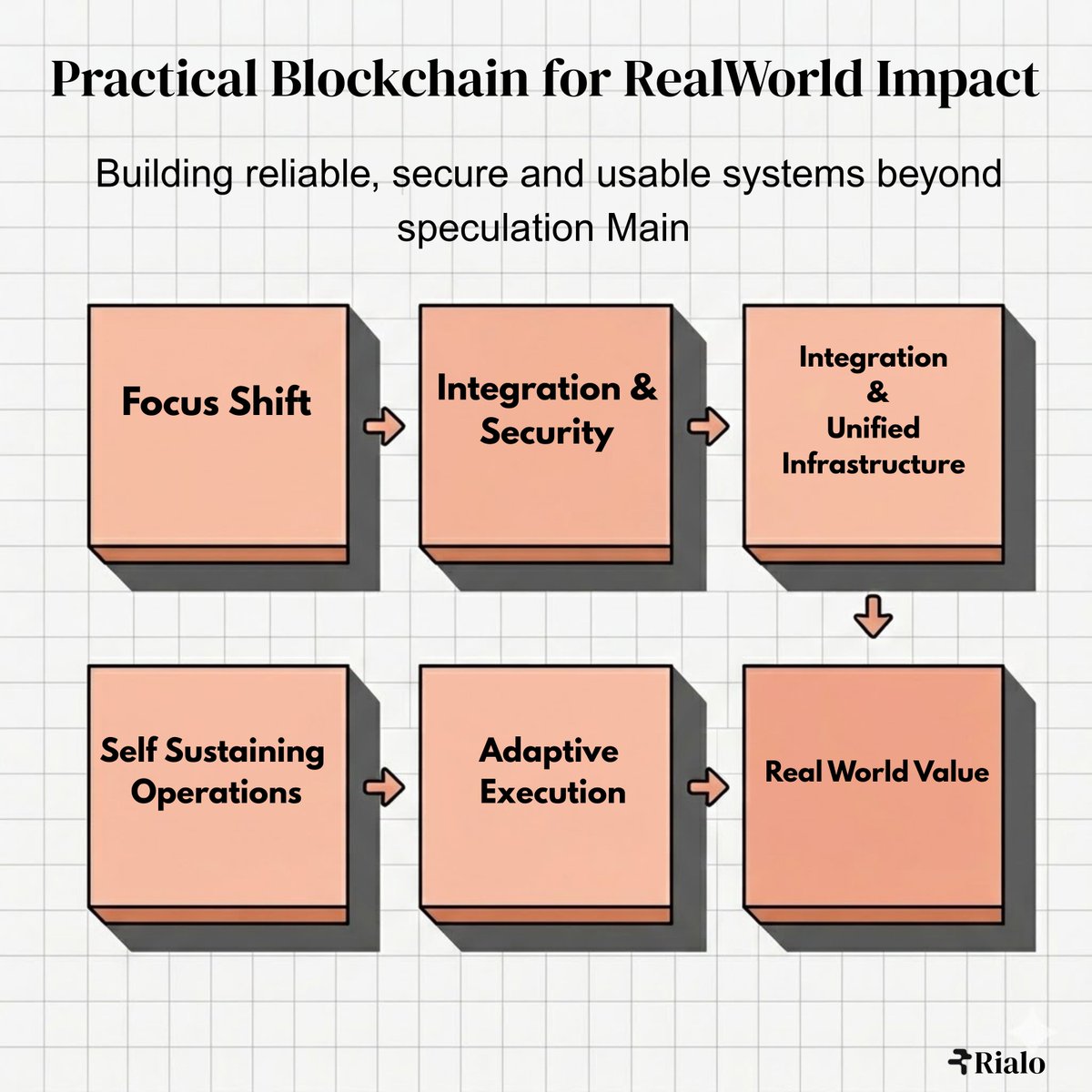
Blockchain progress has largely centered on performance benchmarks, speculative assets and market driven activity. Outside of dedicated crypto circles, most systems still struggle to deliver real everyday value. The limitation was never just speed. It has always been about integration, security, and usability in real environments. Systems that cannot connect seamlessly or operate safely in changing conditions remain difficult to rely on. A new design direction is starting to emerge. Instead of acting only as transaction layers, modern architectures are being built as full infrastructure. They allow applications to interact directly with external services, live data, and operational systems. At the same time, sensitive information remains protected at the protocol level. This shift expands what developers can build. Rather than depending on multiple middleware layers and separate data providers, applications can operate in a more unified environment. Fewer dependencies reduce complexity, improve reliability, and make systems easier to maintain. There is also a rethink in how operations are sustained. Many protocols today require constant manual input despite holding significant capital. A more integrated model connects network incentives with service execution. This allows applications to maintain routine activity with minimal intervention and better long term stability. Security is evolving as well. Execution is no longer treated as something that must always happen instantly. Actions can be evaluated based on real time conditions, helping prevent unintended outcomes when environments shift. All of this points to a broader transition. Blockchain is moving from experimentation toward dependable infrastructure. The systems that prioritize reliability, automation and real world interaction will define what comes next. @RialoHQ | @AhmedNir | @RollinsR79
Ryve tweet media
English
11
4
21
199
𝐒𝐚𝐝𝐢𝐤𝐮𝐫 !!
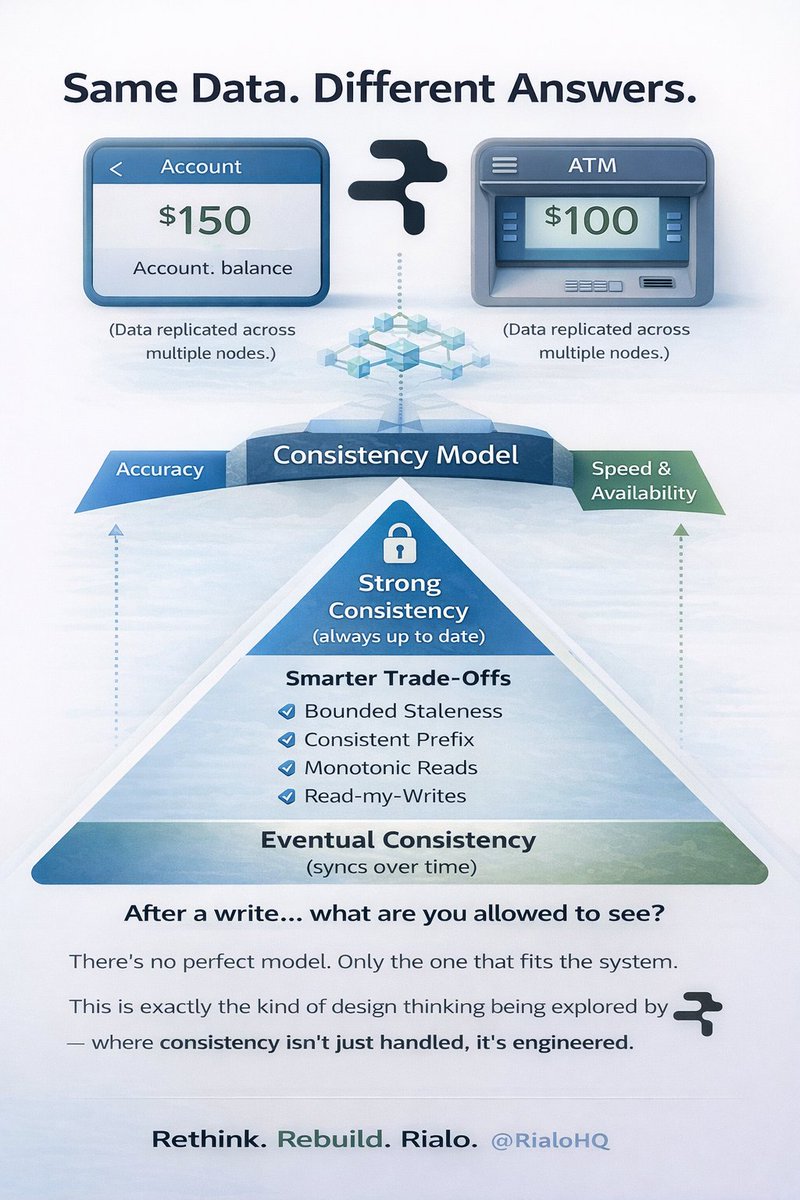
Same data. Different answers. You check your balance → $150 ATM shows → $100 Broken system? Not really. That’s how distributed systems work. Data is replicated across multiple nodes. Updates take time to sync. Until then, different replicas can show different states. This gap is where consistency models come in. Some systems choose accuracy first → Strong consistency (always up to date) Some choose speed & availability → Eventual consistency (syncs over time) And in between, there are smarter trade offs : • Bounded staleness • Consistent prefix • Monotonic reads • Read-my-writes Each one answers a simple question : “After a write… what are you allowed to see?” There’s no perfect model. Only the one that fits the system. This is exactly the kind of design thinking being explored by where consistency isn’t just handled, it’s engineered. @RialoHQ
𝐒𝐚𝐝𝐢𝐤𝐮𝐫 !! tweet media
English
5
2
15
104
SIRAJUL ISLAM
SIRAJUL ISLAM@binancesks01·
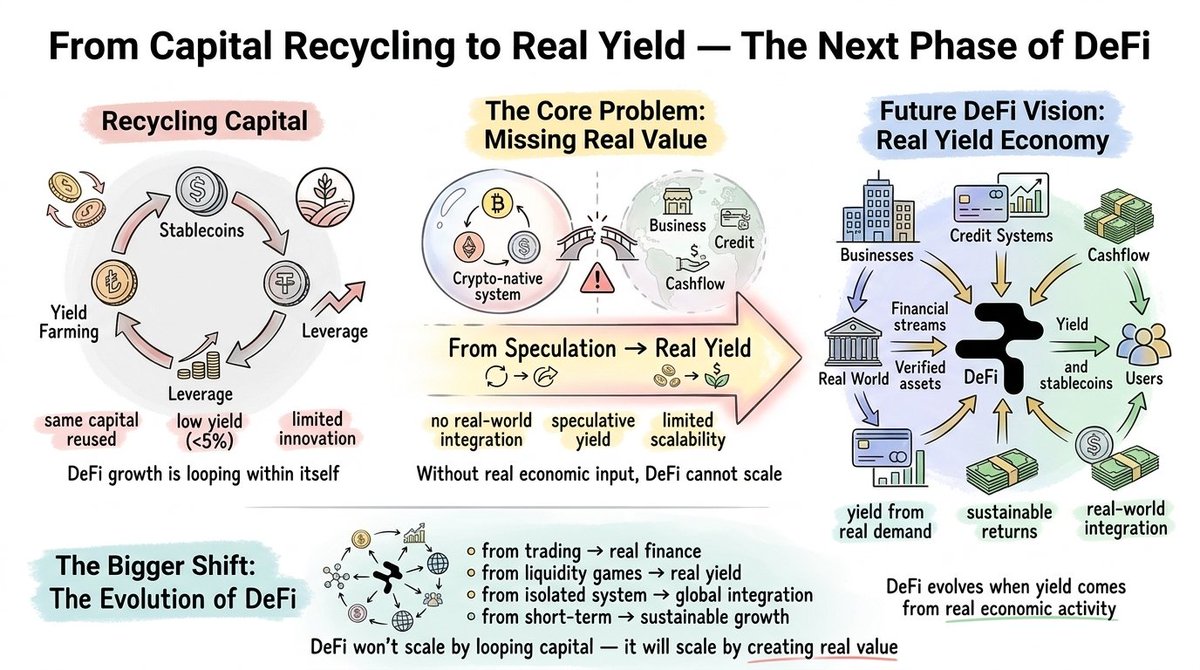
Topic: Has DeFi really reached its limits? Or are we just looking in the wrong places? To be honest, it seemed like something for a long time. DeFi is powerful, but somehow stuck. Everything is stuck in the same place over and over again. Stablecoin, yield farming, leverage Something new is coming, of course, but basically the same capital is being recycled over and over again. When I see that 90%+ stablecoins in such a large ecosystem are giving returns below 5%, it is hard to understand that the system is turning inside itself. Real growth comes only when a new value system is introduced. This is where the mindset shift is very important. How far can we go with crypto-native leverage? Ultimately, we have to connect with the real-world. Real businesses, real credit, real cashflow Without these, DeFi will never reach trillion scale. And honestly, this is where Rialo's vision stands out. They're not just talking about increasing yield, they're talking about changing the source of yield. From speculative farming A shift in real economic activity Where returns will come from actual demand, not just liquidity games. If stablecoins are truly linked to real-world credit, DeFi will not just be a playground for traders, it will become a real financial layer. Maybe this transition won't happen overnight. Maybe still early. But history says that big changes start quietly. DeFi is now on its way to growing up. And in this evolution, those who build real value will ultimately survive. Maybe this is that moment. @RialoHQ @ericargent31113 @AhmedNir
SIRAJUL ISLAM tweet media
Rialo@RialoHQ

The current system of DeFi is reaching its limit. When 93% of stablecoins earn under 5%, it’s a sign that our system is simply recycling the same speculative capital. To scale to trillions, we have to move beyond the echo chamber. We are investing in the shift from crypto-native leverage to onchain private credit. By connecting stablecoins to real-world economic activity we are replacing volatile "yield farming" with sustainable, spread-based returns. DeFi is finally growing up and Rialo will be the bridge to bring in new building blocks.

English
4
0
10
41
Airish Arifin Asha
Airish Arifin Asha@iashaxz·
the shift from traditional blockchains to a world-first 'reactive' infrastructure is officially here and @RialoHQ is leading the charge with a $20 million seed round from heavyweights like pantera and coinbase. most people don't realize that current l1s are essentially just passive ledgers but rialo is building the first ever 'blockchain for the real world' that actually responds to live data. the technical breakthrough here is enshrining web2 primitives directly into the protocol layer so things like http calls and real-time data streaming are now native instructions. this completely removes the need for clunky third-party oracles or risky cross-chain bridges that usually eat up 80% of a developer's time and create massive security vulnerabilities. imagine sending crypto as easily as a text message or having a prediction market that settles the millisecond a game ends because the validators are monitoring the live feed themselves. by turning phone numbers into payment endpoints and eliminating seed phrases rialo is finally making decentralized tech feel like a normal human experience. for anyone looking to get involved early the rialo raid army and discord community are the places to be right now for active contributors. this isn't just another speculative token play but a fundamental infrastructure play that is solving the 'fragmented dev experience' once and for all.
Airish Arifin Asha tweet media
English
6
0
7
66
Mostakim
Mostakim@mostakim0202·
Real adoption doesn’t start when a protocol goes live-it starts much earlier, when developers truly understand how the system works and how to build on top of it. That’s the gap Rialo is actively solving. With its continuously expanding learning platform, builders don’t just read documentation—they actually learn by doing. From structured async guides and step-by-step tutorials to deep dives into core architecture and hands-on protocol-level demos like native 2FA, everything is designed to turn curiosity into real building skills. This approach flips the usual pattern in Web3. Most projects launch first and explain later, leaving developers to figure things out on their own. @RialoHQ is taking the opposite route-educating early, demonstrating real capabilities upfront, and making sure developers fully understand the system before they even start building. The result is a much smaller gap between “interesting technology” and “usable product.” With Rialo, developers gain clarity, confidence, and practical experience-things that actually drive meaningful adoption. Takeaway: If 2026 is truly the year of adoption, education isn’t just support-it’s core infrastructure, and Rialo is building with that mindset. @RialoHQ
Mostakim tweet media
English
7
1
12
60
SIRAJUL ISLAM
SIRAJUL ISLAM@binancesks01·
@iashaxz @RialoHQ Strong concept turning attention into a transparent, user-owned economy could redefine digital monetization.
English
0
0
0
4
Airish Arifin Asha
Airish Arifin Asha@iashaxz·
@RialoHQ is fundamentally rethinking user monetization in a digital landscape dominated by intrusive advertising. its core architecture introduces the 'attention miner,' a role where users receive programmable incentives based on verifiable interaction metrics. this is not about passive 'views' anymore but rather about active, validated engagement. what makes this protocol stand out is how it aligns the economic incentives of all three primary network participants. curators are financially rewarded for surfacing quality, while creators and projects receive guaranteed, high-fidelity human attention, moving beyond the traditional CPC/CPM models which are prone to bot fraud. it is essentially establishing a localized micro-economy for attention. by integrating with decentralized finance rails, the protocol ensures that the value created by a user's focus remains within a transparent, user-controlled system, challenging the 'walled garden' approach of legacy web2 platforms.
Airish Arifin Asha tweet media
English
3
0
3
21
𝙷𝚊𝚢𝚡𝚎𝚗 ꧁IP꧂
This is an amazing start! 🔥 Huge congratulations to the team for successfully completing the very first $ION token buyback - $21,601 bought back in just the first week! That’s not just numbers on a screen, that’s real capital flowing back to the holders. What makes this even more powerful is the commitment behind it. Every single week, buybacks are going to continue, and with current revenue, we’re already looking at ~$80K per month. The target of scaling it to $100K+ monthly as the project grows shows serious long-term vision and dedication. This is exactly what real utility and value creation looks like - not just promises, but actual action. @ice_blockchain and the $ION team are proving they’re not just building for today, but for a strong and sustainable future. As a community, seeing this level of transparency and execution feels incredibly motivating. It reminds us all why we believe in this project. We’re all in this together - holders, builders, and supporters. Every buyback strengthens the ecosystem and rewards the loyal community that has been here from the start. This is the kind of movement that creates real momentum! Super proud to be part of this journey. Keep up the incredible work, keep delivering, and keep pushing those numbers higher! The best is yet to come for $ION. Community strong, united, and growing together @BingXOfficial #BingXBlast
𝙷𝚊𝚢𝚡𝚎𝚗 ꧁IP꧂ tweet media
Bao Trader@baomarkets

🔥 FIRST $ION BUYBACK IS COMPLETE We just executed our very first $ION token buyback. 💰 $21,601 bought back this week And this is just the beginning. 🗓️ Every week, we will continue buying back $ION 📈 At current revenue, that's ~$80K/month in buybacks 🚀 As we grow, we're targeting $100K+ monthly This is real demand. Real commitment. Real value flowing back to holders. We're not just talking. We're putting capital behind @ice_blockchain. Bao, Trade Crypto like a Whale 🐋 👉 bscscan.com/address/0x8683…

English
14
6
26
278
Heyfab
Heyfab@cd_sh51200·
Today feels a little different. For a long time, I’ve been quietly doing my part on @ritualnet, in my own way. No big expectations, no shortcuts… just showing up consistently. Today, I got the Bitty role. It might not seem like a big deal from the outside, but for me, it means a lot. Not because of any reward… but because I truly believed in what Ritual is building. And today, it feels like those efforts were finally seen. I’m really grateful to the team for giving me this opportunity. Special thanks to @Jez_Cryptoz for trusting me. This small achievement has given me even more motivation. I’m not stopping here. I’ll keep learning, keep working, and keep moving forward step by step. @Jez_Cryptoz @ritualnet @nft_hinata_eth
Heyfab tweet media
English
27
2
50
378
𝐒𝐚𝐝𝐢𝐤𝐮𝐫 !!
Happy Weekend Rialo fam. The weekend is here and it’s the perfect time to slow down, recharge, and connect with the community. Building the future of decentralized infrastructure is a long journey, but moments like this remind us that the real strength comes from the people behind it. @RialoHQ
𝐒𝐚𝐝𝐢𝐤𝐮𝐫 !! tweet media
English
12
1
22
192
Rialo Bangladesh 🇧🇩
Rialo Bangladesh 🇧🇩@RialoBangladesh·
Hello, Rialo Bangladesh community! We’d like to highlight the most active regional and general community members of this week. This week’s community performance shows strong engagement across both global and regional channels. Based on the activity metrics shown in the graph (including contributions, onboarding support, building meaningful conversations, and consistency), the following members have truly stood out. A special spotlight goes to our Bangladesh region member @rgs_2_tahsin congratulations, brother, on earning this spotlight! Keep showing your consistency and creativity, you could be featured on the next wall!
Rialo Bangladesh 🇧🇩 tweet media
English
13
0
34
301
Siyam Ahmed
Siyam Ahmed@SiyamAhmed117·
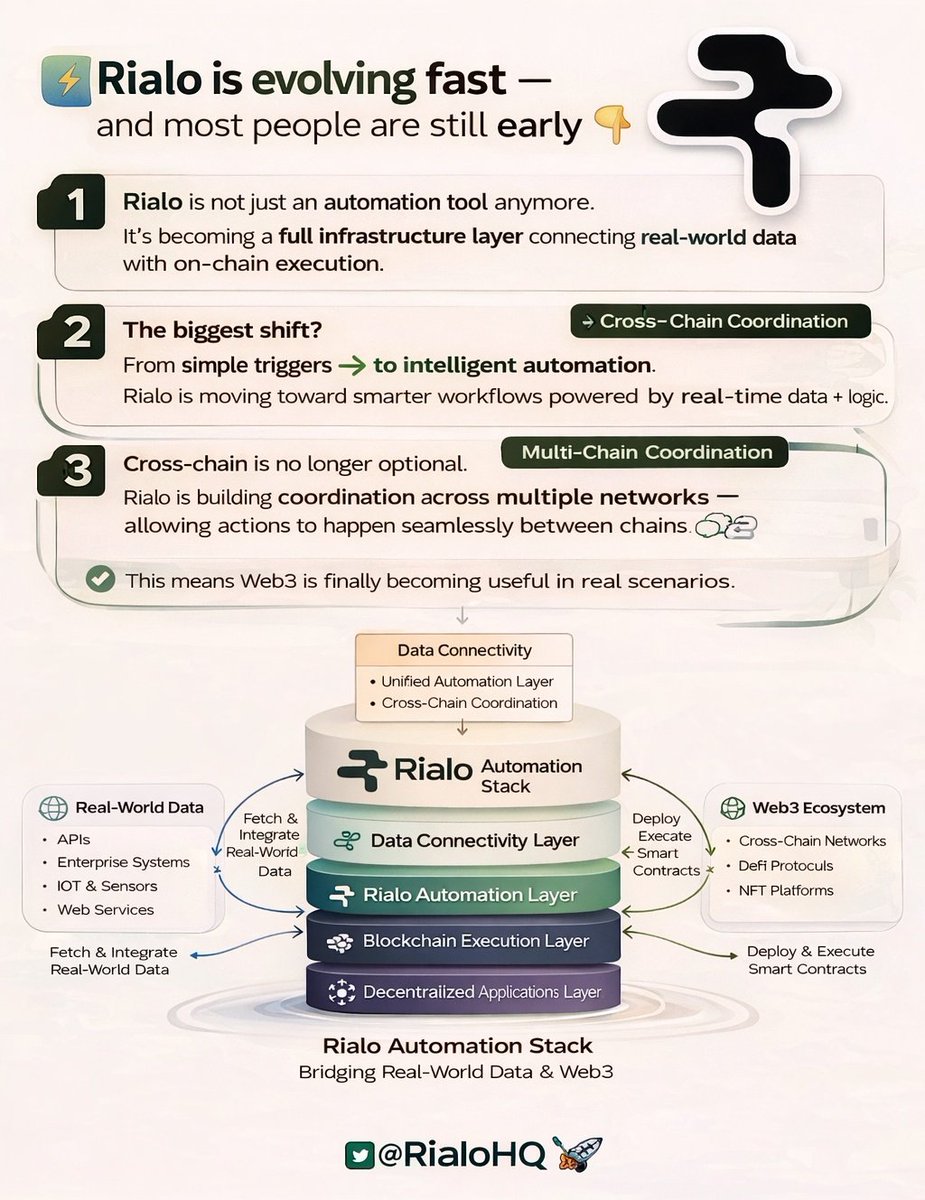
Rialo is evolving fast and most people are still early Rialo is not just an automation tool anymore. It’s becoming a full infrastructure layer connecting realworld data with on chain execution. The biggest shift? From simple triggers → to intelligent automation. Rialo is moving toward smarter workflows powered by real-time data + logic. Cross-chain is no longer optional. Rialo is building coordination across multiple networks allowing actions to happen seamlessly between chains. Realworld data integration is expanding. APIs, enterprise systems, and even IoT data can now be connected into smart contract logic. This means Web3 is finally becoming useful in real scenarios. Builders are getting more power. With the Rialo stack, devs can: • Automate workflows • Trigger contracts instantly • Build scalable dApps faster Community driven building is growing. Spaces like Builders Hub & Shark Tank are turning ideas into real products not just discussions. Focus is shifting toward execution. Not just “what can we build?” But “what can we launch and scale?” Rialo is quietly building a system where.. Data → Logic → Automation → Execution all happen in one flow. This is bigger than just a project. It’s infrastructure for the next generation of Web3 apps. Still early. Still building. But momentum is clear Rialo is positioning itself as a core layer for automation in Web3 🚀 @RialoHQ
Siyam Ahmed tweet media
English
4
0
12
89
Zyraa 🫰(❖,❖)
Hey Rialo family, happy weekend Just sharing some calm office vibes from yesterday. learning, building and growing step by step with rialo slowly understanding the space and becoming better every day. grateful to be part of a community that supports and evolves together. let’s keep showing up and growing stronger, one step at a time. @RialoHQ @ericargent31113 @JEAMSETH07 @AhmedNir
Zyraa 🫰(❖,❖) tweet media
Zyraa 🫰(❖,❖)@Zyraa_b

i joined the Rialo Shark Tank last night and it was a really interesting experience for me as i am still learning in web3. Seeing real builders present their ideas and getting live feedback taught me a lot. It felt less like an event and more like a space to learn and grow. excited to keep exploring and learning more with the community. @RialoHQ @ericargent31113 @JEAMSETH07 @AhmedNir

English
10
0
27
260
MUNNA BHAI
MUNNA BHAI@Muni00910·
Breaking the Loop: Why Private Credit Is the Yield DeFi Can't Build Right now DeFi is stuck in a loop that most people ignore. You deposit stablecoins → someone borrows to speculate → you earn yield → they stop borrowing → yield collapses. Same money, same cycle, zero real growth. 93% of stablecoins earn less than 5% today. US Treasury bills are beating DeFi. Those 2021 yields were never real, just a bull market riding on borrowed time. The shift that needs to happen: Crypto speculation → Real world lending Yield farming → Private Credit Volatile returns → Scheduled payments backed by real collateral Token incentives → Actual business cash flow Private Credit means lending to real businesses. A logistics company buying trucks. A business owner taking a loan. They repay from real revenue, not from market hype. Yields of 8 to 15%, backed by collateral, independent of Bitcoin's price. Old way → Issue loans traditionally → Wrap in crypto → Costs months and hundreds of thousands in fees Rialo's way → Create and settle loans directly on-chain → Faster, cheaper, cleaner Rialo connects idle crypto capital → Real world businesses → Sustainable yields → Actual value created DeFi is growing up. And Rialo is building the bridge to get there. @RialoHQ @itachee_x
MUNNA BHAI tweet media
Rialo@RialoHQ

The current system of DeFi is reaching its limit. When 93% of stablecoins earn under 5%, it’s a sign that our system is simply recycling the same speculative capital. To scale to trillions, we have to move beyond the echo chamber. We are investing in the shift from crypto-native leverage to onchain private credit. By connecting stablecoins to real-world economic activity we are replacing volatile "yield farming" with sustainable, spread-based returns. DeFi is finally growing up and Rialo will be the bridge to bring in new building blocks.

English
3
0
8
39
Airish Arifin Asha
Airish Arifin Asha@iashaxz·
been looking into how @RialoHQ is actually solving the oracle and bridge problem by making web calls and data feeds native to the protocol. most chains struggle with off-chain data but they have built a stack where real world triggers are just basic instructions. the research into their native payment endpoints is honestly the most interesting part of the project. being able to use a phone number or email instead of managing seed phrases makes the whole onboarding process feel much more human. it really shifts the focus from just speculative trading to actual utility like prediction markets that settle automatically. having validators monitor public feeds for resolution in real time is a huge step for decentralized infrastructure.
Airish Arifin Asha tweet media
English
6
0
8
74
atik.eth
atik.eth@oxeth_evm·
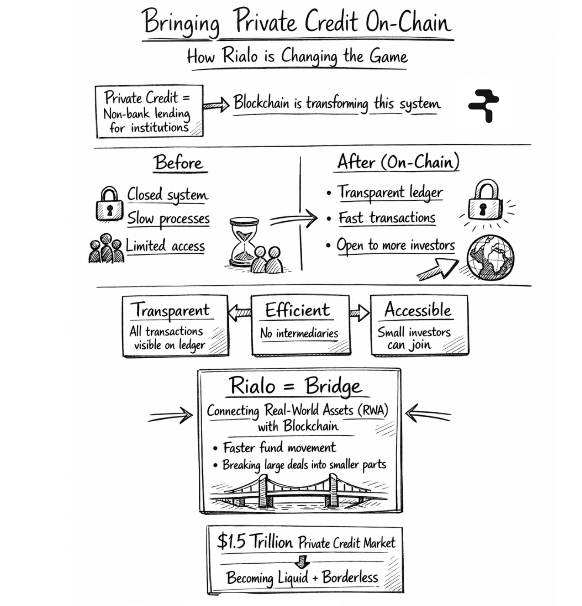
Bringing Private Credit On-Chain, How Rialo is Changing the Game Private Credit is a market leading provider of financial services to institutional investors. Blockchain technology is a powerful tool for this. Transactional finance which is private credit is non bank lending. When it is brought to the blockchain or on-chain, the whole thing become.... ~ Transparent : All transactions are in the ledger. ~ Efficient : Works without intermediaries or middlemen. ~ Accessible : Small investors can now participate in this big market. @RialoHQ is acting as a bridge that connects real-world assets (RAW) with digital finance. Because of blockchain, investor can move their funds quickly. Large credit deal are broken down into smaller parts, making it easier for everyone to invest. The global private credit market is over $1.5 trillion. Platform like Rialo are making this huge pool of capital more liquid and borderless. It is not just technology, it is a democratization of finance. @itachee_x @JanCamenisch
atik.eth tweet media
English
16
0
30
414
Ryve
Ryve@ryvexbt·
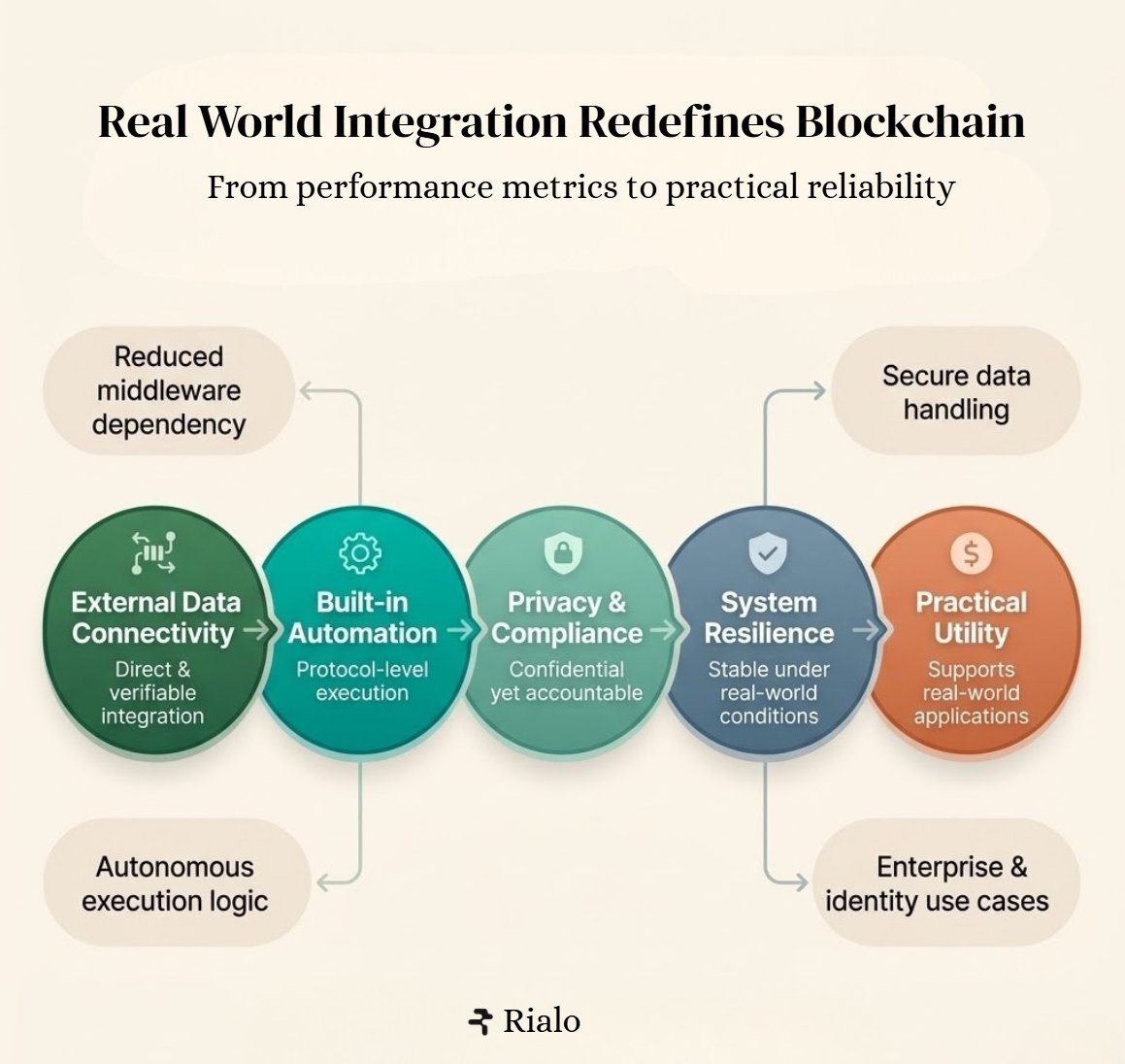
As blockchain technology begins extending beyond purely digital ecosystems, the criteria for evaluating it start to shift. For a long time, conversations in Web3 have revolved around metrics like transaction speed, low fees, and network throughput. While these are important, they do not ultimately decide whether a system can function effectively in real world environments. What truly matters is the ability of applications to manage real world data securely, remain dependable under less than ideal conditions, and execute processes automatically without relying heavily on human input or external coordination. This is where the approach taken by Rialo stands out. Rather than positioning blockchain as just a mechanism for processing transactions, Rialo treats it as foundational infrastructure. The focus is on enabling decentralized systems to support practical, real world operations rather than limiting their use to trading or speculative activities. Several key elements highlight this approach. To begin with, connectivity to external systems is handled differently. Instead of relying on complicated middleware to occasionally pull in off chain data, the architecture is designed to interact with outside sources in a way that is both direct and verifiable. This reduces reliance on fragile intermediaries and makes development more straightforward. Another major factor is built-in automation. In many blockchain ecosystems today, automated execution depends on third-party bots or services that must remain active. Rialo shifts this responsibility closer to the protocol layer, allowing logic and triggers to execute more consistently and predictably within the system itself. Privacy and regulatory alignment are also treated as fundamental requirements. Real-world use cases demand that sensitive information is protected, but at the same time, systems must maintain a level of transparency and accountability. Balancing confidentiality with auditability is essential, especially for sectors like finance, identity management, and enterprise solutions. Equally important is the concept of resilience. Unlike controlled environments, real world systems face constant unpredictability. Delays, disruptions, and changing conditions are normal. Infrastructure built for these scenarios must prioritize stability and predictable outcomes, even when performance degrades, rather than assuming everything will function perfectly at all times. Looking at the bigger picture, this signals a broader change in how blockchain technology is judged. The focus is gradually shifting away from questions like "How fast can it process transactions?" toward more practical considerations such as "Can it reliably support meaningful applications in everyday use?" For blockchain to become a core part of global digital infrastructure, it needs to operate seamlessly in the background, delivering reliability and security without demanding constant attention. Ultimately, this evolution in priorities will define the next stage of Web3 far more than raw performance metrics ever could. @RialoHQ | @AhmedNir | @RollinsR79
Ryve tweet media
English
5
1
19
166