
Bitcoin World Order retweetledi

@aubreystrobel @nic_carter @apruden08 @projecteleven @theaubservation Ridiculous exagerated FUD. By the way, co-author is from the Ethereum Foundation 🤡
English
Bitcoin World Order
2K posts

@bitcoinwo
#Bit🌽 #NOSTR: #npub17pgmxpumkdzna0c7t22e5qyemjd37darvsjh89qh7fanzrqq6hlsm3yr9d




Yep, Ark is fine, we already talked about this Arkade is shitcoiny but I don't think their protocol spams The rest of the "L2s" are not real L2s because they don't have unilateral exit, so they don't really scale bitcoin because they involve trust Some of the fake L2s (like rollups) also require lots of arbitrary data which is abusive Stablecoins are dumb and will be replaced by stablechannels They are also central bank money and should be opposed on those grounds alone Not sure where brink and localhost get their funding but I wouldn't be surprised if it was partly these shittoken/stablecoin companies

Chris, Thanks. Good to get confirmation from someone with your background. @hodlonaut fyi for consideration in future articles, in case there's something here you haven't already discovered. Great first article ... I know first hand how much work it is to assimilate all that. @mattkratter fyi for consideration in future videos. @LukeDashjr fyi in case you want to weigh in, particularly the controversial changes noted at the end of this post. I don't know how you've managed to consistently continue your fight against these bastards for so long. 🙏 @GrassFedBitcoin FYI for your ongoing battle too. I'm going to take this opportunity to get most of my findings documented in one place here ... warning, it's a ridiculously long post, with many interconnections. I've repeated many things in an attempt to help keep them straight. I'm going to try to summarize in a more digestible format soon, but just putting it all down here for now. I suppose there's a chance of a few inaccuracies here, or mis-guided interpretations and conclusions. If that ends up being the case, sobeit, I'll have to live with it. I did my best. It's all about "Following the Money". It's important because it highlights the real fight, which is against a very well-funded Fiat Complex. The only way they're going to be prevented from taking over and centralizing Bitcoin is if enough folks reject Bitcoin Core, imo. I sincerely hope this motivates more people to seriously consider running BIP-110. A major new revelation for me while doing additional research for this post is Blockstream. I couldn't figure out all the blatantly shallow arguments against BIP-110 from current and past employees. They aren't exploiting SegWit/Taproot on Bitcoin mainnet. I couldn't find any monetary reason for them to oppose BIP-110 ... until ... I found they have strategic plans to launch their smart contract protocol called Simplicity, on Bitcoin mainnet. It's currently just on Liquid ... it relies heavily on Taproot, which BIP-110 would hinder. More on that below. The Core funding apparatus is an incredible Tangled Web of Malincentives as summarized below. The same folks funding shitcoins and stablecoins on Bitcoin are concurrently funding Bitcoin Core. I think it's a primary driver behind opposition to BIP-110, Luke's 2023 datacarriersize PR and even the stealthily merged datacarriersize re-definition PR in 2023. It's probably the main driver behind uncapping OP_RETURN, although widespread exploitation of that hasn't happened yet. And while not as obvious, it might even have influenced the "bug" getting into Taproot in the first place ( admittedly, that might be a stretch - but the more you see all the well-funded, connected dots described below, perhaps not). These shitcoin/stablecoin VCs, Angels and companies are funding maintainers and developers that have introduced the most controversial changes to Bitcoin over the past five years. Is it coincidence or intentional? There are literally billions of dollars behind companies that would be negatively impacted if BIP-110 if it were to be adopted. It's the real reason for the pushback, imo. It's always puzzled me how shallow their arguments have been ... it's because they can't state the real reason. Any single event may not be that big of a deal, but combined, it's proof beyond any reasonable doubt that well-funded outside forces have been significantly influencing Bitcoin Core the past 5+ years. It's the Fiat Complex trying to get their shitcoin and stablecoin hooks into the Bitcoin ecosystem. IMHO. And if one believes the Bitcoin protocol should be optimized solely for decentralized and immutable money, then this is a real problem. As I said in my OP, this is a full on 5 Alarm Fire. ----- The Tangled Web of Malincentives ----- Wences Casares: Co-Founding Donor of Brink and Localhost Research. There are also indications of personal grants to Core developers, but no confirmed names. He's also an angel investor in Alpen Labs. Founder and ex-CEO of Xapo Bank. Participated in 2020 Treasury Department led "Crypto Summit", which discussed, among other things, stablecoins. Served on Facebook's Libra Association Board of Directors. Through Brink and Localhost Research, he's directly responsible for establishing the funding vehicles behind four of five Core maintainers in the 2022 - early 2026 timeframe. John Pfeffer: Co-Founding Donor of Brink. Personal grants to Antoine Riard and Samuel Dobson. Also angel investor in Alpen Labs. Brink: Formed 2020. Fully funds/funded three Core maintainers and numerous developers. Funded maintainers are: Michael Ford, Hennadii Stepanov and Gloria Zhao (prior to her departure Feb '26). Casares and Pfeffer are Brink's Founding Donors. Other Brink donors mentioned in this post are Coinbase, Xapo Bank, Paxos, Lightspark, OKX and Mark Casey. Localhost Research: Formed Oct 2024. Fully funds Core Maintainer, Ava Chow and Lead Contributor, Mark "Murch" Erhardt, along with several other contributors. Casares and Mark Casey are co-Founding Sponsors. Coinbase: 2nd largest donor to Brink. 4th largest shitcon crypto and stablecoin exchange in the world. Raised ~$550 million before going public. Current market cap is ~$43 billion. Brian Armstrong participated in 2020 Crypto Summit. Founding member Libra Association. Xapo Bank: 3rd largest donor to Brink. They have directly funded Anthony Towns (pre-2020) and Amiti Uttarwar. Towns was an important coder for Speedy Trial, the controversial Taproot activation. Towns also co-authored Taproot BIPs 341 and 342. Casares is founder and ex-CEO. $40M raised thus far. Xapo is a major player using stablecoins for on/off ramps. Partnered with Lightspark for infrastructure builds. Participated in 2020 Crypto Summit. Founding member Libra Association. Paxos: 10th largest donor to Brink. Major player in stablecoins. Has issues three stablecoins themselves. $535M raised thus far. Last known valuation $2.4 billion. Charles Cascarilla (CEO and co-founder of Paxos) is another angel investor in Alpen Labs, alongside Casares and Pfeffer. OKX: 11th largest donor to Brink. Separately, they fully funded Marco Falke 2020-2023 while he was a Core maintainer (OKX and Paradigm co-funded him in 2023). Falke authored and merged the controversial "Clarify Datacarrier" PR the redefined the definition (more below). Funded Amiti Uttarwar (2020 $150k joint grant with BitMex) - there are indications they're still funding her. Other grantees listed on their website include: Gloria Zhao, Dusty Daemon, Joao Barbosa and Antoine Riard. OKX is the 2nd largest shitcoin crypto exchange in the world, including emphasis in tokens, BRC-20, NFTs, etc.. Lightspark: 17th largest donor to Brink. They've also contributed to Localhost Research. VC-backed company formed in 2022, founded by David Marcus and other former Libra/PayPal executives. $175M raised thus far. Funding co-led by a16z crypto, the biggest shitcoin VC of them all, and Paradigm, the 2nd largest shitcoin VC. Ribbit Capital also participated - another shitcoin VC who led Alpen Labs funding. Lightspark developed BTKN, a "Bitcoin Token Protocol" based off LRC-20 to enable stablecoins on Bitcoin, including USDB issued by Brale. David Marcus: Lighspark founder, CEO. Was head of the Libra Association Board of Directors. Through Lightspark, contributors to both Brink and Localhost Research. Of particular concern, check out these quotes from O'Dell talking about Marcus and Lightspark: Watch this (7:55 - 12:20). youtu.be/y3eOfwXFPio?si… "Spark knows your entire transaction history." "Technically, if Spark wanted to be malicious they could do some shady shit probably." "Spark got funded by there notorious shitcoiners A16Z ... $160M." "For better or worse he [David Marcus] brought a, kind of like a, pragmatic shitcoiner approach to Bitcoin ... and we should probably do more of it" "There are a lot of arguments [against Spark]: is spark decentralized enough ... is it trust minimized enough?" Paradigm: With OKX, Paradigm directly co-funded Marco Falke in 2023 while a Core maintainer. Paradigm also funded Core contributor, Anthony Towns (2020-2022). Falke and Towns both had key roles in the controversial Speedy Trial to activate Taproot. Towns also co-authored Taproot BIPs 341 and 342. Falke authored and merged the controversial "Clarify Datacarrier" PR the redefined the definition (more below). Paradigm is the 2nd largest crypto VC co-founded in 2018 buy Fred Ehrsam, co-founder of Coinbase, and Matt Huang, former partner at Sequoia Capital. They co-led Lightspark funding. A VC DIRECTLY FUNDING A CORE MAINTAINER AND A CONTRIBUTOR IS ESPECIALLY CONCERNING, ESPECIALLY A SHITCOIN CRYPTO VC. Ribbit Capital: No indication of Core funding, but relevant because they led Alpen Labs funding. Also participated in Lightspark and Xapo funding. Meyer “Micky” Malka: Founder and managing partner, of Ribbit Capital. Participated in the 2020 Crypto Summit. Founding member of Libra Association. Longstanding relationship with Casares, including joint executive involvement with Patagon (founded by Casares) in late 1990's. Alpen Labs: No indication of Core funding, but relevant because Casares, Pfeffer and Paxos CEO (all Core funders) are also angel investors in Alpen Labs. Alpen Labs is a VC/Angel-backed Bitcoin infrastructure startup (founded in 2022) - raised $19M thus far. They're developing a ZK-powered validity rollup called Strata. They're partnering with Liquity to enable a bitcoin-backed stablecoin called Bitcoin Dollar (BTD). Blockstream: I initially dismissed them as having a conflict of interest because there's no indication they're currently exploiting Taproot. But, turns out they have strategic plans to put Simplicity, their smart contract protocol on Bitcoin mainnet. Simplicity is currently just on their sidechain, Liquid. It's very relevant because it's a smart contract protocol that relies heavily on exploiting Taproot ... BIP-110 would hinder it. Blockstream also had a very significant role in the development and introduction of Taproot within Bitcoin Core. Did they have this planned all along? Was the Taproot "inscription bug" just an unintended byproduct, or was it intentional? Simplicity was conceived by Blockstream's Russel O'Conner in 2017. Greg Maxwell proposed the idea of Taproot in 2018. And Blockstream employees had, by far, the biggest role in Taproot's development and implementation within Core. Makes you wonder. Blockstream currently funds, or has previously funded, the following Core maintainers and contributors, many of which had key, leading roles in the development and implementation of Taproot. Peter Wuille: Blockstream co-founder and employee 2014-2020. Core maintainer 2011-2022. Lead designer, primary implementer and co-author of Taproot BIPs 340, 341 and 342. Led and authored PR #19953, which implemented the full consensus rules for Taproot into Bitcoin Core - merged Oct 2020.. He left Blockstream and went to Chaincode in 2020. Ava Chow: Blockstream employee 2018-2024. Core maintainer 2022-present. Wrote the Taproot-specific activation parameters (PR #21686) - as Andrew Chow (before transition). She also closed Luke's 2023 Datacarriersize PR in Jan '24. She left Blockstream and went to Localhost Research Oct '24. Andrew Poelstra: Blockstream employee since 2014. Core contributor 2014-present. Key co-designer of Taproot along with Wuille. Jonas Nick: Blockstream employee since 2015. Core contributor 2015-present. Co-author all three Taproot BIPs. Tim Ruffing: Blockstream employee since 2018. Core contributor 2017-2022. Co-author Taproot BIP 340. Greg Maxwell: Blockstream co-founder and employee 2014-2018. Core contributor 2011-2018. Originator of the Taproot high level concept in 2018. Matt Corallo: Blockstream co-founder and employee 2014-2018. Core contributor 2011-2022. Maintainer 2014-2018. Taproot reviews and technical feedback. Rusty Russell: Blockstream employee 2015-2023. Core contributor 2011-2021. and others. Russell O'Connor: Blockstream employee since 2016. Core contributor 2016-present. Originated the core concept of a short "trial" activation window, that became the controversial Speedy Trial to activate Taproot. He was also the creator/inventor of Simplicity, introducing the concept in 2017. He continues to be the main force behind its development, formal semantics, jets (optimized primitives), and integration with Taproot. Again, Simplicity is currently on the Liquid sidechain, but they've announced their intention to also bring it to Bitcoin mainnet. Back, Wuille, Maxwell, Poelstra, O'Connor, Corallo have all been vocal opponents of BIP-110. Blockstream, privately held, has raised $650-$730 million across multiple rounds. Peak valuation: $3.2 billion after 2021 Series B round. Blockstream views Simplicity as a key long-term technical bet on Bitcoin-native programmability. They describe it as: A major milestone in “Bitcoin-native programmable finance”. The foundation for more expressive, formally verifiable smart contracts on Bitcoin Layer-2 (starting with Liquid) A way to bring advanced features (vaults, covenants, tokenized assets, post-quantum cryptography) while staying true to Bitcoin’s security model Blockstream has invested years of research into it, beginning with O'Connor's introducing the concept in 2017. They actively promote it as enabling “the next wave of tokenized finance and adoption” on Bitcoin rails. Simplicity Launches on Liquid Mainet: blog.blockstream.com/simplicity-lau… How Simplicity works: docs.simplicity-lang.org/documentation/… It's relevant because Simplicity launched on Liquid Mainnet July 2025. And that's relevant because in the announcement they said: "Liquid is just the beginning. With community feedback, real-world usage, and more tooling, docs, wallet support, and example contracts, our next major goal is to activate on a Bitcoin test network." blog.blockstream.com/simplicity-lau… Bitfinex an investor and strategic partner of Blockstream's published an article in Aug '25 titled: What Can Simplicity Bring To The Liquid Network. blog.bitfinex.com/education/what…. The following is stated: "While the initial deployment is confined to Liquid, the long-term objective is to gather community feedback, expand tooling, and potentially move toward testnet, and eventually mainnet, activation on Bitcoin itself once Simplicity proves itself battle-tested. Simplicity represents a shift in how programmability on Bitcoin is conceived." ----- Controversial Changes by Bitcoin Core ----- << 2021 TAPROOT >> Arbitrary data exploiting SegWit/Taproot (e.g., inscriptions) became very controversial in hindsight. Speedy Trial activation method controversial at the time. PR #21377 (the main Speedy Trial PR): Authored by Anthony Towns. A short 3-month signaling window using a BIP 9-style versionbits mechanism. Required 90% hashrate in any 2-week difficulty epoch to lock in. Clean expiration if miners failed to signal enough (no forced activation). PR #21686 added the Taproot-specific parameters: Merged by Andrew Chow (Ava Chow). Start time, timeout, and threshold settings tailored for Taproot. Russell O'Connor originated the core concept of a short "trial" activation window, which became the controversial Speedy Trial to activate Taproot. Towns funded by Xapo and Paradigm Chow and O'Connor were/are Blockstream employees. Some developers, notably Luke Dashjr, claimed the community had leaned toward a BIP 8 (with LOT=true options). He publicly called aspects of the push an "attack on Bitcoin" because it ignored that perceived consensus and pushed a miner-friendly BIP 9 variant instead. Key contributors to Speedy Trial and Taproot BIPs 340, 341 and 342, along with associated PRs were: Wuille, Chow, Nick and Ruffing (all Blockstream employee), Towns (funded by Xapo then Paradigm), and Falke (funded by OKX and Paradigm). Taproot activate November 2021. << CLARIFY DATACARRIERSIZE - change definition >> PR Number: #27832 Title: doc: Clarify -datacarriersize, add -datacarriersize=2 tests Author: Marco Falke (maflcko) Opened: July 2023 Merged: August 3, 2023 Merged by: Marco Falke himself (as maintainer) Falke funded by OKX and Paradigm. This PR was documentation-only — it did not change any code behavior, only the help text and description of the -datacarriersize option. Before (old help text, used for years): “Maximum size of data in data carrier transactions we relay and mine (default: 83)” After (new help text): “Relay and mine transactions whose data-carrying raw scriptPubKey is of this size or less (default: 83)” It explicitly narrowed the documented scope to only raw scriptPubKey (mainly OP_RETURN outputs), excluding witness data (the method used by Ordinal inscriptions via Taproot script paths). Luke Dashjr was one of the most vocal critics. He called the PR a “stealth redefinition” and argued: The change retroactively narrowed the option’s scope without proper discussion. It was a bug that -datacarriersize did not already cover witness data. He later opened his own PR (#28408) to expand-datacarriersize to also limit witness data, which was closed without merging amid heavy debate. Luke has repeatedly referred to inscriptions as “exploiting a vulnerability” in Bitcoin Core and considers the 2023 clarification part of the problem. << LUKE'S DATACARRIERSIZE PR >> PR Number: #28408 Title: datacarriersize: Match more datacarrying Author: Luke Dashjr (luke-jr) Opened: September 5, 2023 Closed: January 5, 2024 The PR aimed to extend the existing -datacarriersize configuration option so that it would also apply to witness-based data carrying methods, such as: OP_FALSE OP_IF … OP_ENDIF envelopes used by Ordinal inscriptions Other post-SegWit / post-Taproot ways of embedding arbitrary data It was Luke’s response to the earlier controversial documentation-only PR #27832 (by Marco Falke in August 2023), which clarified that -datacarriersize only applied to raw scriptPubKey (mainly OP_RETURN). Luke argued this created a “bug” that inscriptions were exploiting. The broader debate led to further OP_RETURN policy changes in Bitcoin Core v30 (2025), which removed the default 83-byte OP_RETURN limit entirely. This PR became one of the most contentious in recent Bitcoin Core history and highlighted the deep split over whether Bitcoin should actively discourage non-monetary data. The broader debate led to further OP_RETURN policy changes in Bitcoin Core v30 (2025), which removed the default 83-byte OP_RETURN limit entirely. Ford and Zhao voiced opposition to the PR. Both were funded by Brink. Chow closed the PR. Chow was a Blockstream employee at the time. Moved to Localhost Research October 2024. << UNCAP OP_RETURN Core v30 >> PR Number: #32406 Title: policy: uncap datacarrier by default Author: Gregory Sanders (instagibbs) Opened: Around early June 2025 (replacing an earlier related PR) Merged: June 9, 2025 Merged by / Decision Write-up: Gloria Zhao (glozow) — she posted the official merge rationale. Sanders was a Blockstream employee Apr 2022 - mid-2023. He joined Spiral July 2023. Zhao funded by Brink. This PR is the one that effectively removed the default OP_RETURN data limit in Bitcoin Core. The whole OP_RETURN debate has been discussed ad naseum, so no more info needed here. << BIP-110 INTRODUCED >> BIP-110 draft introduced October 2025. Back, Wuille, Maxwell, Poelstra, O'Connor, Corallo, Erhardt (Murch) have voiced significant opposition to BIP-110. So has David Seroy, Head of Ecosystem at Alpen Labs. It's reasonable to question the motivation.





CAPTURE An investigation across four articles into how informal power over Bitcoin Core was assembled, exercised, and defended. Article One: The Network citadel21.com/the-network


72.71% after 84 hours.

We just had a rare-ish two block fork/reorg between Foundry and AntPool+ViaBTC. Foundry mined six blocks in a row. bnoc.xyz/t/two-block-re…

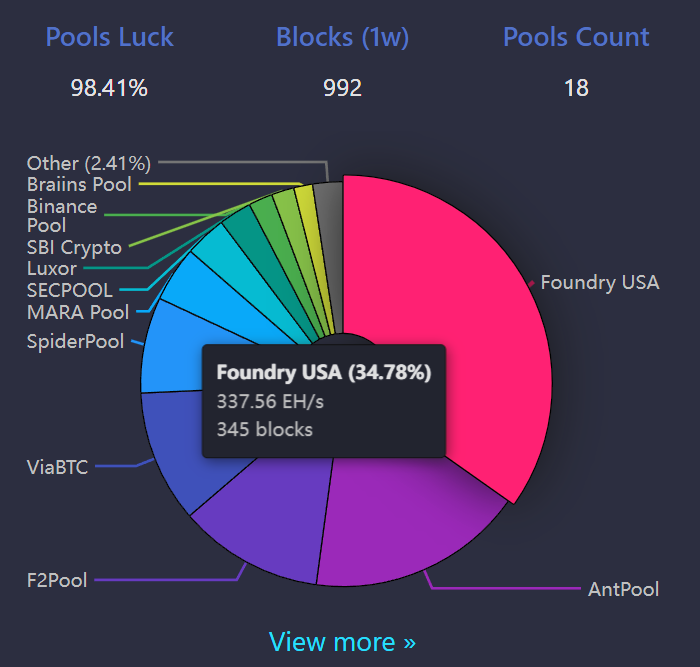
We just had a rare-ish two block fork/reorg between Foundry and AntPool+ViaBTC. Foundry mined six blocks in a row. bnoc.xyz/t/two-block-re…

