BitHappy

1.7K posts

BitHappy banner
BitHappy

BitHappy

@bithappybtc

Bitcoin: A Peer-to-Peer Electronic Cash System.

Earth Katılım Eylül 2015
506 Takip Edilen210 Takipçiler
Sabitlenmiş Tweet
BitHappy
BitHappy@bithappybtc·
The blocksize war turned Bitcoin from P2P cash to digital gold and allowed the fiat/debt prison to continue. youtu.be/PX3Rpml4qKU?si…

YouTube video
YouTube
English
0
0
1
242
BitHappy retweetledi
Jeffrey A Tucker
Jeffrey A Tucker@jeffreytucker·
You need to see this chart. The keys to public/private health and better lives are clean water, sanitation, fresh food, and good hygiene. Vaccines have historically played a minor/tiny role at best. The reason we keep talking about them constantly pertains almost entirely to industrial interests.
Jeffrey A Tucker tweet media
English
84
765
2.1K
70.1K
BitHappy retweetledi
Sama Hoole
Sama Hoole@SamaHoole·
People ask me why I'm so passionate about sheep. Here's why. A sheep wakes up on a hillside nothing else will live on. 32-degree slopes. Acidic soil. Wind off the Atlantic. Rain in quantities most European crops would consider insulting. She walks out, eats grass nobody asked her to grow, and turns it into meat, milk, wool, lanolin, and the maintained landscape beneath her feet. She requires no pesticides. No irrigation. No imported feed. No lab. No patent. She takes the sun, the rain, the soil, and the specific botanical composition of a particular upland, and produces the leanest, most nutritionally complete meat in the British food supply. Every gram of lamb contains complete protein, zinc, iron, B12, selenium, and the conjugated linoleic acid your metabolism actually asked for. She also produces, as a side effect, the landscape the tourists photograph. The wildflowers the campaigners claim to care about. The birdlife the charities fundraise on. The stone walls the poets write about. The curlew, the skylark, the golden plover, the red grouse, the hen harrier. None of it exists without her. And we have spent the last fifty years being told this animal is wrecking the countryside. The audacity. I'll take my chances with the creature that has been shaping these hills for ten thousand years over the pea protein isolate that was patented in 2017.
Sama Hoole tweet media
English
103
1.6K
6.2K
47.1K
BitHappy retweetledi
Anglo Futurism Capital LP 🇬🇧🐿️
Good morning PAYE Pigs! Up and at em! As you drag your sorry carcasses into the office this fine morning in an honest attempt to barely break even or even worse - struggle to make ends meet - whilst more than half the country sits on its collective arse doing nothing, know this: Britain has, quietly, crossed the Rubicon. 52.6% of households now receive more from the state than they pay in. The majority of people you see today are net recipients. The minority (you) fund it. This means it can no longer be accurately labelled as just a “welfare system”, in fact what we have is a demographic pyramid scheme with better branding. The numbers, for anyone still pretending: • 8.4m on Universal Credit, Feb 2026. Highest ever. • Up from 5.5m in March 2022. 53% rise in under four years. • ~20% of the working-age population now on UC. • 50% of UC claimants are in the “no work requirements” regime. • 4.2m working-age adults on UC, not required to look for work. • Two-child cap lifted this month. Numbers about to accelerate. • UC uplift for 2026/27 above inflation. Baked in. Now consider the net contributor base: • 52.6% of households net recipient. 47% net contributor. • 35.1m individuals in net recipient households, +4m since pre-Covid. • 89% of retirees in net claimant households. 46% of non-retirees, and rising. • Strip out children, students, dependents: genuine net contributors are ~35-40% of adults. • Net recipience was 37% of households in 1977. It’s 52.6% today. • Net recipient headcount up ~11m since 2000. • Growing fastest among working-age people. Ageing isn’t the driver. Wage stagnation since 2008 is. The net contributor base is structurally too small to fund the commitments. Fiscal drag is buying time, not solving anything. The bond market will deliver the verdict the political class refuses to. A majority of the country votes for a system that takes more from the minority than the minority can sustainably give. Call that equilibrium what it is: a run rate. Run rates have terminal values. Ours is being priced at the long end of the curve in real time, and nobody in Westminster has the stomach to read the chart. Starmer is done, what follows will be much much worse. This picture will deteriorate faster and harder. Britain is cooked… 👀 👇
Anglo Futurism Capital LP 🇬🇧🐿️ tweet media
English
58
341
974
141.8K
Alex 👽
Alex 👽@AlexesNakamoto·
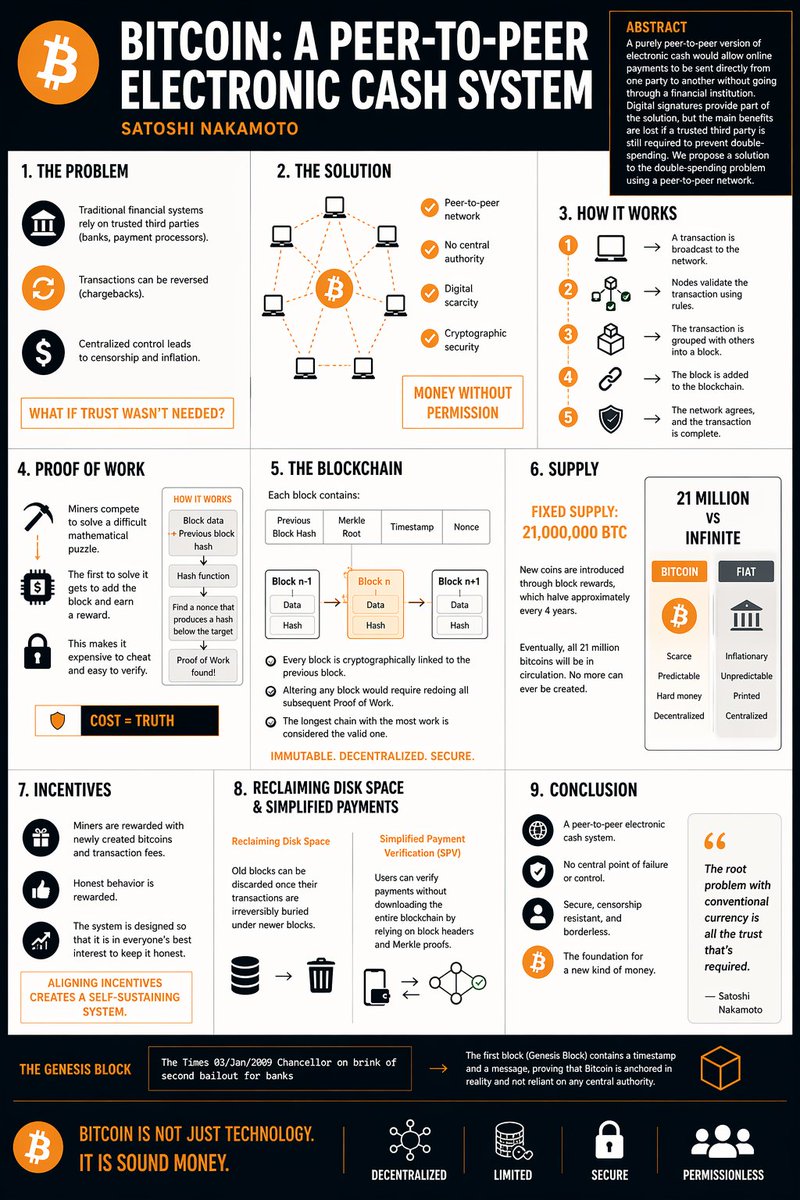
Bitcoin Whitepaper… generated from a single prompt. ChatGPT Image 2.0. Wow.
Alex 👽 tweet media
English
50
466
1.5K
55.6K
BitHappy
BitHappy@bithappybtc·
@Rajatsoni And that is why Adam Back turned Bitcoin from electronic P2P cash to a digital asset so that it wouldn't compete with Visa and co. Which is why he is the Judas of Bitcoin. He did it by lying to everyone about keeping the block size small. Hence Bitcoin can't be used as money.
English
0
0
0
79
Rajat Soni, CFA
Rajat Soni, CFA@Rajatsoni·
Visa charges 3-5% in transaction processing fees $100 bill: Visa takes $3-$5 $1,000 bill: Visa takes $30-$50 $10,000 bill: Visa takes $300-$500 We pay for this with higher prices! This is how the financial industry steals from us And most people don't even realize it
English
23
14
191
8.5K
BitHappy
BitHappy@bithappybtc·
@iAmJoshHunt Basically you have proved that the government should not run or manage anything. It is not fit for purpose and is detrimental to all of our health, wealth and happiness. We would all be better off without the curse of government.
English
0
2
5
344
Josh Hunt
Josh Hunt@iAmJoshHunt·
We've reached the age of consequence. I've spent weeks pulling apart the data on Britain's major institutions. The NHS. Schools. Defence. Roads. Councils. Housing. Water. Pensions. Demographics. Each one looked like a separate crisis. Each one had its own numbers, its own failures, its own outrage cycle. But the deeper I went, the clearer it became. They're not separate crises. They're consequences. Decades of deferred maintenance. Deferred decisions. Deferred honesty. All arriving at once. All compounding. And all connected. There are many reasons Britain is where it is. Monetary policy. Demographics. Political choices. Fraud. Failures of regulation. I'll get to those. But running through almost everything I've examined is one pattern so consistent it deserves a name. Organisational inertia. Every organisation that exists long enough eventually stops serving the purpose it was created for and starts serving itself. Processes are created to manage risk. Roles are introduced to manage process. Policies emerge to manage roles. Gradually, the organisation's attention turns inward. What began as a vehicle for purpose becomes a system primarily concerned with its own continuity. The structure that was supposed to support the work becomes the work. This doesn't just apply to companies. It applies to countries. Start with the NHS. It was created to provide healthcare. Today it spends £3.6 billion a year settling clinical negligence claims arising from its own failures. Billions more servicing PFI contracts signed decades ago. It manages a waiting list of over 7 million people. Its staff are burning out. And a provision of around £60 billion sits on the government's books for the expected future cost of clinical negligence claims. The NHS still provides extraordinary care, delivered by extraordinary people. But a growing share of its energy and budget is consumed not by healing, but by managing the consequences of its own structural failures. Look at education. The system was built to prepare children for the future. Today it manages a £13.8 billion maintenance backlog. The DfE has said over 80% of schools contain asbestos. RAAC concrete, described by the government's own advisors as "life expired and liable to collapse," has required urgent mitigation in hundreds of schools. A SEND system that has doubled in cost and is driving councils toward insolvency. Teacher recruitment and retention remain a serious challenge, with the profession struggling to attract and keep the people it needs. School spending per pupil fell sharply through the 2010s and has only recently begun to recover, according to the IFS. The system still educates. But more and more of its resources go to keeping the structure standing rather than improving what happens inside it. Look at defence. The armed forces exist to protect the country. Today they manage an equipment plan with a £16.9 billion affordability gap. The Deputy Chief of the Defence Staff told the Defence Committee that the UK could not sustain an enduring war "for more than a couple of months" due to insufficient ammunition, reserves, and equipment. The First Sea Lord has reportedly said the Royal Navy will not be ready for an armed conflict until 2030. The structure is maintained. The capability is hollowed out. Look at local government. Councils exist to serve communities. Today, 35 councils have been granted exceptional financial support for 2026-27. Surveys show a significant share of councils see effective bankruptcy as a realistic risk over the next five years. Social care consumes an ever larger share of budgets, crowding out everything else. Services have been cut to the bone while the cost of running the institution keeps rising. The institution persists. The service it was created to deliver is disappearing. Now look at the budget. Because the budget is where the inversion becomes most visible. The government spends £1,370 billion a year. Almost all of it is consumed before a single discretionary decision is made. £333 billion on welfare. £202 billion on health. £114 billion on debt interest. £95 billion on education. £39 billion on defence. Then layer on the hidden costs that most people never see. PFI repayments. Clinical negligence settlements. Nuclear decommissioning provisions. Billions in public sector consultancy spending. The Government Major Projects Portfolio contains 227 projects with a combined whole life cost of £834 billion, of which only around 11% are green-rated by the Infrastructure and Projects Authority. Unfunded public sector pension liabilities of around £1.3 trillion. By the time the system has paid for itself, there is almost nothing left to invest in making anything better. The country is spending record amounts and going backwards. Not because the money is being wasted on frivolous things. But because the cost of maintaining a deteriorating system consumes everything before improvement becomes possible. EY has estimated that the gap between public sector productivity and private sector productivity alone is costing the UK economy £80 billion a year. If left unaddressed, that figure could rise to £170 billion by 2030. But even that number understates the true cost. Because it only measures the productivity shortfall. It doesn't count the £3.6 billion in annual clinical negligence settlements. The billions in PFI overpayments above capital value. The project overruns across government. The £645 million a year in pothole damage to drivers. The economic output lost because 7 million people are on waiting lists and can't work or can't work fully. The investment deterred by a system too expensive and too complex to operate in. The labour mobility destroyed by unaffordable housing. The skills potential lost by a deteriorating education system. The 2.8 million people economically inactive due to long-term sickness, partly because the health system meant to support them is itself under strain. The measurable productivity gap is £80 billion. The true cost of a state that has turned inward is almost certainly far higher. And the system doesn't just consume resources. It generates its own demand. The Institute for Government has described much of the demand on public services as "failure demand." Demand created not by citizens needing help, but by the system's own earlier failures to intervene effectively. Patients who end up in A&E because they couldn't see a GP. Children in crisis because early intervention was cut. Homeless families in expensive temporary accommodation because social housing was never built. Potholes that cost more to repeatedly patch than they would have cost to resurface properly in the first place. Each failure generates more cost. Each cost absorbs more budget. Each squeezed budget reduces the capacity to prevent the next failure. The system feeds on its own dysfunction. Organisational inertia is not the only reason Britain is struggling. Demographics, monetary policy, globalisation, political failures, and a dozen other forces play their part. I've written about some of them already and I'll write about more. But this pattern, the quiet inversion of purpose, the system turning inward, runs through almost every institution I've examined. It is not the whole explanation. But it's a thread you can trace through all of them. The UK state has become a system that spends much of its energy managing itself. Servicing its debts. Honouring its legacy contracts. Settling its legal liabilities. Maintaining its crumbling infrastructure. Administering its own complexity. The original purpose, delivering better lives for the people who fund it, has not disappeared. But it has been steadily crowded out by the cost of keeping the structure alive. The institutions still speak the language of mission and purpose. Every government department has a strategy. Every public body has a set of values. Every spending review promises reform and efficiency. But in practice, much of the energy goes inward. Managing risk. Maintaining process. Sustaining the structure. The language points outward. The money flows inward. Every thread I've written has documented a different piece of a larger picture. This one is about the pattern that connects many of them. Not the only pattern. But one of the deepest. Britain's crises are not unrelated. They reinforce each other. And at the heart of many of them is a system that has gradually shifted from serving the public to sustaining itself. The question is not whether the country can afford to reform its institutions. The question is whether it can afford not to. Because the measurable cost is already £80 billion a year. The real cost is a country that forgot what it was for.
English
40
139
434
101.7K
BitHappy retweetledi
Diana PATRIOTS ARE UNITED❤️🇺🇸🙏🐸
IN 1934, ROYAL RAYMOND RIFE CURED 16 TERMINALLY ILL CANCER PATIENTS IN 90 DAYS USING NOTHING BUT FREQUENCY. EVERY ONE OF THEM WALKED OUT ALIVE. THEN THEY BURNED HIS LABORATORY. Royal Raymond Rife was not a doctor. He was an engineer. And that is exactly why he saw what no doctor could. In the 1920s, Rife built the most powerful optical microscope in the world — a device he called the Universal Microscope. It could magnify living specimens up to 60,000 times without killing them. No electron microscope could do this. Electron microscopes require dead, stained samples. Rife's machine observed living organisms in real time. What he saw changed everything. Rife discovered that every microorganism — every bacterium, every virus, every pathogen — has a specific electromagnetic frequency at which it vibrates. He called it the Mortal Oscillatory Rate. And he proved that when you expose a pathogen to its own frequency at sufficient intensity, it shatters. The same way an opera singer can shatter a wine glass by hitting the exact resonant frequency of the glass. The pathogen is destroyed. The surrounding tissue is completely unharmed. Because healthy cells vibrate at a different frequency. The signal passes through them like a radio wave passes through a wall. In 1934, the University of Southern California appointed a Special Medical Research Committee to oversee a clinical trial of Rife's technology. Sixteen patients with terminal cancer were selected. They were treated with Rife's frequency device for three minutes every three days over a period of 90 days. After 90 days, 14 of the 16 patients were declared clinically cured. The remaining two were treated for an additional four weeks. They recovered as well. Sixteen out of sixteen. A 100% success rate on terminal cancer patients using nothing but electromagnetic frequency. Dr. Milbank Johnson, who supervised the trial, prepared to announce the results to the world. Before he could publish, he was found dead. His papers vanished. The Beam Ray Corporation, which manufactured Rife's devices, was subjected to a lawsuit funded by Morris Fishbein — the head of the American Medical Association. The lawsuit was eventually dismissed, but it bankrupted the company. Every laboratory that had been working with Rife's technology was either raided or destroyed by fire. Rife's own laboratory was burned. Scientists who had supported Rife were visited by strangers who made it clear that their careers would end if they continued. Dr. Arthur Kendall, who had collaborated with Rife at Northwestern University, accepted a $250,000 payment and retired to Mexico. He never spoke about the research again. Rife spent the rest of his life in obscurity. He died in 1971, broken and forgotten. The technology that cured 16 terminal cancer patients in 90 days was erased from medical history. But the physics did not disappear. Resonance is a law of nature. It cannot be unproven. It cannot be legislated away. It cannot be burned. Every pathogen still has a mortal oscillatory rate. Every cell still responds to frequency. The science Rife proved in 1934 is as true today as it was then. The only thing that changed is who controls the information. Now you have it. What you do with it is up to you. 🔔 They burned his lab. They cannot burn the internet. Share this now. Source: @QuantumMedicineNews
Diana PATRIOTS ARE UNITED❤️🇺🇸🙏🐸 tweet media
English
79
2.3K
4.1K
63K
BitHappy
BitHappy@bithappybtc·
@MDBitcoin Just another consequence of not using Bitcoin for what it was built for due to small blocks and other perversions of the code.
English
0
0
1
102
MDB
MDB@MDBitcoin·
This needs more attention! "The only reason price is not going to the moon is because bitcoin is being rehypoticated" - Saylor There needs to be a more nuance conversation about paper bitcoin because it likely does not require some grand conspiracy to exist. paper btc can come from anywhere market participants gain exposure to Bitcoin’s price without taking full custody of actual coins in cold storage... That can happen through -leveraged products -rehypothecation -OTC arrangements -loans collateralized by BTC -derivative overlays -ETF plumbing -institutions promising Bitcoin exposure while settling mostly in fiat terms. In that world, multiple parties can believe they have a valid claim tied to the same underlying Bitcoin, (even if only one entity controls the real asset) the further the market moves from final settlement into custody assumptions, counterparty chains, and synthetic exposure, the easier it becomes to manufacture supply elasticity around an asset that is supposed to be absolutely scarce.
English
15
9
84
4.7K
BitHappy retweetledi
Sama Hoole
Sama Hoole@SamaHoole·
A cow, given grass and rain, produces: Meat. Complete protein, top of the bioavailability table. Milk. So nutritionally complete we feed it to our young. Leather. Ten thousand years of footwear. Composts when you're done. Tallow. Stable cooking fat, soap, candles. Currently being sold back to us as skincare at eight times the butcher's price. Bones. Broth, tools, fertiliser. Organs. The most nutrient-dense food on earth, ignored by the culture that buys three supplements to replace them. Manure. Grows the grass. The cycle runs again. Try to engineer that. A machine that takes rain and a patch of grass and produces six complete products while improving the soil and reproducing itself. You can't. We haven't. We're being told to eliminate them. While flying almonds in from California.
Sama Hoole tweet media
English
207
4K
10.8K
104.7K
BitHappy retweetledi
Not A Number
Not A Number@myhiddenvalue·
This is why the banks want rid of cash
English
60
1.5K
2.6K
48.1K
BitHappy
BitHappy@bithappybtc·
@CheekyCrypto @Revolut Eventually you will all realise that crypto can replace every bank on earth. That's why Bitcoin was diverted into digital gold so that humanity could not use it as money. Banksters are not needed to transfer money.
English
0
0
1
47
Cheeky Crypto
Cheeky Crypto@CheekyCrypto·
Been with @Revolut for 2+ years on the Ultra plan (£500+/year). Today (Saturday), they flagged a crypto deposit for info due to their new banking license. I answered everything immediately, only to be told the relevant team doesn’t work weekends. They won’t review it or reverse the transaction until Monday. Why trigger a compliance check on a Saturday if you don’t have the staff to resolve it? Absolutely ridiculous "Ultra" service. 😡 Moving forward I will be informing our 300,000 Followers across Youtube and other social platforms to no longer deposit any #crypto / #Altcoins on your platform...
English
169
72
1.5K
188K
BitHappy retweetledi
Kurt Wuckert Jr
Kurt Wuckert Jr@kurtwuckertjr·
One megabyte block limit. He called it temporary. Said it would come out later. It never did. That limit started a 15-year war. Read the full history: kurtwuckertjr.com/post/written-h…
English
3
17
110
3.1K
BitHappy retweetledi
Sama Hoole
Sama Hoole@SamaHoole·
Your stomach produces acid at a pH of 1.5 to 2. One of the strongest digestive environments of any animal on earth. This is not an accident. It is the signature of an apex predator. Herbivores don't need stomach acid this strong. They need fermentation chambers. You have a stomach designed to sterilise and break down animal tissue. Your small intestine is optimised for absorbing fat-soluble vitamins. You have a gallbladder dedicated to producing bile for fat digestion. You do not have a rumen. You do not have multiple fermentation compartments. You are not a cow. The human digestive system is approximately twenty-five feet long. A gorilla's, a true herbivore, is roughly three times that. The extra length is for fermenting cellulose. You don't have it because you didn't evolve eating plants as a primary food source. Your gut microbiome evolved alongside a diet of animal tissue, organs, fermented foods, and occasional seasonal plant matter. It did not evolve alongside seed oils, emulsifiers, artificial sweeteners, or modified starches. These compounds have been in the food supply for less than a century. The microbiome has had no time to adapt. The gut health crisis: the IBS, the food sensitivities, the leaky gut, the dysbiosis, arrived in the same decades as the ultra-processed food supply. The recommended fix is more wholegrains, more plant diversity, and a probiotic capsule. Which is the dietary equivalent of treating smoke inhalation with a scented candle.
English
22
279
1.2K
29.5K
BitHappy retweetledi
Sama Hoole
Sama Hoole@SamaHoole·
In 1900, heart disease was a medical rarity. The first description of a myocardial infarction in the medical literature was published in 1912. The cardiologist Paul Dudley White, who would later treat President Eisenhower, reported that in his early career in the 1920s he might see one or two heart attacks per year. By 1950, heart disease was the leading cause of death in America. Something happened between 1900 and 1950 that transformed a rare clinical curiosity into the number one killer of the wealthiest nation on earth. That something was not saturated fat. Americans had been eating saturated fat for their entire history. Butter consumption peaked in the 1930s. Lard was the default cooking fat in every kitchen. Beef tallow was universal. Heart disease was rare. That something was not cholesterol. Eggs had been a dietary staple for centuries. Organ meats were consumed weekly. Cholesterol intake had not meaningfully changed. That something was not red meat. Per capita red meat consumption was broadly stable from 1900 to 1960. The one dietary variable that tracks, almost perfectly, onto the rise of heart disease in America is the introduction and rapid scaling of industrially processed seed oils. Crisco, the first commercially available hydrogenated vegetable oil, was launched in 1911. It was made from cottonseed oil, which had previously been classified as industrial waste. Procter & Gamble, who manufactured it, had been using cottonseed oil to make soap and candles. They discovered that the hydrogenation process could turn the liquid oil into a solid fat that resembled lard. They patented it, marketed it as modern and scientific, and placed it in American kitchens. By 1950, seed oil consumption in America had risen from near zero to approximately 10 percent of total caloric intake. By 2010, it had risen to approximately 20 percent. Americans now consume, on average, 80 grams of seed oil per day. Their great-grandparents consumed approximately zero. Heart disease tracks this curve. Diabetes tracks this curve. Obesity tracks this curve. Alzheimer's, which some researchers now call type 3 diabetes, tracks this curve. Saturated fat consumption has declined continuously since the 1960s. Heart disease has not declined at the same rate. Cholesterol intake has declined. Heart disease has not followed it down. Red meat consumption has declined since the 1970s. Heart disease has not followed it down. Seed oil consumption has risen continuously, and heart disease has risen with it. The correlation is not proof of causation. But the correlation between saturated fat and heart disease, which the entire Western dietary framework was built on, was never proof of causation either. It was a hypothesis. The hypothesis has been tested, repeatedly, in randomised controlled trials, and it has failed every time. The seed oil correlation has not been tested at scale, because nobody who funds dietary research has any financial interest in testing it. The companies that make the seed oils fund the research. The research does not investigate the seed oils. The seed oils remain in the food supply. Your grandmother cooked with lard. Her heart was fine. You cook with rapeseed oil. Your cardiologist is busy.
Sama Hoole tweet media
English
38
549
1.4K
42.3K
BitHappy retweetledi
Andrew Panella
Andrew Panella@Longevity_EDU·
The most powerful medicine for inflammation on Earth: Astaxanthin. Studies have found it's 6000X stronger than Vitamin C and it reduces the inflammation that causes plaque build up and heart disease. Here are all its health benefits & how to use it properly: 🧵
Andrew Panella tweet media
English
19
168
887
204K
BitHappy retweetledi
Sama Hoole
Sama Hoole@SamaHoole·
In 1953 the Korean War ended and a line was drawn across the 38th parallel. One country became two. Same people. Same language. Same genetic stock. Same height, at that point, of about 5'5" for men. Then the food changed. South Korea industrialised. The government introduced school lunch programmes in the 1960s that, for the first time in Korean history, gave every child in the country daily access to milk, eggs, and meat. Per capita meat consumption went from almost nothing to nine times what it had been within three decades. Dairy consumption went from functionally zero to one of the highest in East Asia. North Korea did not industrialise. North Korea continued to eat rice, vegetables, and whatever the state provided, which was, in practical terms, not enough. The famines of the 1990s stripped whatever surplus existed. The children ate what was available, which was grain. Now look at the numbers. The average South Korean man born in 1983 is 5'9". The average North Korean man of the same generation is 5'5". Four inches. Same genetics. Same peninsula. Same families, in many cases, separated by a line drawn by diplomats who were not thinking about the school lunch programme. South Korean women gained 20 centimetres of average height over the twentieth century. This is the largest documented female height increase of any population on earth over that period. The researchers who measured it published in the Lancet. They attributed it, primarily, to the introduction of animal protein into the childhood diet. The North Korean women gained almost nothing. When North Korean defectors arrive in the South, the height difference is visible immediately. The South Korean military, which processes the defectors, has documented the gap consistently for decades. The defectors are, on average, about 7 centimetres shorter than their Southern counterparts. They are the same people. They grew up on the same peninsula, under the same sky, with the same genes. They ate different food. The Korean experiment is the cleanest natural experiment in nutrition that has ever been conducted on a human population. Two halves of a genetically identical group, separated by politics, fed differently for seventy years, measured continuously by both sides. The side that ate the meat got taller. The side that ate the rice stayed where it was. The bones do not care about ideology. The bones track the food. And the food, on the south side of the 38th parallel, included the animal protein that turns genetic potential into actual height, and on the north side did not. When someone tells you that humans do not need animal products to reach their full physical potential, show them the 38th parallel. Same people. Different lunch. Four inches.
Sama Hoole tweet media
English
34
305
1.1K
26.8K
Maxi
Maxi@AllForProgress_·
Think about what it takes to start a company in Britain today. You remortgage your house or you borrow from your parents or you spend your twenties living on almost nothing while you build something that has, statistically, about a one-in-five chance of surviving its first two years. You work hours that would be illegal if someone else were imposing them. You lie awake running sums on the ceiling. And if you are good, and the market cooperates, and nobody in government decides to change the rules halfway through, you might after a decade have a business that employs people and contributes something to the town you live in. Here is what the state has done to that person in the last eighteen months. -Employer's National Insurance: up to fifteen per cent. -Business Property Relief: slashed to fifty per cent for anything above a million. -Business Asset Disposal Relief: the discounted rate hiked from ten per cent to fourteen, rising again to eighteen per cent this month. The message from the Treasury, delivered with all the cheerful bureaucratic sadism we've come to expect from Whitehall, is: thank you for taking the risk, now hand over a quarter of whatever survived. A hundred and sixty-five thousand Britons left the country to work abroad last year. Companies House filings show company directors departing in numbers that would, in a serious country, have triggered a parliamentary inquiry. Here they barely make the papers, because nobody in government has ever founded a company, employed anyone with their own money, or lain awake wondering whether they can make payroll on Friday. Every competitor nation with economic ambitions is rolling out the carpet for these people. Singapore, the Gulf states, Portugal. France cut its wealth tax specifically to prevent its entrepreneurs from leaving. Britain's offer is a fifteen per cent payroll surcharge and a Chancellor who appears to believe that the economy is a thing that the Treasury is entitled to, rather than a thing that people have to build. We talk about wanting the next ARM or DeepMind. As things are, forget about it. You will not produce them in a country that treats its most ambitious people as a tax cows to be roughly milked, rather than a resource to be cultivated. People are doing the arithmetic. The arithmetic says leave. And the arithmetic, unlike the Chancellor's growth forecasts, tends to be right. Only the heroes, the patriots, and the fools will resist its conclusions.
English
10
53
169
11.7K
BitHappy retweetledi
Josh Hunt
Josh Hunt@iAmJoshHunt·
The British government has wasted more money on failed projects than some countries spend building their entire infrastructure. After hearing about the cancellation of the Stonehenge Tunnel project, yet it still racking up £179 million in cost, I wanted to look at other projects and costs to see what the picture looks like this century. Every number here comes from official reports, the National Audit Office, parliamentary committees, and ministers' own admissions. Let me show you where your money has gone. HS2 was sold to the country as a £37.5 billion high speed rail network connecting London, Birmingham, Manchester, and Leeds. The first phase was supposed to open this year. In 2026. Here's where it actually is. After six years of construction and £46 billion spent, tunnels have been bored, earth has been moved, viaducts have been built. But there is no railway. Not a single metre of track. The legs to Manchester and Leeds have been cancelled entirely. What's left is a line from London to Birmingham with no confirmed opening date, no confirmed final cost, and estimates so unstable that Parliament's own Public Accounts Committee has warned the cash cost of Phase 1 alone could reach £80 billion. Some industry forecasts put it above £100 billion. The Transport Secretary stood in Parliament last year and called it "an appalling mess." She said billions had been wasted on scope changes, ineffective contracts, and bad management. Fraud allegations have since emerged in the supply chain. Three times the original price. A fraction of what was promised. And still years from completion. But HS2 is just one example. The NHS National Programme for IT was supposed to create a unified electronic health record for every patient in England. Launched in 2002 with a budget of £6 billion. Abandoned in 2011 with the Public Accounts Committee putting the expected cost at £12.4 billion. It delivered a fraction of its promised benefits. Only 13 out of 169 hospital trusts received the systems they were meant to get. Then one of the contractors sued the government and won a settlement of nearly half a billion pounds. On top. During Covid, the government threw billions out the door with almost no checks. The Covid Counter Fraud Commissioner's final report, published December 2025, found that fraud and error across pandemic support schemes cost taxpayers £10.9 billion. How much has been recovered? £1.8 billion. The Commissioner's words, not mine. The previous government "left the front door open to fraud." Bounce Back Loans were rolled out in under two weeks with no independent verification. PPE contracts were handed to companies with no track record. Defective gowns, masks, and visors weren't inspected for two years. By the time anyone checked, the money was gone. Universal Credit was supposed to simplify the benefits system. The original programme was budgeted at around £2 billion. The National Audit Office has flagged massive overruns repeatedly as the project ballooned in scope and complexity. Total costs have run many times higher than planned. Nobody was fired. The smart meter rollout was supposed to be finished by 2020. It wasn't. Costs have hit £13.5 billion. The programme has been dogged by meters losing functionality, missed deadlines, and a failure to deliver the energy savings that justified the whole thing in the first place. One many of you will be familiar with. The Post Office spent £600 million on a computer system called Horizon. It was fundamentally flawed. Its defects led to more than 900 wrongful convictions. Sub-postmasters lost their homes. Their businesses. Their families. At least 13 people took their own lives. Compensation has now reached £1.4 billion and is expected to hit £2 billion. Fujitsu, the company that built the system, has not paid a single penny toward that bill. It is still collecting government contracts. The Fire Control project. £469 million. Seven years. An attempt to modernise fire service control rooms. Scrapped. Nothing delivered. What a waste. The electronic tagging programme. Five years late. Tens of millions spent. Abandoned. They ended up buying off the shelf tags that could have been bought for a fraction of the price years earlier. The Garden Bridge. £53 million of public money. Not a single piece was built. You might ask what £53 million was spent on exactly. The Rwanda deportation scheme. £715 million. Four people went voluntarily. Not a single forced deportation was carried out. Then the whole thing was scrapped. Now here's the part that ties it all together. In 2019, the Prime Minister's own Implementation Unit looked at the government's £432 billion portfolio of major projects. Only 8% had proper plans to evaluate whether they were working. 64% of that spending, £276 billion, had no evaluation at all. None. The government was spending hundreds of billions of your money with no way of knowing if any of it was delivering. The National Audit Office has said there has been a "consistent pattern of underperformance" spanning 25 years. Twenty five years of reports saying the same thing. And nothing changes. Add it up. HS2 overruns. NHS IT written off. £10.9 billion in Covid fraud. Universal Credit ballooning. Smart meters over budget. Post Office compensation approaching £2 billion. Fire Control. Rwanda. Garden Bridge. Tagging. And those are just the ones that made the news. The total runs into the tens of billions. More than the entire annual education budget. Approaching what the government now spends on debt interest in a single year. And here's the scary part. This is only what we know about. The NAO has been clear the real picture is worse because most projects aren't properly evaluated in the first place. These are the failures too big to hide. Imagine the ones that aren't. This is the same government that says there's no money for public services. That raises your taxes every year and delivers less every year. That can't build a railway. Can't roll out a computer system. Can't buy protective equipment without losing billions to fraud. And every time it happens, the pattern is the same. The project fails. The minister moves on. The civil servant gets a knighthood. The contractor gets the next contract. And you pick up the bill. The UK doesn't have a funding problem. It has a competence problem. And until that changes, no amount of tax rises, borrowing, or spending reviews will make the slightest difference.
English
199
1.3K
2.6K
98.6K
BitHappy retweetledi
Sama Hoole
Sama Hoole@SamaHoole·
Chloe decided to grow her own food this spring. She has a south-facing raised bed, twelve bags of organic compost, and a vision of complete ethical self-sufficiency. No supply chains. No food miles. No compromise. March 22nd - Sowed courgette seeds. Read that companion planting with marigolds deters aphids. Planted marigolds accordingly. This was the last moment of uncomplicated optimism. April 3rd - Aphids arrived. Thousands of them. On the courgette seedlings. On the marigolds. Possibly on each other. Chloe photographed them. Posted on the garden forum. Someone said: use neem oil. Chloe ordered neem oil. April 10th - Applied neem oil. Neem oil is not a selective treatment. Neem oil is an insecticide that works by disrupting the hormonal systems of any insect unfortunate enough to encounter it. Chloe had just saturated approximately four thousand living creatures in an endocrine disruptor. She posted a photo of the healthier-looking courgette. Caption: "The garden is thriving." April 12th - Slugs. A great number of slugs. Had arrived overnight. Had eaten two courgette plants and most of the chard. Chloe consulted the forum. The forum said: copper tape, beer traps, or nematodes. Nematodes are microscopic parasitic worms that enter slugs through their respiratory pores and kill them from the inside. They are sold in a packet that says "Wildlife-Friendly Slug Control." Chloe has ordered the nematodes. They arrive Thursday. The beer traps go in tonight. Chloe is aware that the rest of the season is going to involve continued decisions of this kind. She has framed these decisions, collectively, as "working with nature." The forum has been supportive of this framing. The slugs have not been consulted. Dan came home this evening with a haul of ground beef from Aldi. A cow had eaten grass in a field in Worcestershire for two years. It had not required nematodes, beer traps, or an endocrine disruptor. It had also not killed a single sparrow. Chloe's garden has been going for three weeks. There is time.
Sama Hoole tweet media
English
20
88
786
17.4K
BitHappy
BitHappy@bithappybtc·
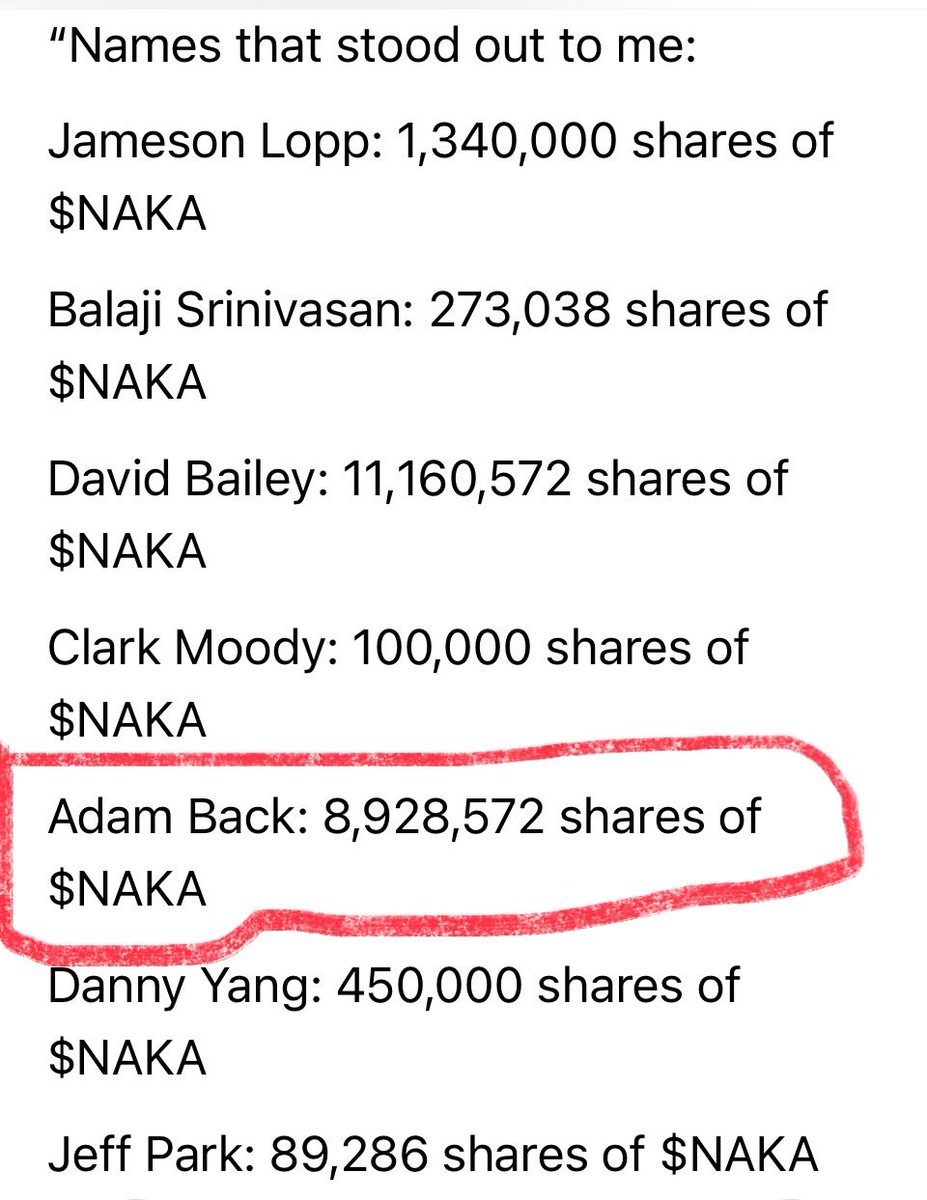
@LiliH65289916 This guy led the destruction of Bitcoin as electronic cash for the world. Why does anyone think he's Satoshi. He is the Judas of Bitcoin.
English
0
0
0
55
Lili H
Lili H@LiliH65289916·
Satoshi Nakamoto would never invest in scams like NAKA. Anyone who claims Andy Back is Satoshi is an insult to Bitcoiners.
Lili H tweet media
English
37
48
399
17.8K